The renewal you lose next quarter is already losing itself this quarter, in four small signals you would catch if you knew where to look. Pipeline dashboards do not show them, because pipeline dashboards track deal stages, not relationship health. Bain & Company’s research on customer retention is consistently quoted as showing that a 5% lift in retention can produce 25% to 95% more profit, but most consulting practices have no system for catching the relationship trajectory in time to act. The fix is to track the four leading signals weekly, so the trajectory surfaces three to four months before the renewal conversation.
I have watched plenty of consultants lose a renewal that “came out of nowhere.” It almost never came out of nowhere. The relationship had been deteriorating for months. Open rates dropped. A champion got promoted out. A few promises slipped. Replies got shorter. None of it was visible on the weekly pipeline review, because none of it lives in pipeline data. By the time the email arrived (“we’ve decided to take this in-house”), the relationship had been quietly drifting toward the door for a quarter.
If you only watch deal stages, you only see the stage changing. The relationship behind it has its own trajectory, and that trajectory is what determines whether you renew. You need a way to see the four leading signals before they turn into a lost renewal, so you are not blindsided once a quarter.
1. The “Record Completeness” check to find the blind spots
If you do not have an executive sponsor logged, the renewal date on the deal, contact info for everyone in the buying committee, and a written engagement scope, you are flying blind. Every missing field is a place where a problem can hide.
The record completeness check is a five-minute weekly audit. Per active client, count: do I have an exec sponsor? Do I have the renewal date? Do I have contact info for all stakeholders? Is the scope written down? Below 80% completeness is a red flag.
What you get is visibility. Clients with high completeness are the ones you can actually manage. Low completeness clients are the ones where bad news arrives without warning.
Picture a long-standing client with no exec sponsor logged because the original buyer is your only contact. Open the contact record for your three highest-revenue clients. Score each one on the four fields above. Anywhere you score below 4/4, ask the contact to introduce you to the missing person this week. Do not accept “we don’t really have one” as an answer.
2. The “Overdue Promise” audit to catch trust drift
Every commitment you made and missed is silent damage. The client noticed. They did not say anything. They updated their internal model of you to “doesn’t always follow through.” Stephen M. R. Covey calls this the trust gap: the difference between what you say and what you do is the biggest determinant of whether the relationship strengthens or decays.
The audit is a weekly pass through your conversations with each active client. For each, ask: did I commit to anything? Did I deliver on time? If not, when?
A single broken promise is forgivable if you flag it and resolve it. A pattern of unaddressed broken promises is fatal. Most consultants do not realise how many they are accumulating.
Three weeks ago you said you would send a benchmark report. You forgot. The client has not asked. They have noticed. Search “I’ll send”, “I’ll get back to you”, and “let me circle back” in your sent emails to your top three clients. Make a list of every promise. Mark the ones you delivered, the ones still in flight, and the ones you have forgotten. Send the forgotten ones today, with an honest note: “this slipped, here it is.”
3. The “Champion Tracking” sweep to spot sponsor changes
Your main contact is rarely the only person who matters. The exec sponsor (who originally bought you in, holds the budget, owns the outcome) is the relationship that determines whether you renew. When that person moves, the renewal is in danger immediately, whether or not your day-to-day contact tells you. LinkedIn’s data on workforce mobility suggests any given senior champion has roughly a one-in-three chance of changing roles within 18 months.
The sweep is a monthly LinkedIn check on the executive sponsor of every active client. Are they still in the role? Still at the company? Still posting about the same priorities? A title change, a new company, or six months of silence on the topic you sell into all signal trouble.
A champion move discovered in the first two weeks is recoverable. The same move discovered three months later, after a successor has reshuffled priorities, usually is not.
Your main client contact is the VP of Operations, but the original sponsor was the COO. The COO just changed roles three weeks ago. For your top five clients, open LinkedIn and check the executive sponsor’s profile. Note any title change, role change, or company change in the last 90 days. For each one, schedule a 15-minute call with your day-to-day contact this week to ask: “How is the new structure affecting your priorities?“
4. The “Engagement Depth” trend to read the temperature
Recency, frequency, reciprocity, and depth of engagement form a composite picture of how a relationship is actually doing. Of those four, depth is the leading indicator most consultants ignore. A client whose replies have shortened from three paragraphs to one line is cooling, even if the call cadence has not changed.
The engagement depth trend pulls the last 10 emails from each active client and compares the average reply length to the previous 10. A drop of more than 50% is significant. A drop with simultaneous gaps in reply timing is severe.
What this gives you is a read on the temperature before it drops far enough to set off pipeline alarms. Depth shifts before stage shifts.
Six months ago, your main contact replied with detailed thoughts on every email. Now they reply “looks good” and never expand. Open the email thread with your most important client. Scroll back six months. Read three replies from then and three from now. If the depth has visibly dropped, schedule a face-to-face conversation (not Zoom) in the next two weeks to find out what changed.
How Nynch Helps You With This
Tracking these four signals by hand for five or more active clients is the kind of admin work that gets dropped the week it matters most. Nynch is the AI CRM that runs the audit whether you remember to look or not.
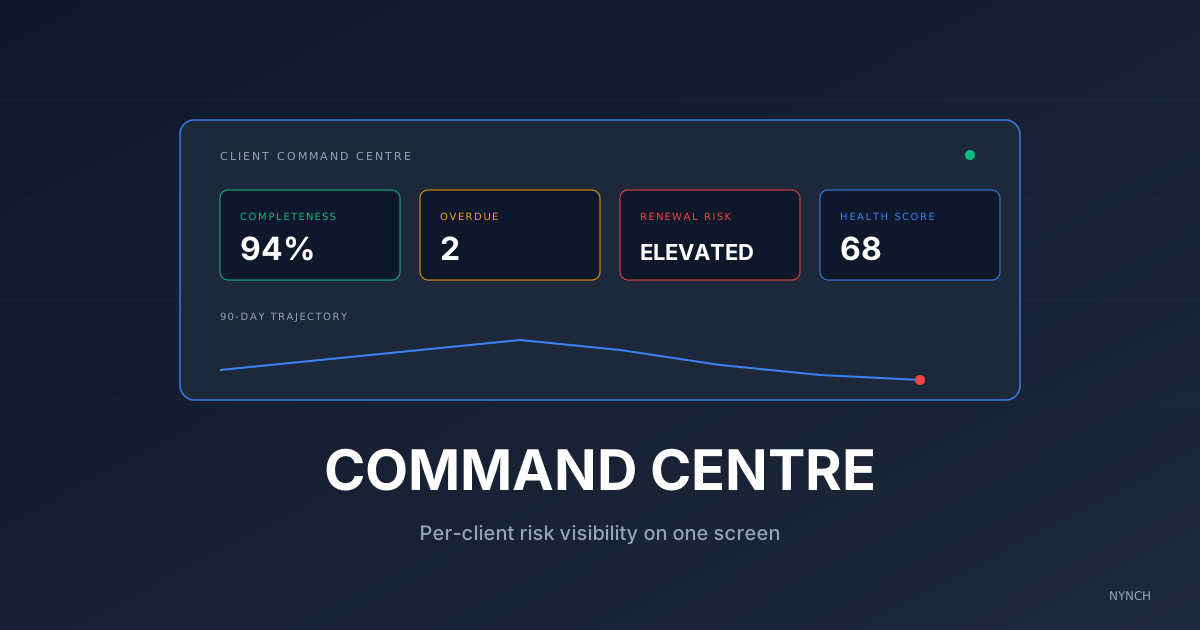
Record completeness is scored automatically. A per-client dashboard shows what is missing from the contact, deal, or commitment record, sorted by how much it would matter if a champion went silent next week.
Every promise is captured from your conversations. Every “I’ll send that Friday” or “let me circle back” is extracted and tracked. Your Say/Do Ratio (the share of commitments you made that you actually delivered on time) is visible per client in the Command Centre, alongside the list of specific promises now overdue.
Champions are monitored for career moves. When the exec sponsor at one of your active clients changes role or company, you get an alert in Nynch within minutes, not three weeks later.
The trajectory is surfaced for you. A 90-day relationship-health score combines recency, frequency, reciprocity, depth of engagement, and outcome history into one trend line per client. You see who is drifting before they tell you.
If you would like to see your top five active clients scored against all four signals on one screen, book a 20-minute walkthrough. You will see the Command Centre on a live account.
Once you can see which clients are at risk, the next question is how to expand the relationships that are healthy, because a healthy client is your highest-converting source of new business.
Read next
- Nynch for fractional leaders, how fractional CFOs, CMOs, and COOs build proactive pipeline, protect against cancellation and create more value for clients.
- The intent radar, exactly who to call today, read buying signals so your pipeline runs on intent, not guesswork.
- Build a £500k consulting practice on relationship capital, the operational rhythm that turns a roster of contacts into a compounding business.
Frequently Asked Questions
What signals predict a consultant client is about to churn?
Four leading signals are most predictive. Declining open rates and reply length on the contact thread. Overdue promises (commitments you made and missed). A change in the executive sponsor or main champion. And falling depth of engagement (one-line replies replacing substantive conversation). Any one of these in isolation is noise. Two or more together is signal.
How is per-client risk visibility different from a pipeline dashboard?
A pipeline dashboard tracks deals through stages. Per-client risk visibility tracks the relationship health behind each deal. You can have a deal in Stage 5 with declining open rates, two overdue promises, and a champion who just changed roles. The pipeline shows a healthy stage. The per-client view shows the actual risk.
What is a Say/Do Ratio and why does it predict renewals?
Your Say/Do Ratio is the percentage of commitments you made to a client that you actually delivered on time. Clients who renew tend to be the ones where it stays high. Clients who churn tend to be the ones where it drifts down and the breakage compounds. A Say/Do Ratio above 80% is healthy. Below 60% is the leading indicator of a renewal at risk.
How early can I catch a renewal at risk?
If you watch the four leading signals weekly, you can typically catch the trajectory three to four months before the renewal conversation. Earlier than that, the signal-to-noise is too low. Later than that, the relationship is usually past the point where a single intervention can save it.
What should I do when I spot a client at risk?
Three steps in order. First, call (don’t email) the main champion to surface anything you’re missing. Second, audit your overdue promises and clear the backlog this week. Third, schedule a 30-minute review of the engagement scope with whoever holds the budget, even if you have to ask for it specifically. Don’t wait for the renewal cycle to surface the issue.