Consultants get paid for trust. Everything else is the mechanics.
Trusted relationships convert at 8× the rate of cold leads, close 3× faster, and command 2× the price. The Trust Premium is real, measurable, and the economic reason consulting practices win on trust, not volume.
Say-Do Ratio measures what you committed to versus what you actually did, week after week. Trust premium turns from a vibe into a number you and your buyers can see.
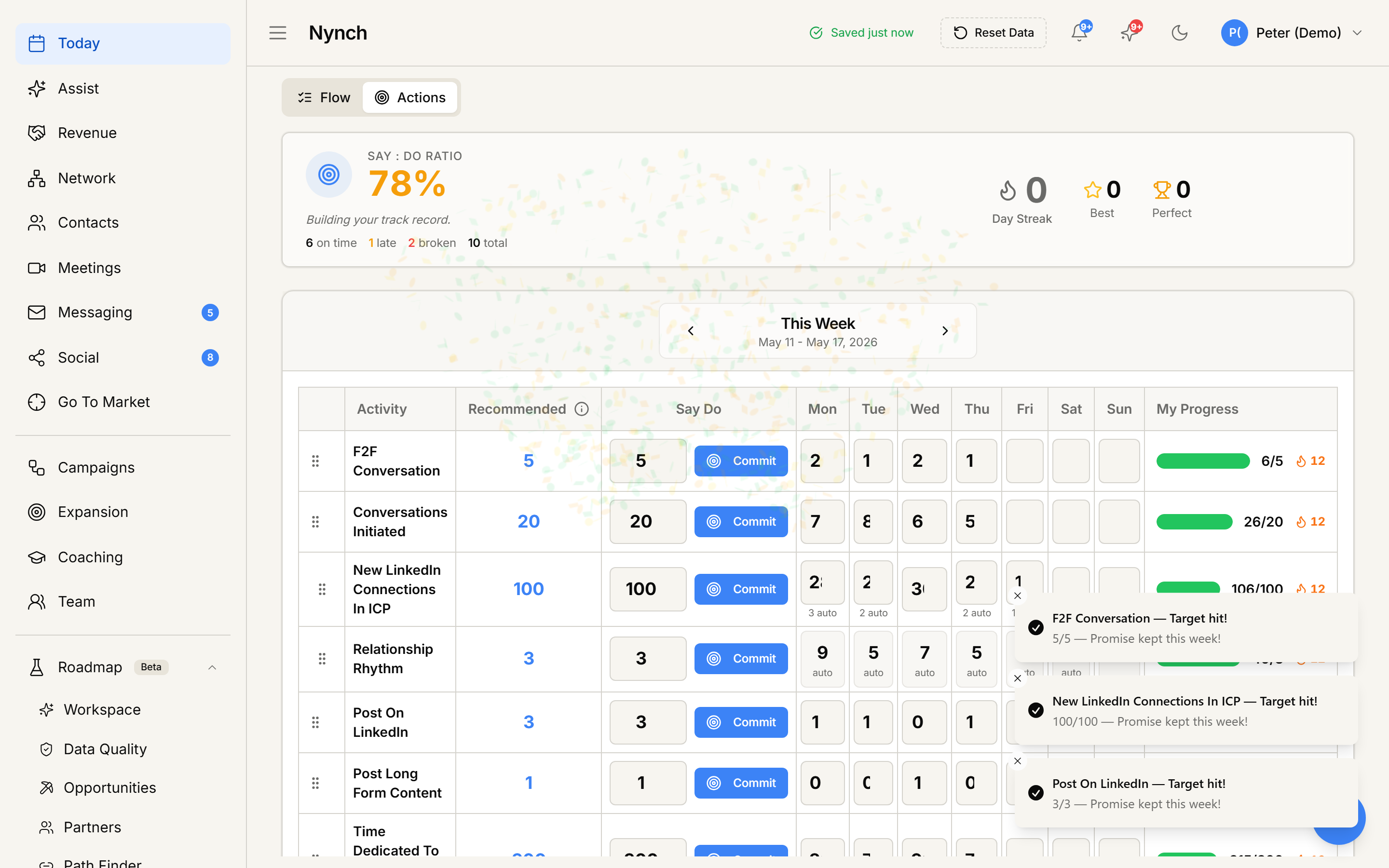
Measure the advantage in your own practice
Trust can change how a buyer evaluates risk, how quickly a serious conversation starts and how much price pressure appears. The size of that advantage is not universal. It has to be measured from your own work.
Compare warm and cold opportunities across the same five questions.
Together, those measures show whether Relationship Capital is changing the economics of your practice. Nynch can organise the evidence. It cannot invent the result.
Why the Trust Premium is widening, not shrinking
The default story about AI is that it commoditises every kind of work, including consulting. The reality is the opposite. AI commoditises the parts of consulting that were already commodities: cold outreach, polished proposals, generic case studies, competence-signalling content. The parts that were never commodities cannot be automated. Trust earned through delivery. Reputation accumulated over years. Judgement honed by being in 200 boardrooms.
So the Trust Premium widens. The lower the floor on commodity work, the higher the ceiling on trusted work. A buyer who can get a polished proposal from any AI in seconds places almost no value on the polish. They place enormous value on the question: do I trust this person to be in the room when it matters?
The implication is not subtle. Consulting practices that build their position on volume tactics (outbound sequences, content marketing at scale, paid acquisition) are competing in the part of the market AI is making cheaper every quarter. Consulting practices that build their position on trust (defended client relationships, compounding referrals, a reputation that precedes the introduction) are competing in the part of the market AI is making more valuable.
The more AI commoditises everything else, the higher the premium on the thing it cannot touch.
The Trust Premium and the four-frame architecture
The Trust Premium is the worldview. Three other terms complete the structure of how consulting practices think about growth in this category:
- Why. The Trust Premium. Consultants get paid for trust, so trust is the asset that earns the premium.
- What. Relationship Capital. The asset on the practice’s balance sheet, the trusted network earned through delivery.
- How. Relationship-Led Growth. The discipline that systematically builds the asset rather than letting it accumulate by accident.
- What if. The upside scenarios when the strategy works, and the objection prehandles when buyers are tempted to ignore it.
Each frame answers a different question. The Trust Premium answers why the asset is valuable. Relationship Capital answers what the asset is. Relationship-Led Growth answers how the asset is built. The What-If section below answers what happens if you take the asset seriously, and what happens if you do not.
What if this works?
The reasonable scepticism about any positioning argument is whether the upside is real. For the Trust Premium, the upsides are quantifiable and large.
What if you keep doing what you’re doing?
The other reasonable scepticism is whether the change is necessary. Most consultants we work with have already tried something. These are the most common objections and the honest answer to each.
How Nynch makes the Trust Premium visible
Most consulting practices accept the Trust Premium intuitively but cannot point to it in any system. Nynch is the platform that makes it legible.
The platform tracks the three measures that quantify the premium: win-rate differential between warm and cold relationships, cycle-length differential between trusted and untrusted buyers, and price-sensitivity differential across both. The dashboard shows the multiplier in real numbers for the practice, not industry averages.
And it surfaces the asset that earns the premium. Every relationship in the network can be reviewed for trust, recency, decay risk, and revenue potential. Relationships that may be cooling are shown with their evidence, and dormant contacts that match a current opportunity can be reviewed before they are forgotten. You decide what gets defended and what action follows.
The Relationship Capital calculator puts a real number on what the practice is currently sitting on as Dormant Network Value, and what the Trust Premium is worth, in pounds, on that base.
About the Trust Premium
What is the Trust Premium?
The Trust Premium is the commercial advantage a consultant can earn when a buyer already understands and trusts their work. Measure it through your own warm and cold win rates, sales-cycle length, fee pressure, expansion and retention.
Can the Trust Premium be measured?
Yes. Compare your own warm and cold win rates, sales-cycle length, fee pressure, expansion and retention. The result must come from your data rather than an industry-wide multiplier.
Why does the Trust Premium matter more in 2026?
AI has commoditised outreach, content, and competence-signalling. The things that used to make a consultant stand out, a polished proposal, a relevant case study, a thoughtful email, can now be generated by anyone in seconds. Trust earned through delivery is the only signal that has not been commoditised, which means the Trust Premium is widening, not shrinking. The more AI replaces transactional work, the higher the premium goes on the trust that cannot be automated.
How does the Trust Premium relate to Relationship Capital?
The Trust Premium is the worldview. The economic conviction that consultants get paid for trust. Relationship Capital is the asset that earns it. Relationship-Led Growth is the strategy that builds the asset. The three pieces interlock: Trust Premium explains why the asset is valuable, Relationship Capital names what the asset is, and Relationship-Led Growth describes how to compound it.
What happens if I ignore the Trust Premium and treat consulting as a volume game?
You compete in a market you cannot win. Consulting bought through volume outbound is bought on price, by procurement, against competitors who are usually cheaper or larger. Consulting bought through trust is hired without RFPs, often without competition, at premium prices. Treating consulting as a volume game means voluntarily abandoning the trust premium that makes the work financially viable in the first place.
Most of the next 5 years is in the trust you have already earned
Book a 20-minute walkthrough using your real network. We will show you the Trust Premium your practice is currently capturing, and the part you are leaving on the table.