Two relationship platforms. Two different buyers.
Rings is built for VCs, PE firms, and investment banking teams. Nynch is built for consultants, fractional executives, and boutique consultancies. Both reject the transactional CRM. Pick the one built for the world you actually operate in.
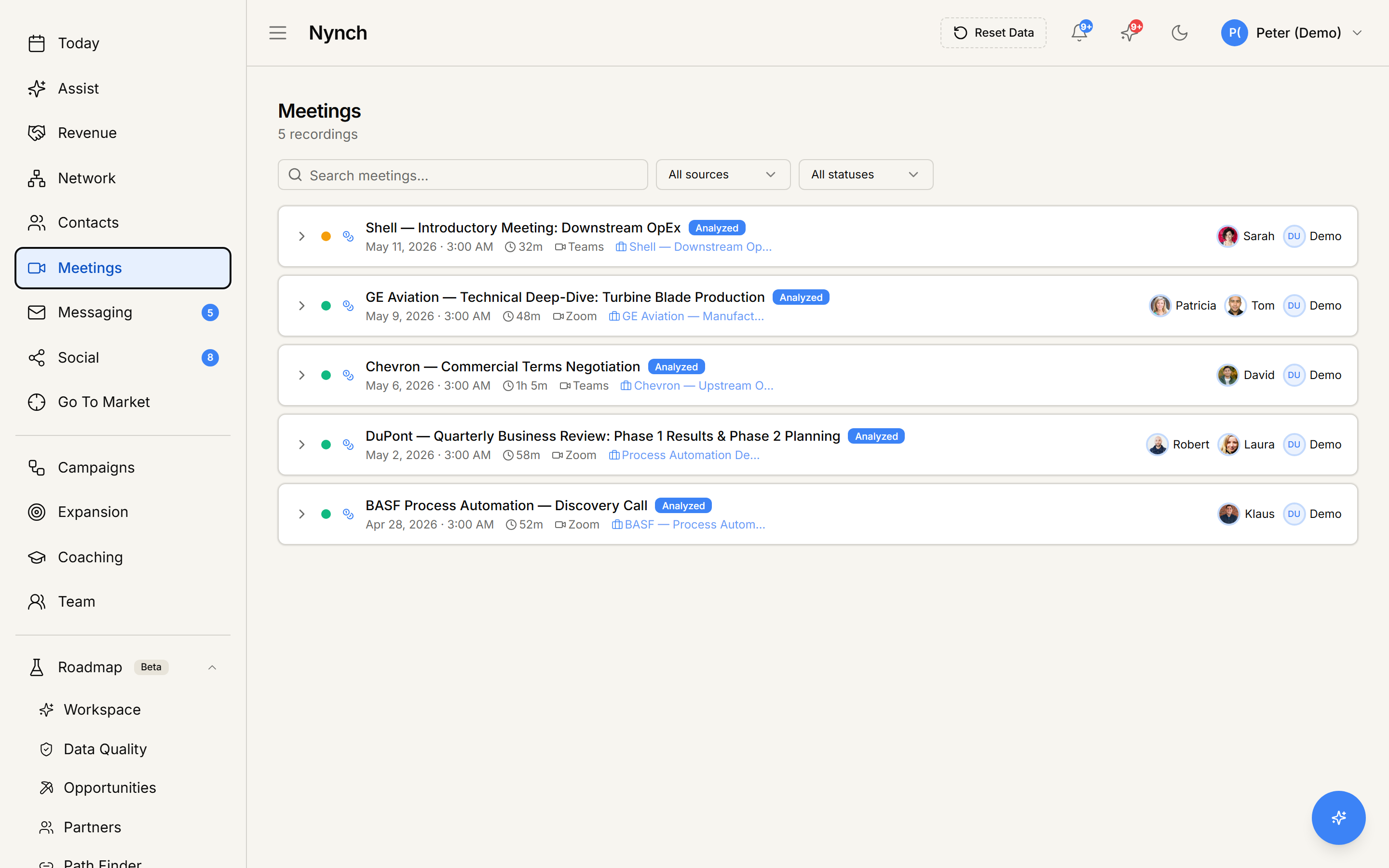
Every recording analysed. Decisions, next steps, risks, people mentioned. Pushed to the right deal automatically.
The shared idea
Rings and Nynch start from the same observation: the standard CRM is wrong for any business where the unit of work is not a deal cycle. Sales-team CRMs (Salesforce, HubSpot, Pipedrive) are built to push strangers through stages. Most relationship-led businesses do not work that way. The relationships compound over years. The same name appears in seven different deals. The next engagement comes from someone you helped four years ago.
Both platforms reject pipeline-as-the-unit-of-work. Both treat the relationship graph as the actual asset.
The difference is which relationship graph, and therefore which buyer.
Rings: built for the deal network
Rings serves venture capital, private equity, investment banking, fund-of-funds, and adjacent advisory teams. The relationship graph there is a network of investors, founders, deal counterparties, board members, and operators. Trust is held across years and across deals. The platform’s flagship feature, Pathpower, maps that network including indirect connections and influence paths. It is well-built for the world it serves.
If you run a VC fund, a PE shop, or a boutique investment bank, Rings is genuinely tailored to your operating reality. Their case studies, language, and feature priorities are tuned for that buyer.
Nynch: built for the consulting practice
Nynch serves consultants, fractional executives, boutique consultancies, and small advisory firms. The relationship graph here looks different. It is past clients who renew, peers who refer, decision-makers who hired you once and might again, prospects who said “maybe next year” three years ago. Trust is held across engagements, not across deals.
The frameworks built into the platform are tuned to that operating reality:
- Relationship Capital as the asset on a consulting practice’s balance sheet. The trusted network earned through delivery.
- dormant network value. The revenue sitting in neglected client and referrer relationships, often six figures.
- Relationship rhythm alerts. Nynch learns each relationship’s natural rhythm and flags the ones drifting quiet.
- The Superbrain Learning Loop. An AI that learns your specific consulting playbook, not “consultants in general.”
- The Lookalike Play. Finds prospects who match the pattern of your best-fit clients, drawn from your own network.
These frameworks are not generic relationship-intelligence features with new labels. They are the vocabulary of a consulting practice translated into platform behaviour.
Side by side
Which one fits
The choice is straightforward.
If you are a venture capital, private equity, investment banking, or fund-of-funds professional managing a network of investors, founders, and deal counterparties. Rings is well-suited to that operating reality.
If you are a consultant, fractional executive, boutique consultancy, or small agency whose revenue runs through past clients, referrers, and trusted prospects. Relationship Capital is what you are actually building, and Nynch is the platform tuned to that pattern.
If you are coming from Rings
Some Nynch customers arrive having tried Rings and concluded the operating model was tuned for a different buyer. The platform itself is well-built. The consulting practice has different frameworks. If that is you, two paths exist:
- Connect Nynch to your existing tools. Nynch automatically discovers your relationship network from email, calendar, and LinkedIn. No manual import is needed.
- Export contacts from Rings. If you want a clean handover, export your Rings contact list and import it into Nynch. The platform will enrich and start measuring Relationship Capital from there.
Either way, the migration is fast. The shift is mostly conceptual, from a deal-network frame to a Relationship Capital frame, not technical.
Nynch vs Rings
What is the difference between Nynch and Rings?
Rings is a relationship intelligence platform built primarily for venture capital, private equity, and investment banking teams who manage networks of investors, founders, and deal counterparties. Nynch is the CRM for consultants and fractional executives, built for consultants, fractional executives, and boutique consultancies whose revenue runs through trusted client and referrer relationships. Both reject transactional CRM thinking. Rings serves the deal-network world. Nynch serves the consulting-practice world.
Should consultants use Rings?
Rings is well-built for its intended audience: VC, PE, and investment banking teams tracking networks of investors and deal counterparties. Consultants and fractional executives have a different operating reality. The unit of work is a client engagement that compounds into renewals and referrals, not a deal cycle that closes. Nynch is the CRM purpose-built for that pattern: it reads your network for buying signals, surfaces who is warm today, and helps you keep relationships warm between engagements.
Does Nynch do network mapping like Pathpower?
Yes. Nynch maps your full relationship network including indirect connections through past clients, referrers, advisors, and shared connections. The lookalike engine identifies prospects who match the pattern of your best-fit clients. The difference is what the network is used for. Rings uses network mapping to support deal-flow plays. Nynch uses it to surface the next conversation that can strengthen your network value.
Is Rings UK-friendly?
Rings is a US-built platform. Nynch is built and run from the UK with European data residency, GDPR-native posture, and pricing in GBP. For UK and European consultants, fractionals, and boutique consultancies, that matters. Both for compliance and for the texture of language and case studies on the platform.
Can I move from Rings to Nynch?
Yes. Nynch automatically discovers your network from your email, calendar, and LinkedIn, so no manual data migration is required. You can also export contacts from Rings and import them. The faster path is to connect Nynch to the tools you already use, and let the platform map your network from there.
Built for how consultants actually grow
Book a 20-minute walkthrough using your real network. We will show you the Relationship Capital you are sitting on. In the language of a consulting practice, not a deal team.