Know exactly how strong each relationship is.
REI is a single 0 to 100 score for every relationship in your Nynch network, computed from your real interaction history: rhythm, commitments kept, and how each relationship has actually behaved. Most AI CRMs pick a number out of the air. Every REI score links back to the records that moved it.
The Activity Planner forecasts the next 30 days of touchpoints. Each rhythm group has its own warmth signal. Decay arriving is visible before it matters.
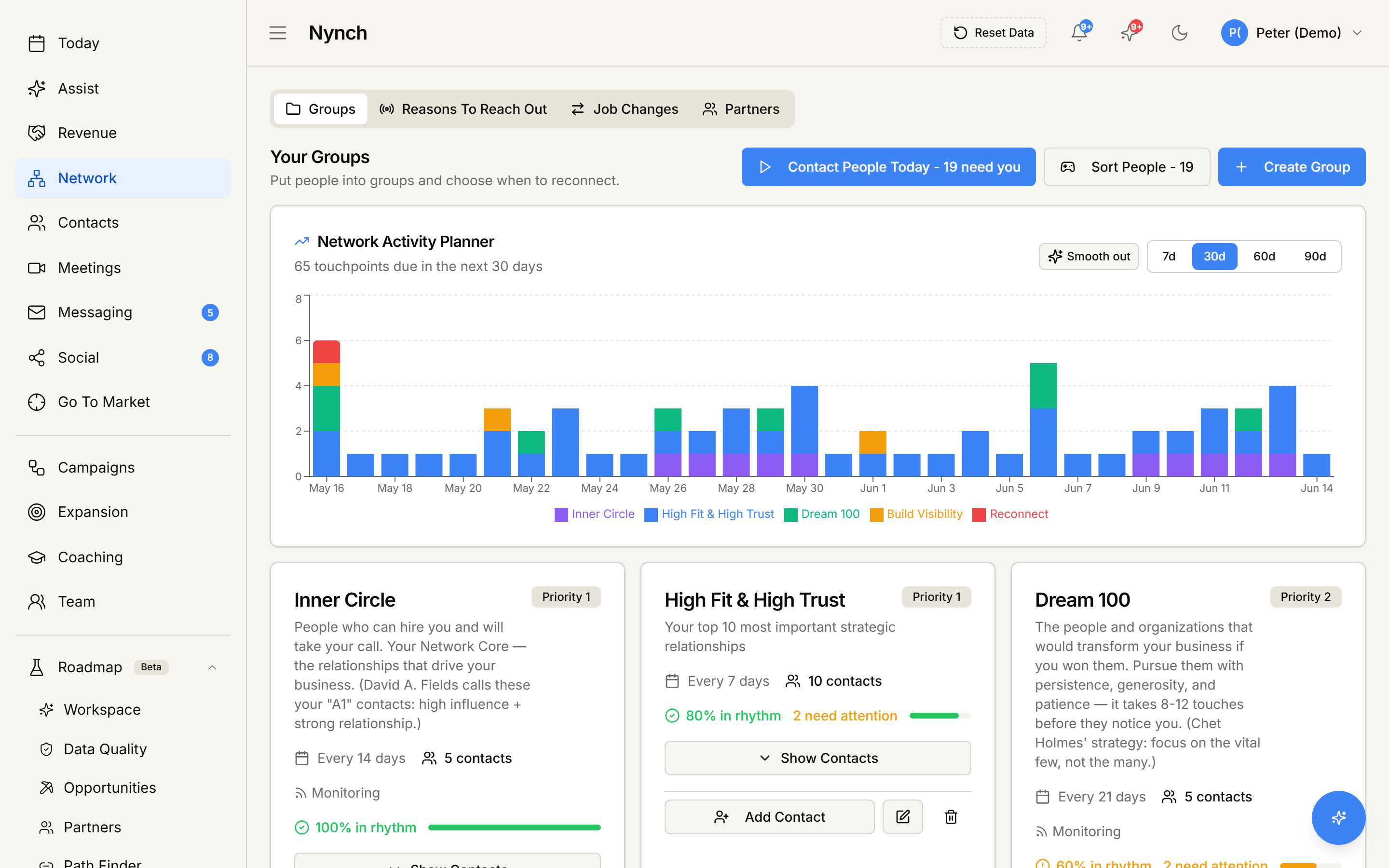
One score per relationship. Four kinds of evidence behind it.
REI replaces the patchwork of separate social, authority, and warmth scores you find in other tools. It is composite, auditable, and outcome-aware: composite because it combines tie strength, bucket placement, commitment history, and rhythm, auditable because every score links back to the records that moved it, outcome-aware because closed deals and stalled deals feed back into the score, so it learns which engagement patterns predict revenue for your specific business.
Tie strength, from behaviour
Strong, weak, and absent ties behave differently, so REI treats them differently. A quarterly check-in with a strong tie is more valuable than five pings with a weak one.
What it gives REI: different cadences and different alert thresholds for different tie strengths. Your strong ties never get the same nudge as your cold ones.
Human limits, respected
There is a cap on how many close, intimate, and meaningful relationships any person can genuinely sustain, and it is far smaller than a contact list.
What it gives REI: bucket sizes that respect human limits. Nynch will not pretend you have 500 close relationships. Focus 10 sits inside your inner circle by design.
Commitments as evidence
Trust is computed from a track record of kept commitments, not declared in a CRM field. Make a promise, keep it, the trust score moves. Miss it, the score moves the other way.
What it gives REI: the Say/Do Ratio as a real metric, with overdue-promise alerts and commitment-history tracking baked into every contact card.
Decay with a shape
Each interaction lifts the score, and the lift fades relative to that relationship's own rhythm, not a fixed calendar. Weekly relationships cool in weeks, annual ones in years.
What it gives REI: the temporal decay model behind every going-quiet alert. Drift shows up while one message is still enough to fix it.
What that means in practice.
The evidence is the credibility anchor. The behaviours are what you actually feel.
- 1 Every contact has one number, and it makes sense. No more juggling a separate authority score, social score, and warmth score. One 0 to 100, with the components visible if you want to drill in.
- 2 Cadence is differentiated. Strong ties get fewer, longer nudges. Weak ties get faster, shallower ones. The system never recommends the same touch sequence to a 25-year mentor and a conference contact.
- 3 Buckets respect human limits. Focus 10 lives in your inner circle. The Daily Relationship Review daily routine flips through buckets sized to human limits, not to whatever the database can hold.
- 4 Trust is earned, visibly. Every commitment you make to a client is tracked. The Say/Do Ratio is on the contact card. Overdue promises trigger alerts before they become reasons not to refer you.
- 5 Decay is visible. Every relationship is tracked against its own rhythm, so drift shows up while it is still cheap to fix. Nynch surfaces it before the silence becomes terminal.
- 6 Outcomes feed back in. Every closed deal, every stalled deal, every won renewal updates the weights. By month three, REI is calibrated to your actual revenue motion, not to consultants in general.
How REI compares to a generic warmth score.
Most CRMs that claim to score relationships use a single proxy: time since last contact, response rate, or a vibe metric. REI is composite, grounded, and outcome-aware. The difference shows up in which questions each system can actually answer.
| Capability | Generic warmth score | Nynch REI |
|---|---|---|
| Treats strong and weak ties differently | No | Yes (tie-strength weighting) |
| Caps close-relationship counts to human limits | No | Yes (bucket caps) |
| Computes trust from kept commitments | No | Yes (Say/Do Ratio) |
| Measures decay against each relationship's own rhythm | No | Yes (rhythm-relative decay) |
| Updates from your real deal outcomes | No | Yes |
| Day-1 score and day-365 score are different | No | Yes |
| Auditable: every component is inspectable | No | Yes |
REI is a design, not a claim to laboratory truth. Every number it reports is computed from records you can open: the interactions, the commitments, the rhythms. Where the evidence is too thin to stand behind a number, it says so rather than inventing one.
This is the framing every founder, sales rep, and product page should keep when talking about REI. A sceptical buyer believes a score they can interrogate, not a score with a confident label.
See REI on a live account.
Book a 30-minute demo and we will walk you through REI on a real contact list, including the Say/Do Ratio for one of our customer accounts and a live decay curve for a real relationship.