Every message, informed by everything Nynch knows.
LinkedIn signals. Past interactions. Won-work patterns. Your services and ideal client profile. Warm paths. Nynch uses five reference sources to prepare a starting draft, then shows you the evidence behind it. You review, edit and decide whether to send.
Generic AI writes generic emails. Nynch doesn’t.
Most AI writing tools generate plausible prose with no context. The output is grammatically perfect and emotionally empty , recognisable to any buyer who’s been hit with five of them this week. The fix isn’t a better model. It’s a model with the right inputs.
Nynch reads from five reference sources for every message, and surfaces which source contributed which line so you can see exactly why the AI said what it said.
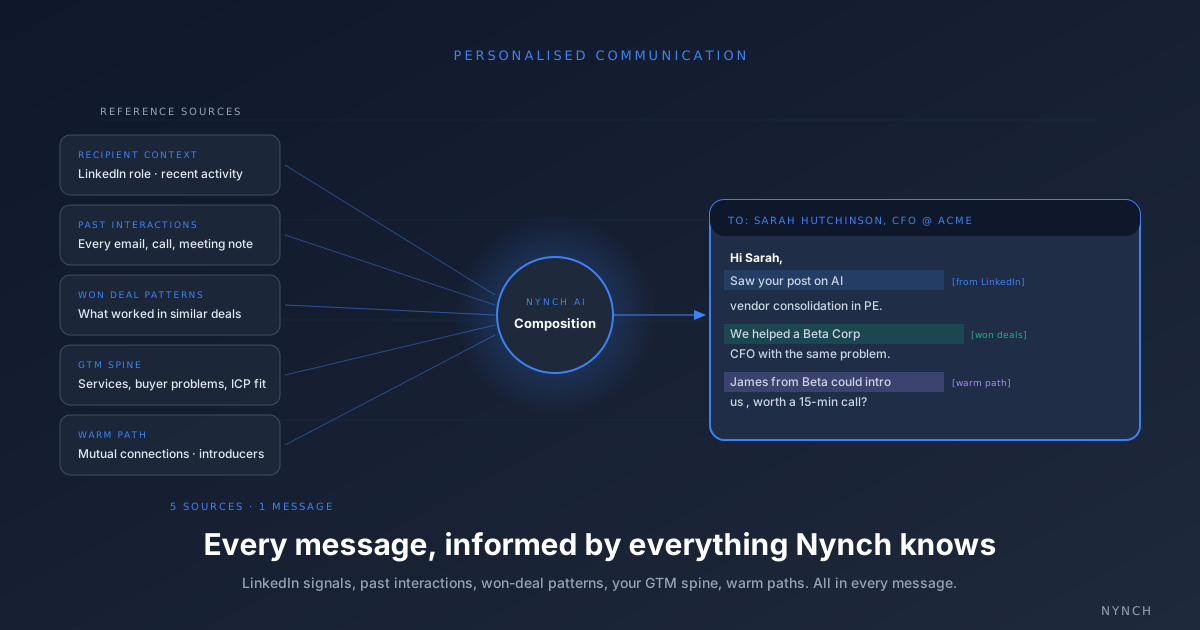
The five reference sources.
Each input contributes specific phrases, references, or framings to the final message. You can see them tagged inline as the AI composes.
Recipient context
LinkedIn role, recent posts, role changes, content engagement, mutual interests. The opening of every message references something specific to the recipient’s actual recent activity, not a generic “hope this finds you well.”
Past interactions
Every email, call transcript, meeting note, Slack thread, and LinkedIn DM you’ve had with this person. The AI knows what was discussed, what was promised, what objections came up, and what tone you usually take with them.
Won-deal patterns
From Superbrain’s learning ledger: which framings worked when you’ve closed similar buyers before. Which case studies resonated. Which call-to-action phrasings actually got replies. Tuned to your specific revenue motion, not generic best practice.
GTM spine
From your Command Centre: which of your services solves the buyer problem this recipient has, the typical deal size, the proof points, and the right methodology overlay. The AI references your services consistently across every message.
Warm paths
Whether anyone in your network can introduce you to this recipient, with relationship strength scoring. If a strong path exists, the AI can offer to draft a warm-introduction request to your consultant instead of a cold email , or weave a credible mutual reference into the message itself.
Source-tagged composition.
You don’t have to trust the AI’s output blind. As the message is generated, every distinctive phrase is tagged to the source it came from. “Saw your post on AI vendor consolidation in PE” is tagged [from LinkedIn]. “We helped a Beta Corp CFO with the same problem” is tagged [won deals]. “James from Beta could intro us” is tagged [warm path].
The tags are visual aids during composition. They do not appear in the sent message. They make the AI’s reasoning legible, so you can see whether the message is grounded in real data or reaching. If the LinkedIn reference is two months old or the won-deal pattern feels weak, you swap that line for something stronger before sending.
The AI gets better, the more you use it.
Every message you send (after editing or as-is) plus the response it gets feeds back into Superbrain’s learning ledger. The system tunes which framings work for your style, which case studies resonate with which buyer types, which call-to-action phrasings convert.
Useful out of the box
Best-practice patterns from relationship-led growth research, plus your existing reference sources. Generic where it has to be, immediately useful for daily outbound.
Pattern recognition
The system has enough sent-and-replied data to start tuning. You see fewer suggestions you’d reject, and the tone of drafts can move closer to yours.
Calibrated to you
Recommendations are visibly different from a generic AI’s. The system knows whether you win with data-driven ROI arguments or relationship narratives. Drafts read like you wrote them.
Built for scale when you need it.
The same composition engine runs whether you’re sending one message or 200. When you need bulk send, Nynch composes each message individually using all five reference sources for each recipient. Not mail-merge with template swaps , genuinely individual composition that just happens to run 200 times in parallel.
Every address checked
Email validation via Signaliz before send. Invalid addresses are filtered out so they never bounce , bounces hurt sender reputation worse than non-delivery.
Natural send cadence
Default 50/day. Send pattern mirrors human cadence: irregular intervals, working hours, no perfect minute-clocking that flags machine-sent.
Cold to warm in one click
Before sending to a recipient, Nynch checks for warm paths. If a strong one exists, you can swap the cold send for a warm-introduction request via your consultant , typically 3x reply rate.
For relationship-led businesses.
Reactivation that doesn’t feel like spam
The 200 dormant contacts in your Sleeping Network get individually personalised messages drawn from your actual relationship history with each one. Reads as if you wrote it personally because the data behind it was personal.
Different voice per portfolio
Your fractional CRO motion has a different tone than your advisory motion. The AI learns each one separately from the messages you send in each context. Switching portfolios switches voice.
Account team consistency
Five account leads composing messages from the same firm-level GTM spine produce consistent positioning even when each one writes in their own voice. The agency’s point of view stays coherent across the team.
See your reference sources flow into a real message.
Book a 30-minute walkthrough. We’ll connect to a sample of your contacts and compose an actual message live, with each reference source tagged inline so you see exactly what the AI is drawing from.