01Source material
Start with your own thinking.
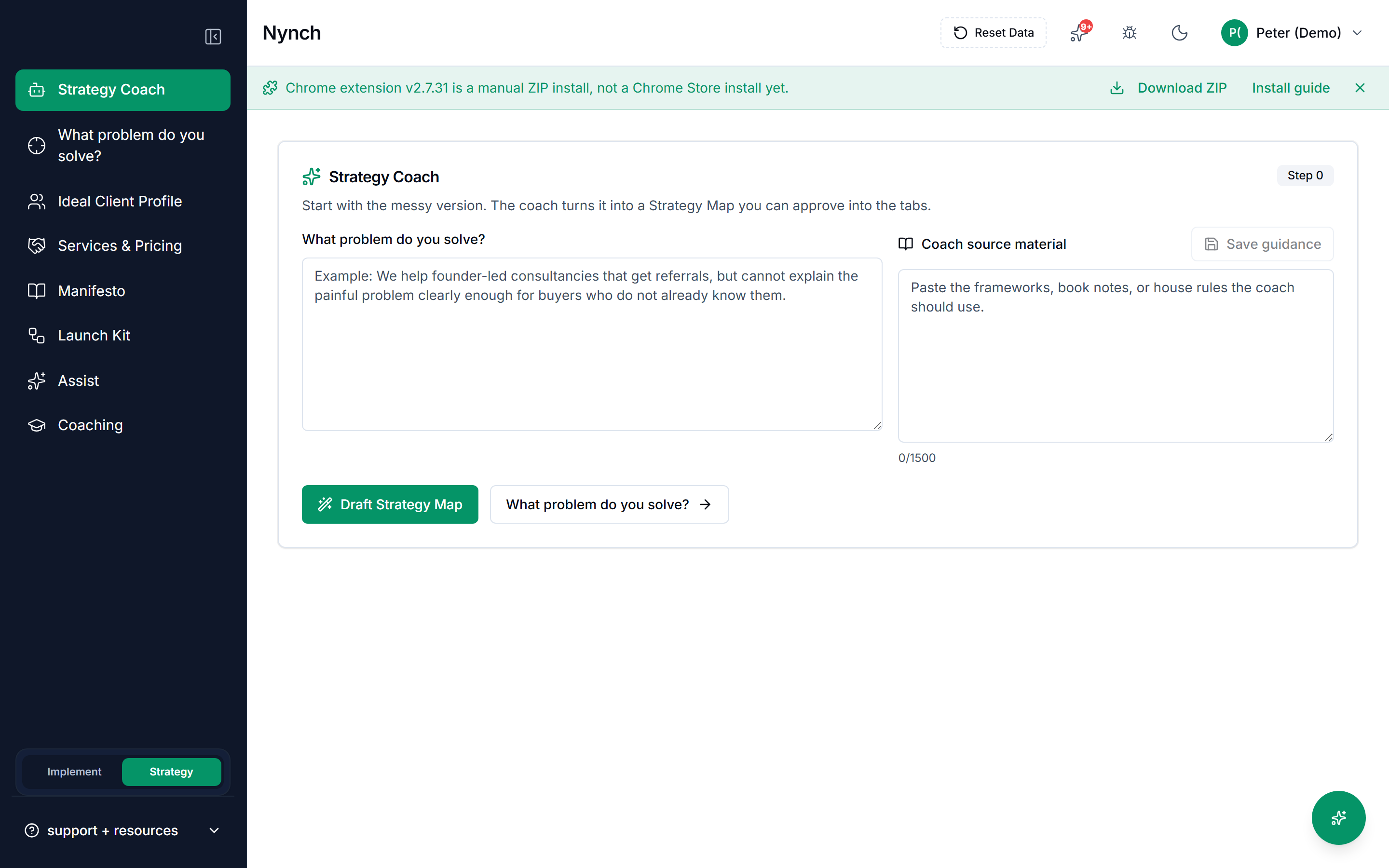
Bring writing, examples and the problem you solve into Strategy Coach.
Use material you have permission to share.
Manifesto
Turn your thinking about a buyer problem into a clear written argument. Build from your strategy, add your evidence and refine the draft in your own voice.
See how it works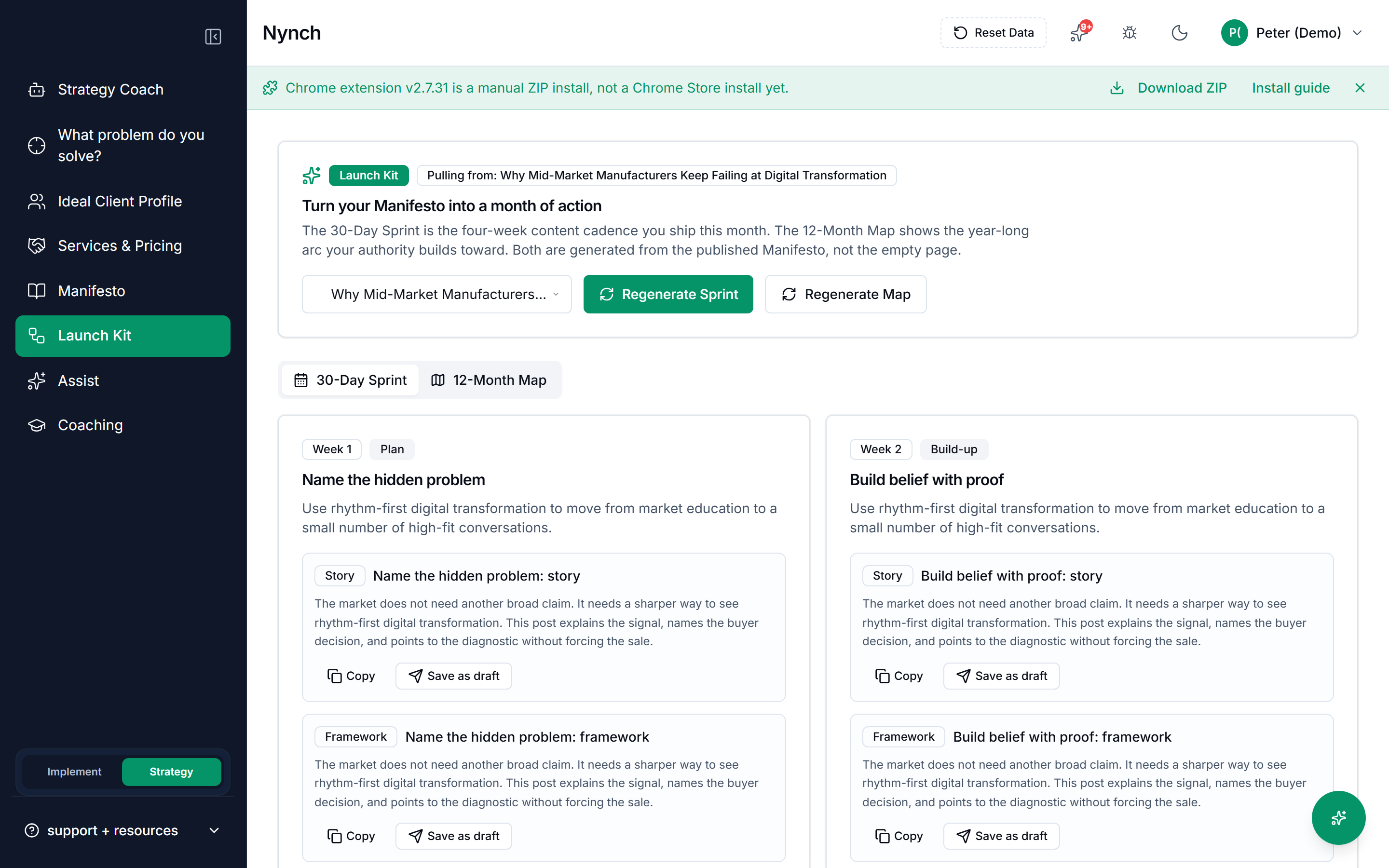

What gets in the way
A buyer needs to understand how you see the problem and why your approach is worth considering. That argument often stays scattered across presentations and conversations.
You know what needs to change but struggle to put the case into words.
Broad claims take the place of concrete experience.
A polished document loses the language that makes your perspective yours.
How Manifesto works
Make the problem, perspective and evidence clear before sharing the document.
Bring writing, examples and the problem you solve into Strategy Coach.
Use material you have permission to share.
Connect the buyer’s situation to your view of what needs to change.
Use the strategy canvas to challenge vague claims.
Develop the piece with concrete examples and a clear progression from problem to recommendation.
Refine the wording in your own voice.
Use the argument to guide useful posts and briefs for the buyers you want to reach.
Review the evidence before publishing or sharing.
What Nynch decided, and why
A manifesto argues one point of view from your own material. These are the rules that shape the document Nynch writes, and why each one takes discipline to hold together by hand.
It opens with who should listen, then the problem getting worse, why the usual answers fail, what you believe instead, and finally the offer with its proof and language. Each part does one job in that sequence, so the offer arrives after the reader has seen why the usual answers fail.
Doing it yourself: Keeping five connected parts in one order across a whole document is hard to hold together when you rewrite any one of them by hand.
Writing a whole manifesto is a long job, and a failure near the end should not cost you the parts that worked. Nynch saves each finished part, and when a run stops early it tells you to start the same generation again to resume from what was saved.
Doing it yourself: Rebuilding a whole document after one section fails means rewriting the sections that were already good.
The playbook holds pitch variations, a repeatable week, outreach scripts and sales assets. Each part is drawn from the same saved argument, so the words you use to pitch stay tied to the document a buyer may already have read.
Doing it yourself: Turning one argument into pitch variations, a weekly routine, outreach scripts and sales assets, all in the same words, is four separate jobs.
Anything you have not confirmed, such as your capacity or customer proof, is kept as unknown rather than filled in. If one result is invented, the reader has no way to tell which of the others are real.
Doing it yourself: Going through every goal, timing and product in a playbook and labelling each one as a proposal is easy to skip when the draft reads well.
One connected Nynch platform
Prospecting, relationships, meetings, proposals, Deal Rooms and client growth work together in Nynch. Start with the job you need to do today. Keep the context as the relationship develops.
The details
A written argument for how you see a buyer problem and what should change. It should help a reader understand your perspective, rather than simply advertise a list of services.
Your buyer, the problem you solve, your point of view and examples from your work. Your own writing gives the draft a stronger starting point for voice.
Yes. Treat it as a draft. Restructure the argument, add evidence and remove language that does not reflect what you actually believe.
Do not use invented results, client examples or quotations. Review every claim against source material you can stand behind.
The manifesto develops the central argument. Build Authority helps you turn that perspective into useful content for the audience you want to reach.
When the problem, argument and evidence are clear, the wording sounds like you and the material is appropriate for the intended audience.
See a point of view develop from strategy into a usable draft.