Context. The part of Nynch that knows what they said, what they meant, and what comes next.
Your clients drop hints. Your prospects make promises. Year-end budgets get mentioned in passing. A referral gets offered and quietly forgotten. The single biggest tax on consulting and fractional work is everything other people said to you that no human can hold in working memory for a year. Nynch holds all of it, brings it back at the moment it matters, and turns it into work you can act on.
Every email, meeting, transcript, signal, and commitment for a person, on one timeline. No tabs to stitch together.
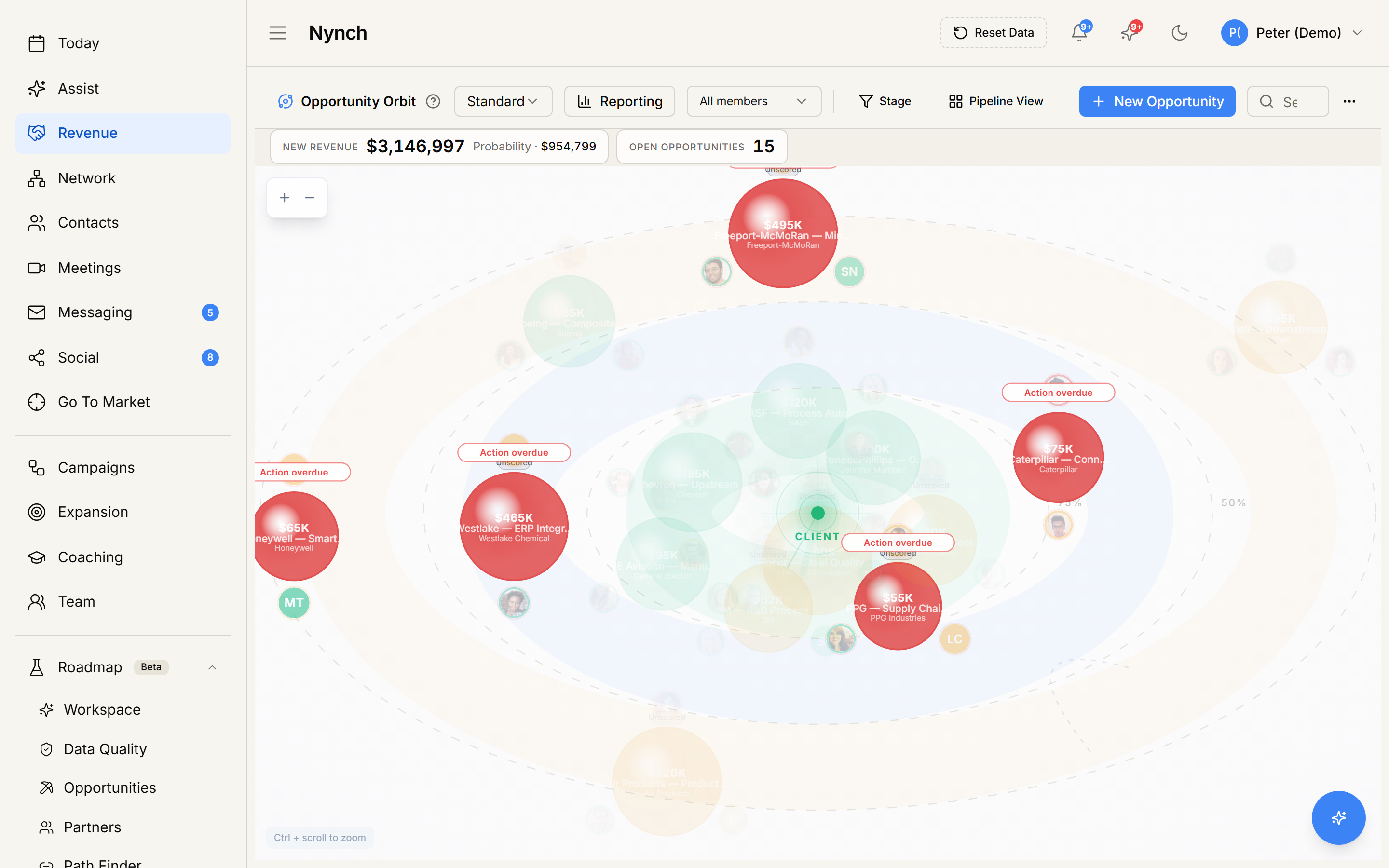
What we mean by context
Context is everything they told you that you can no longer hold in your head.
A client mentioned in October last year that they always have leftover budget to spend in Q4. This year, you have not spoken to them since March. A prospect ended a call in February with "call me in July." It is now late June and the note sits buried in a transcript. A long-standing client said over coffee three months ago, "I should introduce you to Sarah at Acme, she would love this." No intro has arrived.
Every one of those moments was money. Every one of them slipped because no human can hold a thousand conversations in working memory for a year.
Salespeople fake context with pipeline stages. You cannot. Your work runs on trust, and trust runs on whether the other person feels remembered. The person across the table can tell within ten seconds if you actually recall what they said or just looked them up.
Nynch removes the tax. Context is the part of the product that holds both sides of every relationship, continuously, and surfaces what they said at the moment you need to act on it.
What Nynch hears, captures, and remembers
Nynch reads from the places your relationships actually live. None of it asks you to type.
- Every word they said in a meeting. Zoom, Google Meet, Granola transcripts. The half-sentence about budget timing. The casual mention of a competitor. The promise to introduce you. All captured, attached to the right person, retrievable a year later.
- Every email they sent and you sent back. The question they asked in February you forgot to answer. The "let's revisit in Q3" they typed once and you both moved on from.
- Every commitment, from both sides. What you said you would do, and what they said they would do. Tracked, surfaced when due, scored when fulfilled or missed.
- Every signal from their world. Job changes, funding rounds, hiring spikes, content they posted. The reasons to reach out that you would never see in time.
- Every meeting on the calendar. Who attended, who declined, what was scheduled, what was skipped. The pattern of someone going quiet shows up before they ghost.
- Every browser session and voice note. The article you read about them and meant to send. The note you dictated walking out of a meeting that you would have forgotten by the time you sat down.
Each of those used to live in a tab, a transcript folder, or your head. In Nynch they become one timeline per person, one timeline per company, one network view across your whole book.
How it becomes one living picture
Most CRMs store data. Nynch builds a graph.
A graph means every word they said connects to every email they sent, every meeting they attended, every commitment either side made, and every signal from their company. When a client mentions a project that comes up again in another conversation eight months later, Nynch knows. When a prospect says "call me in July" and July arrives, Nynch tells you. When a client said they would refer you and the referral never appeared, Nynch keeps the open thread visible until it closes.
Three properties make this different from your records, but searchable.
- Recency-weighted. Last week matters more than last year. But a one-line promise made twelve months ago that comes due today is still surfaced, exactly when it matters.
- Network-aware. Warm-intro paths discovered automatically. When a client mentions someone they know, Nynch checks whether the path is real.
- Commitment-aware. Their promises are tracked alongside yours. A client who said they would introduce you and never did is a quiet, visible open loop. A prospect who said they would circle back next quarter is a calendar item, not a hope.
This is the layer that gives Nynch its other AI features something real to work from. Outreach drafts that quote the actual sentence the client said. Deal probability scored against the specific signals from your specific past wins. Briefings that pull from the conversation history, not generic web search. None of it works without context underneath.
Context first. Work second. AI matters when it moves the next action.
How context becomes work
Context only matters if it changes what happens next.
This is the system-of-work layer underneath the AI CRM. Not another place to search. The layer that turns remembered context into a briefing, a draft, a reminder, a referral ask, a proposal angle, or a safe follow-up ready for you to approve.
A line in a transcript becomes a callback. A referral promise becomes an open loop. A budget mention becomes a draft. A stalled reply pattern becomes a priority. The CRM stores the record. Nynch turns the record into prepared work.
You stay in the relationship. Nynch removes the admin between seeing the moment and acting on it.
What it feels like in practice
A few moments where context shows up.
The Q4 budget reminder
Last October a client said they always have unspent budget by year end. You have not spoken since March. On the first of October this year, Nynch surfaces the line they said, with the full transcript link, and suggests an outreach. You send a single email referencing it. They reply within an hour.
The July callback
A prospect ended a call in February with "let's reconnect in July." The note lived in a transcript you never re-read. Late June, Nynch puts it at the top of your week. You reach out three days before they expected.
The unfulfilled referral
A client offered to introduce you to a peer over coffee three months ago. It never happened. Nynch keeps the open thread visible. You mention it lightly on the next call. The intro lands two days later.
The job change you would have missed
A contact you spoke to two years ago just took a senior role at a target account. Nynch surfaces it the morning the news breaks, with your full conversation history attached. You congratulate them in context, not as a stranger reaching out cold.
The relationship going quiet
A long-time client has not replied to your last two emails. Their LinkedIn activity dropped. A meeting was rescheduled twice. Nynch flags the engagement decay before you would have noticed. You make the call before the renewal conversation goes cold.
The proposal that writes itself
You are drafting for an account you have spoken to six times across two years. Nynch pulls every sentence they said about their priorities, every objection raised, every commitment made on both sides. The proposal reflects what they actually told you, not what you assumed.
Why nobody else can build this
Most CRMs were designed around deals. The contact record is a side effect of a pipeline. Add AI on top and you get smarter pipelines. You do not get the other person's words from a meeting eleven months ago, because their words were never in the schema.
Nynch was built around relationships from day one. The data path absorbs both sides of every interaction. Their words. Your words. Their commitments. Yours. Their signals. Their silence. The relationship graph is the primary object. Every feature plugs into the same context layer. Every new integration deepens it.
That is why a CRM with AI features cannot become Nynch by shipping an update. The schema would have to be rebuilt. The data path would have to be reversed. Five years of engineering would have to happen in the right order.
In the meantime, every conversation you have ever had is sitting in transcripts, inboxes, and calendars, telling you exactly what to do next. Nynch is the system that finally listens, prepares the work, and keeps you in control of the relationship.
You already had the conversations. Nynch turns them into context and next actions.
You already had the conversations.
Nynch gives you the context.
Connect Gmail, Calendar, and the meeting tools you already use. Watch Nynch surface what your clients and prospects said over the last eighteen months that you would have lost. Decide if it is something you want to keep.
Context, answered
Context is the foundation Nynch is built on. It turns relationship memory into prepared work: briefings, drafts, reminders, referral asks, proposal angles, and safe next actions. There is no separate purchase.
Gmail or Outlook with full two-way sync, Google or Microsoft Calendar, Zoom, Google Meet, Granola, LinkedIn via the Nynch browser extension, voice notes from the mobile app, and external signals from funding, hiring, and news sources. New sources are added regularly.
Every meeting transcript and email thread is indexed against the right person and company. When a future moment matches a past statement, like a promised callback date arriving or a budget cycle reopening, Nynch surfaces the original line with a link to the source. You see the exact words, not a paraphrase.
Nynch tracks them the same way it tracks your own. If a client offers a referral and it never lands, the open thread stays visible. If a prospect says "call me in July," the date becomes an action. You decide when to follow up. Nynch never reaches out for you.
Only you, unless you explicitly share with a teammate. Nynch never trains models on your data. Every read by an AI feature is audit-logged in your account.