01Point of view
Start with something you have learned from the work.
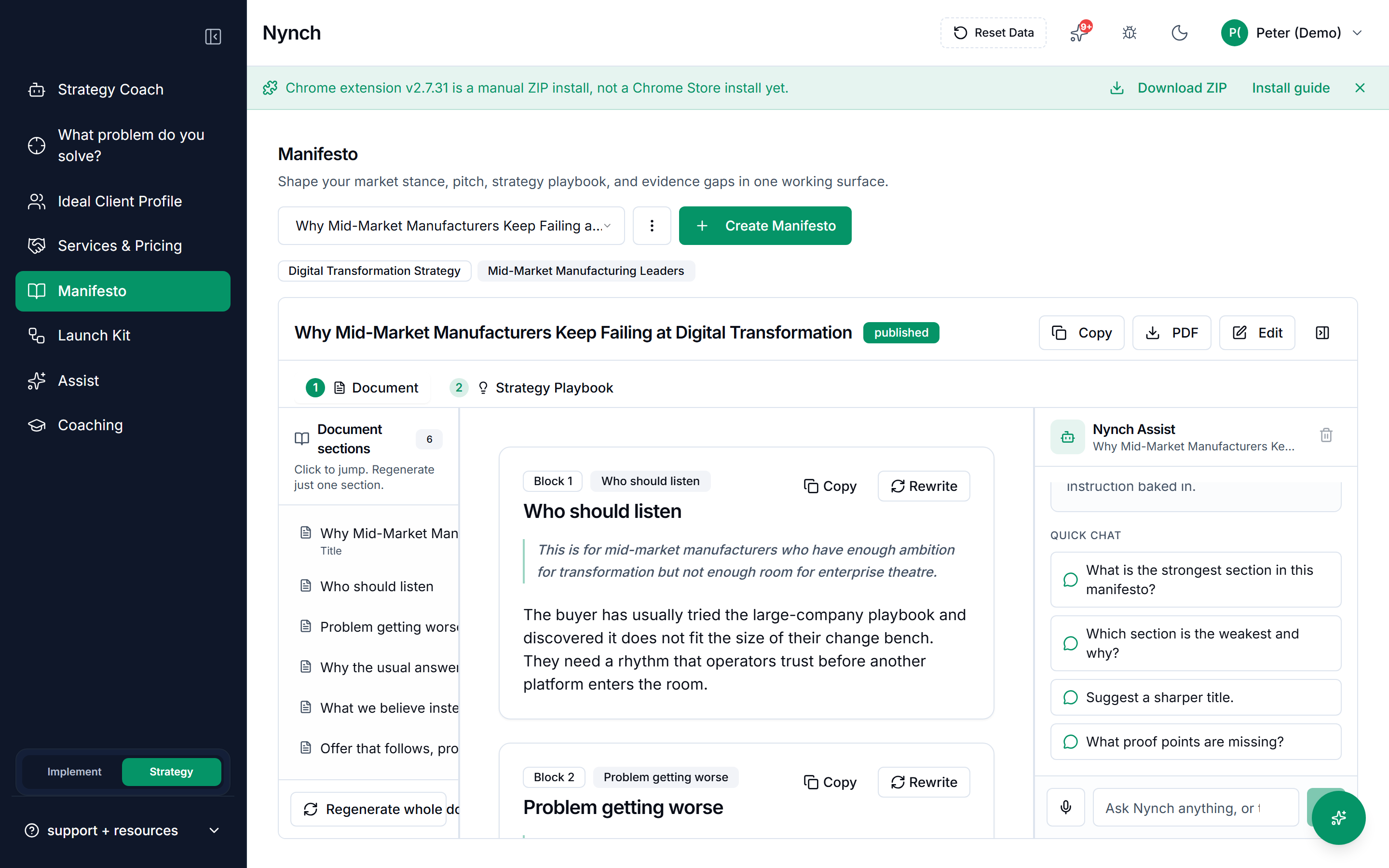
Use your strategy to name the buyer problem and the perspective you want to be known for.
Add your own language and experience to the source material.
Build Authority
Develop content from the problems you solve and the point of view behind your work. Keep ideas, drafts and publishing plans together in Nynch.
LinkedIn content for consultants, inside the complete Nynch business development platform.
See how it works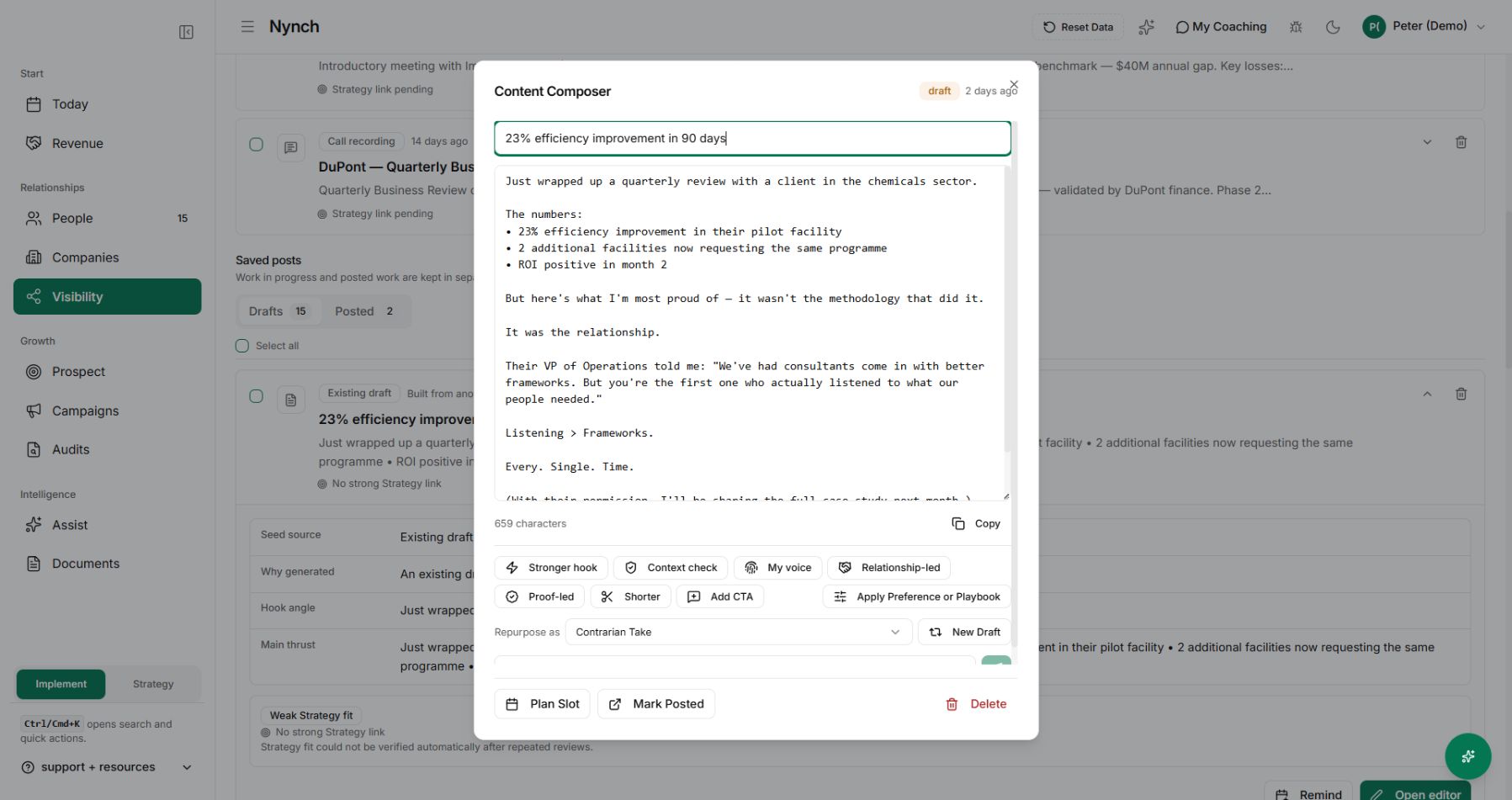
What gets in the way
You have useful experience to share, but a blank editor turns publishing into another job. The content you do produce can drift away from the work you want to win.
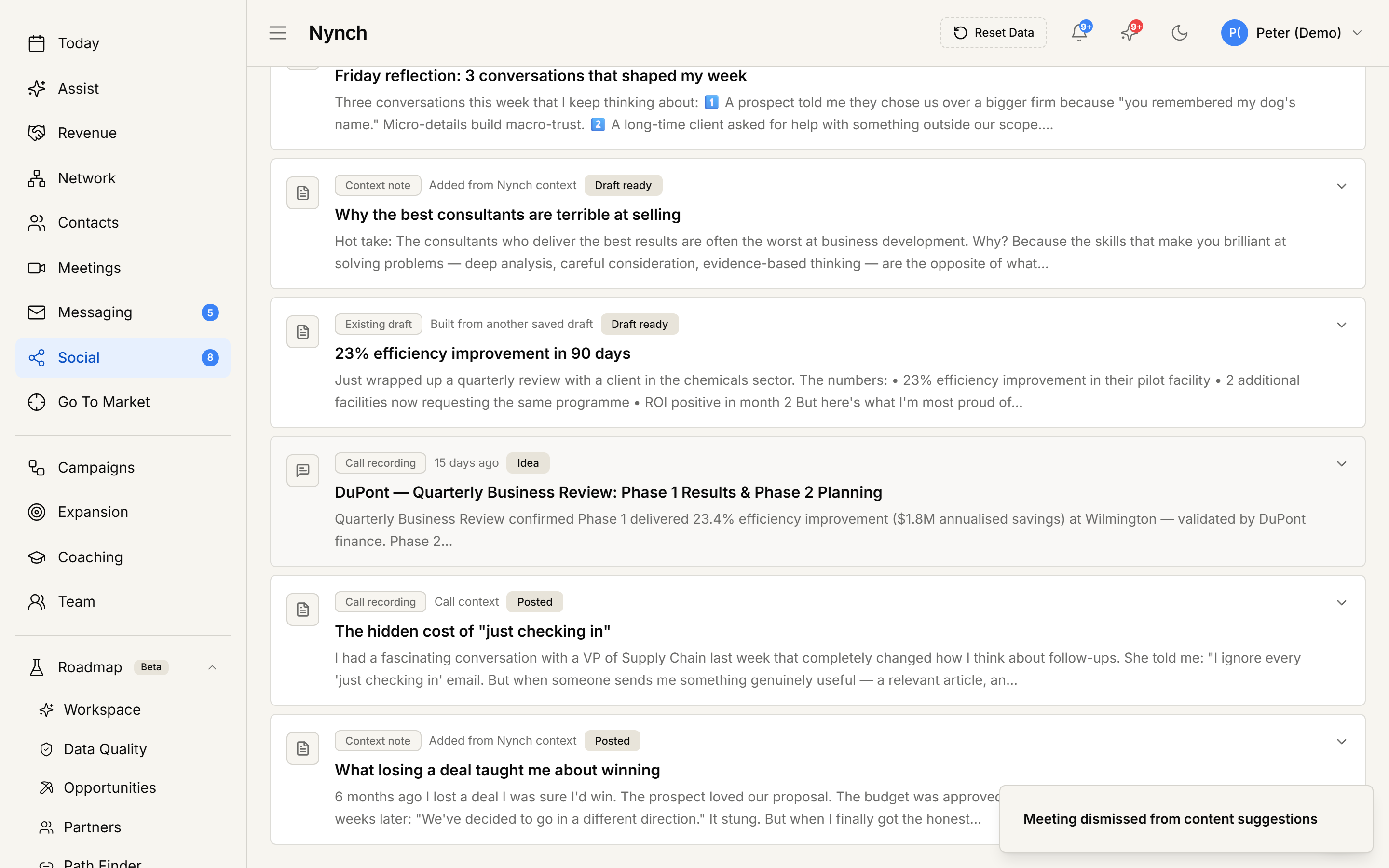
A useful observation stays in a meeting note instead of becoming a piece buyers can read.
The words are polished but could have come from any consultant.
You start again whenever delivery leaves a gap.
How Build Authority works
Connect the content to your buyer and your expertise before deciding how to publish it.
Use your strategy to name the buyer problem and the perspective you want to be known for.
Add your own language and experience to the source material.
Review ideas drawn from your meetings and the questions your buyers ask.
Keep the angle connected to the service and audience.
Develop the draft, add the concrete example and remove claims your experience cannot support.
Review the wording and any client details before publishing.
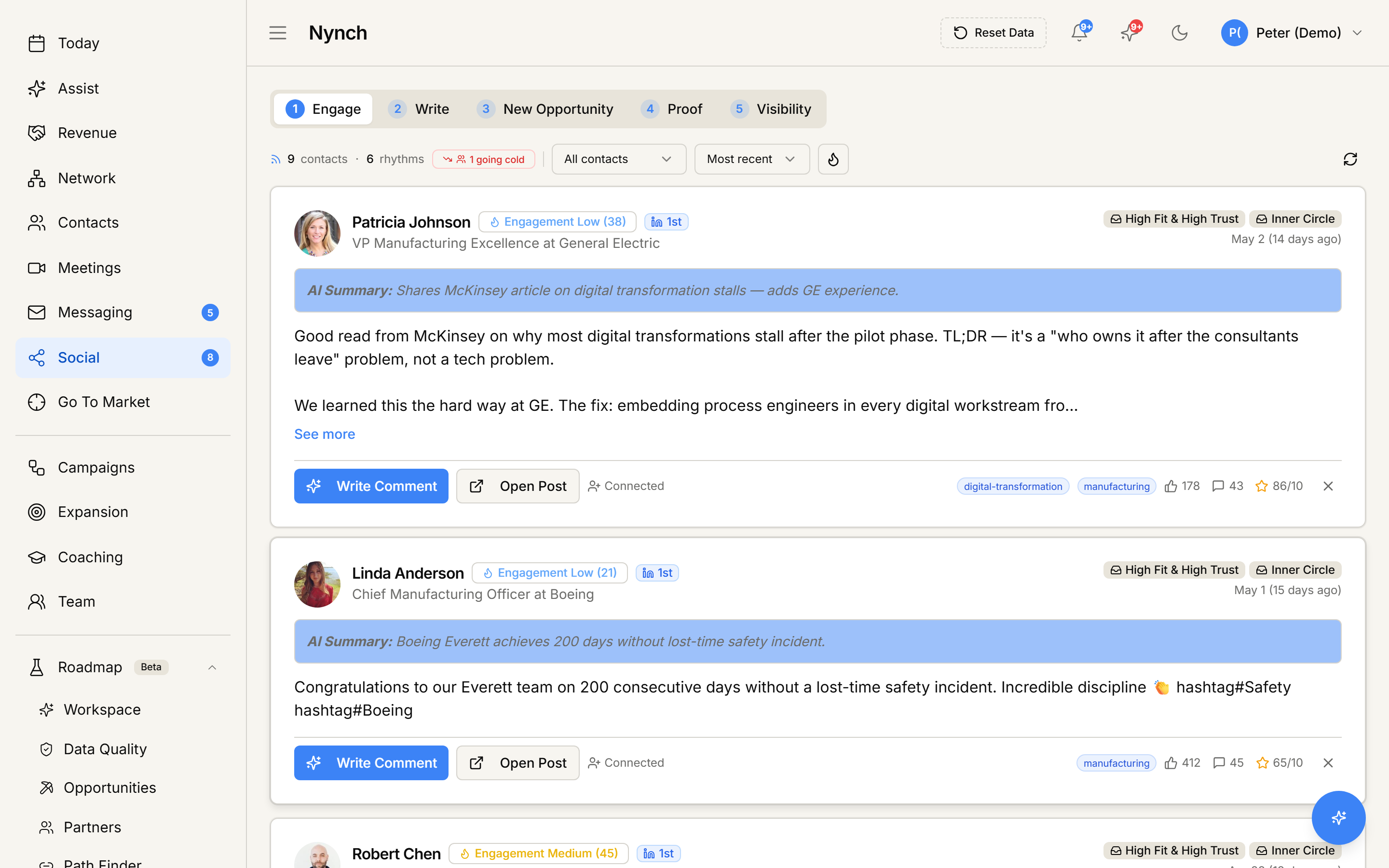
Review relevant LinkedIn posts alongside your content work. Add a useful perspective when you have something to contribute.
Build familiarity through the conversation as well as your own posts.
What Nynch decided, and why
Nynch turns one post you wrote into a set of posts, and it can also read the posts you already published. These are the rules it follows, and why each one is slow to keep up by hand.
Pages you import from your blog or Substack start as drafts, and only an owner or admin can approve them. An approved piece needs a summary of at least twenty characters, because the campaign emails are written from that summary. An old post may no longer say what you believe, so a person decides when it goes in.
Doing it yourself: Going back through every old post, deciding which still stands and then placing each one into the campaigns that need it is a job most people keep putting off.
A week of three posts uses the story, one middle angle and the question. A week of five runs through five angles in the same order, and no two posts share a hook. Each post is written to stand alone, so a reader who sees only one still gets a complete point.
Doing it yourself: Five posts from one idea, each taking a different angle and none repeating the hook, is a planning job most people never finish.
Nynch scores your last 100 week posts, counting a comment as two likes and a share as three. An angle has to have two posts before it counts, and the top angle has to be ahead of the next one. Once it qualifies, it takes the middle slot in a three-post week and gets the strongest hook in a five-post week.
Doing it yourself: You would have to record the likes, comments and shares for every post, sort them by angle and work out the averages each time you plan a week.
If the writer returns fewer posts than you asked for, Nynch discards that run and asks you to try again, so you never end up with three posts out of five. The whole week is saved in one step, so either all of it arrives or none of it does. A post that runs too long is trimmed by removing hashtags and then whole middle paragraphs, which keeps the opening and the ending.
Doing it yourself: Counting, trimming and rereading each post against LinkedIn’s length limit before you trust the set is the step that gets skipped when it is done by hand.
Counters, stage counts and boards in a picture are built only from figures that appear in the text. A second model then scores the finished picture out of ten, and anything under eight can be revised, but only twice. A claim the post does not support counts as a fault, so a high score cannot carry it through.
Doing it yourself: You would have to check every number and label in a picture against the post by eye, and do it again after every change.
One connected Nynch platform
Prospecting, relationships, meetings, proposals, Deal Rooms and client growth work together in Nynch. Start with the job you need to do today. Keep the context as the relationship develops.
Your point of view and client work inform the content you share and the conversations you start.
The details
Start with your point of view, buyer problems and experience of doing the work. Nynch gives those inputs a place in your strategy and content workflow so a draft has a clear purpose.
Yes. The editor is for refining the piece before publication. Add examples, change the structure and remove language that does not sound like you.
Provide examples of your own writing in Strategy Coach and review the resulting drafts. Your examples help establish the voice, but your final edit remains important.
Use the lessons and evidence you have permission to share. Remove confidential details and check any named client, result or quotation before it becomes public content.
No. Your buyer profile and services give the content a commercial focus. Use them to judge whether a piece will help the people you want to work with.
No. The workflow helps you publish useful, relevant work consistently. Enquiries depend on the quality of the ideas, who sees them and the conversations that follow.
See how a point of view becomes a useful piece of content in Nynch.