Track the hidden value in your client relationships.
It is the trusted network earned through delivery, and the single largest predictor of the next 5 years of revenue.
Inner Circle, High Trust, Priority Accounts. Each relationship sits in a tier with its own cadence and Relationship Engagement Index (REI). The Activity Planner forecasts the next 30 days.
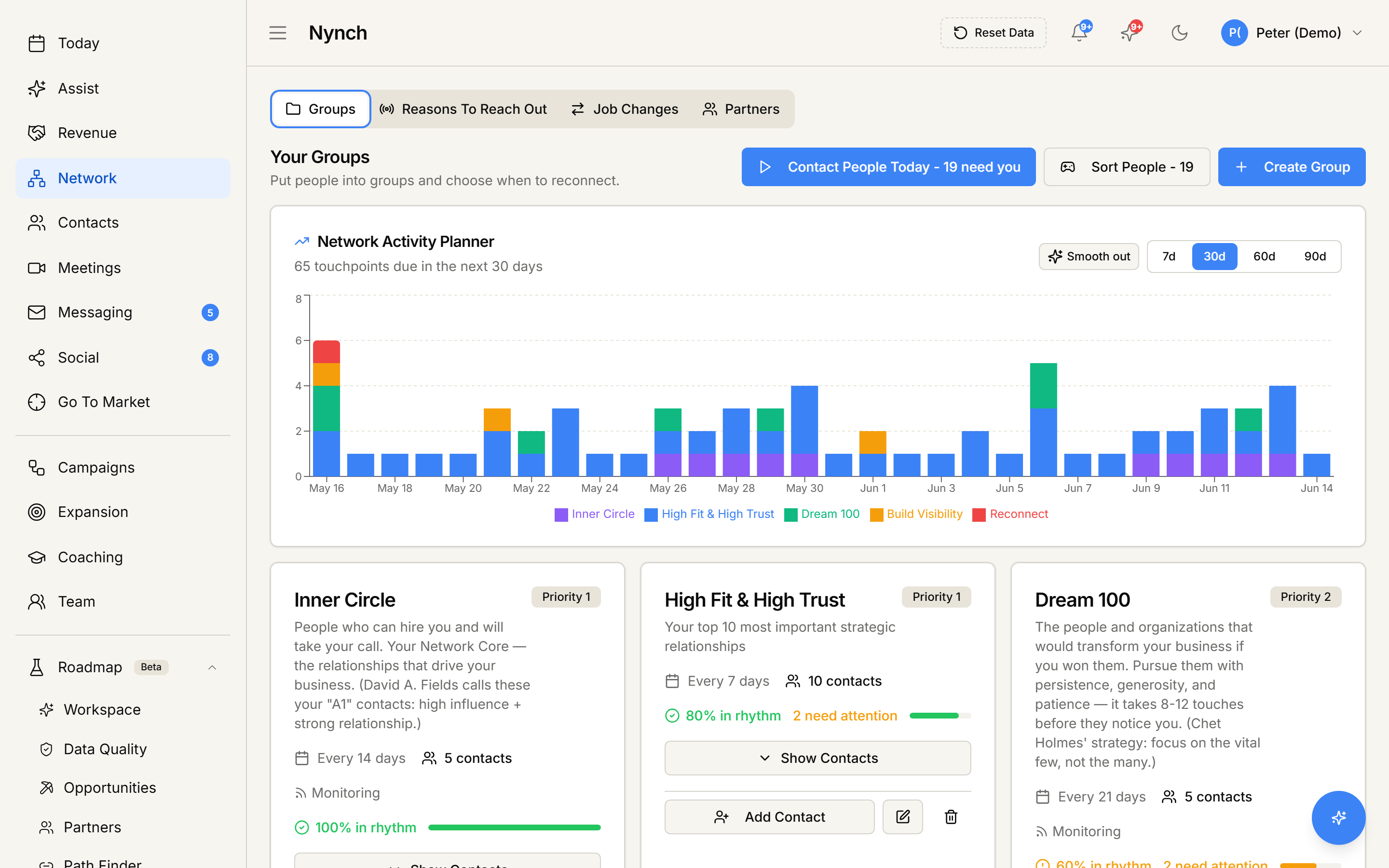
What Relationship Capital is
Every consulting practice runs on two balance sheets. The first is the one the accountant sees: cash, receivables, equipment. The second is the one the founder feels but never measures: the network of past clients who would take a call, the referrers who would recommend the work, the advisors who would make an introduction, the prospects who remember the talk you gave four years ago.
The second balance sheet is Relationship Capital. It is the asset built up over years of trustworthy delivery, kept conversations, and arriving on time with the right answer. It is the reason the next 5 years of revenue exists. And for almost every consultant we work with, it is also the asset they have no system to track, defend, or grow.
Relationship Capital vs Pipeline
Pipeline is what sales teams measure. Relationship Capital is what consulting practices actually run on. The difference is not semantic.
A consulting practice trying to grow Relationship Capital using a pipeline tool is like a long-term investor using a day-trading platform. The instrument is wrong for the game.
Why Relationship Capital depreciates if you ignore it
The trap that catches every consulting practice is the assumption that Relationship Capital, once earned, stays earned. It does not. Trust without contact decays. The relationship that was warm twelve months ago has cooled. The referrer who used to recommend you regularly has shifted attention. The prospect who said “maybe next year” said it three years ago.
We measure this decay with three quantities:
- dormant network value. The revenue sitting in neglected relationships. For most consulting practices, Dormant Network Value runs into six figures. Not metaphor. Money already earned the right to compete for, drifting away through inaction.
- Rhythm health. Every relationship has a natural cadence. When the gap since your last conversation stretches far beyond it, the relationship quietly goes cold. Watching that drift is the difference between a save and a restart.
- stale relationships rate. The pace at which trust erodes once contact lapses. Different relationships decay at different rates. A former client decays faster than an industry advisor, a referrer faster than a peer.
Together these turn a soft asset into a measurable balance-sheet item. They also turn the question “how am I doing?” from a feeling into a number.
Relationship Capital and Relationship-Led Growth
The two terms work as a pair.
Relationship Capital is the outcome. The asset on the balance sheet, the network you have earned, the basis on which the next 5 years of work rests.
Relationship-Led Growth is the strategy. The operating model that builds Relationship Capital systematically rather than accidentally. Spotting buying signals, defending against decay, compounding trust over time.
You apply Relationship-Led Growth as the discipline. Relationship Capital is what accumulates when you do it well. A platform built for one supports the other.
Why most AI CRMs ignore Relationship Capital
Most AI CRMs are sales tools with a chatbot bolted on. They are built for outbound teams running high-volume sequences against strangers. The unit of work is the deal. The metric is volume. The user is a sales rep with a quota.
Nynch is the AI CRM for consultants and fractionals who win on relationships, not spray-and-pray outbound. The unit of work is the relationship. The metric is depth and durability. The user is a consultant or fractional executive whose revenue runs through trust.
The two answer different questions. A volume-first AI CRM answers “which deals are at which stage?” Nynch answers “which relationship is decaying right now, and what is the one conversation that will compound it?”
If you have tried a transactional AI CRM and felt the tool was solving someone else’s problem, that is because it was. See how Nynch compares.
How Nynch tracks Relationship Capital
Nynch is the platform built specifically for Relationship Capital. Three jobs sit at its core.
Visibility. Nynch maps the relationships behind your business. Past clients, referrers, advisors, prospects who almost bought. Each is scored for trust, recency, decay risk, and revenue potential. The asset becomes legible for the first time.
Defence. stale relationships are silent. Nynch surfaces the relationships drifting far past their natural rhythm, the dormant contacts who match a current opportunity, the referrers who have not heard from you in too long. The platform shows you who to reach out to today, and why.
Compounding. Relationship Capital grows when every interaction lands well. Nynch prepares the context, drafts the outreach, summarises the meeting, captures the commitment, and reminds you to keep it. The friction between knowing what to do and doing it disappears.
The shift isn’t from consultant to salesperson. It’s from consultant to consultant. Someone who scales Relationship Capital systematically.
What Relationship Capital is worth, in pounds
The argument for Relationship Capital is not philosophical. It is financial. It exists because consultants get paid for trust. The Trust Premium is the worldview that justifies treating relationships as an asset rather than a soft skill.
Across the consultancies I have advised, most of the next 12 months of revenue comes from someone already in the network. A past client renewing, a referrer recommending, a dormant relationship reactivating. And a warm conversation converts differently from a cold one: faster cycles, less price pressure, no proving yourself from zero.
The implication is straightforward. Every pound spent maintaining Relationship Capital returns more than every pound spent generating new pipeline. A consulting practice that systematically tracks, defends, and grows its Relationship Capital outperforms one that does not. Not by 10% but by multiples, compounded over years.
The Relationship Capital calculator puts a real number on what is currently sitting in your network as dormant network value. For most users it is the most uncomfortable hour they spend with the product. It is also the most useful.
What if you start measuring Relationship Capital today?
The reasonable scepticism about any new measurement framework is whether the upside is real. For Relationship Capital, the upsides are quantifiable and large.
What if you keep doing what you’re doing?
The other reasonable scepticism is whether the change is necessary. Most consultants we work with have already tried something. These are the most common objections and the honest answer to each.
About Relationship Capital
What is Relationship Capital?
Relationship Capital is the value held in the trusted relationships a consulting practice has earned through delivery. It is the asset on a service business’s balance sheet that traditional accounting never captures. The network of past clients, referrers, advisors, and decision-makers who would take a call, recommend the work, or hire again. For consultants and fractional executives, Relationship Capital is the single largest predictor of the next 5 years of revenue.
How is Relationship Capital different from a CRM database?
A CRM database is a record of contacts. Relationship Capital is the live, decaying value held in those relationships. A balance-sheet asset, not a contact list. It can be measured, tracked, grown, and lost. Most CRMs treat every contact equally. An AI-assisted CRM built for Relationship Capital tracks the rhythm of each relationship, shows the evidence when one may be cooling, and helps you review which conversation matters today.
How is Relationship Capital different from Relationship-Led Growth?
Relationship Capital is the outcome. The asset you build. Relationship-Led Growth is the strategy. How you build it. The two terms work as a pair. Practitioners apply Relationship-Led Growth as the operating model and accumulate Relationship Capital as the result. A platform built for one supports the other.
Can Relationship Capital be measured?
Yes. Relationship Capital can be quantified using three measures: dormant network value (the revenue sitting in neglected relationships, counted from your own contact list and engagement values), relationship decay (how many relationships drift quiet each quarter), and rhythm health (how many of your key relationships are inside their natural contact rhythm). Together, these turn a soft asset into a measurable one.
Who should be tracking Relationship Capital?
Any expert professional whose revenue runs through trusted relationships rather than volume-driven outbound. That includes independent consultants, fractional executives (CFO, CMO, COO, CRO), boutique consultancies, advisors, and small agencies. If your last 10 clients came from referrals, prior engagements, or warm introductions, Relationship Capital is the asset that produced them, and the one that will produce the next 10.
Most of the next 5 years is already in your network
Book a 20-minute walkthrough using your actual data. We will show you the Relationship Capital you are sitting on, and the dormant value already at risk.