Most solo consultants max out around $150K to $200K in annual revenue. That ceiling is not about work ethic or intelligence. It is about unit economics.
If you bill 40 hours a week at $150 an hour, you make $312K a year gross. After taxes, software, infrastructure, and overhead, you net somewhere around $150K to $180K. That is a good living. It also hits a wall quickly.
Getting to $500K takes a different model. You cannot do it purely on your hourly rate. You have to build relationship capital: the stock of trust, reputation, and referral intent you hold across the people who already know your work.
Here is how the maths works.
The Basic Unit Economics
Assume a typical profile:
- Average consulting engagement: $25K
- Average engagement duration: 4 weeks
- Billable hours per engagement: 160 hours (4 weeks x 40 hours a week)
- Your rate: $150 an hour
You work four weeks on an engagement, take a week off or use it for business development, then move to the next one. That is about 10 engagements a year, or $250K in gross revenue.
To reach $500K, you need to double that. Three levers matter.
Lever 1: Land Bigger Engagements
Instead of $25K engagements, land $40K or $50K ones.
That can mean:
- Longer engagements (8 weeks instead of 4, same rate).
- A higher rate (as you deepen expertise or specialise).
- Scope expansion (the client brings you into a bigger project).
Landing a $40K engagement instead of a $25K one is a 60% revenue increase. That is worth pursuing.
How do you land bigger work?
Through deeper relationships. A client who knows you, trusts you, and understands the value of your work will give you larger engagements. A cold prospect will give you a small test project.
Relationship capital drives engagement size more reliably than any pitch deck.
Lever 2: Increase Utilisation
Instead of sitting at 50% utilised (one week a month off for business development), aim for 70 to 80%.
At 80% utilisation (32 billable hours a week), you do roughly 12 to 13 engagements a year at $25K each. That is $300K to $325K gross from the same hourly rate.
Higher utilisation means more revenue without raising your price.
How do you raise utilisation?
By building a referral pipeline that feeds you work without constant hunting. If you are not always looking for the next client, you stay billable more of the time.
Lever 3: Raise Your Rate
Most consultants keep the same rate for five years or more. They leave money on the table.
Raise your rate from $150 to $200 an hour and you increase revenue by 33% on the same work and the same hours.
Your rate should climb each year if your expertise, reputation, or positioning improves.
How do you justify the increase?
Through track record and relationship capital. When referrals come to you, the client’s risk falls, and you can charge more without the conversation becoming a fight.
The $500K Model
Here is a realistic model for $500K annual revenue.
Assumptions:
- Average engagement size: $40K (above the baseline)
- Average engagement duration: 5 weeks
- Billable hours per engagement: 200 hours (5 weeks x 40 hours a week)
- Your rate: $200 an hour (up from $150)
- Utilisation: 75% (about 30 billable hours a week on average)
- Engagements per year: 12 to 13
Maths:
- 13 engagements x $40K = $520K gross revenue
- Minus roughly 20% for overhead, taxes, and software = about $416K net
This is doable. It requires:
- Specialisation and a track record strong enough to command $200 an hour.
- Engagements at $40K or more, not a string of $15K projects.
- 75% utilisation, which means a steady pipeline so you are not hunting constantly.
The only way I have seen people hit this without burning out is through referrals. If you are always hunting, you will never hold 75% utilisation for long.
How Relationship Capital Gets You There
The compounding power of relationship capital is what sustains 75% utilisation without constant hustle.
Year 1: Build Foundation
- You land 10 to 13 engagements mostly through your existing network and the first few referrals.
- Average engagement: $25K to $30K (you are still establishing reputation).
- Gross revenue: $250K to $390K.
- Utilisation: 50 to 65% (one or two days a week still go to business development).
You are working hard. You are hustling. You are building a track record.
At the end of Year 1, you have:
- 10 to 13 past clients.
- A small referral network (maybe 3 to 5 people who actively send work your way).
- Clarity on your positioning and who you help best.
- Social proof (testimonials, case studies, project wins).
Year 2: Expand the Network
Your Year 1 relationships start paying dividends.
- Each of your 10 past clients refers 1 or 2 people on average. That is 10 to 20 new opportunities.
- Your referral network is more active. People think of you when something comes up.
- Your reputation is stronger. Warm introductions convert at 40% or more instead of around 30%.
- You get more selective about which engagements you take (you can afford to be picky).
- Your average engagement size moves to $30K to $40K (bigger clients, bigger budgets).
Engagements in Year 2: 13 to 15 (some new, many from referrals). Average engagement: $30K to $40K. Gross revenue: $390K to $600K. Utilisation: 65 to 75% (less time hunting, more time delivering).
At the end of Year 2, you have:
- 20 to 25 past clients.
- A stronger referral network (5 to 10 active referral sources).
- Higher rates justified by your track record.
- Real selectivity (you can say no to bad fits).
- A reputation in your niche.
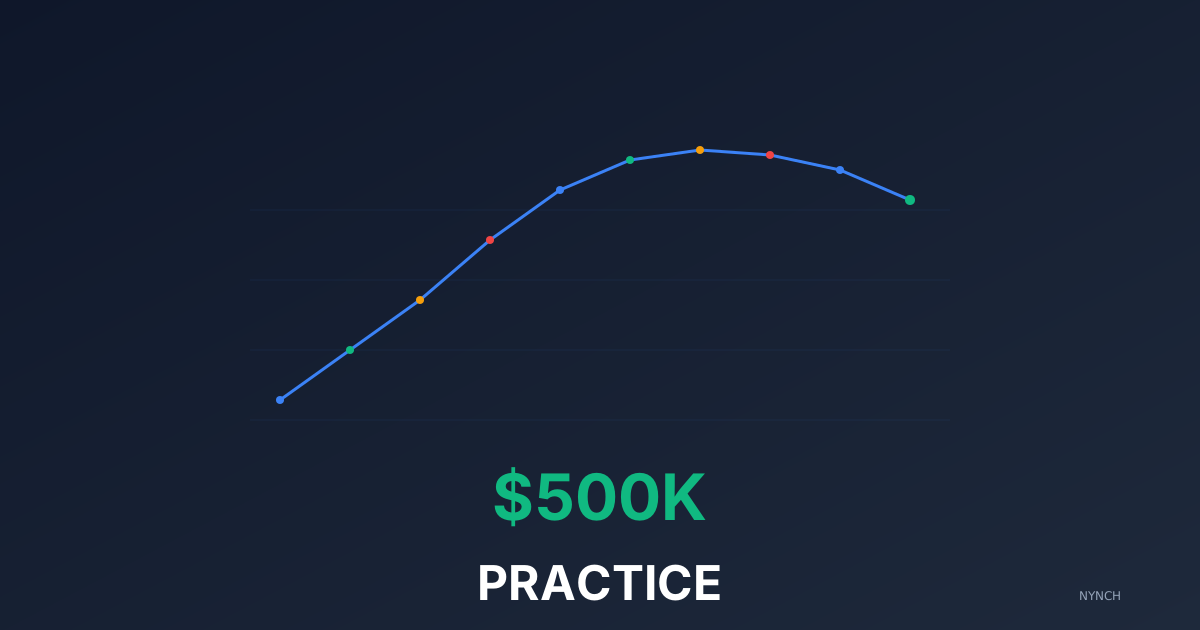
Year 3: Relationship Capital Compounds
This is where the curve bends.
- Your 20 to 25 past clients collectively know dozens of colleagues and peers. They have worked with you. They trust you. They refer you on purpose.
- Your referral network now generates 40 to 50% of your new business (the rest is direct inbound).
- Your rate has moved to $200 an hour or more (justified by specialisation and reputation).
- Your average engagement is now $40K to $50K (you have the standing to scope larger projects).
- You hold 75% or higher utilisation without constant hunting.
Engagements in Year 3: 12 to 15 (mostly referrals and inbound). Average engagement: $40K to $50K. Gross revenue: $480K to $750K. Utilisation: 75 to 80% (you pick and choose).
By Year 3 you have built real relationship capital. Each engagement adds to it. Each client becomes a potential referral source. The network compounds.
The Mechanics of Relationship Capital
Here is how the compounding works as a simple model, not a clinical finding.
Define relationship capital as: number of active relationships × probability they will refer × average referral quality.
Year 1:
- Active relationships: 10 past clients + 50 network connections = 60 relationships.
- Refer probability: 20% (most people do not actively refer).
- Referral quality: 30% conversion (still fairly cold introductions).
- Implied referrals per year: 60 x 0.20 x 30% = 3.6 referrals.
Year 2:
- Active relationships: 25 past clients + 100 network connections = 125 relationships.
- Refer probability: 40% (more people know you and think of you).
- Referral quality: 40% conversion (warmer introductions).
- Implied referrals per year: 125 x 0.40 x 40% = 20 referrals.
Year 3:
- Active relationships: 40 past clients + 150 network connections = 190 relationships.
- Refer probability: 50% (reputation is strong, people look for chances to send work).
- Referral quality: 50% conversion (very warm, highly qualified).
- Implied referrals per year: 190 x 0.50 x 50% = 47 referrals.
By Year 3, you are generating 40 or more qualified referrals a year and you only need 12 to 15 engagements. You are oversubscribed. You can:
- Be selective (take the best opportunities).
- Raise your rate (demand exceeds supply).
- Expand scope (larger projects with the same clients).
That is how you hit $500K. Not by working harder every year. By building relationship capital that compounds.
The Non-Linear Growth
Your effort does not rise in a straight line with your revenue.
In Year 1, you are hustling 50 hours a week (40 billable, 10 on business development).
In Year 3, you are working 35 to 40 hours a week (30 billable, 5 to 10 on relationship maintenance).
You make more money. You work less. That is the point of relationship capital done well.
The first year is hard. You are building from scratch. You have little track record. People do not know you yet.
The second year is easier. You have social proof. You have referrals. The network starts working for you.
From the third year on, you are maintaining a system that generates a large share of its own revenue.
How to Accelerate to $500K
If you are still in Year 1 or Year 2, here is how to compress the timeline.
Be Selective About Clients
Not all clients are equal. Some will refer you repeatedly. Some will never refer. Some will give you bigger engagements. Some will nickel-and-dime you for years.
Be intentional about who you take on. Each client is an investment in your network and reputation.
Take on five bad-fit clients and you waste energy on people who will not refer you or grow the work.
Take on five right-fit clients and you build relationship capital that compounds for years.
Specialise Ruthlessly
Generalist consultants tend to max out around $200K. Specialists more often reach $500K and beyond.
Why? Specialists are easier to remember. Their reputation is sharper. People refer them with more confidence. They can charge more.
Pick a niche. Own it. Build a reputation inside it.
Within 18 to 24 months, you can become the person people refer for that specific problem.
Invest in Your Network
Every strong relationship is an asset. Treat your top 20 with the same intensity you give top clients.
A strong referral partner can be worth roughly $100K in revenue over three years, based on the work they send. That is an estimate from the patterns I see, not a guarantee.
Spend time with them. Share knowledge. Make introductions for them. You are building assets that pay off more than once.
Track Your Economics
You need to know:
- Average engagement size (are you trending up?).
- Win rate by source (referrals vs inbound vs outbound).
- Time spent on business development (is it falling?).
- Utilisation rate (are you approaching 75%?).
A simple spreadsheet is enough. Update it monthly. The pattern becomes hard to ignore.
The Real Cost of Not Building Relationship Capital
If you stay in Year 1 forever (constant hunting, low utilisation, small engagements), you will max out around $150K to $200K.
You will spend half your time on business development. You will burn out. You will leave money on the table.
The alternative is to invest Years 1 and 2 in building relationship capital. It is hard. You work like crazy. By Year 3, the system works for you more than you work for it.
That is the difference between hustling forever and building something that compounds.
$500K is achievable for a solo consultant. It requires understanding the unit economics and building relationship capital on purpose, not hoping it happens by accident.
Read next
- Wake up your dormant network, fill your week with warm conversations from people you already know.
- The client command centre, the dashboard consultants actually open every morning to spot risk and expansion early.
- Nynch for fractional leaders, how fractional CFOs, CMOs, and COOs build proactive pipeline, protect against cancellation and create more value for clients.