You have 200 professional contacts. You know they are valuable. Check your records honestly and you will find that around 60 per cent of them have not heard from you in six months or more. Some you have not spoken to in years.
Each of those dormant relationships is money sitting idle. Not maybe. Actually.
This is not about guilt. It is about the maths. When a client relationship goes cold, something shifts in how they see you. They stop thinking of you as a resource. They assume you have moved on. Once they stop thinking of you, you are invisible when a problem you could solve shows up.
I call that loss Dormant Value at Risk, or DVaR. It is a working model, not a clinical finding. For most consultants and fractional executives, the number is still large enough to take seriously.
The Psychology of Silence
Here is what tends to happen in a client’s head when you go quiet.
Month 1-2: Normal. You are probably busy. They are not thinking about you unless they have an immediate problem.
Month 3: They notice. They think “Haven’t heard from Sarah in a couple of months. Wonder what she is up to.” Neutral so far.
Month 4-5: An assumption forms. “I guess Sarah is focused on other clients right now.” That changes how they see you. You no longer feel available. You feel busy with someone else.
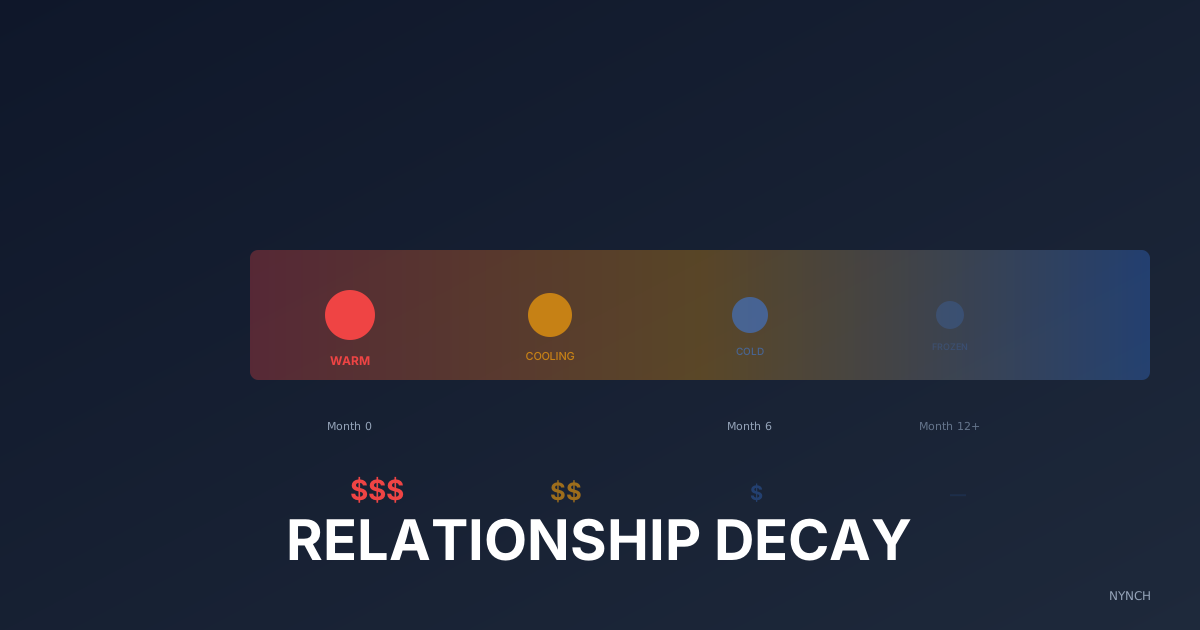
Month 6: Emotionally complete. They have moved on. They are thinking “I should reach out to [someone else] if this comes up again.” They have already hired your replacement in their head.
This is not careful judgement. It is ordinary psychology. When someone does not hear from you, they often read it as “you are not interested in me.” Which makes it easy for them to stop being interested in you.
By month 9-12, if you suddenly try to re-engage, they may stay polite and still feel sceptical. “Where is this coming from? Are they just looking for work?” The relationship needs rebuilding, not a quick reactivation.
Every relationship runs on a rhythm
The model I use is simple: relationships fade relative to their own rhythm. Go quiet for longer than the relationship is used to and it starts to fade. Stay quiet and it goes dormant. Leave it long enough and it is effectively gone.
Sixty days matters because most professionals run on monthly rhythms (monthly metrics, monthly planning, monthly board meetings). Miss one full monthly cycle and you are off their radar. Miss two (60 days) and someone else has often taken your place in how they think about help.
The asymmetry is the point. A dormant relationship that takes hours of careful rebuilding to reactivate could have been maintained with an occasional ordinary message. Neglect costs many times the effort of maintenance.
Staying in touch is about eight times cheaper than trying to resurrect a relationship later.
The Math of Dormant Value at Risk
Run the numbers on your own network.
Assume you have 200 professional contacts: people who have hired you, referred clients to you, or look like the kind of person who might engage your services. Say your average revenue per activated contact is $25,000 per year (a project, a retainer, or a referral that turns into paid work). The range is wide. Use that only as a baseline.
Your total network value on that model is 200 × $25,000 = $5 million in theoretical value.
If 60 per cent of your network is dormant (no contact in six months or more), that is 120 people in the dormant category.
Dormant Value at Risk = 120 × $25,000 = $3 million.
Not all of that comes back. A realistic reactivation rate is probably 20-30 per cent if you reach out with a real reason and a clear offer of value. Some contacts have left your market. Some already work with competitors. Some have simply aged out of relevance.
Put your own recovery rate on it. Even a cautious one, applied to 120 dormant relationships at your average engagement value, lands in six figures. Run the numbers with your own inputs.
That is revenue on the table because nobody picked up the phone.
And that is a conservative sketch. If your average engagement is higher (and for many consultants it is), or your contact base is larger, the figure grows quickly.
The Dormancy Cascade
Not all silence is equal, which is what makes this worse.
You have tiers. Some people are actively engaged (contact in the last 60 days). Some are recently dormant (60-180 days). Some are deeply dormant (six months or more). Some are effectively archived (a year or two and up).
The further down that cascade you go, the harder reactivation gets. The damage is worse than linear.
When you neglect one relationship, you often neglect a cluster. If you are not in “staying in touch” mode with one client, you are probably not in that mode with several. Dormancy compounds. As your active base shrinks and your dormant base grows, the system frays. Warm referrals slow. You miss promotions and company changes. You stop catching opportunities early.
Then, when you finally reach out, enough time has passed that the person has moved on. One cold conversation could have stayed warm if you had stayed present. After a year of silence it becomes a cold note that gets “nice to hear from you, but I’m good right now.”
Three Ways to Stop the Bleeding
The fix is simple in concept and hard in practice. You need a habit that stops dormant relationships getting worse, and a deliberate plan to reactivate the ones worth saving.
1. Create a relationship review rhythm. Pick one day per month (the first Monday works for many consultants). Spend 30 minutes on your active contact list. For each person, ask: when did I last connect, and is it time to reach out? If it has been more than 60 days and they are high value, they get a touch this month. No excuses, no overthinking. A message, a call, or a coffee.
2. Build a reactivation list. Pull the 20-30 people in your recently dormant bucket with the highest reactivation value. Former clients who paid well. Referral sources you like. People in your target market you want to work with again. Write a specific reason to reach out to each. Not “catching up,” something real: a job change, a company milestone, industry news, a concrete way you can help. Schedule them across the next 90 days. About three per week.
3. Set up signals so you are not relying on memory. You will not remember who changed jobs or started a company without help. Use LinkedIn alerts for key contacts, or a tool that surfaces job changes and company news. When a signal arrives, that is your reason to reach out. It feels natural, it feels timely, and it works.
The Compound Effect of Staying Connected
Here is the upside most advisors underrate.
If you keep light contact with 150 people (even once every 90 days) and you reactivate just 10-15 dormant relationships a year on purpose, you lock in recurring revenue and referral flow.
That is not luck. That is a system.
Your network becomes an asset instead of a vague obligation. You stop wondering who to contact because the system tells you. You stop missing opportunities because you notice what is changing in people’s lives. You stop losing revenue to dormancy because you are not silent for a year at a stretch.
The cost of running that system is small. Even an hour a week is 52 hours a year. Price those hours at your own rate and set them against the dormant value you just calculated. The return is obvious.
The only real question is whether you will build the habit and keep it.
Read next
- The client command centre, the dashboard consultants actually open every morning to spot risk and expansion early.
- 5 Ways To Spot Adjacent Problems And Naturally Expand Your Scope By 20%, The easiest sale is to an existing client.
- Nynch for fractional leaders, how fractional CFOs, CMOs, and COOs build proactive pipeline, protect against cancellation and create more value for clients.