Skip to content
Product overview
Explore all 15 product areas1. Services and Offer2. Ideal Client Profile3. Find Prospects4. LinkedIn Network5. Relationship Management6. Relationship Intelligence7. Value Audits8. Personalised Outreach9. Authority and Content10. Meeting Intelligence11. Pipeline and Opportunities12. Proposals13. Deal Rooms14. Client Management15. Grow Existing Accounts
Today and AssistSell your business
Use cases Pricing In Person Workshop Resources Sign in Book a call
← Back to changelog
New

See the reason to get in touch, with its source

The shared Signals panel brings company and contact signals into one place, with clear actions for evidence you have used or want to dismiss.

Release note added 30 October 2026. Screenshots show the current demo app.

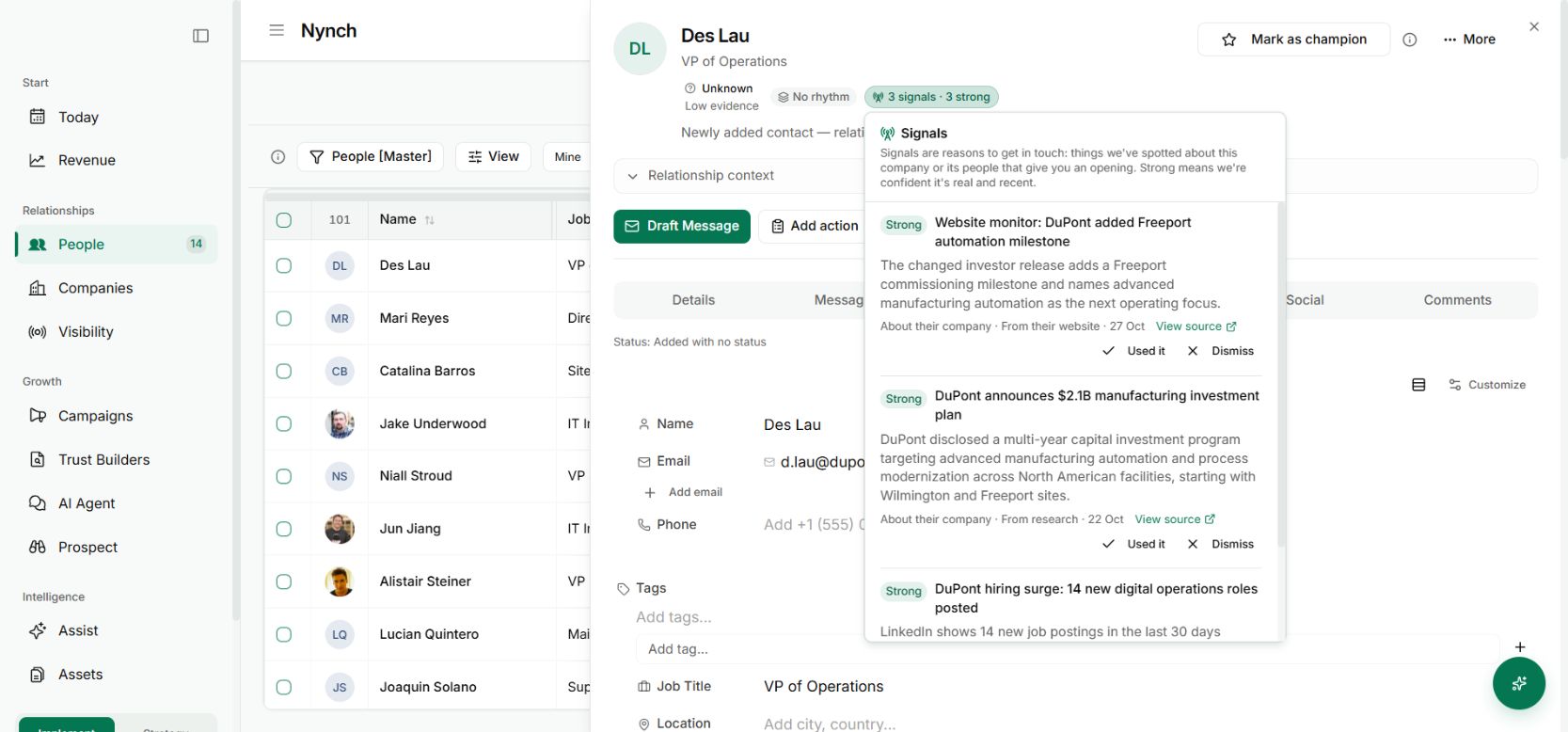
Contact signals panel with source links and used or dismiss controls
The signal panel shows the reason for an alert and where it came from. Demo workspace with illustrative data. Open the image to see it full size.

“Something changed at this company” is only useful when you can see what changed and whether it matters to your relationship.

The change

Signals now use a shared source across records, lists and counts. On the contact record, the signal indicator opens the evidence, its origin and the available actions.

You can inspect a source link where one is available, see whether the information concerns the person or their company, and mark a signal as used or dismiss it.

Put it to work

Open a contact with signals and read the panel before drafting a message. Follow the source, check the date and decide what it could mean for the work you do.

Keep the distinction between evidence and interpretation. A new hire or investment announcement may justify a question. It does not prove an approved budget for your service.

Why it is useful

You have a clearer basis for choosing who to contact and what to ask. The useful observation stays close to the relationship instead of becoming another disconnected news alert.

After you use the signal, record that action so you are not repeatedly treating the same announcement as new.

Read several signals as context, not a verdict

A role change, a recent reply and a website update can point to different next actions. Open the underlying evidence before combining them into a story about the buyer.

If the person has changed companies, check the current employer before using old account information. If they replied, read the reply before treating another external signal as more important. The useful output is the next question or action you can explain.
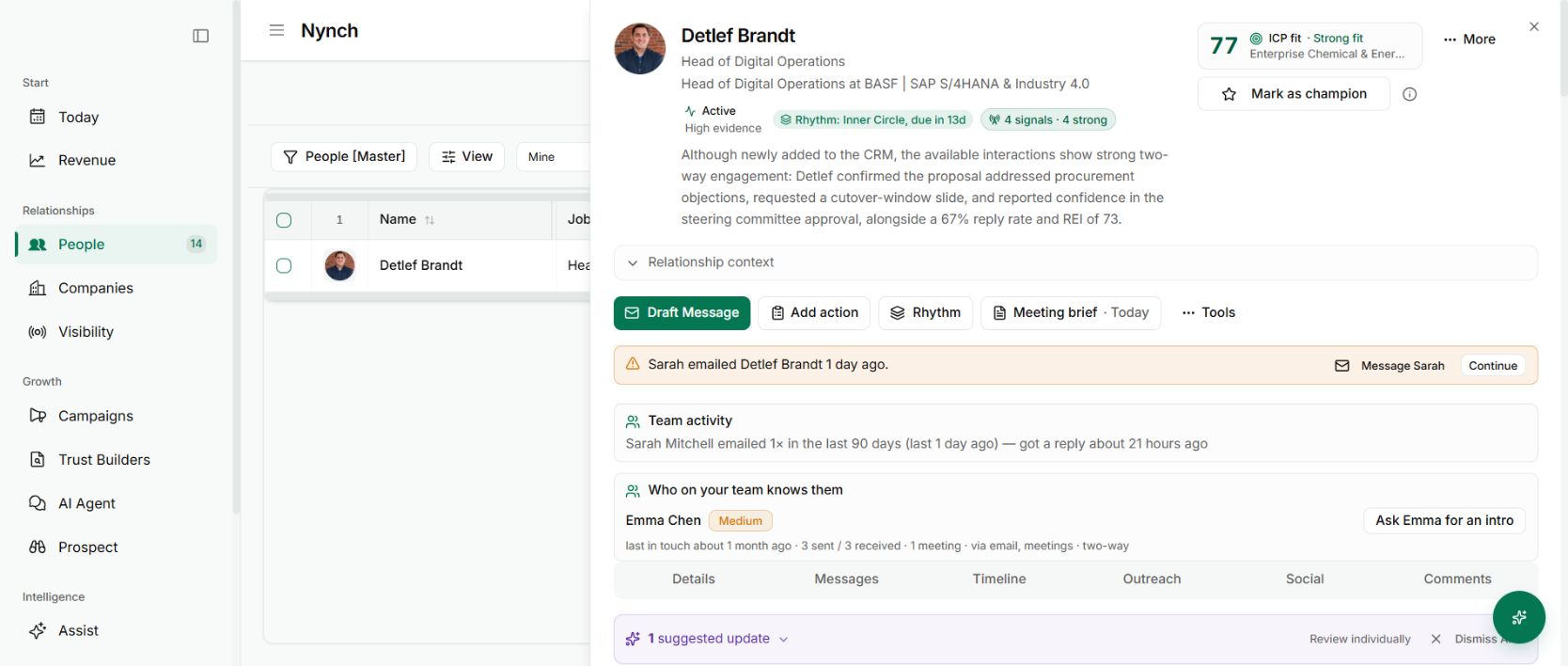
Team relationship evidence on the same contact record
Bring a signal back to the relationship and coordinate with colleagues before acting. Demo workspace with illustrative data. Open the image to see it full size.
See it for yourself

See Nynch from start to finish

The complete walkthrough: 28 minutes, every screen. Or pick the part you need.

Choose where to start

Chapters Jump to any partHide chapters
  1. Why relationships win the work
  2. A memory that thinks
  3. Every contact arrives already researched
  4. Your inbox, with intelligence
  5. Arrive prepared, every time
  6. A network that never goes cold
  7. Personal outreach, at scale
  8. Campaigns, run with AI agents
  9. Turn conversations into signed work
  10. The procrastination beater
  11. Your AI partner, on every screen
  12. Build the network you do not have yet
  13. Part two: build the foundations
  14. Name the problem, and prove it
  15. Know exactly who you serve
  16. Sell outcomes, not hours
  17. Stand for something
  18. Get the right clients coming to you
  19. Now watch it all work

See this working for your business

Bring a real relationship or opportunity. We will show you where Nynch can help.

Book a call

30 minutes. On your real data. Not generic slides.