Tom Searcy’s Whale Hunting framework was built for sales teams chasing huge enterprise deals. Most of it adapts well to solo consultants chasing one or two transformative clients a year, the kind that 5x or 10x your typical engagement value. The translation is not perfect (the team-role phases collapse into you), but the core holds. This is the primer for solo consultants who want to add Whale Hunting without abandoning normal engagement work.
You close a £50K engagement and wonder what it would take to land a £500K one. The answer is not more outreach. It is a different process. Most solo consultants run one sales motion: warm referrals come in, you talk, you scope, you sign. That motion works for normal-sized work and breaks for transformative ones. Whales (deals 5-25x your typical) do not arrive as random referrals. They come from disciplined, multi-quarter pursuits. The reason most solo consultants never land one is rarely capability. It is that they never run a process built for that size of deal.
If you have been living on referrals for three years and engagement values have plateaued, the ceiling is usually not delivery quality. It is the absence of a deliberate hunt for the one or two deals that would change annual revenue. Waiting for the whale to walk in is not a strategy. Pursuing one or two over the next 12 months is.
1. Define your whale criteria
Whales are not just big logos. The right whale for you depends on engagement size, strategic fit, and whether the decision cycle fits your delivery capacity. A £500K engagement that needs you embedded full-time for six months is useless if you are trying to keep three other clients.
The criteria need to be specific. Minimum buyer revenue (often around 10x your normal client minimum). Minimum engagement size (5-25x your typical). Strategic fit (industries you can credibly serve at that scale). Decision structure (committee, CEO, procurement?).
Searcy’s principle: write the criteria down before you start, because mid-pursuit you will be tempted to lower them. The whales you abandon halfway teach you what your real criteria are.
Example: your typical engagement is £40K with founder-led companies under £5M revenue. Whale criteria might be target companies at £20-50M revenue, engagement size £200-500K, decision via founder plus COO plus board approval.
Write your whale criteria on one page. Four sections: buyer revenue range, engagement size range, industry fit, decision structure. About 30 minutes.
2. Build a target list of 10-15 whales
The instinct is to cast a wide net. The framework collapses if you spread thin. Pick 10-15 specific companies that meet your criteria, and commit to working all of them in parallel for the next 12 months. The shortlist is the discipline.
Searcy’s research suggests 10-15 because it is small enough to work each one seriously, and large enough that timing variance does not kill the year. Some will close in month 6, some in month 18, some never.
Targets should be named companies, not segments. “Mid-market manufacturing” is a segment. “Acme Industries, Beta Manufacturing, Charlie Components” is a target list.
Example: your criteria narrow to UK-based industrial manufacturers at £20-100M revenue. You research and identify 12 specific companies. That is your target list for 2026.
Use Crunchbase, LinkedIn, or industry directories to identify 12 specific companies that meet your whale criteria. Save the list. Do not pursue any of them until you have completed step 3.
3. Map the buying committee for each target
For every target, identify the 6-10 stakeholders involved in a decision your size. Searcy calls this the swim-lane analysis. The roles are economic buyer (budget authority), technical buyer (evaluator of your work), champion (internal advocate), and influencers (people who shape opinion without holding budget). Power Base Selling makes a similar point: large deals fail when sellers focus on whoever answers the email rather than the actual decision-makers.
Without the map, you sell to the person who replied first, which is almost never the decision-maker. With the map, you can engage each stakeholder properly and see the political dynamics that decide whether the deal lands.
Example: at Acme Industries, the buying committee for your engagement is the founder, the CFO, the COO, two department heads, and the chair of the audit committee. You map all six.
For your top 3 targets from step 2, use LinkedIn to identify the 6-10 likely stakeholders. List them with role, seniority, and any existing connection you have. About 90 minutes.
4. Find or build a champion
Every whale needs an internal champion: someone inside the target who actively advocates for hiring you. The champion is the most important variable in whale outcomes. No champion, no whale.
Two paths. Find a champion already inside the target (a former colleague, a warm referral, a connection from an industry event), or build one through patient relationship work over months. The build path is slower and is where most solo consultants give up. Three to six months of relationship-building before any commercial conversation is normal for whale pursuits. It feels glacial next to standard consulting sales.
The champion’s job early on is not to fight for you in committee meetings (that comes later). It is to give you the inside view of priorities, politics, and timing. With that view, you write proposals the committee cannot easily dismiss. Without it, you are guessing.
Example: at Acme, your champion is the head of operations you met at a trade conference 18 months ago. You have been quietly building the relationship through monthly coffees and one shared LinkedIn thread.
For your top 3 targets, identify a candidate champion. If they already exist as a warm contact or mutual connection, schedule a non-commercial coffee within 30 days. If they do not, identify the right person and start the relationship work now. This is a 3-6 month motion.
5. Run the 9-phase Searcy process or your adapted version
Searcy’s full nine phases include team roles (Harpooner, Shaman, Chief) that do not map cleanly to solo consultants. The adapted version for one-person practices is roughly: target, research, champion-build, multi-stakeholder map, proposal, deliver, expand. Run the same target through the same sequence over 6-18 months.
The whale lands when champion, budget, timing, and scope all align, not before. Most solo consultants force one of those variables early (proposing scope before timing is right, or pushing for budget before the champion is in place) and lose the whale.
The discipline is patience. The whale moves through the company’s calendar at the company’s pace, not yours. Your job is to be present when the four variables line up.
Example: you have been working Acme for 11 months. The champion is in place. The CFO recently flagged a £400K budget for operations transformation. You finally write the proposal. It lands in month 14.
For your top 3 targets, write down which phase you are in and what specifically needs to happen before the next phase can start. Review monthly.
How Nynch Helps You With This
Whale Hunting is a long-cycle relationship motion across multiple stakeholders. The system that supports it has to track relationships, surface signals, and remember context over months and years. Sales-pipeline CRMs are the wrong fit. Their data model treats a long pursuit as a deal stuck in a stage.
Network organisation around target accounts. Nynch tracks each whale target as a named account with all 6-10 stakeholders mapped, plus the champion designation. The Path Finder feature surfaces warm-introduction routes you might have missed.
Champion change detection. Career Move alerts catch when one of your whale champions moves role. Sometimes that is good (they got promoted into the budget seat). Sometimes it is bad (they left and you are starting over). Either way, you find out within minutes.
Long-cycle relationship maintenance. Nynch automatically flags when a whale champion has gone quiet past the relationship’s usual rhythm. Whale pursuits die from neglect more often than from rejection.
Built-in methodology support. Whale Hunting is one of the five sales methodologies built into Nynch, alongside FIELDS, Sandler, BuyerSphere, and Power Base. The CRM understands the framework you are running.
If you are pursuing one or two whales right now without a system for the long cycle, book a walkthrough. I will show you how Nynch tracks a whale pursuit on a live account.
Once you have landed your first whale, the next move is systematically expanding the relationship into the rest of their network.
Read next
- The intent radar, exactly who to call today, read buying signals so your pipeline runs on intent, not guesswork.
- The 3 Biggest Mistakes Consultants Make When A Contact Goes Silent (And How To Fix Them), Silence triggers anxiety which leads to bad decisions.
- The client command centre, the dashboard consultants actually open every morning to spot risk and expansion early.
Frequently Asked Questions
What is the Whale Hunting framework?
Whale Hunting is a B2B sales methodology developed by Tom Searcy and described in his book of the same name. It’s specifically designed for landing huge deals (whales) that are 5 to 25 times larger than your typical engagement. The framework has nine phases including target identification, harpooner roles, and harvest planning, all built around the premise that whale deals require a fundamentally different process from standard sales.
Can a solo consultant use Whale Hunting?
Yes, with adaptation. The original framework assumes a small sales team. For solo consultants, the framework adapts well to landing one or two transformative clients per year (consultants who 5x their typical engagement value via one big client). Phases like target identification, champion building, and stakeholder mapping translate directly. The team-role phases (Harpooner, Shaman, Chief) collapse into the consultant playing all three.
What size deals qualify as whales for a consultant?
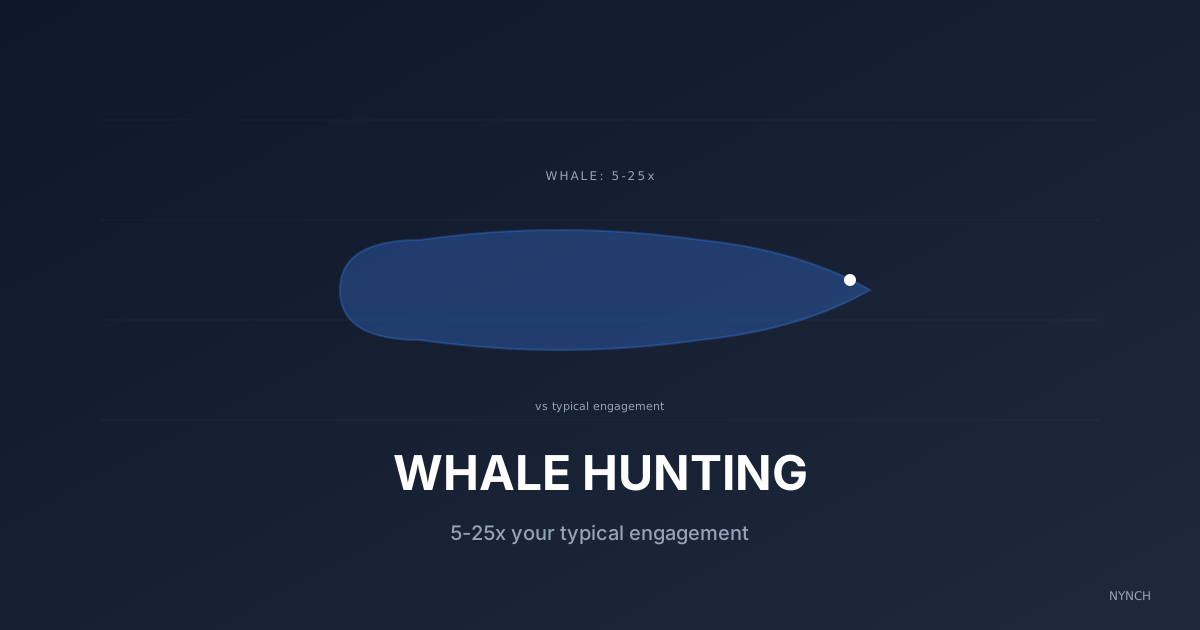
Whales are deals 5 to 25 times your typical engagement. For a solo consultant whose average engagement is £30K, whales start at £150K. For one whose average is £75K, whales start at £375K. The exact threshold matters less than the principle: a whale is large enough that landing one materially changes your annual revenue.
How long does a Whale Hunting cycle take?
Six to 18 months from target identification to closed deal. The longer cycle is one of the framework’s hardest disciplines because solo consultants are usually under pressure to close anything available. Whale Hunting requires holding capacity for the long-cycle pursuit while running normal-engagement work in parallel.
What’s the difference between Whale Hunting and traditional consulting sales?
Traditional consulting sales is reactive and relationship-led: a referral comes in, you have a conversation, you scope, you sign. Whale Hunting is proactive and target-led: you identify the specific company you want, build a strategy to penetrate it, and execute over 6-18 months. The two approaches are complementary: most consultants need both, with traditional sales running the bread-and-butter pipeline and Whale Hunting reserved for one or two transformative pursuits per year.