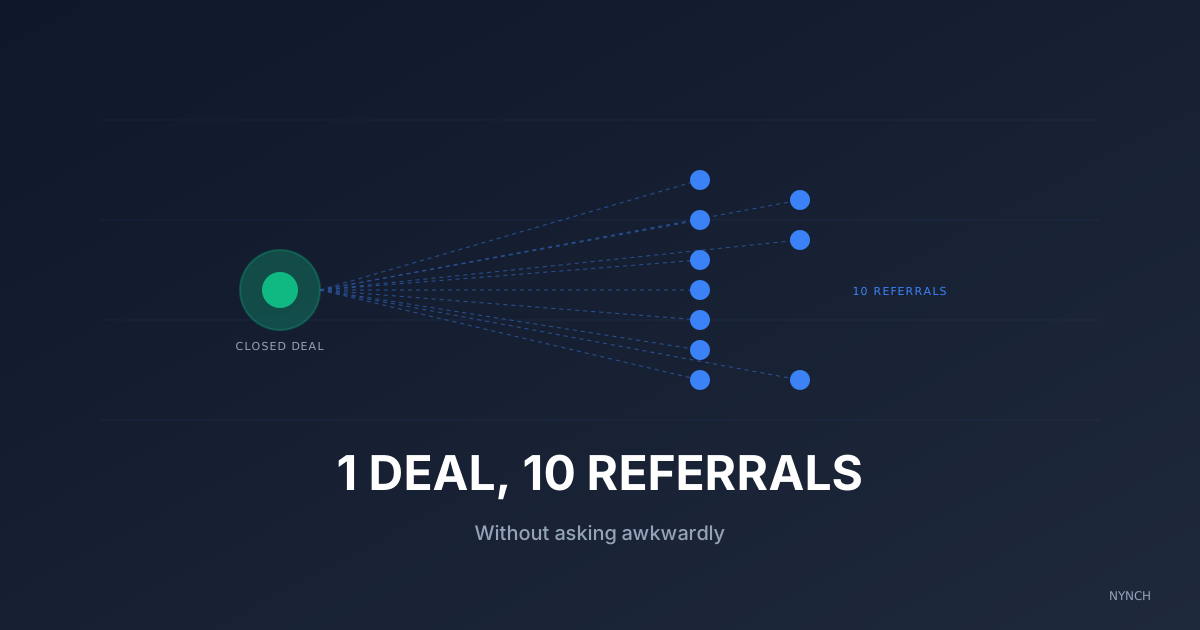
The strongest moment in a consulting engagement for asking for referrals is also the moment most consultants miss it. A four-step system makes referral generation systematic without making it feel transactional. Most consultants without a system get 1-3 referrals per year. With a system, the same engagement volume produces 15-25 referrals annually.
You deliver a great engagement and leave without ever asking the client who else they know who’d benefit. It happens to most consultants. The work feels too good to interrupt with what feels like a sales ask. The relationship feels too valuable to risk with what might come across as transactional. So the engagement ends, you move on, and the client moves on, and the network of warm contacts they could have introduced you to never materialises.
If you’re finishing 10+ engagements a year and getting fewer than 5 referrals from them combined, you’re leaving the cheapest growth channel you have on the table. The referral network of your existing clients is, on average, 50-150 contacts each, of whom 5-15 are direct fits for your work. Across 10 closed engagements, that’s 50-150 warm potential introductions you have access to and aren’t accessing.
You don’t need referrals to show up uninvited. You need a four-step system after every closed engagement.
1. Wait for the satisfaction moment
The mistake most consultants make is asking for referrals on a calendar schedule (end of engagement, every quarter, and so on) rather than at the natural emotional moment.
The right moment is when the client has just expressed satisfaction in their own words: a delivered milestone they’re happy with, a positive email saying “this is great”, a verbal acknowledgement in a meeting. That moment passes quickly. If you ask within 24 hours of it, the conversation flows naturally. Ask three weeks later and you’re trying to recreate the moment artificially.
The discipline is recognising the moment when it happens. Most consultants miss it because they’re busy with the next deliverable. The fix is paying explicit attention.
Example: you delivered a strategic review last Thursday. The client emailed you Friday morning: “Really helpful, thank you. Going to share with the team.” That email is the moment.
After every milestone delivery, watch for the satisfaction signal in the next 7 days. The signal might be a positive email, a verbal acknowledgement, an unsolicited “this is great.” When it lands, immediately schedule a 20-minute conversation to debrief the engagement. The referral conversation happens during that debrief.
2. Ask for the introduction, not the contact
The framing of the ask matters more than the content. “Can I have their email?” puts the client in gatekeeper mode and makes them think about whether to give you access. “Who in your network would benefit from this same work?” puts them in advocate mode and makes them think about who to help.
Same outcome wanted, different psychological positioning. The first frame asks for permission. The second invites collaboration.
Example: you’re in the debrief call. You ask: “This kind of work seems to have hit something specific. Who else in your network is dealing with the same problem?” The client thinks for 30 seconds and names two people.
Before the debrief call, write the question down: “Who in your network would benefit from the same work?” Use it word-for-word. The specific phrasing matters. Do not paraphrase to “do you know anyone who might be interested in our services”, because that’s the gatekeeper frame.
3. Provide a draft message they can copy-paste
When the client names two contacts, the ask isn’t done. The introduction still has to happen, and most introductions die at the “I need to compose an introduction email” step because that takes 10 minutes the client doesn’t have.
The fix is sending the client a 4-sentence draft they can copy-paste. Write it from their perspective. Their work drops from “compose an introduction” to “forward this if you’re happy.”
Sample draft (sent to the client after the call):
Hi [Friend], Wanted to introduce you to [Consultant], who just helped us with [specific outcome]. They work with [type of company] on [type of problem]. Thought you’d find them useful given [specific thing about Friend’s situation]. They’re at [email]. Happy to share more if useful.
The drop in friction is what determines whether the introduction actually happens. According to research on referral mechanics from Influitive, introduction emails that the introducer has to compose from scratch happen roughly 30% of the time. Pre-drafted versions happen 70-80% of the time. Treat those figures as directional industry estimates rather than a clinical finding for consulting specifically.
Example: after your debrief, you send the client a follow-up email containing two pre-drafted introductions for the two contacts they named. Both go out within 48 hours.
Build a template for your introduction-draft email. Customise the [outcome] and [problem] fields per engagement. Send within 24 hours of any debrief where referrals are named.
4. Follow up the introduction with personal value
When the introduced contact replies to the warm intro, your first message back is not a sales pitch. It’s a useful piece of value: a relevant article, an introduction to someone they should meet, a one-paragraph perspective on their stated problem.
The reason this matters is that the introduced contact is not yet sold on you. They’re sold on the trust of the referrer, which is why they replied at all. Your job in the first message is to demonstrate that the trust was warranted by being immediately useful before being commercially relevant.
The first commercial conversation happens in message 2 or 3, after value has been demonstrated. Trying to compress that into message 1 wastes the warm introduction.
Example: the introduced contact replies: “Thanks for the intro, happy to chat.” Your first reply: “Likewise. Before we set a call, here’s a quick perspective on the problem [referrer] mentioned: [3-sentence observation]. Useful?”
For your next 5 introductions, write down what specific piece of value you’re going to lead with for each. Don’t pursue the call until value has been delivered.
How Nynch Helps You With This
The four-step system depends on accurate timing (catching the satisfaction moment), tracking introductions across many engagements, and remembering context across years for relationships that develop slowly. Manual tracking breaks down past 10 active engagements. Nynch is the AI CRM for consultants and fractionals who win high-value deals based on relationships, so this is the kind of continuity work it was built for.
Engagement health tracking. Nynch’s Client Command Centre tracks per-client engagement signals and surfaces the satisfaction moments automatically. Positive email patterns, milestone deliveries, and explicit satisfaction signals all surface as triggers for the referral conversation.
Referral tracking. Each introduced contact is a relationship in its own right. Nynch tracks the full network including referrers, with explicit links between the introduction and the source.
Long-cycle relationship continuity. Some referrals develop into work in 30 days. Others take 18 months. Nynch tracks every long-cycle relationship against its own contact rhythm, so referrals don’t go cold during the build phase.
Champion tracking on referrers. When the client who referred you changes roles, Career Move detection surfaces the change. Sometimes a champion’s move is bad (you’ve lost an internal advocate). Sometimes it’s an opportunity (your champion is now at a new company).
If you’re running 10+ engagements a year and want to systematise referral generation, book a walkthrough and I can show you the per-engagement referral view.
The next move after building the referral system is running a Whale Hunting motion alongside it, because the strongest growth combines referral-driven inbound with deliberate target-led pursuits.
Read next
- The intent radar, exactly who to call today, read buying signals so your pipeline runs on intent, not guesswork.
- 3 Ways To Retrieve Relationship History Instantly To Walk Into Any Call Sounding Like A Genius, Stop bluffing your way through client calls.
- The client command centre, the dashboard consultants actually open every morning to spot risk and expansion early.
Frequently Asked Questions
When is the best time to ask for a referral?
Right after a delivered milestone where the client just expressed satisfaction in their own words, ideally over email or in a meeting where you have written record of their satisfaction. Not at the end of the engagement (too late, they’ve moved on), not in the middle of crisis-resolution (wrong emotional moment), and not as a generic ask out of context (feels transactional).
How many referrals should I expect per closed engagement?
1-3 quality referrals per closed engagement is realistic. Some clients give zero. A few give 5+. The variance is huge. Across 10 engagements over a year, expect 15-25 total referrals if you have a system. Without a system, most consultants get 1-3 referrals total per year, which is roughly an order of magnitude lower.
What’s the conversion rate from referral to closed deal?
Roughly 30-50% for warm referrals where the introducer makes a personal handover. Down to 10-15% for cold referrals where you’re given a name and an email. The introduction quality matters enormously. A good referral with a 30-minute warm handover converts at 5-10x the rate of a name-and-email referral.
How do I ask for a referral without making it awkward?
Three rules. First, ask after a satisfaction moment, not as a generic request. Second, ask for the introduction, not the contact details. Third, give the client a draft message they can copy-paste so the work for them is zero. The awkwardness usually comes from making the client do work. remove the work and the ask becomes natural.
Should I ever offer financial incentives for referrals?
Almost never for B2B consulting. Cash incentives change the relationship from “professional courtesy” to “commercial transaction” and most senior buyers find it slightly distasteful. The exception is a structured affiliate program with explicit terms (5-10% of first-year fees, capped, declared upfront) for partners whose business model is referrals. For one-off client referrals, no money.