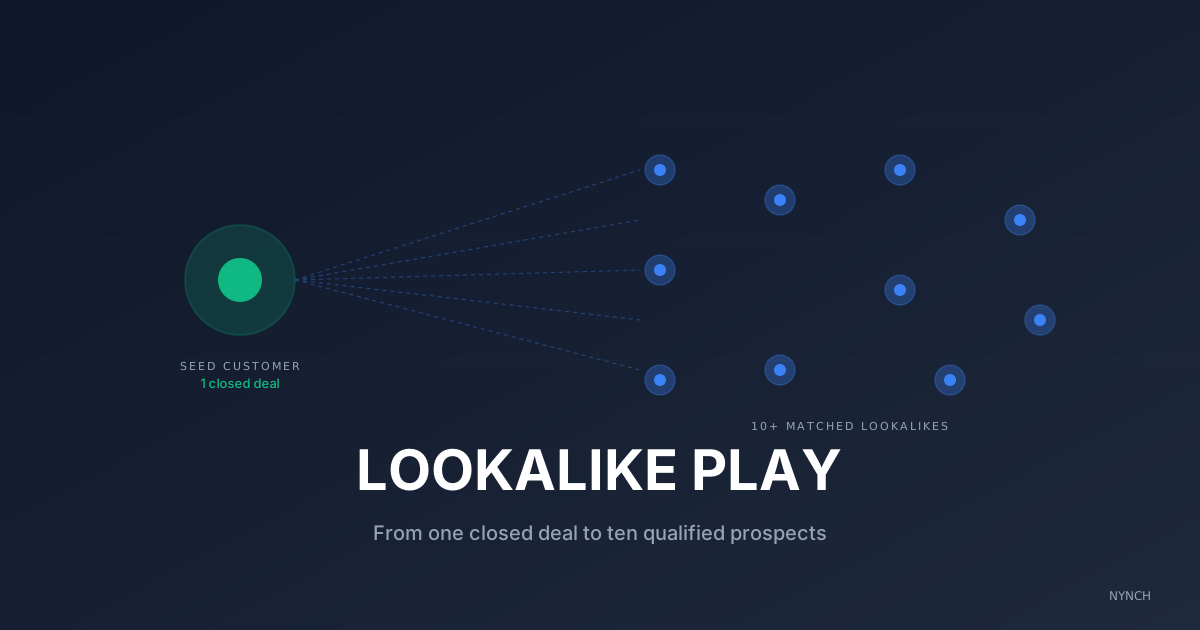
The customers you’ve already won are the highest-quality signal you have of who else will buy. The play that converts that signal into more conversations, the lookalike play, is the single most underused growth tactic in consulting. The numbers are hard to ignore. Research compiled by the Harvard Business Review consistently shows existing-customer references are the dominant driver of B2B service-firm growth. The reason the play stays unused is operational, not strategic. The manual workflow takes six hours per closed deal.
You’ve closed a great client and thought “if I had ten more just like them, I’d be set.” The instinct is correct. The customers you’ve already won share something specific (industry, size, life stage, technographic stack, recent events that opened a buying window) that made you a fit. Other companies that share the same profile are dramatically more likely to convert than cold names. The credibility of “I did this for [closely-comparable firm]” is a door-opener no cold pitch can match.
If you have closed even two great clients in the last year and never ran the lookalike play on either of them, you are leaving the strongest growth move on the table. The play exists. The data exists. The reason most consultants skip it is the six hours of admin per deal, which always gets bumped to “next week” and never happens.
You can run the whole thing by hand in about fifteen minutes on a Friday afternoon once you stop treating it as a research project. Here is the play, step by step.
1. The “Pick The Best Seed” rule to get the highest-quality lookalikes
The output of a lookalike play depends entirely on the seed. Pick a mediocre customer and you’ll source mediocre names. Pick your best (highest contract value, longest retention, strongest advocate) and the lookalike list will be loaded with high-fit candidates. This is the principle Meta’s lookalike audiences built a billion-dollar business on: take a real seed and find statistical matches, rather than guessing which traits matter.
Most consultants default to “whoever I closed last quarter” because that customer is freshest in mind. That’s a mistake. Lookalikes off your best customer convert at multiples of lookalikes off your average one. In my experience the difference is roughly 5% versus 15% conversion on the resulting outreach (an estimate from running this with consultants, not a published study). Same workflow, very different outcomes.
Say you closed three deals last year. The first was a £15K project that ended messily. The second was a £75K engagement that renewed twice. The third was a £30K stalled pilot. Only one of those is a seed worth building a list from.
Make a list of your best 5 closed customers ranked by contract value, retention, and advocacy. Star the top one. That’s your seed for this quarter’s lookalike play. Don’t substitute “more recent” for “better.”
2. The “Three-Variable Profile” definition to focus the search
Lookalike searches that try to match on too many fields produce zero results. Searches that match on too few produce thousands of irrelevants. The trick is to identify the three variables that most distinguished your seed customer from the rest of your CRM.
A three-variable profile is just three dimensions that, taken together, define the seed. The candidates are usually some combination of: industry, company size, life stage (Series A/B, post-IPO, and so on), technographic stack, geography, hiring stage, or a recent event such as funding, a leadership change, or an expansion.
Done well, you get a tight, high-conversion list. Three variables typically produce 50 to 200 candidate companies, which is the right size to filter manually.
Example: your best customer is an 80-person professional services firm in the UK that just hired a Head of Operations. Industry, headcount band, and that hiring move might be your three.
Write down three variables that defined your seed. Industry, size, and a recent buying-window event is a safe default. Run a Crunchbase or LinkedIn search using those three. Aim for a result set between 50 and 200. If it’s 1,000, your variables are too loose. If it’s 5, they’re too tight.
3. The “Customer Reference Outreach” template to convert the list
Sourcing the list is half the play. Converting it depends entirely on whether the outreach uses the customer reference correctly. A generic “I work with consulting firms in the UK” pitch wastes the asset. A specific “I helped [named customer] do X” pitch converts. Nielsen’s research on consumer trust consistently shows references are the most-trusted form of marketing in every category, including B2B services.
The template names the customer, the outcome, the timeframe, and the question. Four sentences max. Don’t bury the reference. Don’t hedge it. The reference is the credibility anchor. Everything else is friction. In practice, consultants I work with see roughly a 5x to 10x reply rate compared with generic outreach (again an estimate from real runs, not a lab result).
You sourced 60 lookalikes off your seed customer Acme Co. You’re about to send the first round. Use this template, customised per recipient:
“Hi [First Name], saw [your company] and the work on [recent initiative]. I helped [seed customer name] do [specific outcome] in [timeframe]. Wanted to ask whether [the same problem] is on your radar this quarter. Open to a 15-minute conversation if so.”
Send to 10 candidates this week. Track reply rate.
How Nynch Helps You With This
The reason most consultants don’t run the lookalike play isn’t strategic. It’s the six hours of operational work per cycle. Nynch compresses that to fifteen minutes by automating each of the seven steps in the workflow.
The seed profile pulls automatically. Pick a closed Nynch deal and the system extracts the firmographic and behavioural profile (industry, size, life stage, signals, technographic stack) without you compiling it manually.
Matching criteria get weighted from your deal history. Superbrain uses your landed-deal pattern to determine which fields actually predict conversion for your style of winning work. You don’t have to guess which three variables matter.
Sourcing, filtering, and enrichment run in one workflow. Candidates are pulled from external data providers, scored against your ICP, and enriched with contact emails and LinkedIn URLs through a waterfall. The qualified set lands in a Nynch campaign deduplicated against your existing network.
You can run it on any closed deal in your CRM. Even one closed deal is enough to seed the play. Multiple closed deals improve targeting precision but aren’t a prerequisite.
If you’ve closed at least one deal this year and want to see what the lookalike list looks like off your best customer, book a 30-minute walkthrough. The play runs live on your data, not a sandbox demo.
Once you have the lookalike list, your follow-up question becomes how to actually start the conversations, because a list you don’t reach out to is the same as a list you never sourced.
Read next
- The intent radar, exactly who to call today, read buying signals so your pipeline runs on intent, not guesswork.
- 5 Ways To Spot ‘Invisible’ Opportunities And Add Qualified Conversations To Your Diary, Opportunities aren’t always obvious.
- The client command centre, the dashboard consultants actually open every morning to spot risk and expansion early.
Frequently Asked Questions
What is a lookalike play?
A lookalike play takes one closed customer and uses their firmographic and behavioural profile (industry, size, life stage, technographic stack, trigger events) to source other companies that match. Those companies are statistically more likely to convert than cold prospects because the signal of fit is taken from a real win, not a guess.
Why do most consultants not run lookalike plays?
Because the manual workflow takes around six hours per closed deal: pull the customer profile, define the matching criteria, source candidates from multiple databases, filter for ICP fit, find the right contact role at each, enrich emails and LinkedIn URLs, and push the qualified set into a campaign. Six hours of admin per closed deal gets dropped almost every time.
Which lookalike criteria actually predict conversion?
It varies by consultant. For some, technographic match (same software stack) is the strongest predictor. For others it’s industry + size + life stage. The only reliable way to know is to run the play across multiple seed customers and track which criteria correlate with the deals that close.
How many prospects should a single lookalike play produce?
30 to 80 qualified, ICP-scored, contact-ready prospects per closed deal. Below 30 means your matching criteria are too narrow. Above 80 usually means they’re too broad and the conversion rate will be low. The sweet spot is a list small enough to run high-touch outreach across.
How often should a consultant run the lookalike play?
Quarterly, with a different seed customer each time. Running it on the same customer repeatedly saturates the lookalike pool and starts re-targeting the same companies. Four different seeds across the year produce four diverse pipelines, each anchored on a different reference customer.