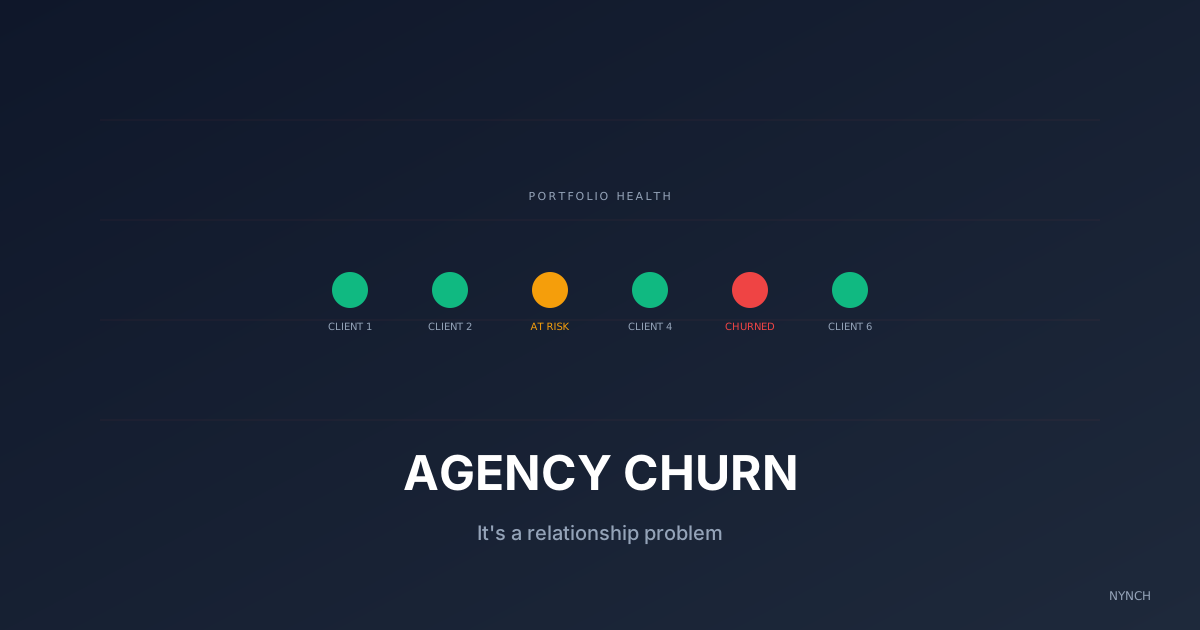
Most agency churn reviews start with delivery quality. That is usually the wrong place to look. From what I have seen across agency accounts, most client losses are relationship-driven, not delivery-driven. The original sponsor changes role. The account team turns over and continuity breaks. The strategic conversation goes quiet. By the time the agency treats it as a delivery problem, the relationship has already failed.
I have sat in post-mortems that ended with “the work was great, we just don’t know what happened.” That is not a mystery. The work looked fine because someone was tracking deliverables. The relationship was cooling because nobody was watching it. By the time the client said they were taking things in-house, six months of quieter replies, shorter meetings, and missing context had already gone past without a flag on any status report.
If you are losing clients you are confident you delivered well for, the gap is almost always there. The fix is operational, not another creative review.
Instead of running another delivery post-mortem after the next loss, run a four-part habit that catches relationship signals 60-90 days earlier.
1. Track engagement depth weekly
The strongest early warning of agency client churn is a drop in how deeply your senior contact engages. The person who signs off (CMO, founder, head of marketing) stops sending real replies and starts sending one-liners.
The shift is gradual, and easy to miss if you are not looking for it. Three months ago your senior contact wrote detailed thoughts on every campaign brief. Now they reply “looks good.” The deliverables are unchanged. The relationship is cooling.
Do a weekly pull of the last five emails from each senior client contact. Compare reply length and depth to the five from the previous month. A clear drop is your early warning. In my experience this kind of signal shows up 60-90 days before anything looks wrong in project stages or renewal dates. That window is an estimate, not a lab finding, but it is consistent enough to act on.
Take a CMO contact who has been replying to campaign briefs with one-line approvals for six weeks. Three months ago she was sending half-page strategic comments. The cooling is real even though the work is still being approved.
For your top five client accounts, pull the last ten emails from the senior contact. Compare reply depth to the previous ten. Where the depth has visibly dropped, schedule a face-to-face strategic conversation in the next 14 days.
2. Watch for executive sponsor changes
The original sponsor (the executive who hired the agency, holds the budget, owns the outcome) is the relationship that decides whether the engagement renews. When that person moves, the engagement is in danger immediately, even if day-to-day work still looks fine.
LinkedIn’s data on workforce mobility suggests senior executives have roughly a one-in-three chance of changing roles within 18 months. For an agency running ten active client engagements, that is three to four sponsor changes a year. Each one is a churn risk if you do not catch it fast.
Once a month, check the LinkedIn profile of the senior client sponsor at each active engagement. A title change, a new company, or removal of a current role should trigger a 15-minute call within the week with whoever now sits in the budget seat.
Picture the CMO who originally hired you at Charlie changing companies. Your day-to-day contact, the marketing manager, did not think to mention it. By the time you find out, the new CMO has already started reviewing agency relationships.
Once a month, open LinkedIn for the senior sponsor at every active client. Note any change in the last 90 days. For each change, schedule a 15-minute conversation with the new sponsor (or the day-to-day contact who can introduce you to them) within 14 days.
3. Make relationship context institutional, not personal
The third source of churn is account-team turnover. When a senior account manager leaves, the relationship context that lived in their head fails to transfer. Within six months, the agency typically loses one or two of that person’s clients to relationship drift.
The fix is making context institutional. Per-client running documents that anyone in the agency can read. Capture from email and calendar so the system rebuilds context from raw data rather than depending on one person’s memory. Scheduled handover conversations when account managers change accounts.
Building this costs about five hours per client once, plus 30 minutes per handover. Skipping it costs you a client every time a senior account manager leaves.
Your senior AM Sarah leaves. The new AM, James, inherits six of her accounts. With a documented relationship record, James reads the per-client docs and can lead the next stakeholder review competently. Without it, James spends four to six weeks rebuilding context from scratch and loses continuity while he does it.
4. Run quarterly strategic resets
The fourth move is a structured strategic conversation every three months per client, separate from the delivery review.
The agenda is three questions: What is working in the engagement? What is not? What should we be doing that we are not currently doing? The conversation deliberately does not focus on delivery quality (which most agencies talk about endlessly). It surfaces the expectations the client has not said out loud.
Most agencies skip this because it feels like asking for criticism. The ones that do it tend to have lower churn, because they catch unmet expectations before those become exit signals.
Bain & Company’s research on retention consistently shows that proactive relationship maintenance is a dominant variable in B2B service-firm retention. The strategic reset is that maintenance ritual. It does not depend on something going wrong first.
At your quarterly reset with Delta, you ask what you should be doing that you are not. The CMO mentions she has been wanting board-prep support but never said anything because it felt out of scope. You scope a board-prep retainer alongside the existing engagement. You expand the relationship instead of losing it.
How Nynch Helps You With This
The four-part system depends on a relationship layer that captures email and calendar continuously, surfaces signal changes automatically, and makes context institutional rather than personal. Manual tracking breaks down past five active accounts.
Engagement-depth tracking automatically. Nynch’s Client Command Centre tracks reply length, frequency, and timing per stakeholder per account. The cooling signal shows up in the dashboard rather than depending on a manual review.
Champion change detection. Career Move alerts catch executive sponsor changes within minutes. You stop discovering a sponsor moved three months after the fact.
Institutional relationship context. Every conversation, commitment, and meeting is captured into the per-client record. When an account manager transitions out, the new person inherits the full context rather than starting from scratch.
Per-account dashboards for quarterly resets. The strategic reset conversation is faster and better prepared when both sides have the per-client data in front of them.
For agencies running 10+ active client engagements, preventing even one churn typically covers the relationship-system budget. Run the arithmetic on your own retainers. Book a 20-minute walkthrough.
The next move after preventing churn is systematically expanding healthy accounts, because the strongest growth comes from existing-client expansion, not new logo wins.
Read next
- The client command centre, the dashboard consultants actually open every morning to spot risk and expansion early.
- 4 Ways To Reconnect With Former Clients And Secure High-Margin Referrals, Stop neglecting your best source of revenue.
- Nynch for fractional leaders, how fractional CFOs, CMOs, and COOs build proactive pipeline, protect against cancellation and create more value for clients.
Frequently Asked Questions
Why do agency clients actually churn?
From what I have seen across agency accounts, most churn is relationship-driven, not delivery-driven. The most common patterns are: original sponsor changes role, account team turnover breaks continuity, the agency stopped proactively bringing strategic input, and budget reallocation away from the agency’s category. Genuine delivery failures are the minority. The rest is the relationship layer.
What’s the leading indicator of agency client churn?
Engagement-depth decline is the strongest leading indicator. When the senior client contact stops sending substantive replies and starts sending one-liners, the relationship is cooling 60-90 days before it shows up as churn. Other leading indicators: declining attendance at status meetings, fewer direct asks, and shorter response times shifting to longer ones.
How does account-team turnover affect client retention?
Strongly. When a senior account manager leaves, the agency typically loses 1-2 clients within 6 months as the relationship-context that lived in the AM’s head fails to transfer. The fix is making relationship context institutional rather than personal: shared notes, automated capture, scheduled handover ceremonies. Most agencies don’t do this and pay for it in churn.
Can an agency recover a client who’s signalling churn?
Often yes, if the signal is caught in the first 30 days. The intervention isn’t more delivery (the delivery is usually fine). The intervention is reopening the strategic conversation, surfacing the un-met expectations the client hasn’t articulated, and offering a reset. Most agencies miss the window because they’re focused on delivery quality and don’t see the relationship signal.
What’s the cost of one agency client churn?
Beyond the lost retainer revenue, the agency loses months of internal capacity to recovery work (ramping a replacement client, processing the loss, managing the team morale impact). Run it on your own numbers: lost retainer months plus replacement effort plus opportunity cost puts the all-in cost of one churn at several times the headline monthly fee. Preventing one churn per quarter pays for the entire relationship-system investment.