Ask the account managers in any creative, marketing, or digital agency to track a fortnight of CRM updating and context hunting, and the answer comes back in hours per week, not minutes. For a 20-person agency with 5-7 account managers, price those hours at loaded cost and the annual hidden bill runs well into six figures. The cost is invisible because it is spread across hundreds of small tasks. The fix is an auto-capture CRM that recovers most of it.
Ask your senior AM where the conversation about Acme’s renewal stands, and watch them spend ten minutes searching emails before answering. That is not a knowledge gap. That is CRM friction. The AM has the context, but it is scattered across email threads, Slack channels, project-management notes, and CRM records that have not been updated in weeks. Reconstructing the answer takes longer than the answer itself. Multiply by fifty such queries a week, across seven AMs, and you have an agency operating well below its real capacity.
If your agency feels like it should be more productive than it is, friction is usually the reason. The CRM that is supposed to be the system of record has become the thing that slows the work down. You do not have to accept that as a cost of doing business. You can measure it and recover it.
1. Where the friction actually goes
The hidden cost has three components, in roughly equal proportion.
Pure CRM data entry. Meeting notes, contact updates, deal stage changes, follow-up tasks. About 5 hours per week per AM. The work is mostly transcribing information that already exists in email and calendar into a separate database that the team will reference inconsistently.
Context hunting. Searching past emails, finding old meeting notes, reconstructing decisions made months ago. About 3 hours per week per AM. The work happens whenever a question comes up that needs historical context, and most senior AMs face 50-100 such queries per week.
Handover overhead. When an AM is sick, leaves, or transitions accounts, the new owner spends 5-10 hours rebuilding context that should have been captured automatically. Across a year of normal turnover, this adds up to roughly 1 hour per AM per week once you amortise it.
Total: 9-10 hours per AM per week. For a senior AM at a £100/hour internal rate, that is £45K-50K per year per AM. The cost compounds across 5-7 AMs to £200K-350K for a typical 20-person agency. Treat these figures as working estimates, not a published industry benchmark. Run the same audit on your own team and the numbers will land close enough to matter.
2. Why agencies have it worse than other businesses
Three structural reasons.
Account context sits across too many tools. Most agencies use a CRM for relationships, a project management tool (Asana, Monday) for delivery, file storage (Google Drive, Dropbox) for assets, email for client communication, and Slack for internal coordination. The full picture of any account spans all five tools. Assembling that picture for a single question means checking all five.
AM-to-account ratios are high. Senior account managers typically own 6-12 active client accounts. Past about eight, the working memory required to hold each account’s context exceeds what one person can carry, and the AM starts depending on the CRM as external memory. If the CRM does not capture context automatically, the AM does the capture work by hand instead of strategic work.
Client cycles are short and dense. Agency engagements run weekly or bi-weekly cadences with multiple stakeholders per client. The volume of micro-decisions and commitments per client is much higher than in, say, fractional-executive work. Manual CRM admin scales linearly with that volume. The only way out is automation.
3. What auto-capture changes
An auto-capture CRM reads email and calendar continuously, builds contact records on its own, extracts commitments from conversation text, scores relationship health, and surfaces signals (champion job changes, declining engagement, overdue promises) without manual data entry.
That shift removes the bulk of the data-entry time. The judgement layer (strategic notes, account strategy, qualitative context) stays manual, but becomes faster when it is the only manual work left. Account managers get hours back each week, not minutes.
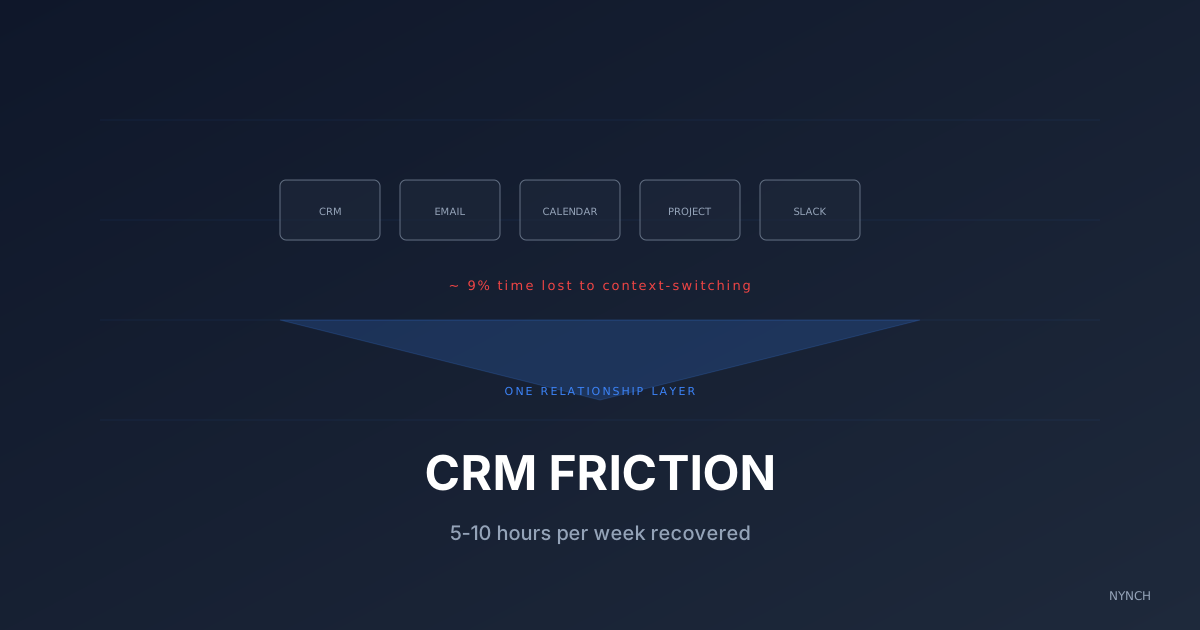
It also collapses context-hunting time. Instead of searching across five tools, the AM has one place where the relationship layer lives. Time per query drops from 5-10 minutes to under one.
Take a concrete case. An agency had six senior AMs running an average of eight accounts each. CRM admin was eating 8 hours per AM per week. After switching to auto-capture, admin time dropped to 3 hours per AM per week. Recovered capacity: 30 hours per week across the team, equivalent to a part-time strategist hire.
4. Implementation: 30 days, three phases
The shift does not require a rip-and-replace migration. Three phases over 30 days.
Phase 1 (week 1): Pick the three accounts with the most CRM friction. Connect the auto-capture system to email and calendar. Let it rebuild the relationship record from the last 12 months of communication history. Validate that the right contacts and commitments came through.
Phase 2 (weeks 2-3): Pilot the auto-capture system on those three accounts only. Other accounts stay on the old CRM. Measure AM time per account, time to answer “where does X stand?” queries, and handover quality.
Phase 3 (week 4): If the pilot shows 3+ hours saved per AM per week, roll out across all accounts. Do not try to migrate historical CRM data. Let the new system rebuild from email and calendar. Decommission the old CRM after 60 days of parallel running.
Atlassian’s research on context-switching shows knowledge workers lose roughly 9% of their day to switching between fragmented tools. For agencies, that 9% is the CRM friction tax. Auto-capture removes most of it.
How Nynch Helps You With This
Nynch is an AI CRM built around auto-capture as the primary architecture, not as a feature bolted on top of a manual system. It reads email, calendar, LinkedIn, and meeting transcripts continuously and builds the relationship record automatically.
Zero manual data entry. Contacts get created from email exchanges. Meetings get logged from calendar. Commitments get extracted from conversation text. The AM never opens a “new contact” form or types a follow-up reminder.
Cross-tool context in one view. Each account has a Client Command Centre showing relationship health, overdue promises, recent activity, and a stakeholder map. The five-tool sprawl collapses into one view.
Champion change detection. When the senior client contact at one of your accounts changes role or company, you get a Career Move alert within minutes. Before they tell you, before the deal is at risk.
Handover continuity. When an AM transitions accounts, the new owner inherits the full relationship record. The 5-10 hours of context rebuild collapses to zero.
For a 20-person agency, the typical first-year payback is 6-10x the tooling cost. Book a 20-minute walkthrough and you will see the AM dashboard on a live account.
If you are recovering AM time and looking for what to invest it in, the next move is systematic relationship expansion across existing accounts, because that is where most agencies’ growth comes from.
Read next
- The client command centre, the dashboard consultants actually open every morning to spot risk and expansion early.
- 3 Ways To Pivot The ‘Wrap-Up’ Meeting To Secure A 12-Month Strategic Extension, Don’t let your retainer expire.
- Nynch for fractional leaders, how fractional CFOs, CMOs, and COOs build proactive pipeline, protect against cancellation and create more value for clients.
Frequently Asked Questions
How much time do agency account managers spend on CRM admin?
Track it for a fortnight and the answer comes back in hours per week: pure CRM data entry, plus context-hunting (searching past emails, looking up old notes, reconstructing meeting context). Price a senior account manager’s time at your internal rate and the hidden cost per AM runs to tens of thousands a year. A 20-person agency with 5-7 AMs is carrying a six-figure annual friction bill.
Why does CRM admin take so long in agencies?
Three reasons. Account context is split across multiple tools (CRM, email, calendar, project management, file storage). Updates have to happen manually because traditional CRMs don’t auto-capture from email or calendar. And handover gaps when an AM is sick or transitions out require rebuilding context that should have been captured automatically all along.
What’s the actual ROI of switching to an auto-capture CRM for agencies?
Agencies that switch recover hours per AM per week within 60 days. Price the recovered hours at your internal rate across your AMs and set the total against the tooling cost. Run the arithmetic on your own rates before you believe anyone’s ROI multiple, including ours. It lands heavily in favour of switching.
Will an auto-capture CRM replace our project management tool?
No. Project management tools (Asana, Monday, ClickUp) track delivery work. An auto-capture CRM tracks client relationships and revenue. The two are complementary. The mistake some agencies make is trying to use Monday or Asana as a CRM, which leaves relationship data scattered across project channels and doesn’t track revenue, expansion, or churn risk.
How do I migrate my agency from a manual CRM to an auto-capture one?
Two-week process. Week 1: connect email, calendar, LinkedIn to the new system, let it auto-capture historical data. Validate that the right contacts are coming through. Week 2: run both systems in parallel for active clients while AMs adjust. After two weeks, decommission the old CRM. Don’t try to do bulk historical migration. let the new system rebuild the record from email and calendar history.