Your network is only worth what you can remember about it. If you cannot recall who you know, when you last spoke, or what they care about, that network is effectively invisible. Most consultants, advisors, and fractional executives get this wrong because they use tools built for sales teams: tools designed to move deals through a funnel, not to keep relationships alive over years.
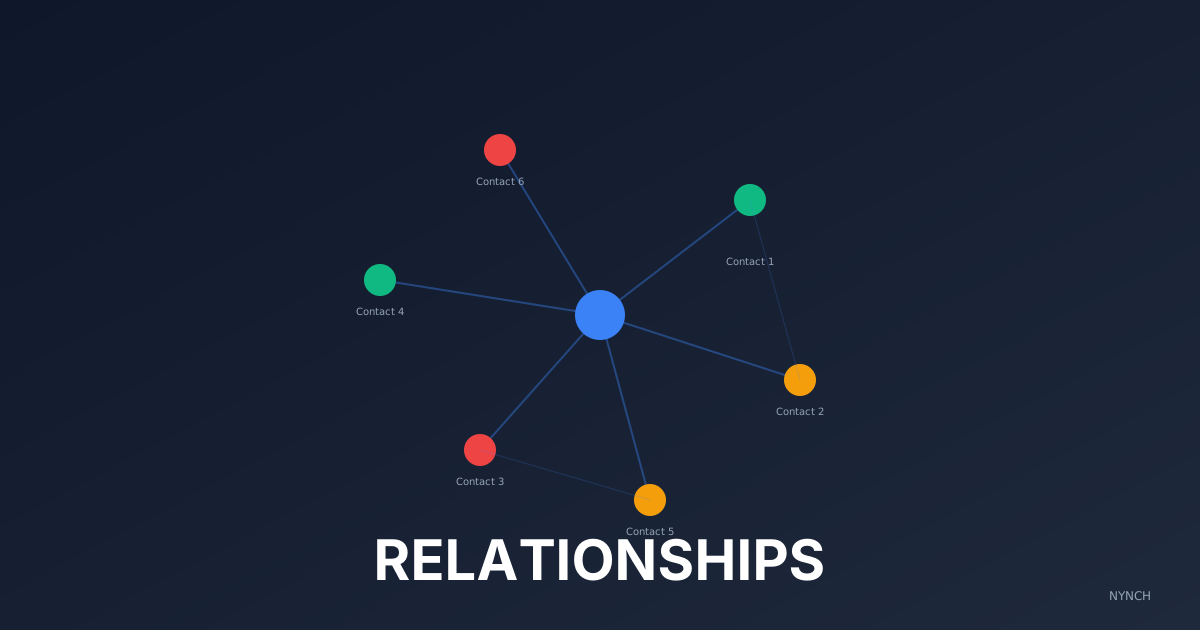
A traditional CRM assumes you work at one company, sell the same thing to many buyers, and move them from “prospect” to “customer” in months. Your world is different. You might work with five clients at once. Each engagement is unique. Relationships are how the work arrives. You need to track people, not deals. Relationship depth, not pipeline stages.
The question is not whether you need a system. You do. Most advisors with over 100 active contacts lose work because they forget to reach out. The question is what kind of system fits how you actually work.
Why Traditional CRMs Fail Advisors and Consultants
A CRM is optimised for one thing: moving deals through a funnel. It is built around the assumption that you have a sales process, a team, and a target number of deals per quarter. Every feature exists to maximise that metric.
Your work does not fit that mould.
You might be a fractional CFO serving three companies. You might be a strategy consultant with relationships that span years. You might sit on boards and get paid for staying connected. In each case, the value is not “winning” a deal this week. It is being the first person someone thinks of when a problem appears.
A CRM will ask: “What stage is this deal in?” Your honest answer is often: “There is no deal. This is a relationship I want to maintain.”
It will push you to qualify people quickly. Your instinct is to stay in touch long-term, even with people who have no immediate need.
It will measure success by revenue recorded this quarter. Your real measure is how many high-value people think of you first.
That mismatch means you fight the tool instead of using it. You build workarounds. You fall back to spreadsheets and email threads. Then you slowly abandon the system because it never helped you do the job.
The Relationship-Led Growth Alternative
Instead of organising around deals, organise around relationships. The shift is small on paper and large in practice.
A relationship-led approach starts with one question: “Who matters to my business, and how do I stay usefully connected?” Not “How do I convert them?” or “What stage are they in?” Just “How do I show up for them in a way that feels natural and valuable?”
That approach has three parts.
First, clarity on your network. You need to know who your real connections are. Not a list of 5,000 LinkedIn contacts, but the 100 to 300 people who actually matter: clients, former clients, referral sources, collaborators, people you have helped before. These are the people who generate your revenue and referrals. You should be able to see this list clearly, see when you last connected with each person, and know what is going on in their world.
Second, signal detection. When someone’s situation changes (a job move, company news, a new role), you should know about it. Not because you are stalking them, but because you decided, on purpose, that this person is worth staying aware of. Then the signal gives you a natural reason to reach out. “Hey, I saw you moved to TechCorp. Congrats. I’d love to catch up” feels genuine. “Hey, been a while, how are you?” feels like you forgot them.
Third, intentional cadence. Different relationships need different rhythms. A current client needs attention every few weeks. A past client you would like to work with again needs a touchpoint every quarter. Someone you are still getting to know may only need a check-in every six months. Instead of one follow-up schedule for everyone, you need flexibility. You need to know whose turn it is to hear from you, and have a real reason when you do.
The Three Core Tracking Elements You Need
If you are building this system yourself, whether in a spreadsheet, a tool, or a simple database, you need these three pieces of information for each relationship.
Who they are and what they do. Not just name and title, but context. What problems do they care about? What did you help them with? What do you respect about how they work? How do they prefer to communicate? Without that, outreach feels generic.
What happened and when. Every meaningful interaction gets a short record. You spoke on the phone: write a note. You sent them an article: note it. They mentioned a problem they are facing: capture it. You are not writing a novel. A paragraph or two is enough. Capture what you learned and what you said you would do next.
What has changed in their world. This is the signal layer. Did they change jobs? Start a company? Get promoted? Have they been posting about a new focus? Are they heading into a predictable pressure point (budget season, annual strategy planning, post-acquisition integration)? Those changes are your reason to reach out. Not “checking in,” but “I thought of you because…”
How to Start This Week
You do not need to overhaul everything. Start with three steps.
Step 1: Make a list of your top 50 relationships. These are the people who give you revenue directly, refer clients to you, or are the type of person who might hire you. Do not overthink it. Write them down in a simple spreadsheet or doc. One row per person. Include name, title, company, how you know them, and when you last connected.
Step 2: Add one signal column. For each person, write down one thing that is true about them right now. Do they have a new role? Are they running a big project? Did they post about something relevant recently? Is their company expanding or restructuring? That is your hook for reaching out.
Step 3: Build one month of touchpoints. Pick four or five people from your list. Write one specific reason to reach out to each. Not “catch up,” but something real. “I saw your article on pricing strategy. Want to talk about how you are thinking about that?” Or “Congrats on the new role. Would love to hear what you are working on.” Or “We have a mutual friend in the sustainability space, and I’d love to make an introduction.”
That is the foundation. Everything else, whether you stay in a spreadsheet, use a specialised tool, or move to an AI CRM built for relationship-led work, builds from here.
The Power Of Staying Connected
Here is what most advisors underweight: the time you spend maintaining relationships is among the highest-value work you can do. It is not cold outreach. It is not pitching. It is staying aware and staying present.
When you are the person someone thinks of first, you do not have to hunt for work. The work finds you.
That is what a relationship-first system gives you: the structure to turn your network from a passive list into an active asset. Not by being pushy or always selling, but by showing up, remembering what matters to people, and taking a genuine interest in their progress.
That is relationship-led growth in practice.
Read next
- Wake up your dormant network, fill your week with warm conversations from people you already know.
- 4 Ways To Know If You Are Sitting On A Goldmine Of Dormant Revenue, You are chasing cold contacts while sitting on a pile of warm ones.
- The intent radar, exactly who to call today, read buying signals so your pipeline runs on intent, not guesswork.