Most business development advice for consultants is recycled sales-team advice. Build a pipeline. Add deals to stages. Track conversion rates. Move things forward.
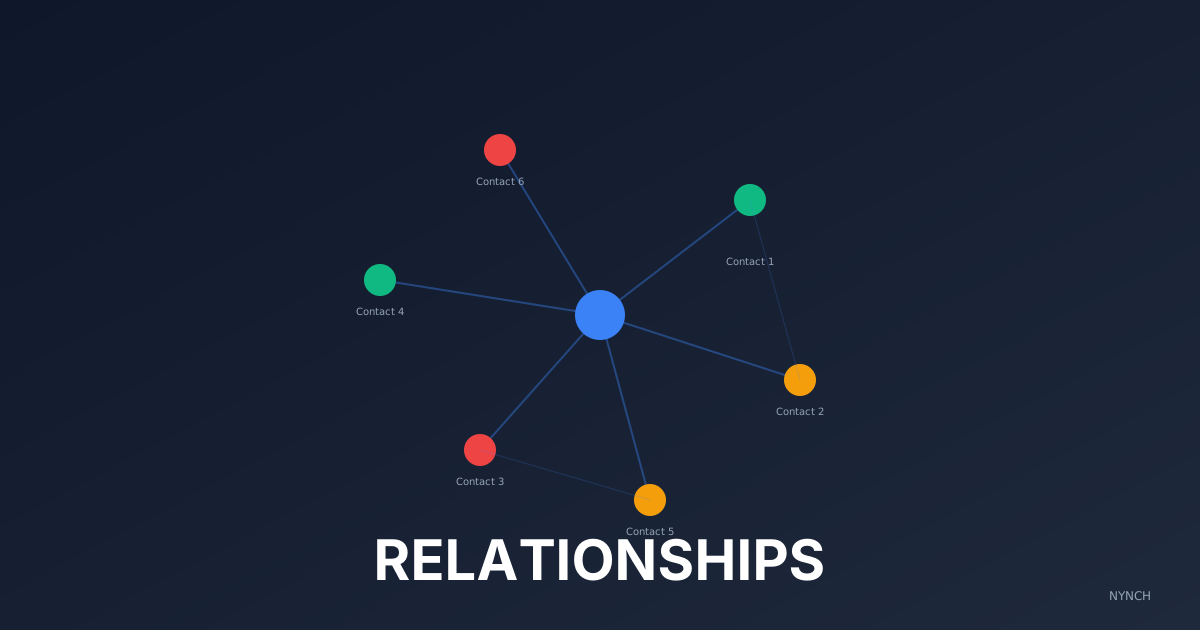
It does not work. Not because the advice is wrong for sales teams, but because consulting is not a sales-team motion. You do not have a pipeline. You have a network. The work is not moving people through stages. The work is keeping a relationship warm enough that when the moment comes, you are the obvious call.
I have watched this mismatch for years. Business development for consultants needs a different operating model. Here is what that model looks like in practice.
The pipeline metaphor breaks for consultants
Sales CRM thinking assumes high volume. You generate leads, score them, route them, sequence them, score them again, and convert a small percentage. The volume justifies the machinery.
Consultants do not operate at volume. Most independent consultants and boutique consultancies have between 5 and 60 active relationships at any given time. Those relationships pay them for years. The lifetime value of one warm relationship can be $200,000 or more.
When you apply pipeline-stage thinking to that reality, you get nonsense. You do not move a senior partner through “stage 3: needs analysis” and “stage 4: proposal sent.” You stay in their orbit so that when their CFO mentions hiring an advisor, you are top of mind. That is not pipeline work. That is relationship maintenance.
The other problem with the pipeline model is where it points your attention. It makes you focus on people who are not ready to buy yet. For a consultant, the real focus is people who already know you, already trust you, and are one event away from needing your help. Pipelines hide those people. Networks surface them.
What business development actually is
Business development for consultants is three things working together.
It is relationship maintenance. The 50 to 200 people who matter to your business need to feel that you exist. Not as a marketer. As a peer who shows up.
It is opportunity detection. People you know move jobs, raise capital, launch products, hire teams, get fired, go through rough quarters. Each of those is a signal. Sometimes it means there is work. Sometimes it means someone needs support, not a pitch.
It is timing. Most lost work is not lost because you were not good enough. It is lost because you were not in the conversation when the decision happened. The skill is being there when the moment comes, which means knowing when the moment is coming.
A real example. The partner who calls you in February when their CFO mentions hiring an advisor. Where did that call come from? Not your pipeline. Not a sequence. Not your latest content piece. It came from the lunch you had with that partner in November. That lunch was not on a sales worksheet. It lived on a map of who knows whom and how warm the link still is.
The 4 jobs of a business development platform
If pipeline tools are wrong for the consultant motion, what is right? A real business development platform does four jobs.
1. Watch the relationship graph. It tracks every contact, every email, every meeting, every commitment, and turns that into a live picture of relationship health. Who is warm? Who is going quiet? Who has not been heard from in nine months but used to be a major referral source?
2. Detect signal cascades. It watches the world outside your inbox for the events that change buying behaviour. A contact moving to a new company. A portfolio company raising a Series B. A board chair stepping down. A division being spun out. These are buying signals. Most consultants miss them because they are not looking.
3. Surface the right person to contact today. Not a list of 200 contacts. A short list of 3 to 5 people who deserve your attention this week, with the context for why. That is the job of a system that learns from your real activity over time. It tells you Jamie just changed jobs, Sarah’s company just raised funding, and Leo has not replied to your last two emails.
4. Make the outreach feel like you, not a sequence. The worst thing a consultant can do is send a copy-pasted reach-out that smells like automation. A real platform helps you write the message in your own voice with the context already loaded. You spend 60 seconds making it personal, not 20 minutes finding the context.
The shift from CRM to relationship intelligence
The cognitive shift that comes with a business development platform is bigger than the tool change.
You stop thinking about deals and start thinking about people. You stop thinking about stages and start thinking about windows. You stop thinking about quota and start thinking about decay. You stop thinking about cold outreach and start thinking about reconnection.
This sounds soft. It is not. The hardest measurable result of running BD this way is the recovery of relationships you forgot existed. The dormant partner who introduced you to three clients five years ago. The COO you helped strategise a launch with in 2022 and then never followed up with. The peer you met at a conference, connected with on LinkedIn, and never spoke to again.
Those dormant relationships are where most of the lost revenue is hiding. A platform that maps them and surfaces them recovers it.
The shift from sales CRM to relationship intelligence is also a shift in cadence. A pipeline is reviewed weekly. A network is monitored continuously. Most consultants do not have time for weekly reviews of a sales pipeline they do not really have. They do have time for a 5-minute Monday morning glance at three names that came up in the system overnight.
A day-in-the-life of relationship-led BD
Tuesday morning. Coffee. You open your platform.
Top of the screen: three suggested touches. Jamie just changed jobs from Director of Strategy at one fintech to VP of Operations at another. The system pulled the news from LinkedIn this weekend. You click once and a draft message appears. It says you saw the news, congrats on the move, and you would love to hear what drew them to the new role. It sounds like you because it is you. The system pulled phrases from your past messages. You hit send.
Below that: a relationship decay alert. You used to talk to Sarah every month. It has been 11 weeks. She is a former client who introduced you to two referrals over the years. The system suggests a no-ask check-in. You write three sentences. Send.
Below that: a signal cascade. A company you know just announced a $40 million Series B. The COO is someone you advised informally last year. Right now, they are about 90 days from needing senior advisory help on org design. You do not pitch. You congratulate. You ask one good question. You stay in their orbit.
Total time: 12 minutes. Three high-quality touches. Two of them are people you would have forgotten without the system. One of them turns into work over the next quarter.
That is what business development for consultants looks like when the operating model fits the work.
What this means in practice
Three takeaways for any consultant reading this.
Stop running a pipeline you do not have. If you have fewer than 30 active prospects, you do not have a pipeline. You have a relationship list. Treat it like one.
Start with the relationships that already pay you. The fastest revenue any consultant can generate is from a former client or referrer who has been out of touch. Map those people. Reach out without an ask. The follow-on work tends to follow.
Use a platform built for the actual motion. A CRM for consultancies that watches the relationship graph and surfaces signals beats a sales CRM you have to configure and update by hand. The right platform makes the work disappear into a 5-minute morning routine. The wrong platform turns BD into the thing you avoid.
For a deeper look at what an AI CRM should actually do, the honest test is whether it works without you logging anything. Most do not. The ones built for relationship-led work do.
The point
Business development for consultants is broken because the tools were built for sales teams. The fix is not a better CRM. It is a different operating model. Stop running pipelines. Start running networks. Watch the graph, detect the signals, show up at the right moment.
That is how consultants have always won. Relationship-led growth is the philosophy behind it. The platform exists to make the practice sustainable when you are deep in delivery and the network would otherwise go quiet.
Read next
- Wake up your dormant network, fill your week with warm conversations from people you already know.
- The Consultant’s Guide to Relationship-Led Business Development, Master the RLG Revenue Formula and discover why traditional business development tactics fail most consultants.
- The intent radar, exactly who to call today, read buying signals so your pipeline runs on intent, not guesswork.