Most consultant business development is backwards. You attend networking events hoping to meet someone. You send cold emails to strangers. You post content hoping someone notices. You wait for the phone to ring.
That approach wastes years.
The problem is not your effort. It is the model. Traditional business development was built for product companies selling to anonymous buyers. Consulting is different. You are not selling a product. You are selling expertise that only becomes valuable inside a relationship.
Relationship-Led Growth is a philosophy for how consultants grow: build a system where revenue is predictable because it flows from relationships you have deliberately kept warm. It is not about being better at networking or writing warmer cold emails.
Below: the RLG Revenue Formula, why traditional business development fails consultants, and the levers you can actually pull.
The RLG Revenue Formula
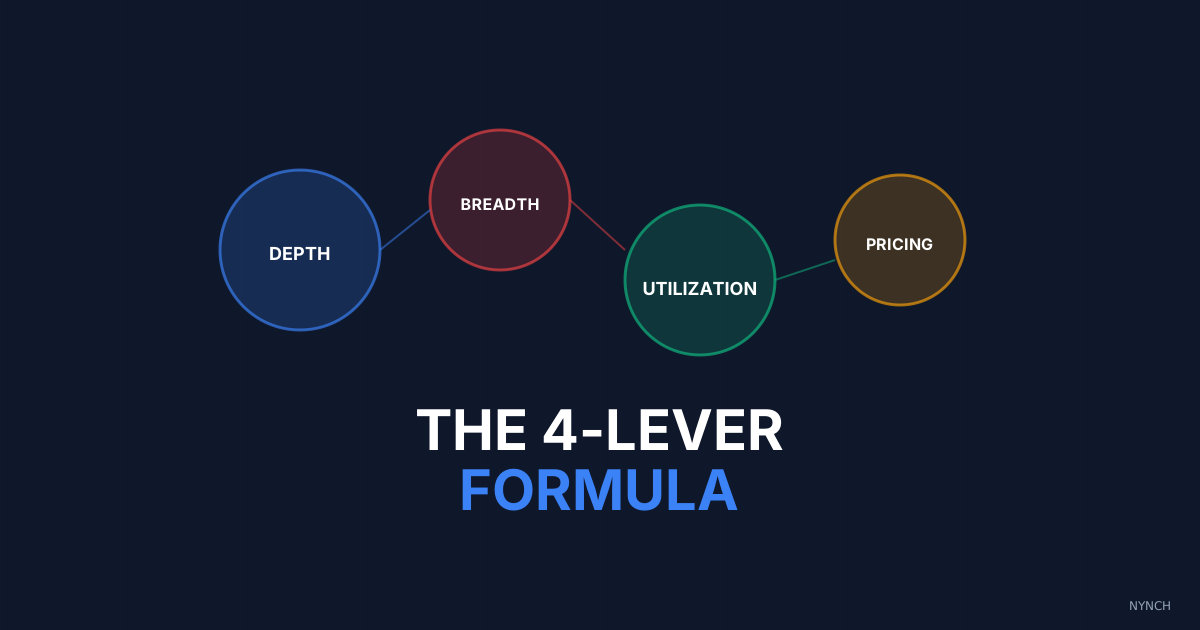
Your consulting revenue is shaped by four factors. Change one, and the rest move with it:
Revenue = Relationship Depth × Network Breadth × Utilisation × Pricing Power
Each lever in turn:
Relationship Depth
How well does your client actually know you?
Relationship Depth has five levels:
- Stranger: They have never heard of you.
- Acquaintance: They have met you once or know your name.
- Known contact: You have had multiple conversations. They understand what you do.
- Trusted advisor: They actively seek your input. You understand their business well enough to spot opportunities they miss.
- Indispensable: They bring you into decisions before those decisions are fully formed. You are a permanent part of their thinking.
Most consultants have relationships stuck at Level 2 or 3. The money shows up at Levels 4 and 5.
Here is why that matters. A client at Level 5 might spend $150K with you per year. A client at Level 2 might spend $5K. Same person. Same budget. The difference is depth.
Network Breadth
How many people in your target market know you?
If you have 30 relationships with CMOs, your chance of hearing about opportunities is roughly 30 times higher than if you have three. With three, you are dependent on luck.
Network Breadth compounds over time. Every engagement creates three to five new relationships. Every satisfied client refers one or two people per year. If you track this on purpose, your network grows much faster than if you leave it to chance.
Most consultants underestimate how wide their network should be. If your target market is B2B SaaS companies with 10-100 employees, there are thousands of companies and tens of thousands of relevant contacts. You should know 50-100 of them well. Right now, you probably know five to ten.
Utilisation
What percentage of your time is billable?
This part is straightforward. At 40% utilisation you are billing about 16 hours per week. At 80% you are billing about 32. At the same rate, 80% utilisation doubles your revenue.
Most consultants treat utilisation as a work-harder problem. It is not. It is about having enough inbound demand that you can choose the engagements that matter. When you are in demand, you can say no to bad fits and focus on clients who value your expertise.
Utilisation rises when Relationship Depth and Network Breadth are strong. When people trust you and know you exist, they call.
Pricing Power
What are you able to charge?
Pricing Power is the lever most consultants ignore. Many keep the same rate for five years and leave money on the table.
Pricing Power comes from perceived value, not from cost. A CMO who sees you as a trusted advisor will pay twice the rate of a CMO who sees you as a contractor. Same time. Different revenue.
Pricing Power increases when Relationship Depth is high. Deep relationships give you permission to charge more because the client understands the outcome they are buying, not just the hours you are spending.
The Four Traditional Tactics That Fail
Most consultants use one or more of these approaches. None of them work alone.
Cold Outreach
You send emails to people you have never met, hoping they will respond.
Why it fails: cold outreach assumes the recipient knows what they need, trusts an unfamiliar sender, and is actively looking for help. None of those is usually true. Your email lands in a pile of 200 others. If they respond at all, it is often “I am not looking for this right now.”
Response rates for cold email to consultants are about 2-5%. Even if you are excellent, you are still around 5%. That means 95 rejections per 100 emails.
Cold outreach does not build Relationship Depth or Pricing Power. It is a numbers game.
Networking Events
You attend events, shake hands, and collect business cards.
Why it fails: events create acquaintances, not relationships. You meet ten people. You have a five-minute conversation with each. Then you follow up with an email they do not remember. Most of those contacts never convert.
Networking events are inefficient. You spend two hours for maybe one or two real conversations. The return is low unless you are deliberate about which events you attend and who you are trying to meet.
Content Marketing
You write blog posts, hoping they attract people who need your kind of help.
Why it fails: content marketing works for products because strangers can evaluate and buy without much trust. Consulting is the opposite. Your content has to be good and consistent enough that readers come to see you as a trusted expert before they will hire you. That takes six to twelve months at minimum.
Content marketing builds awareness, but awareness is not the same as trust. Most content does not turn into consulting revenue on its own.
Referrals (Left to Chance)
You provide great work and hope your clients tell their friends.
Why it fails: that is not a tactic. That is hope. Some clients refer, some do not. You have no control. You cannot build revenue on hope.
The answer is to systematise referrals, not leave them to chance. That comes next.
The Four Levers of Relationship-Led Growth
Instead of traditional business development, focus on these four moves:
1. Build Intentional Network Breadth
You need 50-100 relationships with your ideal clients.
Start by defining who they are. If you work with CMOs at B2B SaaS companies, your network should be filled with CMOs at companies with 10-100 employees in your geography or industry. You should know 50-100 of them by name.
How do you meet them?
- LinkedIn: Find 50 relevant people. Send personalised connection requests with a specific reason why you are connecting (mention a company they work at, a piece they published, an event where you met).
- Warm introductions: Ask your current clients and friends for introductions to three to five relevant people. Warm introductions convert far better than cold email, often by an order of magnitude.
- Strategic events: Attend two to four conferences per year where your target clients gather. Prepare a list of 20 people you want to meet. Schedule coffee chats in advance.
- Your own events: Host a small roundtable or workshop for eight to ten people in your network. Bring in a guest speaker or teach something useful. This deepens relationships and expands your network.
The goal is volume without desperation. You are not trying to win work at this stage. You are building a network.
2. Deepen Relationships Systematically
Having 50 people know who you are is step one. Having ten of them know you well is step two.
How do you deepen relationships?
- Regular cadence: Reach out to your top 20 contacts every two to three weeks. Not to sell. To be useful (share an article relevant to their business, make an introduction, ask for their perspective on something).
- Coffee chats: Schedule 30-minute calls every two weeks with someone from your network. The goal is conversation, not selling. Learn their business, their challenges, what they are working on.
- Provide before asking: Help people in your network without expecting immediate return. Make introductions. Share knowledge. The more you give, the more they trust you.
- Follow their progress: When someone in your network gets promoted, changes jobs, wins an award, or publicly announces a new initiative, congratulate them. Stay aware of their trajectory.
This is not CRM busywork. This is genuine relationship building. The depth of your relationships decides how well you understand your clients and how much they trust you.
3. Master Your Positioning
You need a clear, specific answer to “What do you do?”
Most consultants fumble this. They say something generic like “I help B2B SaaS companies improve their go-to-market strategy.” Everyone says that. Nobody stands out.
Instead, be specific:
- “I help B2B SaaS companies reduce their sales cycle from 5 months to 3 months by fixing their qualification process.”
- “I help product teams at Series B companies avoid building features nobody uses.”
- “I help marketing teams at enterprise software companies prove ROI on their content investment.”
Specificity builds Pricing Power. When someone hears a specific problem you solve, they recognise themselves. They understand the value. They are willing to pay for specificity.
Your positioning should:
- Name a specific client segment (not “companies,” but a subset of companies).
- Identify a specific problem or outcome (not “improve strategy,” but a measurable change).
- Be defensible (something you have actually done multiple times, not something generic).
4. Systematise Referrals
You cannot leave referrals to chance. You have to ask.
That does not mean aggressive. It means direct:
- After a successful engagement, ask your client: “Who else in your network would benefit from work like this?”
- Listen for the answer. If they give you names, follow up: “Would you be comfortable introducing me to [Name]?”
- If they say “not now,” ask: “When do you think the timing would be good?” or “Who do you know who might need this in the next 6 months?”
Systematising referrals means having a weekly practice where you ask two or three of your best contacts if they know anyone who would benefit from your work.
Many of your next clients will not come from your current network. They will come from the networks of people who trust you. That is how you expand breadth without cold outreach.
Putting It Together: A 90-Day Action Plan
You do not need to overhaul everything at once. Pick one lever and get good at it.
Months 1-3: Build Network Breadth
- Week 1: Define your ideal client. Make a list of 50-100 people you want to know.
- Weeks 2-12: Reach out to five people per week (LinkedIn, warm introductions, coffee chats).
- Goal: Have 30-40 initial conversations by the end of Month 3.
Months 4-6: Deepen Top Relationships
- Identify your top ten relationships from Month 3.
- Schedule coffee chats with each one (two to three per week).
- Keep a simple note about what they are working on. Stay informed.
Months 7-9: Optimise Positioning and Pricing
- Refine your answer to “What do you do?” based on what you have learned from conversations.
- Review your pricing. Based on the depth of your relationships and the value you are delivering, raise your rate by 10-20%.
- Systematise referrals: Ask your top ten for introductions.
Months 10-12: Expand Network Again
- Your referral paths are now active. New clients are introducing you to people in their network.
- Start the cycle again with another 50 new relationships.
This is not complicated. It is relationship discipline. By Month 12, you should have:
- A network of 100+ people who know who you are.
- 10-15 relationships at depth (trusted advisor level).
- Higher pricing power (because your relationships justify it).
- Two or three active referral paths.
- Revenue that is more predictable because it flows from relationships, not luck.
The Compounding Effect
Here is why this matters at scale.
Start with a network of 50 people. Your engage rate is 20% (ten people actively consider working with you). Your conversion rate is 30% (three sign contracts). Your average engagement is $20K. That is $60K in revenue per quarter.
Then the compounding starts. Each engagement creates three to five new relationships. Each satisfied client refers one or two people per year.
By the end of Year 2:
- Your network has grown to 150 people.
- Your engage rate is now 30% (you are more recognised, more trusted).
- Your conversion rate is now 40% (deeper relationships mean higher conviction).
- Your average engagement is now $25K (pricing power from depth).
- Your revenue has roughly doubled to $120K per quarter, or $480K annually.
That is relationship capital compounding. Not magic. Arithmetic plus consistency. The numbers above are a worked example, not a forecast for every practice.
The Trap to Avoid
The biggest mistake consultants make is trying to optimise too early. You are not efficient until you have volume. Do not obsess over your positioning until you have 50 relationships. Do not raise your pricing until you have deep relationships. Do not automate until you know what works.
Build breadth first. Deepen relationships second. Optimise third.
Relationship-Led Growth is not a shortcut. It is a system. And systems compound.
Read next
- Wake up your dormant network, fill your week with warm conversations from people you already know.
- 3 Ways To Initiate Low-Lift Outreach And Start 10 Conversations Before Coffee, Overcome “outreach paralysis” with these low-effort, high-impact strategies.
- The intent radar, exactly who to call today, read buying signals so your pipeline runs on intent, not guesswork.