The most expensive moment in consulting research is the moment after you finish it.
You’ve spent four hours synthesising signals across an account. You have a clear read on what the buyer probably wants, what their org is wrestling with, where you fit. The synthesis lives in your head and a Google Doc. The Google Doc gets shared once, read once, and never reopened. The next time you need to brief a partner, you re-do half the work.
Founding users were running into a specific version of this with Assist. The research output was useful but isolated. A deep research report didn’t connect to the deal record. The deal record didn’t pull the research summary into the deal room. The deal room launched without the proof that the research had already surfaced.
We made research a workpiece, with explicit reuse paths.
When you ask Assist for a company report, an account report, a prospect dossier, or a deep research piece, the workpiece is structured for downstream work, not for one-time reading.
- Sourced signals, with each claim linked to the source (a news article, a regulatory filing, an earnings transcript, a LinkedIn change, a network connection)
- Buyer hypotheses that Assist formed from those signals, marked clearly as hypotheses with evidence strength
- Gaps Assist could not fill, listed explicitly. The blank-spot list is often more useful than the report itself.
- Recommended reuse paths into the deal draft (use this hypothesis), deal room (lead with this proof), ABM campaign (target these contacts with this framing), or future research cycles.
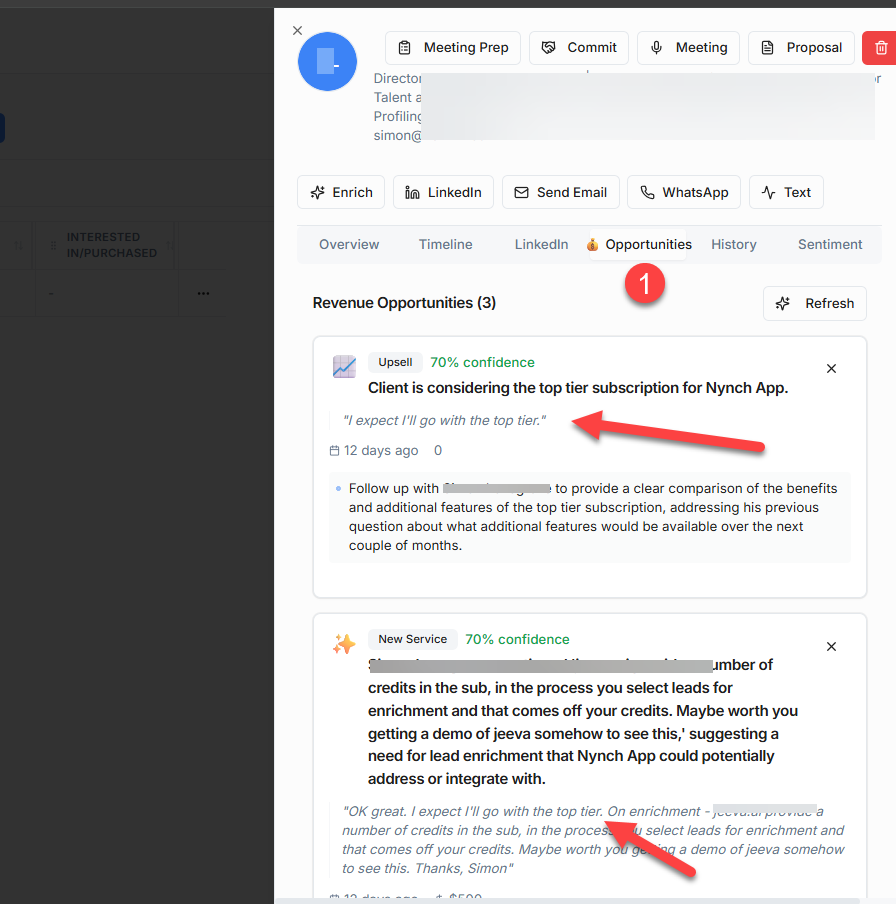
Saving the research surfaces it back to you whenever the linked deal, account, or campaign comes up. The Google Doc that nobody reopens stops being the destination.
What changes for you. The four hours of research powers three artefacts instead of one. The next time you brief a partner on the same account, the synthesis is one click away, with the sources still attached. Research compounds instead of evaporating.