Open your sent folder and search for the name of your best client from three years ago. Look at the date of the last email you sent them.
Often, it’s the week the final invoice was paid. A client who trusted them with a hard problem, paid in full and said “we must do this again” has heard nothing since. Nobody fell out. Life got busy, the next engagement started, and the relationship was filed under “done”.
That is the problem this framework fixes. It’s a way of looking after the people who already trust you, so that when they need help, you are the person they think of first.
I’ve written it so you can run all of it by hand. Nothing here needs software.
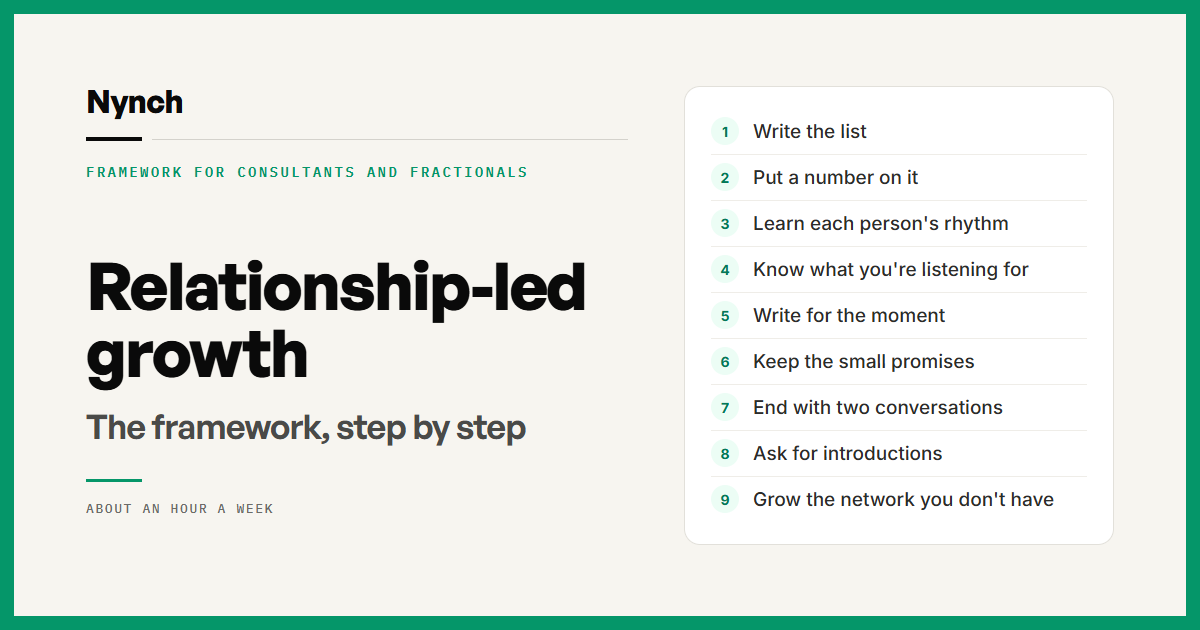
The nine steps at a glance
- Write the list. Everyone who has paid you, sent you work, watched you work or is working with you now.
- Put a number on it. Dormant clients who would hire you again, times the value of a typical repeat job, plus quiet referrers times the value of an introduction.
- Learn each person’s rhythm. Note how often you normally speak, and flag anyone whose silence has run well past it.
- Know what you’re listening for. Job moves, changes in their business, dates they gave you, problems they mentioned and things they say in public.
- Write the message that fits the moment. A reason now, a thread back to your shared history and a small useful offer.
- Keep the small promises. Track what you said you’d send or do, and close it out every week.
- End every engagement with two conversations. What’s next for them, and who else they know facing a specific problem.
- Ask for introductions people can act on. A named person, straight after a good result, with the introduction written for them.
- Grow the part of the network you don’t have yet. Find the shortest real path to the people you want to know, and be useful before you ask.
Run together, they take about an hour a week once the first list exists. The detail for each step follows.
The belief this asks you to change
Most independent consultants carry an unspoken model of where work comes from. New work comes from new people, so when the diary looks thin you go and find new people: post more, go to an event, buy a list of names someone is selling.
My view is different. For an expert who sells their own judgement, most new work comes from people who already know the quality of that judgement. Past clients, people who have referred you before, former colleagues who watched you work. They already trust your work. What they usually need is a reminder, arriving at a moment when they have a problem you can solve.
If that’s true, a thin diary usually means you’ve stopped paying attention to the people you already have.
One honest caveat before going further. If you are in your first year and nobody has paid you yet, this framework has less to work with. You will need some rented attention first, from a platform, a partner or a body of published work, to get your first handful of clients. Everything below assumes you have at least a few years of work behind you.
Part one: know who you have
1. Write the list
Block out ninety minutes and write down every person who falls into one of these four groups:
- People who have paid you. Every client contact, not just the person who signed. The finance lead who approved your invoice counts. So does the operations manager who sat in every workshop.
- People who have sent you work. Anyone who has ever made an introduction that led to a conversation, paid or not.
- People who have watched you work. Former colleagues, people from your employed years, peers on joint projects, the other adviser on that board.
- People you are working with now. Current clients, including the people around your main contact.
Use your sent mail, your invoices, your calendar and your LinkedIn connections to jog your memory. Don’t judge anyone yet. Just get the names down.
Most people are surprised by the length of this list. Someone with fifteen years behind them often finds a few hundred names. You can only really keep track of the ones you happened to speak to recently. That gap between who you know and who you remember is where most lost work goes.
2. Put a number on it
Now do some arithmetic. Use your own numbers, not anybody’s industry average.
- Count the past clients you haven’t spoken to in over a year. Then cross off anyone you honestly don’t think would hire you again, even with perfect timing. Be strict.
- Write down what a typical piece of repeat work from one of them is worth to you. Use a project or retainer you have actually sold.
- Multiply the two.
Do the same for people who have referred you before and gone quiet: how many there are, times what a good introduction is usually worth to you.
The answer is not a forecast. It is a way of seeing what is sitting in relationships you already have. If you’d rather not build the spreadsheet, the relationship capital calculator on this site does this sum with your own figures, adds your wider network and organisations like your best clients, and gives you a workbook for steps 1 and 3.
3. Learn each person’s rhythm
Every relationship has its own natural pace. Some people you used to speak to weekly. Some you saw at the same conference every autumn. Some you only ever heard from when they changed jobs.
Go down your list and write a rough rhythm next to each name: weekly, monthly, quarterly, yearly. Then compare it to the last time you were actually in touch.
What you’re looking for is silence that has stretched well past a person’s normal pace. A weekly relationship that has gone quiet for two months is in more trouble than a yearly one that has gone quiet for ten. This is why a blanket “contact everyone every ninety days” rule fails. It nags you about people who are fine and stays silent about people who are drifting away.
Mark the names where the silence is far longer than the rhythm. That’s your first shortlist.
Part two: know when to show up
4. Know what you’re listening for
A message lands when it arrives at a moment that matters to the other person. The best moments are almost always one of these:
- They changed jobs. A new role means a new set of problems and a short window when they’re allowed to spend money fixing them. Former clients who move are among your best sources of new work, and they’re the easiest to lose track of.
- Their situation changed. A new boss, a restructure, a funding round, an acquisition, a profit warning. Each one creates work someone will be hired to do.
- They gave you a date. “Let’s look at this again in the spring.” “Budgets reset in April.” People tell you exactly when to come back and almost nobody writes it down.
- They mentioned a problem you didn’t solve. In the last engagement they said the sales team was a mess, or the board pack took a week. You were there for something else, but you heard it.
- They said something in public. A LinkedIn post about a hiring push, a quote in the trade press, a talk at a conference.
None of this needs special tools. LinkedIn tells you about job changes if you look. Your own notes tell you about dates and side problems, if you took notes. The work is noticing, and noticing is where most people fall down, because the moment arrives on a busy Tuesday and nobody is watching.
Start a simple file with one line per moment: the person, what changed, when it happened, and the date you’ll act on it by.
5. Write the message that fits the moment
Compare these two messages.
Hi Sarah, hope you’re well! Just checking in. Would be great to catch up sometime.
Sarah, congratulations on the CFO role at Halden. When we worked together at Marlow you said the first thing you’d fix in a new job was the month-end close. If that’s still on your list I wrote up what worked on a similar job last year. Two pages. Happy to send it over.
The first one asks Sarah to do the work. She has to remember who you are, guess why you’re writing and invent a reason to reply. Most people won’t.
The second shows you remembered something she said, connects it to what’s happening to her now and offers something useful with no meeting attached. It’s easy to say yes to. It’s also easy to ignore without any awkwardness, and that second part matters, because people reply more readily when they don’t feel cornered.
A good message has three parts:
- The reason now. The specific thing that changed.
- The thread back. Something from your shared history that proves you were listening.
- A small, useful offer. A note, an introduction, a question answered. Not “let’s grab a coffee”.
If you can’t write the second part, you don’t know the person well enough yet, and that’s useful information too.
6. Keep the small promises
“I’ll send you that article.” “I’ll introduce you to Tom.” “Let me dig out the template.”
These small promises come up in almost every good conversation and they’re often forgotten by the weekend. Keeping them builds trust without you having to say anything. Dropping them wears it down, and the other person notices even if they never mention it.
I find it useful to track a simple ratio: the things I said I’d do for someone this month, against the number I actually did. Call it your say/do ratio. Keep a list of promises as you make them. Review it on Friday. Close the ones you can, and send a short honest note on the ones you can’t.
This step sounds minor. In my experience it has done more for referrals than any other step here, because a referral is someone putting their own reputation behind yours, and they only do that for people who follow through.
Part three: make it easy to say yes
7. End every engagement with two conversations
The end of a piece of work is the moment the client trusts you most and the moment most consultants disappear. Build two conversations into your close-out, every time.
The first is about them. Ask what’s next for the business, and what’s on the list for the next six to twelve months that nobody has started yet. You’re finding out where they’ll be when you next get in touch, and writing down the dates they give you.
The second is about who else. Ask a specific question. “Who else do you know who’s about to go through a finance system change?” works far better than “If you know anyone who might need help…”. The vague version gets a polite yes and nothing more. The specific one makes them think of an actual person.
Then put a date in your diary to get back in touch, based on what they told you, not on a default.
8. Ask for introductions people can act on
Most people who would happily introduce you never do, because you’ve made it hard. They’d have to work out who you help, what to say and how to write the email. That’s homework, and nobody does homework for a favour.
Do the homework for them:
- Ask for one person, by name, where you can. “I noticed you’re connected to the COO at Brightline. Would you be comfortable introducing us?” is easy to answer.
- Ask straight after a good result, when the value of your work is freshest.
- Write the introduction for them. A three-line note they can forward, saying who you are, what you did for them and why the other person might care.
- Close the loop. Tell them what happened, whether it turned into work or not. People who hear back introduce again. People who don’t, stop.
9. Grow the part of the network you don’t have yet
Everything so far works on the relationships you already have. Eventually you’ll want to work with people who don’t know you yet: a bigger type of client, a new sector, a new city.
You can still do this through relationships rather than cold outreach. Write down twenty or thirty people you’d genuinely like to know. For each one, look for the shortest real path: a past client who used to work with them, a former colleague who sits on the same board, a peer they’ve hired before.
Then be useful before you ask for anything. Comment properly on what they publish. Send a relevant piece of thinking. Introduce them to someone they’d value. When you do eventually ask for a conversation, it comes through someone they trust and after they’ve already seen how you think. That’s a warm introduction you built yourself. It is much slower than buying a list of names.
The weekly hour
All nine steps sound like a lot. Once the list exists, the ongoing work fits in about an hour a week. I’d run it like this:
- Look at what changed. Check job moves, news and posts from the people on your shortlist. Add anything relevant to your moments file. (15 minutes)
- Look at who has gone quiet. Which names are now well past their normal rhythm? (10 minutes)
- Check your dates and promises. Anything due this week? Anything you said you’d send? (10 minutes)
- Write three to five messages. Each one with a reason now, a thread back and a small offer. (20 minutes)
- Update your notes. Write down anything people said that you’ll want to remember next time. (5 minutes)
Do it on the same morning every week. Keeping the slot matters more than filling the full hour, because the point is that relationships get attention on a schedule rather than whenever your diary empties and panic sets in.
What goes wrong
A few things I’ve seen break this, so you can avoid them.
Doing it only when work dries up. If the first time someone hears from you in two years is the week you need work, they can usually tell. The fix is to keep running it when you’re busy, which is exactly when it’s hardest.
Treating everyone the same. Sending the same newsletter-style update to three hundred people is broadcasting. Five specific messages will do more than three hundred generic ones.
Keeping notes nowhere. If the thread back to a shared history lives only in your memory, you’ll lose most of it. Write it down within a day of every meaningful conversation.
Asking too early. A message that offers something is welcome. A message that asks for a meeting from someone who hasn’t heard from you in a year is a chore. Offer something first.
Expecting it to be quick. Relationship work pays out over months, not days. If you need revenue this month, this framework won’t fix that on its own. It’s what stops you being in that position again next year.
Where doing it by hand stops working
You should run this by hand at least once. Building the list yourself teaches you things about your own network that no dashboard will. In my experience the first hour turns up a few names you’re slightly embarrassed to have forgotten.
But the manual version has a ceiling, and it’s worth being precise about where it is.
The list is a snapshot. It’s accurate the day you write it and starts going out of date the next morning. Checking job changes and news for twenty-five people is a morning. For three hundred, it’s nobody’s job, so it stops happening. The dates people give you and the promises you make sit in email threads and meeting notes, and you only find them if you go looking. And the moment you’re most likely to drop the weekly hour is the moment you’re busiest, which is exactly when the next round of work is being decided.
That’s the gap Nynch fills. Connect your email, calendar, LinkedIn and meetings, and it keeps the list for you with both sides of every relationship in it: what they said, what you promised, the dates they gave you, how often you normally speak and what has changed in their world since. When a moment is worth acting on, the message arrives drafted with the thread back already in it. You still decide what to send, but the weekly hour starts with the noticing already done.
If you’d like to see what it finds in your own network, talk to the founder.
30 minutes. On your real data. Not generic slides.