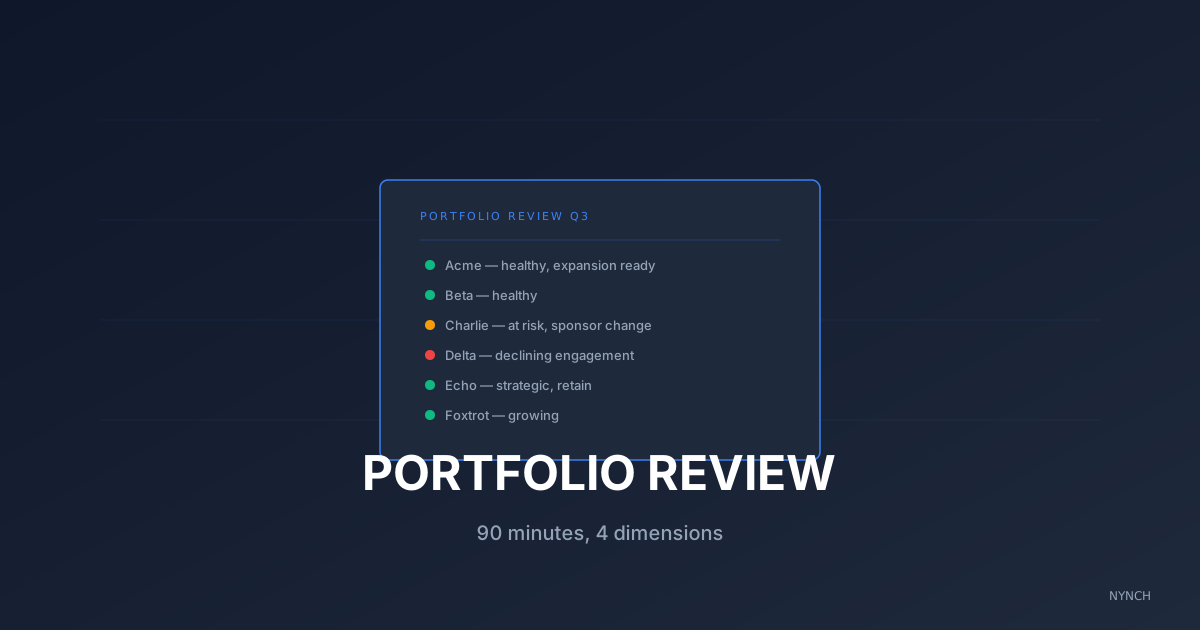
Most boutique consultancies run partner reviews quarterly but never review the client portfolio itself. The result is that churn risks compound silently, expansion opportunities get missed, and capacity-allocation imbalances persist for years. A 90-minute structured portfolio review every quarter surfaces these problems three months before they become crises. The review costs four hours of partner time per year and prevents at least one expensive renewal loss.
I have seen firms lose a strategic client and realise, only in retrospect, that everyone had seen warning signs but no one had put them together. That is the modal failure mode for boutique consultancies. The owning partner sees the open promises but does not track relationship health systematically. The other partners see the relationship health degrading but do not know the engagement context. The senior consultants see the day-to-day shifts but do not have visibility into the strategic frame. Each person has half the picture, no one has the whole one, and the client churns.
If your firm does not review the client portfolio quarterly with all partners in one room, you are operating with the wrong default cadence. Annual reviews are too slow. Weekly partner check-ins are too tactical. Quarterly is the right rhythm. You want to see the loss three months ahead, not discover it on the renewal call.
1. Pre-work: scores submitted 48 hours ahead
The review only works if every partner arrives with their clients pre-scored. Without pre-work, the first hour of the meeting is data-gathering, which is the wrong use of the partners’ shared time.
Each partner scores every client they own on four 1-5 scales: relationship health, financial trajectory, strategic fit, and team-capacity load. The scores go into a shared sheet 48 hours before the review so everyone has read them by the time the meeting starts.
The scoring rubric matters less than the consistency. What matters is that “3” means the same thing to everyone in the firm.
Set up a Google Sheet with rows for every active client and columns for the four scores plus a free-text field. Send it to all partners with a 48-hour deadline.
2. Section 1: at-risk list (30 minutes)
Open the meeting with the clients scoring 2 or below on relationship health. For each, the owning partner explains the trajectory in 90 seconds. The group discusses interventions for 3 minutes.
The discipline is keeping it brief. Each at-risk client gets 4-5 minutes total. Going longer means the rest of the agenda gets cut. The output is specific 30-day actions, owned by name. Not “we should look into this” but “Sarah will call the COO at Acme by Friday and report back next Thursday.”
Client Acme is scoring 2 on relationship health. The owning partner explains: declining open rates, two overdue promises, the original sponsor changed roles last month. The group decides: the partner will call the COO this week, plus the firm will offer a complimentary 30-minute strategic review with the new sponsor.
3. Section 2: expansion opportunities (30 minutes)
The mirror of section 1. Clients scoring 4-5 on relationship health and showing financial growth get the same 4-5 minutes each. For every one, the question is: what is the natural next engagement, and which stakeholders need to be approached?
The output is specific 60-day expansion plays. Not “we should sell more to Beta” but “the Head of Ops at Beta has mentioned needing help with their European launch. James will scope a one-day workshop and propose by month-end.”
Client Charlie is scoring 5 on relationship health and growing 30% year on year. The expansion play: the founder mentioned wanting board-prep support. The firm proposes a quarterly board-prep retainer alongside the existing engagement.
4. Section 3: capacity rebalancing (20 minutes)
Look at team-capacity loads across partners. Two patterns recur in boutique firms.
The first is a partner overloaded with mid-tier work who cannot give strategic attention to any single client. The second is a strategic client receiving less attention than its size warrants because the owning partner is being pulled by louder, smaller engagements.
Both patterns are invisible to the individual partners and obvious to the group. The fix is explicit reallocation decisions: who is transitioning what to whom in the next 30 days.
Partner James is running six mid-tier engagements at 30% capacity each. Strategic client Delta is on his books but only getting 10% of his time. Decision: transition two mid-tier clients to a senior consultant. James focuses on Delta plus four mid-tier engagements.
5. Section 4: portfolio-level decisions (10 minutes)
Step back to the firm level. Three questions usually surface organically from the first three sections:
- Are we taking the right kinds of work? (Are too many engagements concentrated in one industry, one revenue band, or one decision-maker type?)
- Are we pricing correctly? (Are similar engagements priced consistently across partners?)
- Should we fire any clients? (Is there a client where the relationship is permanently broken or where the engagement has become unprofitable?)
The 10-minute window forces firm-level decisions rather than letting them drift another quarter. According to Bain & Company’s research on customer concentration, portfolio-level decisions made deliberately compound dramatically over years. Ones made by default rarely do.
How Nynch Helps You With This
A quarterly portfolio review depends on accurate data: how each client is actually trending on relationship health, financial trajectory, and strategic indicators. Without the data, the review devolves into partner opinion. With the data, it surfaces the patterns nobody on their own can see.
Per-client relationship health scores. Nynch’s Client Command Centre tracks the four signals that predict churn (record completeness, overdue promises, executive sponsor stability, engagement depth) and produces a per-client health score continuously. The portfolio review starts with data instead of memory.
Cross-partner visibility. Every partner sees every client. Senior consultants who own relationships independently see their clients alongside the partners’. The whole portfolio is visible in one view, not scattered across individual heads.
Commitment tracking automatic. Every promise made to every client is tracked across the firm. The Say/Do Ratio per client (the share of commitments made that were delivered on time) is visible to all partners, surfacing the trust drift that is invisible to the owning partner alone.
Champion change detection. When the executive sponsor at any active client changes roles, an alert goes to the owning partner within minutes. No more discovering champion changes three months later in the portfolio review.
If you are running a 5-30 person consulting firm and do not have this data layer, the portfolio review will still work, but you are doing it on hard mode. Book a 20-minute walkthrough and you will see what the dashboard looks like for a multi-partner firm.
Once the portfolio review is running quarterly, the next move is systematically expanding the relationships scoring 4-5 on health, because that is where the firm’s growth comes from.
Read next
- The client command centre, the dashboard consultants actually open every morning to spot risk and expansion early.
- 5 Ways To Schedule Review Calls To Align On Goals For The Next Term, The renewal meeting is the most important call of the year.
- Nynch for fractional leaders, how fractional CFOs, CMOs, and COOs build proactive pipeline, protect against cancellation and create more value for clients.
Frequently Asked Questions
What is a quarterly client portfolio review?
A quarterly client portfolio review is a 90-minute structured session where the partners of a boutique consulting firm review every active engagement against four dimensions: relationship health, financial trajectory, strategic fit, and team-capacity allocation. The output is a ranked list of clients by risk and opportunity, plus specific actions per engagement.
Who attends a portfolio review?
All firm partners plus any senior consultant who owns relationships independently. For a 5-person firm, that’s typically 3-4 people. For a 30-person firm, it’s 6-10. Larger groups dilute the review. smaller groups miss perspective. Anyone running a client engagement should be in the room or have a written input read out.
How is this different from a forecast review?
A forecast review focuses on revenue: which deals will close this quarter, which won’t, what’s the weighted total. A portfolio review focuses on the relationship health behind the revenue: which clients are at churn risk, which have expansion potential, which are strategically important regardless of size. The two reviews are complementary, but boutique firms typically only run the first.
What does a portfolio review surface that you’d otherwise miss?
Three things. First, churn risk that hasn’t shown up on the pipeline yet (declining engagement, sponsor changes, overdue commitments). Second, expansion opportunities buried in past conversations that no individual partner remembers. Third, capacity-allocation imbalances where one partner is overloaded with mid-tier clients while strategic accounts get less attention than they should.
How long does a portfolio review take to run?
90 minutes for a 5-10 client portfolio. Two hours for a 20+ client portfolio. Past 30 active clients, you need a tiered approach: 30 minutes on the top 10 (deep), 30 minutes on the next 20 (medium), 15 minutes on everyone else (flag-only). Trying to give every client equal time means none get useful attention.