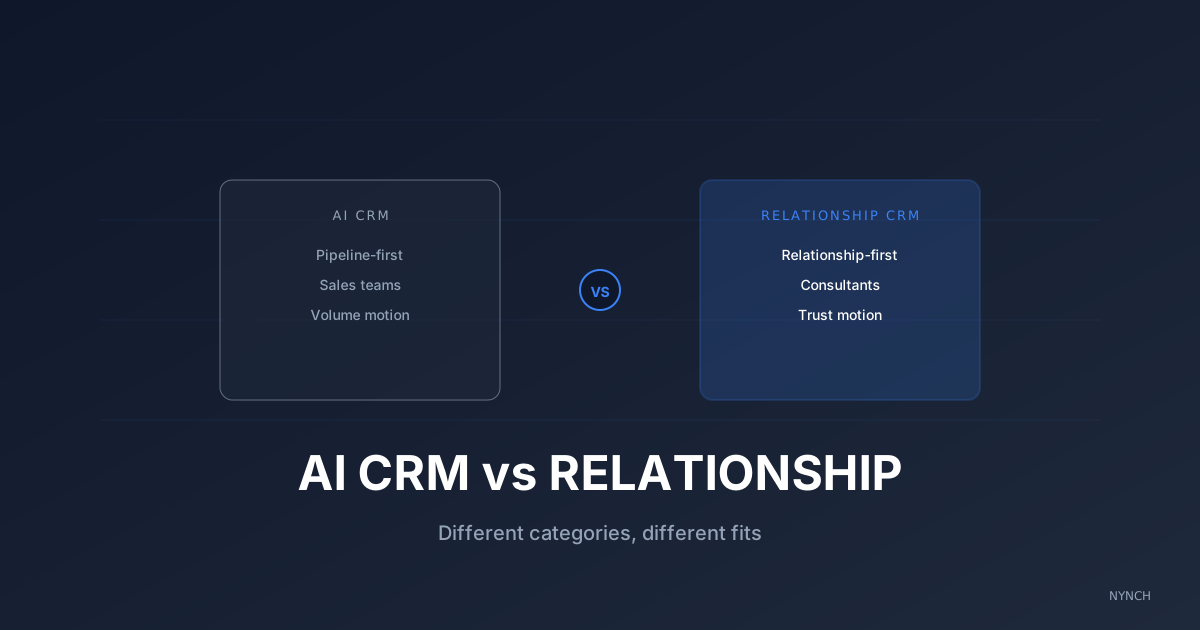
AI CRMs add machine-learning features on top of a sales pipeline. Relationship CRMs treat the relationship, not the pipeline, as the unit of work. The two categories solve different problems, and consulting practices almost always need the second. This post is a tactical comparison: when each is right, when each fails, and how to tell which you actually need.
Most consultants who evaluate an “AI CRM” for their practice end up thinking the same quiet thing. The demo is impressive. The workflow still doesn’t match how they win work.
That isn’t a failure of the product. Most AI CRMs are built for sales teams running high-volume outbound, where the deal moving through the pipeline is the primary unit. The AI features inside tools like Salesforce and HubSpot make that motion faster and smarter. They genuinely do what they claim. They just don’t claim to be doing what consultants need.
If you’ve tried three of them and felt the workflow was always slightly off, the optimisation target is the reason. Most AI CRMs are tuned for sales-team workflows: pipeline velocity, deal probability, stage progression. Not relationship-led ones. Same wallet category. Different unit of work.
The useful question is not “which tool is best?” It is “which category am I buying from?” Three tests will tell you in under an hour.
1. The “unit of work” test
The fastest way to tell what kind of CRM a tool is is to ask: what does the system put in front of you when you log in? An AI CRM opens to a pipeline view. Deals in stages. Weighted forecast. Stuck deals. Activity feed.
A relationship CRM opens to a relationship view. The 10 contacts who need attention today. Decay scores. Signal detection. Champion job changes. Overdue commitments per relationship.
Both views can be useful. The question is which one matters more for the way you actually win business. Gartner’s research on B2B buying behaviour consistently shows roughly 80% of the buying journey now happens between stakeholders rather than with the seller. For relationship-led work, the relationship is where the action is. The pipeline view is downstream.
On a Monday morning, does your CRM tell you “deal at Acme advanced to stage 4” or “Sarah at Acme just changed roles, you have 14 days to reach out before the window closes”?
Open whatever CRM you currently use. Time how long it takes to find the answer to “who do I need to email today?” If it takes more than 30 seconds or requires multiple filter clicks, the system is optimised for the wrong question.
2. The “AI optimisation” test
Both categories use AI. The question is what the AI is being asked to optimise for. AI CRMs train the model on deal velocity, conversion rates, and stage probability. The recommendations the AI generates target faster pipeline progression.
Relationship CRMs train the model on relationship health, engagement signals, and outcome history. The recommendations target keeping the right relationships warm and catching the right signals at the right time.
Same machine learning, different optimisation target. The output looks superficially similar (both produce a “today’s actions” list) but in aggregate, an AI CRM tells you “follow up on this deal” while a relationship CRM tells you “Sarah hasn’t replied in 11 days and her engagement has dropped 40%, send a personal note today.”
One concrete case: your AI CRM suggests you follow up on a stalled deal. The relationship CRM tells you the original sponsor changed companies three weeks ago and the deal is dead unless you find the new sponsor.
Look at your CRM’s daily action list. Does the AI prioritise actions by deal stage, or by relationship health? If it’s only the former, the model is optimising for a sales motion you don’t run.
3. The “data shape” test
AI CRMs are built on a data model where the deal is the primary record. Contacts hang off deals. Activities hang off deals. Notes hang off deals. The whole schema rotates around the pipeline.
Relationship CRMs invert this. The contact (or the relationship between two contacts) is the primary record. Deals hang off relationships. The same contact can span six deals across three companies and the system still treats them as one relationship with continuous history.
The shape matters for fractional executives, agency account managers, and boutique consultancies because the same person often appears across multiple engagements. An AI CRM treats them as three separate contacts on three separate deals. A relationship CRM treats them as one continuous relationship that has weathered three engagements.
Picture a contact who bought from you at Company A in 2023, moved to Company B in 2025, and is now your champion at Company C. An AI CRM has three contact records. A relationship CRM has one.
In your current CRM, search for one of your most-changed contacts. Count how many records the system holds for them. If the answer is more than one, the data model is fighting your relationship-led motion.
When an AI CRM is the right answer
To be clear: AI CRMs are excellent tools when the motion fits. They’re the right answer for:
- Sales teams running structured outbound pipelines with SDRs and AEs
- High-volume B2B SaaS where the deal stage is the dominant variable
- Marketing-driven businesses where the lead funnel maps cleanly to pipeline stages
- Companies with 50+ deals in flight at any time per rep
If that’s your business, an AI CRM such as HubSpot or Pipedrive will compound on what you already do well. The AI features make sales teams faster and the pipeline view is the right primary view.
Most consulting practices don’t fit any of those four. The volume is wrong. The motion is wrong. The data shape is wrong. So the AI CRM that’s right for them is no AI CRM built for sales teams.
When a relationship CRM is the right answer
A relationship CRM fits when:
- The relationship is the unit of value, not the deal stage
- The same contact spans multiple engagements over time
- Trust, referrals, and reputation drive most of your revenue
- You manage 20-200 active relationships, not 2,000-20,000
- Champion job changes are the highest-use signal you can act on
- You don’t have an SDR team, a marketing funnel, or a structured stage progression
That’s most consulting practices, fractional-executive portfolios, boutique advisory firms, and creative or marketing agencies. What fits is an AI CRM built around the relationship as the unit of work, not one built for pipeline volume.
How Nynch Helps You With This
Nynch is an AI CRM built around the relationship as the unit of work, not the pipeline.
The relationship is the primary record. Contacts span engagements over time. Champion job changes get tracked, surfaced, and actioned via Career Move detection. The same contact at three companies is one continuous relationship in your network.
The AI optimises for relationship health. Superbrain tracks every suggestion it makes against the actual outcome (deal won, lost, or relationship deepened) so by month three the system is calibrated to the way you specifically win business.
The pipeline is a downstream view. The Pipeline Board is available when you need stage-based forecast aggregation, but the daily default view is relationship-centric.
If you’re evaluating CRMs and felt every AI CRM you tried was slightly off, the optimisation target is probably the reason. Nynch is the AI CRM for consultants, fractionals, and professional services: same wallet category, but tuned for the relationship as the unit of work, not the pipeline. See it on a 20-minute walkthrough.
Read next
- AI for consultants, what actually helps, the parts of AI that move revenue, and the parts that just make the dashboard prettier.
- How To Tell If Your AI Tool Is Actually Learning Your Playbook (Or Just Talking), Most AI sales tools give you the same generic advice on day 365 as on day 1.
- Your CRM should not do more, it should pay attention, why most CRMs fail consultants and what relationship-led growth replaces them with.
Frequently Asked Questions
What’s the difference between an AI CRM and a relationship CRM?
An AI CRM is a sales pipeline tool with machine-learning features bolted on top: deal scoring, churn prediction, AI-drafted outreach. The unit of work is still the deal in the pipeline. A relationship CRM treats the relationship as the unit of work and rebuilds the system around that. The pipeline is a downstream view of relationships, not the primary database.
Which type of CRM fits a consulting practice?
Most consulting practices fit a relationship CRM better than an AI CRM. AI CRMs are built for high-volume sales teams running structured pipelines. Consulting practices win business through trust, referrals, and long-term relationships, where the deal stage is a poor proxy for what’s actually happening. A relationship CRM gives you the right primary view. an AI CRM gives you a sophisticated version of the wrong primary view.
Can I use an AI CRM for relationship-led work?
You can, but you’ll be fighting the underlying data model. The AI features will keep optimising for pipeline velocity, deal probability, and stage progression rather than relationship health and engagement depth. The output will feel useful in isolation and wrong in aggregate, because the questions the AI is answering aren’t the questions you’re trying to ask.
Is Nynch an AI CRM?
Yes. Nynch is the AI-Native CRM for Consultants, Fractionals, and Professional Services. AI is in the data path, not bolted on, with the Superbrain Learning Loop, signal detection, and suggestion scoring running continuously. The difference from a sales-team AI CRM is what the AI optimises for: relationship health and engagement depth rather than pipeline velocity. Same wallet category, different unit of work.
Do I need a CRM at all if I’m a solo consultant?
Yes, but probably not the kind of CRM your sales-team friends use. A spreadsheet stops working around 100 active relationships. Past that, you need a system that watches your network for you. The category that fits is a relationship CRM (a system optimised for relationship health, not pipeline velocity), not a sales-team AI CRM.