Most “AI” features in sales tools give you the same advice on day 365 as on day 1, because nothing they suggest is measured against what actually happened next. The pattern is so common that Gartner’s coverage of AI in sales keeps flagging “AI washing”: bolting LLM features onto products without changing the underlying data flow. Three quick checks tell you whether the AI in your CRM is learning from your deal history, or whether it is a polished chat window running a generic model.
Does your AI assistant feel useful in the demo and forgettable two months later?
You sign up. The recommendations sound smart. You act on a few. The work you win does not seem connected to the advice. The work you lose does not seem to teach the system anything. By month three you ignore the daily prompts because they feel interchangeable, no matter what you did yesterday or last week.
If your AI never gets better at your specific way of winning work, it is not a learning system. It is a content generator. The two look identical in a demo. They look completely different at month six. The difference comes down to one question: is the AI logging the outcome of its own advice?
You can test that in about five minutes.
1. The “Show Me The Log” Test To Expose Generic AI
A real learning system keeps a record. Every recommendation it makes goes into a log alongside whether you acted on it and what happened in the deal afterward. Without that log, the system has no training data of its own to learn from. This is the same principle Andy Grove described decades ago in Only the Paranoid Survive: a system that does not measure its own decisions cannot improve them.
The test is one question to the vendor: can I see the recommendation history from a customer who has used this tool for 90+ days? The answer tells you almost everything.
A real log shows specific suggestions, the dates they were made, the user’s action (accepted, ignored, deferred), and the resulting deal change. A generic system cannot produce that view because it never tracked the outcomes.
Say you are evaluating an “AI sales coach.” The demo looks impressive. Email the vendor and ask: “Can you show me a 90-day recommendation log from one of your customers, with the action they took and the outcome?” Watch what comes back. A real learning system has this view as a product feature. A wrapper will dodge the question or send a generic case study.
2. The “Before/After 90 Days” comparison to catch drift
Generic AI gives the same advice today as it will in three months. Learning AI does not. The cleanest way to tell which one you have is to compare two snapshots of recommendations spaced 90 days apart.
Save screenshots of your morning AI brief on day 1 and day 90, then put them side by side. Look for specific patterns: does the day-90 version reference your won-deal patterns, your reply-time habits, or your specific buyers? Or does it still read like a generic productivity blog?
If the recommendations have evolved, the system is using your behaviour. If they look interchangeable, you are paying for a content generator.
Say you signed up to a new AI CRM in January and it is now April. Pull up both morning briefings. Highlight any recommendation that mentions you specifically (your typical close cadence, your top-performing day, your usual deal size). If April has none of these, the tool is not learning from you, and it will not, no matter how long you keep paying.
3. The “Suggestion Scorecard” question to force evidence
The hardest test is to ask the AI itself for evidence. Any tool with a real feedback loop can answer “which of your suggestions actually moved deals for me?” with specific data. Tools without one cannot. The Salesforce State of Sales report flags this kind of accountability as what separates top-quartile sellers from average ones.
Use a two-part prompt. First: “Show me the top 5 suggestions you have made me in the last 90 days, ranked by deal-stage advancement after I acted on them.” Second: “Which suggestion category has the highest acceptance rate for me?” Real learning systems answer in seconds. Wrappers produce generic platitudes.
If the AI cannot rank its own suggestions by your outcomes, it has no basis to claim it is learning. You should not be paying for advice the system itself cannot defend.
Open your AI assistant. Type the question word for word. Save the response. If the answer is vague (“I help you stay focused”), the tool is not measuring its own impact. If the answer is specific (“follow-up-after-job-change recommendations have a 60% acceptance rate and 3x deal velocity for you”), the tool is doing what it claims.
How Nynch Helps You With This
Most AI features in CRMs are content generators bolted onto a database. Nynch was built as an AI CRM around the feedback loop, not around the chat interface.
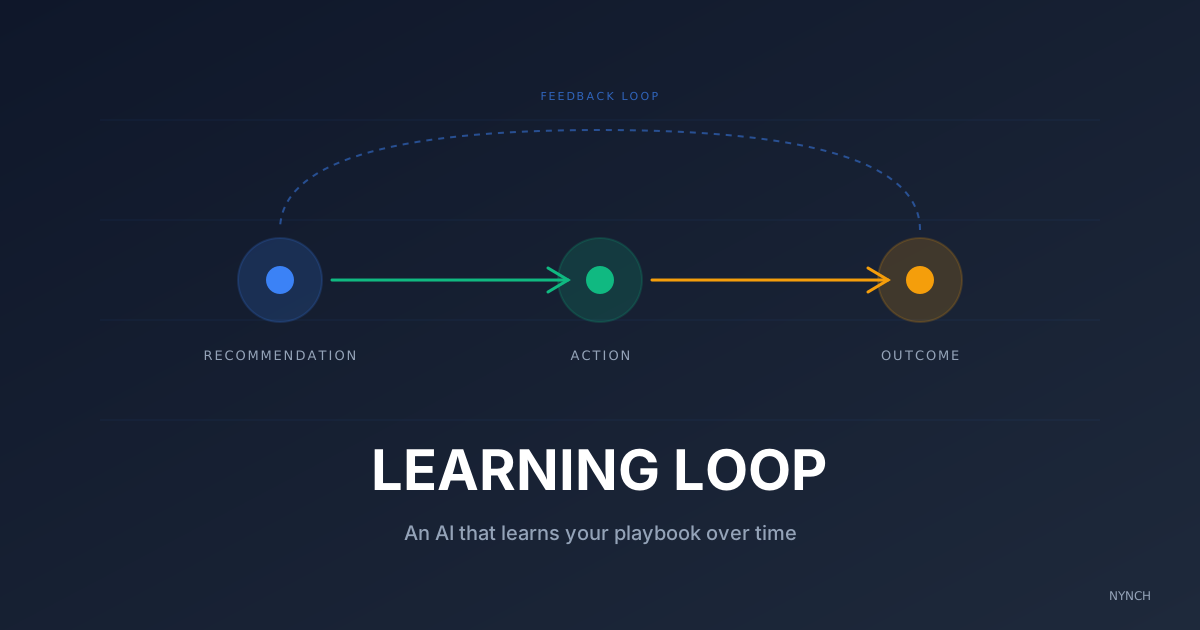
Every nudge Superbrain makes is captured in one place, alongside whether you acted on it and what happened in the deal afterward.
A dedicated screen shows which categories of nudge actually moved your deals. By month three, you can see the top-performing recommendation types ranked by your conversion rate, not consultants in general.
You can also audit the AI’s working. Every recommendation shows confidence scores and outcome attribution. You see when the AI is sure, when it is guessing, and where it is improving over time.
That is what 90 days of calibration looks like when the loop is real: not smarter chat, but a record of which advice worked for you.
Once you have an AI that learns your patterns, your next question becomes where the highest-use signals come from, because the system can finally rank them by what worked for you.
Read next
- AI for consultants, what actually helps, the parts of AI that move revenue, and the parts that just make the dashboard prettier.
- 3 Ways To Clean Old Data To Remove 50 Bounced Email Addresses, A messy contact database is a liability.
- Your CRM should not do more, it should pay attention, why most CRMs fail consultants and what relationship-led growth replaces them with.
Frequently Asked Questions
How do I tell if my AI sales tool is actually learning?
Ask the vendor to show you a recommendation log from a customer who has used the tool for 90+ days. The log should show every suggestion the AI made, whether the user acted on it, and the outcome that followed. If the vendor cannot produce that, the tool is generating advice from a generic model, not from your data.
What is a feedback loop in an AI CRM?
A feedback loop is the system that connects three things: the AI’s recommendation, the user’s action, and the deal-level outcome. Without all three connected in one record, the AI cannot learn what works for your specific revenue motion. It can only generate advice that sounds plausible.
How long does it take an AI tool to calibrate to my business?
Roughly 90 days of normal usage, assuming the tool tracks every recommendation through to outcome. Day 1 to 30 is best-practice patterns. Day 30 to 60 is surface-level personalisation. By day 90 the tool should be making recommendations visibly different from a generic model.
Can a competitor copy a learning AI in six months?
They can build the same LLM-powered features in six months. They cannot replicate the dataset of which suggestions converted, for which user, on which deal. That dataset only exists once a real customer has used the tool for 90+ days. It is the thing that gets harder to replicate, not easier.
Why does my current AI assistant feel generic?
Because it probably is. Most AI sales features are built as a chat interface on top of a general-purpose model. The model has no record of which of its previous suggestions actually moved your deals, so each new recommendation starts from scratch. Calibration to you is impossible without persistent recommendation-to-outcome tracking.