Workbooks is a CRM for consultancies.
Nynch is a CRM for the consultant.
Workbooks is a serious UK mid-market CRM with project management, time tracking, and invoicing bundled in. If you’re running a 50-to-500-person consultancy with a sales team feeding a delivery team, the per-seat pricing makes sense and the modules earn their keep. If you’re a solo consultant or fractional executive who IS the team, you’ve been quoted for a problem you don’t have. Nynch is built for the opposite shape: one operator, many relationships, the next engagement always one warm conversation away.
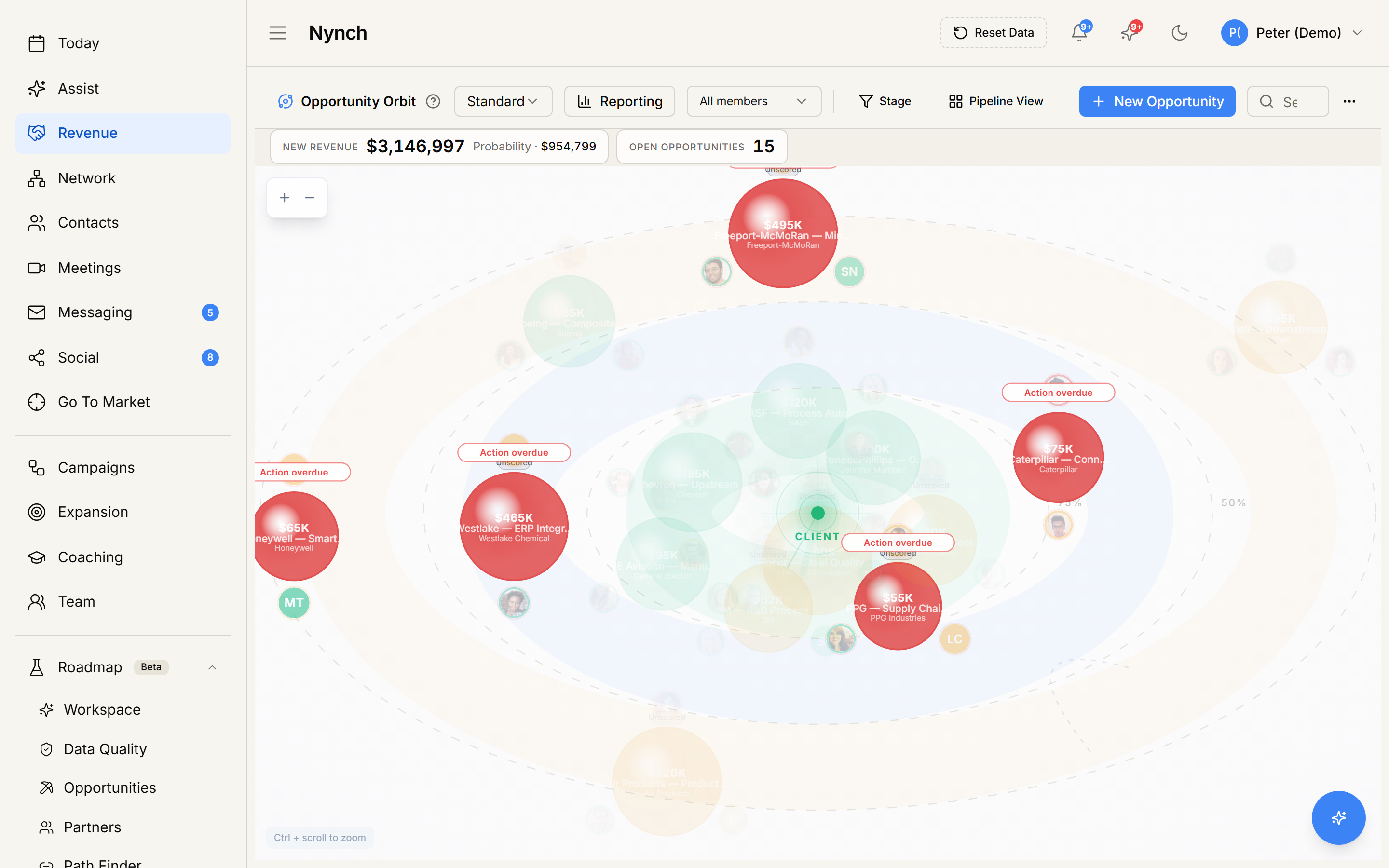
A pipeline that thinks. Currency, probability, every overdue action surfaced. Built for the consultant who IS the team, not for a CRM Manager administering it.
A Firm Operating System vs. A Relationship System
Workbooks is engineered for the sales-to-delivery handover problem. A BD rep wins an opportunity. A project manager opens the project plan. Consultants log time against tasks. Time turns into invoices. Invoices feed recovery-rate dashboards a CRM Manager reviews on Mondays. Every module assumes there is at least one other person to hand the work to.
That handover is a real problem. For a 50-person consultancy with separate BD and delivery teams, it’s the problem.
It just isn’t your problem. If you are a solo consultant or fractional executive, you are the BD rep, the project manager, the consultant logging time, and the operations director chasing your own invoice. The sales-to-delivery handover doesn’t exist because there is no handover. The whole shape of Workbooks is solving a coordination problem you don’t have, with modules and per-seat pricing built for a team that is not on your payroll.
Nynch is built for the opposite shape. Nynch reads Gmail, Calendar, LinkedIn, meeting transcripts, and news for you. It tracks every relationship in your professional network with two-sided memory, surfaces buying signals before your competitor sees them, and tells you which dormant relationship is ready to come back. No project plans. No utilization dashboards. No CRM Manager required.
Three Differences That Matter
Per seat vs. per business. There is only one of you.
Workbooks bills £32 to £82 per user per month, annual. Their pricing model assumes the buyer is procuring seats on behalf of a team. The whole revenue logic of the platform is: more seats, more revenue. That is a sensible model for a 50-person firm with a CRM Manager doing the procurement. It is the wrong shape entirely for a one-person business.
Nynch is £950 per year on the Annual SaaS plan, annual only, for the whole business. No per-seat licensing, no per-contact charges, no module add-ons. The Founder Member charter (£4,950 for 12 months) adds 52 coaching sessions with the founder. The pricing matches the business: one person, one tool, one annual cheque.
Project profitability vs. relationship intelligence.
Workbooks’ core IP is the firm operating system: opportunity to project to time to invoice to recovery rate. Modules for resource scheduling, budget tracking, sales order processing. Reports an operations director can run on a Monday morning. It is well-built and award-winning at what it does. None of it answers the question a fractional executive actually asks: who in my network is about to come back, and what should I say when they do?
Nynch monitors your professional network 24/7. It carries two-sided memory across every touch ("the Q4 budget the client mentioned in October, the board change they hinted at in November"), tracks the Rhythm-Break Rule on stale relationships, calculates an Authority Score on each contact, and gives you a Signal-Driven Alibi to reach out before your competitor knows the opportunity exists. Outcome-calibrated AI that learns from your actual close rate.
Built for the firm vs. built for the founder.
The buyer Workbooks markets to is a CRM Manager, an operations director, a Head of Member Services. The implementation is a "Jump Start" engagement followed by ongoing managed services. The product assumes someone’s job is to configure it, train users, and run reports off it. For a consultant whose only direct report is themselves, that’s overhead with no return.
Nynch assumes you are the team. You wear every hat: business development, relationship building, delivery, finance. Nynch connects to Gmail, Calendar, LinkedIn, Zoom, and meeting tools and starts producing value in 15 minutes. No pipeline stages to configure. No custom fields. No quarterly admin review. Just signal-driven action.
Force a Choice, Not a Comparison
- → You’re a 30-plus-person consultancy with separate business development and delivery teams.
- → You need utilization tracking, recovery rates, and firm-level pipeline forecasting in one tool.
- → You have or are hiring a CRM Manager or operations director who will own administration.
- → You’re a solo consultant, coach, or fractional executive who wins on trust and reputation.
- → Most of your future revenue lives in relationships you have already built, not new inquiries from strangers.
- → You want AI that surfaces buying signals and reactivates dormant relationships, not a firm operating system you have to administer.
- → You want one price for the whole business, not a per-seat invoice that grows with every contractor you bring in.
Your network is already
sending you signals.
See what your Sleeping Network looks like and how much dormant network value is hiding in relationships you have neglected.
Nynch vs. Workbooks, Answered
Workbooks is a UK mid-market CRM with project management, time tracking, and invoicing bundled in. It is built for consultancies of 50 to 500 people with a sales team feeding a delivery team, where the buyer is a CRM Manager or operations director. Nynch is built for the solo consultant or fractional executive who IS the team. Workbooks bills per seat because their economics assume a firm. Nynch bills per business because there is only one of you.
Yes. Workbooks is structurally built around the sales-to-delivery handover problem. Pipeline goes to opportunity, opportunity becomes a project, project tracks time, time turns into invoices, invoices feed recovery rate reports. Every module assumes you have at least one other person to hand work to. If you are the BD lead, the delivery consultant, and the operations team in one body, you are paying for modules that solve someone else’s problem. Nynch is built for the opposite shape: one operator, many relationships, no team to coordinate.
Workbooks charges per user per month: £32 for CRM, £48 for CRM Pro, £82 for Business Pro. Nynch is £950 per year on the Annual SaaS plan, annual only, for the whole business. The Founder Member charter (£4,950 for 12 months) adds 52 coaching sessions with the founder. For a one-person operator the per-seat model is the wrong shape regardless of price. You are not the buyer Workbooks designed for.
Honest answer. If you are growing toward a real consultancy with separate business development and delivery teams, utilization tracking, recovery rates, and a CRM Manager hire on the horizon, Workbooks is the right shape for that destination. Nynch is the right shape for the founder period: the years when you are still the lead seller, the lead deliverer, and the relationship owner. Most fractional executives and solo consultants stay in that shape on purpose, indefinitely. If you are intentionally building a firm to scale past 30 people, plan to graduate.
Workbooks is engineered for the operating problems of a consultancy: pipeline forecasting at firm level, project profitability, margin protection, sales-to-delivery handover. These are real problems for a 50-person firm. None of them is the problem a solo consultant or fractional executive wakes up worrying about. The consultant’s problem is: who in my network is about to come back to me, and which dormant relationship should I reach out to this week? Workbooks does not see that motion because it was not designed to. Nynch is built for it.