Day.ai and Nynch are both AI-native CRMs built to replace manual data entry. That is where the similarity ends. They are built for different buyers with different ways of making money.
The Difference in a Sentence
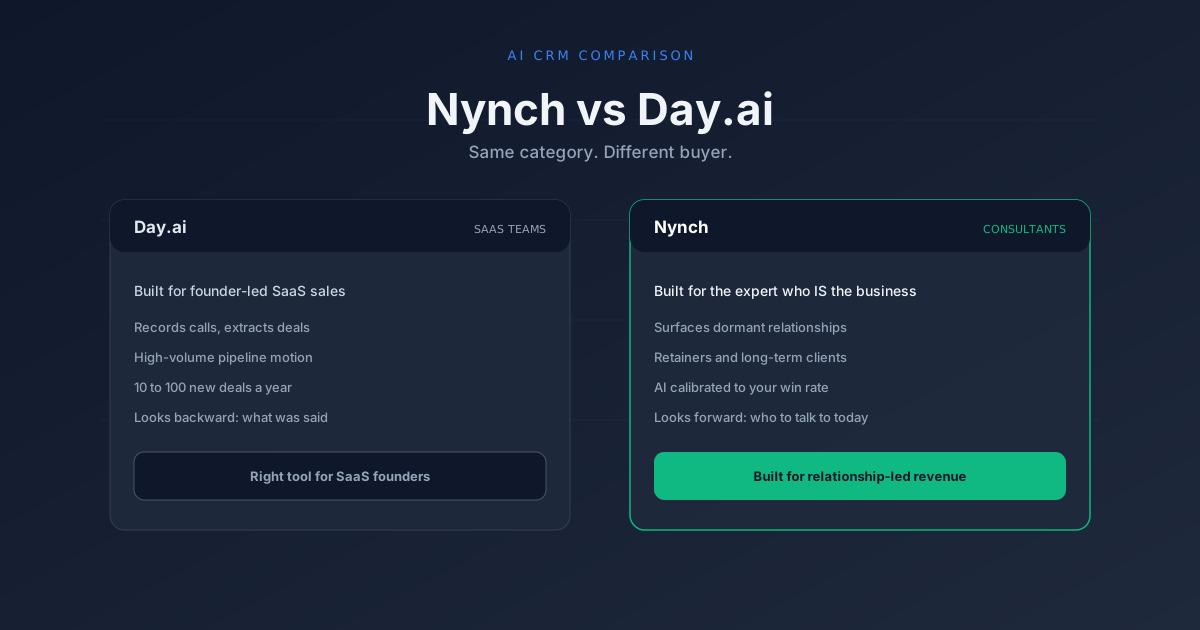
Day.ai is built for founder-led SaaS and product teams who need to win a lot of new deals each year. Nynch is built for solo consultants and fractional executives who win on relationships, not volume.
Where Day.ai Excels
Day.ai has some genuine strengths worth naming.
Founder credibility. Christopher O’Donnell spent a decade as Chief Product Officer at HubSpot before founding Day.ai. That pedigree carries weight with technical founders who remember HubSpot’s early taste of simplicity before it became enterprise bloat.
Capital and distribution. $24M raised, with a $20M Series A led by Sequoia in February 2026, moves fast. The product got 18 months of private beta refinement, something most startups skip. When Day.ai went public in February 2026, the homepage animations and call-recording pipeline were visibly mature.
MCP-first positioning. Day.ai ships as a Claude extension, so Claude desktop becomes your CRM front-end. That integration story is a real advantage if the product underneath stays lightweight.
The “no manual data entry” narrative. Conversation capture across Zoom, Meet, and Teams, with contacts, companies, deals, and action items pulled out automatically, removes the biggest friction point in CRM adoption. For SaaS founders doing founder sales, that is real.
Where Day.ai Falls Short for Consultants
Day.ai is built for a specific buyer: the SaaS founder or product leader doing founder-led sales to win net-new deals. That architecture creates blind spots for consultants.
The consultant sells relationships, not transactions. A SaaS founder is chasing 10 to 100 new deals a year from a cold or warm network. A consultant typically works with 5 to 15 clients at a time over retainers lasting 1 to 3 years. Day.ai’s data model (calls, deals, action items) assumes the SaaS motion. Retainers, billable hours, engagement scopes, and advisor relationships have no native home.
Day.ai captures new conversations. Nynch surfaces old ones. Day.ai’s strength is auto-logging calls and extracting next steps. But that only helps if you are having new calls. For a consultant with a thin book of work, the bigger problem is the calls you should be having but forgot about. The person who said “let’s talk in July” six months ago. The referral partner who promised an intro and never sent it. The dormant client who went silent in March. Day.ai does not see that pattern. Nynch surfaces it automatically.
Relationship intelligence is thin. Day.ai’s agent can retrieve and summarise past calls (“tell me what we talked about”). That is useful. Nynch’s agent goes further: it knows how strong each relationship is, how warm the contact feels, where the risk of loss sits, the best path to them through your network, and when the relationship is drifting cold. For a consultant selling to six stakeholders at the same company, that intelligence is the product.
No outcome-calibrated AI. Day.ai uses a general-purpose AI model to draft emails and suggest actions. That is generic. Nynch learns from your actual win rate. If you win 40% of the work in your lane, Nynch’s AI is calibrated to the engagements that fit your pattern, not the generic SaaS pattern. For consultants, that calibration is the difference between noise and signal.
The Real Wedge: Who the Product Is Built For
Day.ai’s team is two ex-HubSpot leaders solving for the 2024 version of the problem HubSpot solved in 2008. The CRM is bloated, so simplify it. The data entry is manual, so automate the capture. For a venture-backed SaaS founder doing founder-led sales, Day.ai is the right tool.
But that same architecture fails for a consultant because the consultant’s problem is not “my CRM is bloated” or “I hate data entry.” It is “I am one person, my revenue depends on relationships I have built over years, and I am too smart to cold-email 500 people.” Day.ai solves the first problem. Nynch solves the second.
If Day.ai tried to solve for consultants by adding retainer tracking or relationship scoring, it would stop being Day.ai. Their unit economics, their founding story, their go-to-market motion, and their positioning all depend on the SaaS founder buyer. Pivoting away from that buyer means building an entirely different product.
What Each CRM Is Actually Doing
Day.ai: Turns your call recordings and emails into a structured pipeline so you can ask “which deals are at risk” and get specific answers. Strong for SaaS teams. Weak on relationship history outside call contexts.
Nynch: Turns your relationship memory (email, calendar, LinkedIn, call notes) into the briefing you need before each call, so you never walk in unprepared, never forget a promise made six months ago, and always know when a dormant relationship is worth reactivating. Built for consultants who sell trust.
Decision Framework
Ask yourself three questions.
-
Am I winning a high volume of deals from new relationships each year, or am I maintaining a small number of long-term relationships? If the former, Day.ai. If the latter, Nynch.
-
Is my biggest CRM pain “I have too many calls to log” or “I forget to follow up on old relationships”? Day.ai solves the first. Nynch solves the second.
-
Do I have a team doing founder-led sales, or am I selling alone as a trusted expert? Day.ai scales to teams. Nynch is built for the one person who is the business.
If you are a solo consultant, fractional exec, or boutique advisory firm, Nynch is built for you. If you are a SaaS founder or product leader doing founder sales, Day.ai might be the faster path.
Want to see how Nynch helps consultants win retainers instead of chasing volume? Talk to the founder. 30 minutes on your real data, not generic slides.