What an AI CRM actually does, and what most just slap AI onto
A guide, not a sales pitch. Here's how to tell the difference between AI in the data path and AI as a marketing label. If you're a consultant, fractional executive, or agency, Nynch is the AI CRM for relationship-led revenue: built to turn context into prepared work, not add a chatbot to a database.
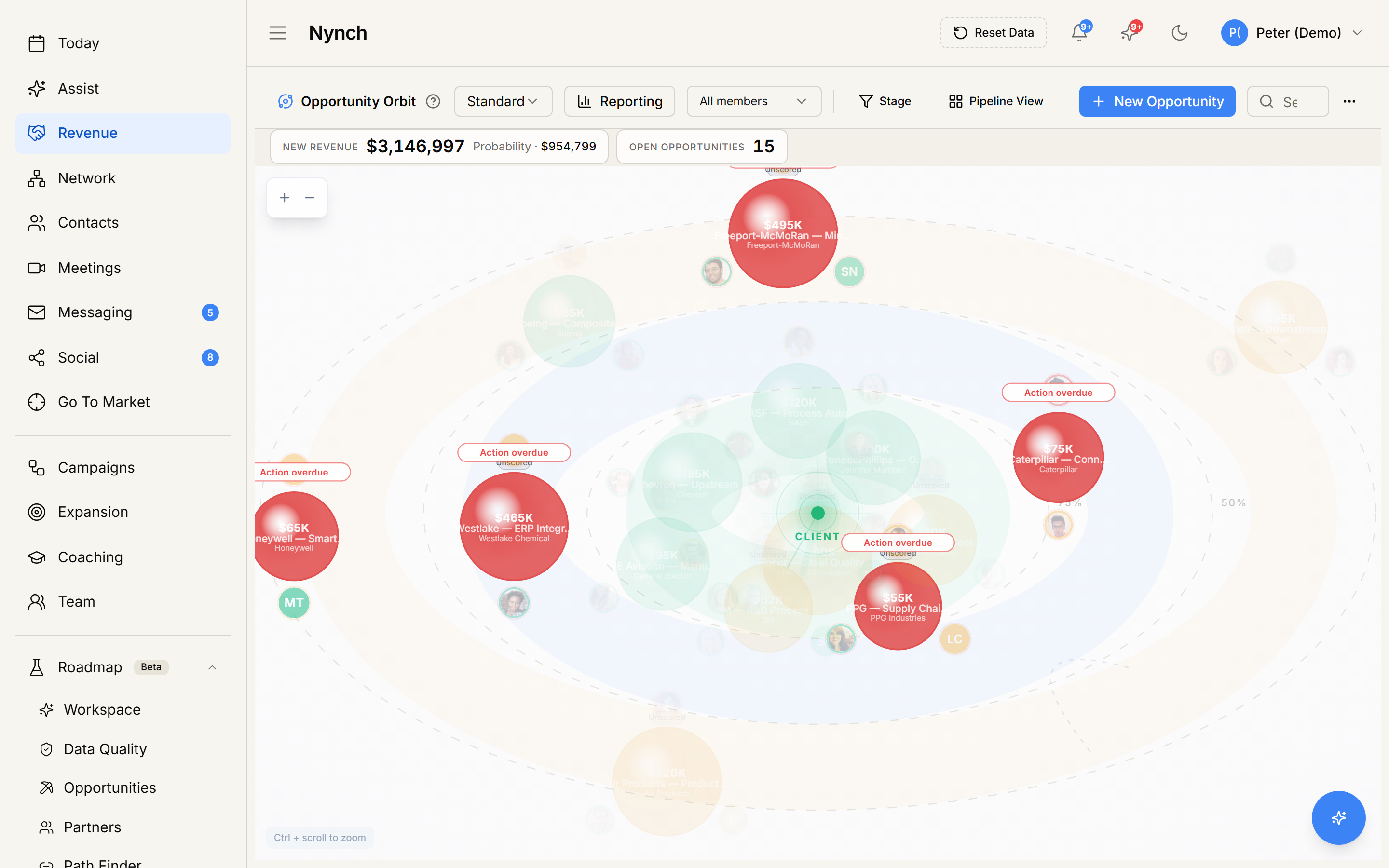
The pipeline replaces the kanban. Currency, probability, what is in motion, what is going quiet. All in one canvas, no admin overhead.
What "AI CRM" actually means
An AI CRM uses machine learning to do work the user used to do manually. Not AI as decoration. Not ChatGPT pasted into a contact form. AI in the data path, preparing the next action from the real relationship history.
Here's the honest test: if you turned off the AI, would the product still work? If yes, it's a regular CRM with AI bolted on. If no, then you have a real AI CRM.
A real AI CRM does this in the background, for you to review:
- Detects relationship health by tracking your contact patterns with each person
- Reads your inbox and calendar to build records, not waiting for you to log in and type
- Surfaces follow-ups based on time since last contact, not on arbitrary pipeline stages you manually update
- Generates meeting briefs from your own conversation history, not from generic web data
- Scores deals based on your actual engagement patterns, not industry benchmarks
- Predicts churn before it happens by tracking engagement decay with specific people
Four markers of a real AI CRM
- Captures records without user input. Reads email, calendar, meeting transcripts. You don't manually log activities.
- Predicts behavior using your data. Not generic benchmarks. Your specific relationship patterns with your specific people.
- Surfaces actions, not just data. Doesn't just store information. Turns records into briefings, drafts, reminders, and next steps.
- Updates continuously. Not when you log in. After every email, call, or meeting.
An AI CRM turns communication patterns into prepared work, not waiting for you to decide what data to record.
The 5 AI features that matter, and 3 that don't
Features that actually work
- Relationship decay detection. Calculates how long it's been since meaningful contact with each person in your network, then alerts you when relationships are cooling. This catches dormant opportunities before competitors do.
- External signal cascades. Tracks job changes, funding announcements, new initiatives, and partnership announcements across your network. When someone you know gets promoted or their company raises funding, you know before the press release.
- Auto-generated meeting briefs. Pulls from your email and call history with someone, summarizes the context, and surfaces what matters before the meeting. Not web search. Your actual conversation history.
- Commitment tracking from transcripts. Listens to your calls, extracts what you promised, what the client promised, and when things are due. No manual task entry required.
- Expansion radar across accounts. Identifies which existing clients have new opportunities based on their conversation hints, your service catalog, and what similar accounts have bought.
Features that don't matter as much
- AI email writing. Everyone has it now. ChatGPT can do it. Not a differentiator.
- AI deal scoring on demos. Most AI deal scoring has a cold start problem. You need 3+ months of data for it to mean anything. It's rarely useful in the moment.
- AI chatbot that summarizes the contact record. You can read the contact record yourself in 30 seconds. A chatbot explaining it back to you isn't saving time.
The features that matter are the ones that watch your relationships continuously and surface what you need to know for you to review.
What "AI CRM" usually means in marketing copy
Most products calling themselves AI CRMs are just regular CRMs with ChatGPT pasted on top.
Salesforce calls Einstein "AI." It's mainly lead scoring based on historical data and email recency. HubSpot's AI features are deal summaries and content suggestions. Neither would work without you manually entering data first.
The honest distinction is this: are customers doing less work, or does the AI just make visible what they're already doing?
If the AI is only in the UI (chat, summaries, suggestions), it's marketing. If the AI is in the data path and turns context into work, it's real.
5 criteria for evaluating an AI CRM
1. Does it run without user data entry?
Ask for a demo where no one types. If the demo requires logging in and manually updating fields, it's not an AI CRM yet.
2. Is the AI trained on your patterns or generic ones?
Generic AI is worthless in your domain. You need AI trained on your specific relationship patterns, your team's communication style, your industry's signals.
3. Per-user pricing or flat?
Per-user pricing ($50 to $100 per person per month) kills team adoption. Your entire team should see relationship intelligence, not just the person paying.
4. Does it integrate with your actual workflow?
An AI CRM that doesn't integrate with Gmail, Google Calendar, Zoom, LinkedIn, Slack, and your video call transcription tool is just a database. You need integration so the AI actually sees what's happening.
5. What happens if you turn the AI off? Does anything still work?
If your CRM becomes useless without the AI running, you have a real AI CRM. If it just becomes a slower, more painful version of a regular CRM, the AI was cosmetic.
Test the product with the AI off. If it still feels like a normal workflow, the AI was bolted on, not built in.
What Nynch remembers that you can't
The honest test of an AI CRM isn't whether it summarises a contact record. It's whether it surfaces the sentence your client said in October that you should be acting on in October the following year.
Every consultant has lived this. A client said something in passing. You meant to track it. Twelve months later, the moment arrived. You missed it.
- The budget mention. A client said in October last year, "we always have leftover budget at year end." You haven't spoken since March. October arrives. Nynch surfaces the line they said, with the transcript link, and prompts the outreach. You send a single email referencing it. They reply within an hour.
- The July callback. A prospect ended a February call with "call me in July." That note lived in a transcript you never re-read. Late June, Nynch puts it at the top of your week. You reach out three days before they expected.
- The unfulfilled referral. A client offered to introduce you to a peer over coffee three months ago. It never happened. Nynch keeps the open thread visible. You mention it lightly on the next call. The intro lands two days later.
If the AI in your CRM cannot quote the exact sentence a prospect said nine months ago, it is not the part that wins business. The part that wins business is two-sided memory.
Why Nynch is not just another AI CRM
AI CRM is the right category. It is what buyers understand, search for, and can budget against. The difference is what happens after the data is captured.
Most AI CRMs make the record easier to read. Nynch turns the record into work. It connects to your Gmail, Calendar, Zoom, LinkedIn, and meeting transcription tools, then continuously:
- Watches your network with a Relationship Engagement Index that scores six dimensions of every relationship, so warming and cooling become visible before they cost you.
- Detects buying signals. Job changes, funding rounds, expansion mentions, surfaced from your inbox and calls before you read the news.
- Drafts outreach from your commercial context. What you do, what outcomes you create, who buys those results, and proof you've earned, reused everywhere instead of asked for again.
- Prepares the next action from remembered context. The briefing, the draft, the reminder, the referral ask, or the proposal angle appears before the moment goes cold.
- Scores deals with Bayesian probability against your specific past wins and losses, not generic benchmarks.
If your work is high-value and won through trust rather than cold outreach, the contact record is not the product. The next right action is. Nynch is the AI CRM built around that.
$950 per year. Annual only. AI is included, not an upcharge.
Your network is already
sending signals.
See what your Sleeping Network looks like and how much untapped revenue is hiding in relationships you've neglected.
AI CRM, answered
An AI CRM uses machine learning to do work the user used to do manually. Detecting relationship health, surfacing follow-ups, generating meeting briefs, scoring deals, predicting churn, and preparing the next action. The honest test: if turning the AI off doesn't change how the product works, it isn't really an AI CRM. It's a CRM with a chatbot bolted on. A real AI CRM has AI in the data path, not just the UI.
A regular CRM is a database that waits for you. You log in, type in what happened, and look at reports. An AI CRM watches continuously, reads your inbox and calendar, builds the records itself, and tells you what to do next. The shift is from passive logging to prepared work.
For high-volume sales teams, the AI features in HubSpot or Salesforce save modest amounts of admin time. For consultants and agencies, who manage fewer, higher-value relationships, an AI CRM that catches relationship decay and surfaces expansion signals is the difference between a 30 percent renewal rate and a 90 percent one.
Most AI CRMs are sales-team tools with AI features added on. Nynch isn't one of them. Nynch is the AI CRM for consultants, fractional executives, and agencies. It scores relationships with the Engagement Index, detects buying signals, drafts outreach from your commercial context, and turns relationship memory into prepared work. All without manual data entry.
Salesforce Einstein adds $50 per user per month on top of the base license. HubSpot's AI features start at the Professional tier ($800 per month). Nynch is $950 per year on the Solo plan, or $4,788 per year on the Implementer plan that adds 8 group coaching calls a month and Nynch set up for you. Annual only. AI included, no upcharge.
Yes. Nynch reads every email, meeting transcript, and LinkedIn signal and attaches them to the relationship. A budget mention from a year ago, a callback date from a February call, a referral promise from coffee three months ago. All captured, all surfaced at the moment they become actionable. Most AI CRMs remember what you did. Nynch remembers what they said. That is the part that actually moves money.