If you have ever read an AI-generated cold email and felt your soul leave your body for a second, you know the problem this article is about.
The technology is real. The use case is real. The output, in the hands of most people, reads as theatre. Cold, hollow, vaguely creepy in its specificity. The recipient knows it was AI. You know they know. The relationship is damaged before it began.
The fix is not a smarter prompt. The fix is a different mental model.
The wrong mental model: AI as you
Most AI BD tools push you to think of the AI as a stand-in for yourself. You give it a prompt. It writes the message. You hit send. The AI is doing the relationship.
This does not work because the AI has never met the recipient. It has no skin in the game. It is optimising for plausibility (the message looks like a BD email) rather than for truth (this is a real moment between two real people).
Buyers feel the absence of a real perspective in two sentences. They have read a thousand of these messages. The pattern is unmistakable. The hook is generic. The transition is forced. The ask comes too soon. The signature line congratulates them on a “recent post” they cannot quite place.
The signal is so clear that “AI-generated outreach” has become a category of message that gets archived without reading. You burned the opportunity before they read past the second line.
The right mental model: AI as your research analyst
Reframe the AI as the research analyst behind your work, not as you.
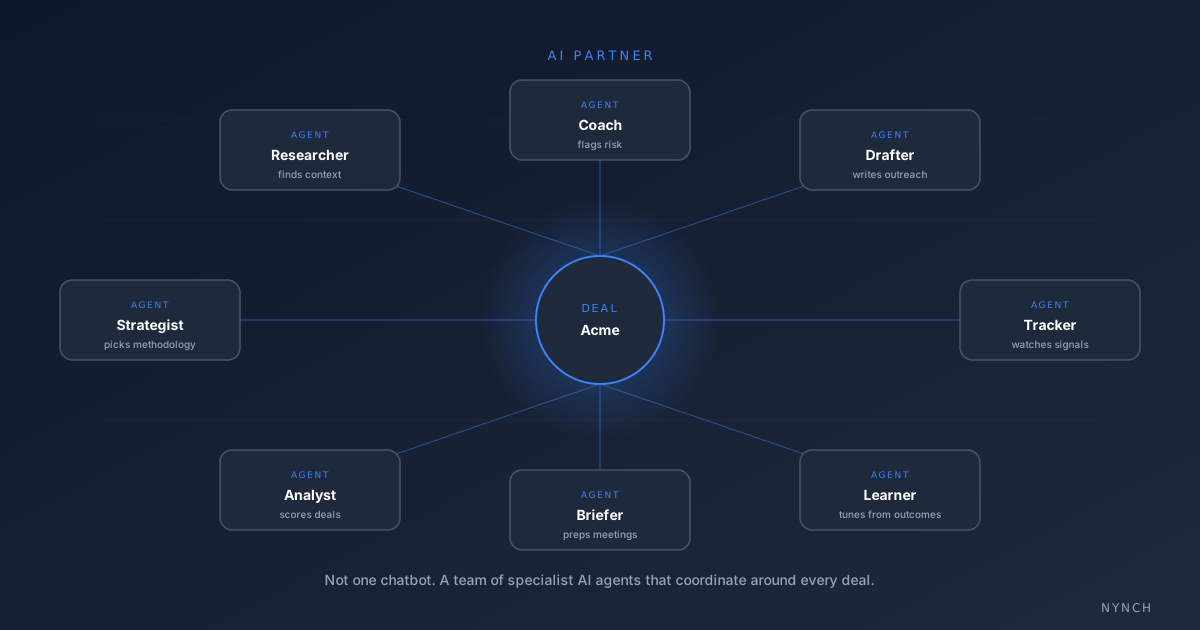
A good research analyst pulls every relevant piece of context before you walk into the meeting. They scan the news. They check the LinkedIn activity. They pull the email history. They surface the three things that matter and the one thing that would make this person feel seen. They give you a brief. The brief makes you look like you have a memory for detail that you do not actually possess.
You walk into the meeting and have the conversation. The analyst stays invisible. You are visible. The relationship belongs to you.
This is the right shape for AI in BD. The analyst does the recall, the pattern detection, the structural drafting. You do the judgment, the voice, the part that requires being a human in this specific relationship.
When the model is right, the output is right. When the model is wrong (AI as you, not AI behind you), the output reads as theatre regardless of how clever the prompt.
The principle in practice
Three concrete behaviours separate AI BD that works from AI BD that backfires.
1. The analyst does context. You do judgment.
The analyst tells you: “Sarah just got promoted to VP of Operations. Last interaction was eighteen months ago, when she was a Director at her previous company. She is now responsible for the operating model you specialise in. Your engagement at her old company delivered a 9-point margin improvement. The current company has been mentioned in three industry articles in the last quarter as growing fast.”
You decide: “This is the right moment to reach out. The angle is to congratulate her, reference the work we did together, and ask about her first 90 days. Tone is warm and specific. Length is short.”
The AI does the first paragraph (the recall). You do the second paragraph (the choice). The message you send is one sentence about the promotion, one sentence about the work you did together, and one sentence asking how the first 90 days are going. No template language. No “I noticed.” Just two humans, with the AI invisible behind you.
2. The first line must contain something only a human in this relationship would know.
Generic openers are the easiest AI tell. “I came across your post,” “I noticed you recently,” “Congratulations on your work at,” are all signals that the writer is not someone with a real connection to the recipient. They feel AI even when they are not.
The fix: open with a specific reference that only a human in this relationship would know. The brutally honest comment you both laughed about at the offsite. The specific quarterly target their team was missing when you last worked together. The fact that their two-year-old was sick the last time you spoke and you want to know if everything is okay.
If you do not have a specific reference, you do not have the relationship yet. Send something different (a connection request, a comment on their content) before you ask for time.
3. Cut every AI tell from the draft before sending.
The AI tells in 2026 are well-known: em dashes everywhere, semicolons in casual writing, triple-adjective stacks, “in today’s” openers, “moreover” and “furthermore” connectives, and abstract filler that sounds like a white paper rather than a person. Most of these never appear in how a human actually writes a Tuesday morning email.
Read the draft out loud before sending. If it sounds like a corporate quarterly update, it is. Cut the connectives. Add contractions. Use a fragment sentence. Make a small joke. Sign it the way you would sign a text to a friend.
You are not trying to write a great email. You are trying to write a real email. They are different goals.
What AI should never do in BD
The three lines you should not cross, regardless of how good the tool gets.
AI should never send messages without you reading them. Autonomy is the wrong frame for BD. Every message that leaves your account is signed by you. Read it.
AI should never fabricate context. Referencing a meeting that did not happen, a connection you do not have, a topic you have never discussed. The buyer will eventually notice. The damage is irreversible.
AI should never use generic flattery as a hook. “Your insights on leadership are inspiring.” “I love what you’re doing at [Company].” Anything that could be sent to ten thousand people with a find-and-replace. If it can be, it is not BD. It is spam with extra steps.
Any vendor pitching autonomous AI BD as the future is selling you a tool that breaks the first rule. Move on.
The shape of AI BD that actually works
Imagine the Tuesday morning ritual again.
The AI has been working overnight. It has read your inbox, scanned LinkedIn, processed the meeting transcripts from yesterday. It has scored every relationship for decay and detected three external signals worth your attention. The morning briefing is two screens long. You read it in three minutes.
You act on three things. A congratulations to a former colleague who got promoted (the AI surfaced the promotion, you wrote a sentence about the time you both ran a workshop together that they still mention). A re-engagement to a champion at an existing account who has gone quiet for sixteen days (the AI flagged the cadence break, you wrote a sentence referencing the specific work you committed to in your last call). A connection request to a prospect who engaged with three of your posts in the same week (the AI flagged the content cluster, you wrote a sentence linking to a piece of work that responds to one of the posts they engaged with).
Three messages, each three sentences. Each contained one piece of context only a human in that relationship would know. Each took you 90 seconds. The AI did the context. You did the judgment. The recipient feels seen, not processed.
You close the laptop. Total time: ten minutes.
This is what AI BD looks like when it works. The AI is invisible. You are visible. The relationships compound.
Where Nynch fits
Nynch is the AI CRM for consultants, fractionals, and professional services. Built specifically for this shape of work. It reads your inbox and calendar continuously so the research is done by the time you sit down. Smart Draft writes in a voice profile you choose (Trusted Advisor, Strategic Consultant, Fractional Exec, Growth Partner, Sales Hunter), so the drafts inherit your tone rather than a generic template. The morning briefing arrives whether you log in or not. Every suggestion shows its sources, so you can check what the AI is recommending and why.
Most importantly: Nynch is not autonomous. The AI never sends without you. The drafts always need your final touch. That is the design intent, not a missing feature. The boundary is what makes the rest credible.
See it on your network in a 20-minute walkthrough. You will see what a morning briefing looks like on your actual data.