A boutique consultancy is the hardest shape to run business development for.
Too small for a dedicated BD team. Too big for one person to hold every relationship in their head. Senior partners win work through old relationships the firm cannot see. Juniors win work through new ones the firm should know about. And the institutional memory of who knows whom lives in nine different inboxes and one badly maintained spreadsheet.
The AI vendors say their product solves this. Most do not. They solve a different problem (data entry, deal velocity, sales rep productivity) and call it the same name.
Here is how AI CRM and AI business development differ for a firm of 3 to 30 people, and which one your firm actually needs.
The category confusion, in one paragraph
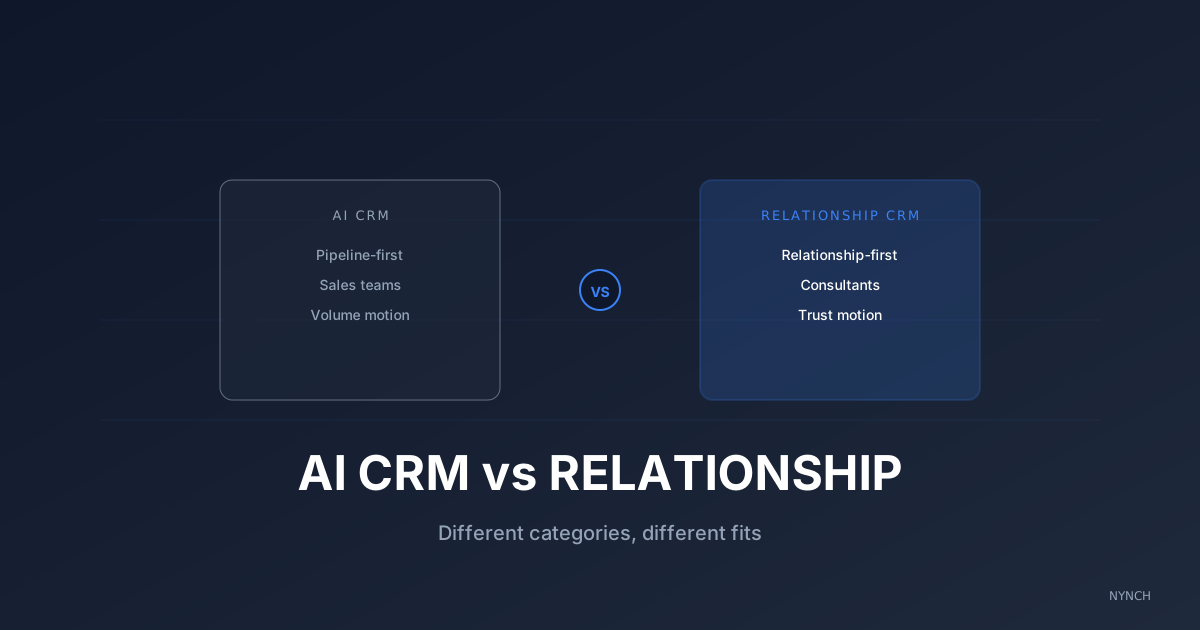
An AI CRM is a database with AI features built around the data: smart search, summary generation, predictive scoring, automated tasks. The unit of work is the record. You type things in, and the AI helps process what was typed. An AI business development platform sits above that. It watches what the team is actually doing across email, calendar, LinkedIn, and meetings, and routes opportunities to the right partner. The unit of work is the relationship. Nothing is typed in by hand.
For a boutique consultancy, the second is meaningfully more valuable. Here is why.
The four problems unique to a boutique consultancy
1. The data hygiene tax
A solo consultant maintains their own records. A 200-person firm has a CRM team. A boutique sits in the middle. There is no CRM person. There is just an expectation that every partner will log their calls. They do not. Some weeks they do. Most weeks they do not.
The cost of this is invisible until it bites. A partner leaves. The firm tries to figure out which clients they were the warm contact for. The CRM says half of them. The actual list, when reconstructed from email, was twice that. The pipeline shrinks by the gap.
An AI CRM cannot fix this. The AI works on the data that was typed in. If 60% of the relationships in your firm exist only in inboxes, the AI can summarise 40%.
An AI BD platform reads the inboxes. The data hygiene problem dissolves because nothing has to be typed in. Every email is a contact event. Every meeting is a relationship update. The firm’s institutional memory becomes the system, rather than something that depends on partner discipline.
2. The warm-path routing problem
Your firm of 12 wants to win an engagement with a fintech CFO. Question: who on the team has the strongest warm path to that person?
In most boutiques, this is answered by sending a Slack message to the whole team and hoping someone replies. Half the time the question gets ignored. A quarter of the time, the wrong person volunteers because they remember meeting the target three years ago at a conference, not because they have the strongest relationship. A quarter of the time, nobody knows the answer.
An AI CRM cannot answer this. The data is not there. Even when it is, the AI does not know how to score relationship strength across multiple team members.
An AI BD platform with warm-path routing answers it in about five seconds. It looks at every team member’s interaction history with the target contact, scores each path as strong, warm, or cool, and tells you who should make the introduction. The right partner reaches out. The wrong ones do not waste time.
3. The senior partner problem
The rainmaker. Every boutique has one or two. They have spent twenty years building relationships, they bring in about 40% of the work, and they will not share those relationships with the firm because the relationships are their job security.
This is rational. It is also a firm-level risk. If the rainmaker retires, gets sick, or leaves, the firm shrinks. The natural response is “well, let’s get them to start logging their relationships in the CRM.” That conversation does not work, and has not worked in any firm in the last twenty years.
AI BD changes the conversation. The rainmaker does not have to log anything. The system reads their inbox and their calendar. The relationships become firm assets in the background, without the rainmaker having to do anything they perceive as risky. The firm has continuity. The rainmaker still gets credit. The risk gets dissolved.
This is the single biggest BD outcome for a 10 to 30 person consultancy.
4. The junior partner visibility problem
The mirror of the senior partner problem. A junior partner joins. They cannot see who the firm knows. To pitch a piece of work, they have to ask each senior partner individually whether they have a path to a target. That makes them slow, and it makes them dependent on senior partner goodwill.
An AI BD platform with a shared team network map makes the firm’s combined network visible to everyone (with the right permissions). The junior partner can see who knows whom. They can pitch with full visibility into the firm’s actual reach. They stop being a junior. They become an effective partner faster.
For firms trying to grow past the rainmaker-dependent stage, this is the use.
What the right tool does for a boutique
The bar for a boutique-grade AI BD platform is higher than for a solo. Five capabilities matter:
- A team network graph. The firm’s combined network as one live map, with overlap indicators showing which contacts multiple partners know.
- Warm-path routing. For any target contact, the system ranks paths by strong, warm, or cool and suggests the right introducer.
- AI owner recommendations. When a new contact lands (CSV import, LinkedIn capture, signal detection), the system suggests which partner should own the relationship based on existing warm paths and current load.
- Per-seat flexibility. Full BD access for partners. Limited internal user types for delivery consultants who need read access but not full BD seats.
- Suggestion scorecard per partner. Each partner sees their own learning loop. Their AI is tuned to their voice, their way of working, their relationships. The firm sees the aggregate.
If your tool does the first three and gets per-seat right, it is a real boutique BD platform. If it stops at a shared CRM with team logins, it is an AI CRM with team features, and the four problems above will continue.
The honest order of operations
Boutiques often try to skip steps and regret it. The right order:
- Solve the typing problem first. Get the firm onto an AI CRM that reads inboxes and calendars and builds records automatically. Without this, nothing else works.
- Add the team network graph. Connect every partner. Run the first overlap audit. You will be surprised. Every boutique that does this discovers the firm knows three to five times more people than the CRM showed.
- Turn on warm-path routing. Start using it for every new piece of work. The first two months feel awkward (you have to actually ask the system before asking the team). By month three, the pattern is automatic.
- Layer in AI owner recommendations and suggestion scorecards. This is where the firm-wide learning loop kicks in. Each partner’s AI gets better. The firm’s collective BD intelligence compounds.
Skip step 1 and the rest is theatre. Most boutiques skip step 1 because the existing CRM was paid for and partners are resistant to change. Honest answer: the existing CRM is a sunk cost. The capability gap is too large.
Where Nynch fits
Nynch is the AI CRM for consultants, fractionals, and professional services firms, built for boutiques of 3 to 30 people. It reads every partner’s inbox and calendar so records build themselves. A team network graph shows the firm’s combined network as one map. Warm-path routing ranks paths as strong, warm, or cool. Owner recommendations route new contacts to the right partner. Each partner has their own AI voice profile, so drafts sound like them, not a firm template.
The four boutique problems (data hygiene, warm-path routing, senior partner risk, junior partner visibility) are solved by this stack working as one product, not five point tools wired together.
See Nynch on your firm’s network in a 20-minute walkthrough. You get the team network graph populated with your actual relationships, not generic slides.