How Fractional CFOs Manage 5+ Client Relationships Without Dropping Anything | Nynch Blog Skip to content
Pricing Blog Changelog About Sign in Talk to the founder
How Fractional CFOs Manage 5+ Client Relationships Without Dropping Anything
Fractional/Specialized June 2026 • 7 min read

How Fractional CFOs Manage 5+ Client Relationships Without Dropping Anything

How Fractional CFOs Manage 5+ Client Relationships Without Dropping Anything

The hardest part of fractional CFO work isn’t the finance. It’s tracking commitments, board cadences, and budget cycles across 5+ clients without anything slipping. Most fractional CFOs lose engagements to forgotten follow-ups and missed signals, not to bad strategy. A four-part operating system catches the drift before the drop.

Have you ever been mid-call with one client and accidentally referenced something from another?

It happens to every fractional executive who scales past three concurrent engagements. The board priorities blur. The vendor names blur. The pricing models blur. By client five, you’re spending more time recovering context than applying expertise. The engagement that ends isn’t the one where the work was bad. It’s the one where you forgot to send the benchmark report you promised three weeks ago.

If you’re managing 5+ client relationships and don’t have a system for tracking commitments, board cadences, and stakeholder changes, the question isn’t whether you’ll drop something. It’s how soon, and which client. The fix is operational, not strategic.

Instead of running on memory and hoping, what if you had a four-part system that surfaces the drift weekly?

Let’s see how.

1. Calendar segmentation by client

Visual separation prevents context bleed. Use a distinct colour per client across your calendar. Where possible, block the same day-of-week for each client (Mondays for Client A, Tuesdays for Client B) so context stays grouped.

The reason this works isn’t aesthetic. It’s that the brain needs a reset between clients, and the calendar is the cheapest reset cue available. Without segmentation, you’ll talk to Client B on Tuesday morning still half-thinking about Client A’s board agenda from Monday afternoon.

The threshold where this starts to matter is around three concurrent clients. Below that, you can hold the context. At five, you can’t.

Concrete Example: You finish a 90-minute board prep call with Acme at 11am. Your next call is Beta Industries at 11:30. You walk into Beta’s call with Acme’s pricing model still active in working memory.

Action Step:

Open your calendar this week. Pick a colour for each active client. Tag every meeting in the next 30 days. Where possible, batch meetings for the same client on the same day. Should take 20 minutes of setup, then runs continuously.

2. Per-client running document

Memory is unreliable past three concurrent clients. The fix is one Google Doc per client, updated after every meeting, and read before every interaction.

The doc has three sections. Top: last 5 board decisions made this engagement. Middle: current strategic priorities (3-5 bullets). Bottom: open commitments with owners and deadlines. Update at the end of every meeting (5 minutes), read at the start of the next one (3 minutes).

Six minutes of context-loading per client per interaction prevents most operational mistakes. The doc is also the artefact that makes you continue to look smart in month 18 of an engagement, when you’ve made hundreds of decisions and the founder has forgotten 80% of them.

Concrete Example: It’s been three weeks since your last call with Beta. The CEO asks “did we ever decide on the pricing-tier rename?” and you have no idea.

Action Step:

Open Google Docs. Create one document per active client. Add the three sections (decisions, priorities, commitments). Spend 15 minutes filling them in from memory and recent emails. From now on, update at the end of every call.

3. Weekly Say/Do audit

Every commitment you made and missed is silent damage. The fractional executive equivalent is worse than the consultant version because each engagement involves multiple senior stakeholders, and a missed commitment to one signals to the others that you’re unreliable.

The audit is a 30-minute Friday afternoon ritual. List every commitment you made this week to each client. Mark delivered, in flight, or missed. For everything missed, send a personal note acknowledging the slip and committing to a new date. The acknowledgement is what saves the relationship; the slip itself is forgivable.

Concrete Example: You promised the CEO at Beta you’d send an industry benchmark by Tuesday. It’s Friday. You haven’t sent it.

Action Step:

Search “I’ll send”, “let me get back to you”, and “I’ll circle back” in your sent emails to each active client this week. List every promise. Send the missing ones today with a one-line acknowledgement: “this slipped, here it is.”

4. Monthly champion job-change check

Your day-to-day contact at each client is rarely the only person who matters. The executive sponsor (the one who originally hired you, holds the budget, owns the outcome) is the relationship that determines whether the engagement renews. When that person moves, the engagement is in danger immediately, whether or not your day-to-day contact tells you. LinkedIn’s data on workforce mobility suggests any given senior champion has roughly a one-in-three chance of changing roles within 18 months.

Once a month, open LinkedIn for the executive sponsor at each active engagement. Look for title changes, new companies, or removal of a current role.

A champion move discovered in the first two weeks is recoverable. The same move discovered three months later is usually the end of the engagement.

Concrete Example: The COO who originally hired you at Acme just changed roles. Your day-to-day finance contact didn’t think to mention it.

Action Step:

For each active client, open LinkedIn and check the executive sponsor’s profile. Note any title change, role change, or company change in the last 90 days. For each one, schedule a 15-minute call this week with your day-to-day contact to ask how the new structure is affecting priorities.

How Nynch Helps You With This

Running this four-part system manually for 5+ clients works for about six months before the admin overhead becomes the limiting factor. Nynch automates most of it.

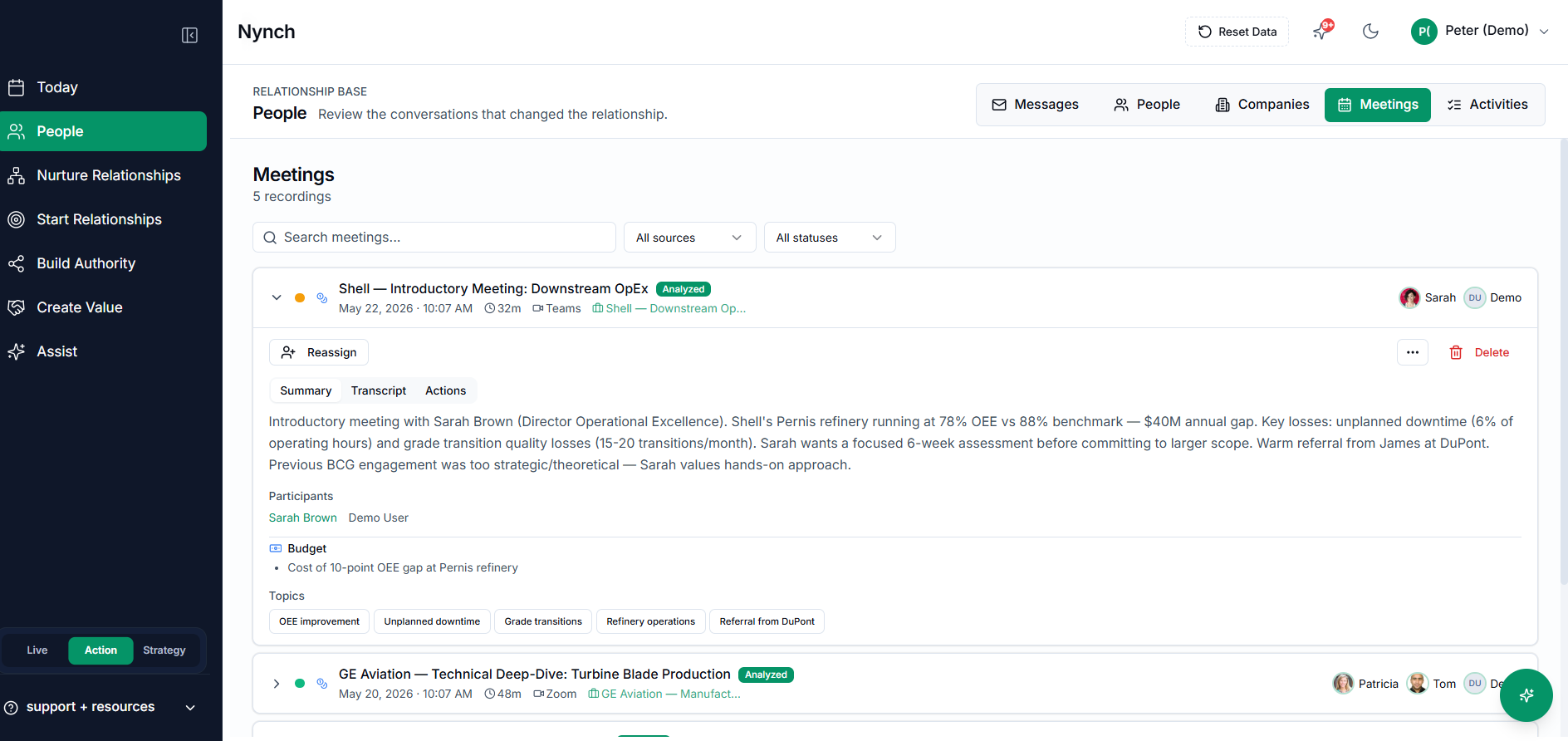
Per-client dashboards. Each client has a Client Command Centre showing record completeness, overdue promises, renewal risk, and current relationship health on one screen. The dashboard you’d otherwise build in Google Docs runs continuously without manual updates.

Automatic commitment extraction. Every “I’ll send”, “let me circle back”, and “I’ll get back to you” gets extracted from your sent emails automatically and tracked. The Say/Do Ratio per client is visible without you running the Friday audit yourself.

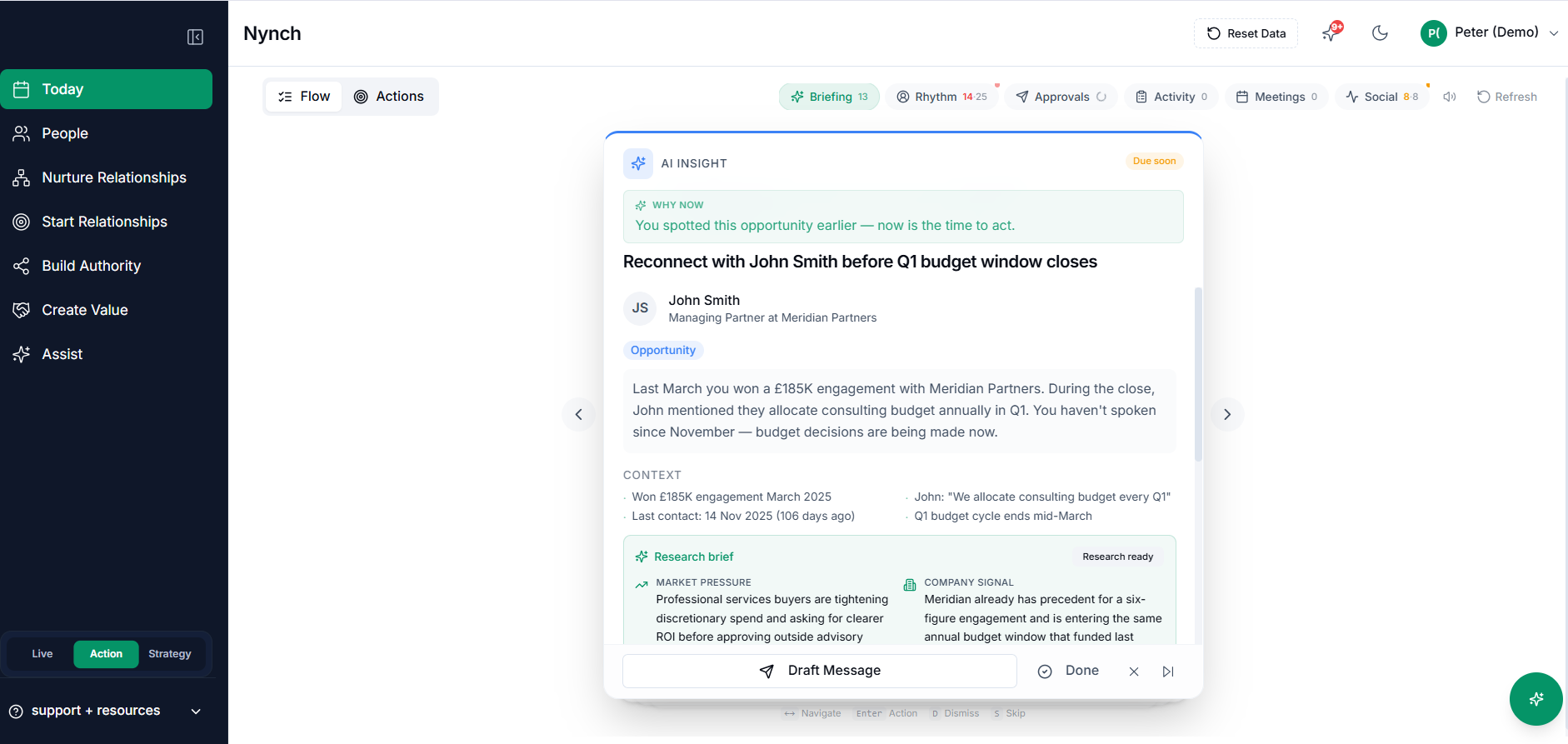
Champion change alerts. When the executive sponsor at one of your active engagements changes role or company, you get a Career Move alert within minutes. No more monthly LinkedIn sweeps.

Cross-engagement relationship continuity. When the CMO at Client A becomes a board member at Client C, Nynch keeps one continuous relationship record. Your network compounds across engagements.

Most fractional executives we talk to free up 3-5 hours a week of admin once the four-part system is automated. Book a 20-minute walkthrough and we’ll show you the dashboard on a portfolio of test clients.

Once the operational system is running, the next question is how to convert engagement endings into network expansion, because the strongest fractional executives build relationships that survive the engagement.

Frequently Asked Questions

How many clients can one fractional CFO realistically manage?

Five to eight active clients is the typical sustainable range for a single fractional CFO. Past eight, the relationship overhead (board prep, exec reviews, ad-hoc decisions) compounds faster than the billable hours. Below five, the income usually doesn’t justify the operating overhead. The right number depends on the engagement model: 0.2 FTE per client allows seven; 0.4 FTE per client caps you at four.

What’s the biggest operational risk for a fractional CFO?

Promise drift. Across five clients with two senior stakeholders each, you’re juggling roughly 20 monthly commitments. Drop two and the trust erodes silently. Most fractional CFOs lose engagements to forgotten follow-ups, not to delivery quality. A weekly Say/Do audit catches drift before it compounds.

How do fractional executives keep board context separate across clients?

Three habits work. Calendar segmentation (a colour per client). A per-client running document with last 5 board decisions, current priorities, and open commitments. And a weekly 30-minute review per client where you read your own notes before the next interaction. Without those three, context bleeds between clients and you’ll mention Acme’s pricing in a Beta Industries call.

What CRM works for fractional executives across multiple clients?

A relationship CRM where the same contact can span engagements over time, not a sales-pipeline AI CRM. The data model matters: when the CMO at Client A becomes a board member at Client C, you need one continuous relationship record, not three disconnected ones. Nynch is built for this; most pipeline-centric CRMs aren’t.

How long should a fractional CFO engagement last?

12 to 24 months is the typical productive range. Below 12 months, you don’t see strategic projects through. Past 24 months, the work shifts from strategic finance to operational finance and the company should usually hire full-time. The strongest fractional CFOs build relationships that survive the engagement (the CFO who becomes an investor, the founder who starts another company) so the network compounds across roles.

Peter O'Donoghue
Peter O'Donoghue
Founder of Nynch. Spent a decade coaching 200+ consultants on business development and built Nynch after watching great consultants lose deals not to better competitors - but to forgotten follow-ups. LinkedIn

Related reading

Free Growth Plays Guide
The Plays
That Fill
Your Pipeline
From your existing network. And the next one.

Relationship-Led Growth Plays

The 5 plays consultants and fractionals use to fill the pipeline from existing relationships and net-new contacts. Plus the hours you save when Nynch runs them for you.

Get the Plays Guide

No signup required. Delivered by the Nynch Growth AI.