Most consultants do not avoid outreach because they hate people. They avoid it because “do outreach” is not a real task.
“Reach out to people” is vague. “Follow up with contacts” is vague. “Do some BD” is the vaguest of the lot.
Vagueness creates friction. Friction creates avoidance. Learn how to structure your week to engage contacts consistently. Avoidance quietly kills utilisation.
You open your contact list or LinkedIn with good intentions and see hundreds of names, no obvious starting point, scattered notes, and old threads you barely remember.
So you do what everyone does. You answer some emails, tweak a slide, check LinkedIn, and tell yourself you will “do some outreach later”.
Days slip by without a meaningful contact. Opportunities stall because you never reopened the conversation. Warm people drift into the “too awkward to message now” bucket. Your utilisation drops and you feel more anxious about revenue.
The problem is not outreach itself. Once prepared, execute micro-outreach in just 15 minutes to stay consistent. The problem is outreach preparation.
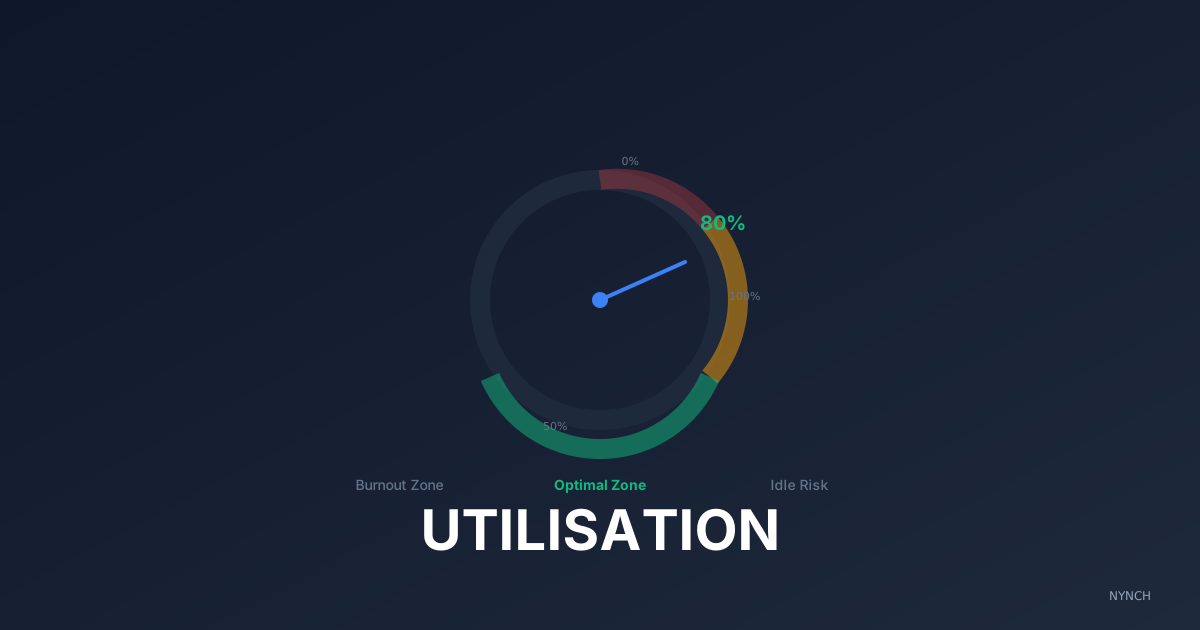
If you prepare properly, sending messages becomes light and quick. And if sending messages is light and quick, you can maintain 80%+ utilisation without heroic sales days.
Below are three practical ways to prepare outreach so you know exactly who to contact, why you are contacting them, and what to say, even on busy delivery days. Where Nynch shows up later, it is only to cut the admin that makes preparation feel heavier than it needs to be.
1. Turn “reach out” into a small, focused campaign
Most outreach plans fail because they are too broad.
“I’ll reach out to my network” sounds reasonable, but your brain hears chaos. Your network is too big, too mixed, and too unsorted. There is no edge to push against.
Instead, treat outreach as a series of small, focused campaigns.
Each campaign is built around one type of person, one type of situation, and one type of relevance.
Examples:
- “People who have moved role in the last 90 days”
- “Previous clients who now have a new boss”
- “Contacts who engaged with my content in the last month”
- “Decision-makers at companies going through visible change”
- “Warm contacts that paused 3 to 6 months ago”
Once you decide a campaign, your outreach job becomes: “Today, I am preparing messages for people who fit this pattern.”
That immediately narrows the search space, sharpens your language, makes each message feel less random, and gives your brain a clear, bounded problem.
It moves outreach from “talk to someone” to “talk to this specific group, for this specific reason”.
How Nynch supports this
Because Nynch keeps relationship context in view rather than relying on a pipeline you have to update by hand, it can surface people who fit your campaign without manual searching:
- Filter for contacts who have changed job title in the past 90 days
- Surface past clients with no activity since a certain date
- Highlight contacts who have recently viewed your profile or engaged with your content
- Bring up stalled opportunities that had strong fit but went quiet
Instead of scrolling and guessing, you open a campaign view and see a shortlist of people who match that pattern, complete with context.
Preparation starts with who, and Nynch makes the “who” obvious.
2. Build a one-page context sheet for each person before you write anything
The main reason messages feel hard to write is that you do not remember the story.
You half-remember that you spoke before, there was something about a team issue, you sent a proposal maybe, and they changed role at some point.
But you do not remember what actually mattered. So every message feels like starting again.
A much better way is to build a short context sheet for each contact before you type a single line of outreach.
This can be as simple as five bullets:
Who they are now Current role, team, responsibilities Any recent changes (promotion, company move, re-org)
How you know them How you first connected What projects or conversations you have had
What they cared about last time Problems they raised Constraints they mentioned Stakeholders who mattered
What has likely changed since then New leadership above them New business direction New pressure or visibility
What a useful next step could be A short call to reconsider options A quick review of their current situation A simple diagnostic to see whether support is needed
Once you have these five bullets, the outreach almost writes itself. You are not talking into thin air. You are continuing a very specific story.
Instead of:
“Hey, just checking in, thought of you the other day…”
You can say:
“Last time we spoke, you were trying to keep the leadership team focused through the restructuring. I noticed you’ve now taken on the wider Ops remit. Would it help to look at how the new structure is actually behaving in practice?”
Same person, same inbox, completely different impact.
How Nynch supports this
Nynch makes building these short context sheets much easier because it already holds:
- a timelined history of past calls, notes, emails and meetings
- AI summaries of previous conversations
- visible signals (role changes, company announcements, engagement)
Instead of bouncing between email, calendar, Slack, notes and LinkedIn, you see one coherent view: what they said, what you promised, what changed, and what you did or did not do.
You can scan that in seconds and turn it into the five bullets above. The “what’s the story here?” question is answered for you.
Preparation now takes minutes, not half an hour of digging through old threads.
3. Design a reusable “outreach scaffolding”, then personalise in 60 seconds
Most consultants either write every message from scratch (slow, tiring), or use generic templates (fast, but dead).
You want the middle ground: scaffolding.
Scaffolding is a reusable structure that you personalise heavily. You do not copy-paste the same email 50 times. You use the same shape while making the content feel tailored and specific.
A simple scaffolding for warm outreach:
Anchor to context “I saw you’ve just taken on the Head of Ops role.” “You mentioned on our last call that Q4 would be crunch time for the team.” “I noticed your post about the friction between Sales and Delivery.”
Reflect their situation in your own words “Stepping into a bigger remit when the organisation’s still adjusting is never straightforward.” “Trying to keep initiatives moving with that much cross-functional involvement is a lot to carry.”
Offer a concrete, low-friction next step “If it would help, I’m happy to spend 20 minutes mapping out the three or four pressure points you’re seeing and whether there’s anything you can de-load.” “We could do a short working session to examine where decisions are actually getting stuck right now.”
Set a soft frame for timing “If the next couple of weeks are packed, we can look at something early next month instead.”
You keep the structure, but you change the context, the reflection, the offer, and the timing reference.
Because you have done the prep in step 2 (the short context sheet), the personalisation is quick and natural.
You are not sending a template. You are sending a considered, human message that just happens to sit inside a familiar frame.
This makes it realistic to send 3 to 5 strong, relevant messages per day, even with a busy client load.
How Nynch supports this
Nynch can support your scaffolding in a few ways:
- It can generate an initial draft based on the context it already knows about the person and your last interactions
- It can pull in specific details (previous projects, dates, topics) so you do not have to look them up
- It can store your favourite scaffolds so you do not reinvent them every time
You still make the judgment call on tone and content. Nynch’s job is to give you a high-quality starting point so preparation takes seconds, not hours.
How This Protects 80% Utilisation
Outreach prep is not a side activity. It is directly tied to how full and stable your delivery load is.
If you run one small, focused outreach campaign at a time, build short context sheets so messages feel easy to write, and use scaffolding so you are not starting from zero each time, then reaching out to 3 to 5 people per day becomes mentally light, time-efficient, and emotionally manageable.
That rhythm, roughly 15 to 25 thoughtful outreaches per week, is more than enough to keep a solo consultant at 80%+ utilisation, provided the people you are contacting are warm, relevant, and chosen at the right moments.
That is where Nynch matters.
Because Nynch is watching for changes (new roles, engagement, drift, silence), it keeps feeding you the right people at the right time, with the story already prepared. You are no longer spending your limited mental bandwidth on finding, remembering, and reconstructing.
You spend it where it counts: writing clear, grounded, human messages and having real conversations.
With that combination, prep structure plus Nynch doing the grunt work, you do not need bursts of frantic BD effort. You can maintain utilisation calmly, week after week, on top of your delivery.
That is the real goal. A consulting business where outreach is just another part of your day, not a heroic event you dread and delay.
Read next
- Build a £500k consulting practice on relationship capital, the operational rhythm that turns a roster of contacts into a compounding business.
- Unforgettable Lessons After Trying To Run A Six-Figure Practice From An iPhone, You don’t need a laptop to be a heavyweight consultant.
- Wake up your dormant network, fill your week with warm conversations from people you already know.
Frequently Asked Questions
How do consultants maintain 80% utilisation without burning out?
The key is preparation, not volume. When you know exactly who to contact, why you are contacting them, and what to say, outreach takes 15 minutes a day rather than half a day of dreaded effort. A prepared outreach system running consistently will maintain utilisation more reliably than sporadic bursts of heavy sales activity.
What is the best outreach preparation system for a solo consultant?
Three elements work together: a focused campaign targeting one type of person in one type of situation, a micro context sheet for each contact that captures what they care about and what has changed since you last spoke, and a reusable message scaffold that you personalise in 60 seconds rather than writing from scratch.
How do I make outreach feel less overwhelming when I have a full client load?
Narrow the scope. Replace ‘reach out to my network’ with a specific, bounded task like ‘send 3 messages to contacts who changed role in the last 90 days.’ A clearly defined campaign with a short contact list is something your brain can start. an open-ended list of hundreds is something it avoids.
How many outreach messages per day does a consultant need to maintain a full network?
For most solo consultants, 3-5 well-prepared, contextually relevant messages per day - roughly 15-25 per week - is more than sufficient to maintain a steady network. The quality and relevance of each message matters far more than the raw number sent.