You open your laptop on Monday and you already feel behind.
Your inbox is full. LinkedIn is noisy. Your CRM feels like a junk drawer.
You know you should reach out to people, but you are staring at a wall of names and half-finished notes. You are not short of contacts. You are short of structure.
That is how most consultants quietly lose the week.
You do not lose because there are no opportunities. You lose because your system leaves too much to chance. Who you speak to is driven by who happens to email you, who posts on LinkedIn, or who you remember in the moment.
What that produces:
- Some people get too much attention
- Others never hear from you again
- Warm opportunities drift
- Your network feels unstable
This is not a talent problem. It is a weekly design problem.
If you put a simple rhythm in place and run it consistently, you can engage five meaningful contacts every week without drama. Over a year, that is 250 or more solid conversations. You do not need more contacts than that. You need a way to move through the ones you already have.
Engaging five new contacts every week is a structural habit, not a motivation challenge. The five pieces below are what make that volume realistic on a full delivery week: one commercial theme for the week, a daily shortlist of five people, planning kept separate from sending, outreach fitted into micro-moments rather than a heroic “BD afternoon”, and a story-level note at the end of each day.
1. Start the Week with One Clear Revenue Theme
Most consultants start their week with a list of tasks. Tasks create pressure. Themes create focus.
A weekly revenue theme is a single commercial intention that shapes who you contact for the next five working days. Instead of “I should follow up with people,” you say:
- “This week is about reactivating past clients.”
- “This week is about newly promoted executives.”
- “This week is about advancing stalled but high-fit opportunities.”
- “This week is about turning warm LinkedIn engagement into calls.”
A theme does three useful things:
- It removes the “who should I contact?” paralysis.
- It pulls your attention toward the contacts that matter this week.
- It sharpens your messages, because everyone you contact sits in the same context.
You are no longer doing random outreach. You are running a small, focused campaign each week.
How Nynch helps:
You set the theme in your own mind. Nynch then helps you find people who match it:
- Past clients with no activity in 3 to 6 months
- Contacts who just changed role or company
- Opportunities marked as “stalled” but still relevant
- People who have recently engaged with your content or emails
You are not scrolling through 500 names. Nynch pulls a focused list that fits your intention.
2. Use a Daily Five-Person Shortlist (and Nothing Else)
The human brain does not operate well when faced with choice overload. Opening a CRM and seeing hundreds of records is an invitation to put it off until tomorrow.
Instead, each day you want one thing:
A shortlist of five specific people to move forward today.
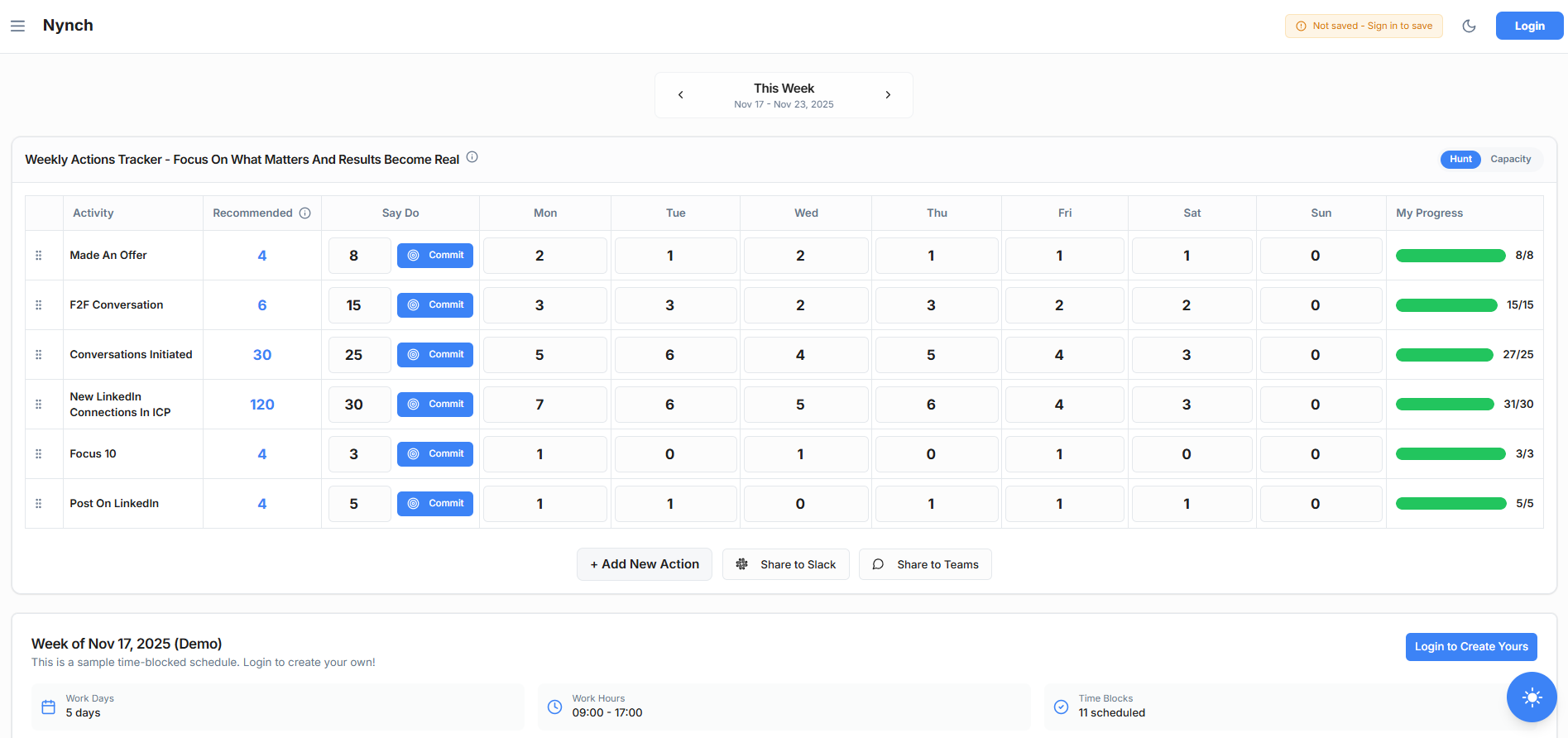
Five people is manageable. Five messages is realistic, even on full delivery days. Five conversations a day is more than enough to keep a solo consultant or small team busy with opportunity.
The structure is simple:
- Every morning, you look at a list of five names
- Each name is connected to your weekly theme
- You have clear context for each person (what happened last)
- Your only job is to move those five forward in some way
Over a week, that is 25 people. Over a month, 80 to 100. You do not need more volume than that. You need consistency.
How Nynch helps:
Nynch automatically:
- Surfaces a “Today” list of priority contacts based on signals and theme
- Shows you why each person is on the list (job change, engagement status, recency)
- Lets you open the full relationship timeline in one click
No searching, no filtering, no guessing. Five people, clearly explained, every morning.
3. Separate Thinking from Sending
Outreach feels heavy when you try to do two different jobs at once:
- Deciding what to say
- Actually sending it
These are different mental modes. Mixing them adds friction.
A better pattern is:
Morning: thinking work
- Review your five-person shortlist
- For each contact, write a one-line intention
- Example:
“Revisit Q2 planning after their promotion”
- Example:
“Turn last week’s comment into a conversation”
Afternoon: sending work
- Turn those one-line intentions into messages
- Send all five in a 20 to 30 minute block
- Log next steps inside Nynch immediately
When you decide in advance what you want from each interaction, the message almost writes itself later. You remove the blank-page feeling.
How Nynch helps:
Nynch reduces the thinking load by:
- Summarising recent interactions for each contact in a few lines
- Highlighting key topics you discussed last time
- Suggesting prompts you can adapt (“Follow up on X”, “Ask about Y initiative”)
You still decide what to say, but you are never staring at an empty box wondering where to begin.
4. Build Outreach into Micro-Moments, Not “BD Sessions”
Consultants often postpone outreach because they frame it as a big block of work:
“I need a whole afternoon to do business development.”
In reality, most meaningful touches take under two minutes:
- Congratulating someone on a new role
- Reacting thoughtfully to a post they wrote
- Sending a short note after they comment on your content
- Forwarding a useful link with one line of context
- Following up on a previous conversation with a single question
If you rely on large chunks of time, life will always win: client emergencies, meetings, travel, fatigue. Micro-moments are how you make progress inside a real week.
The weekly rhythm is then:
- Five people per day
- Short, specific touches
- Often sent between other tasks
There is no “switch into BD mode” barrier. It is just part of how you show up professionally.
How Nynch helps:
Nynch watches for:
- Job changes and promotions
- New posts and visible engagement
- Opens and clicks on your existing messages
- Periods of silence after previously warm interaction
It turns those events into suggested micro-moments:
- “They were promoted last week - send a quick congratulations.”
- “They interacted with your post - turn it into a conversation.”
- “They opened your last email twice - nudge with a clarifying question.”
You are not forcing outreach. You are responding to live signals.
5. End the Day by Capturing the Story, Not Just the Task
Many CRMs are full of vague tasks:
- “Follow up in two weeks”
- “Check in Q3”
- “Revisit later”
A week later, those notes are meaningless. You have no idea what “later” refers to, what you were thinking at the time, or why the contact mattered.
Instead, capture the story:
- What happened last?
- What did they say?
- What did you notice about their situation?
- What is the likely next inflection point?
- What would make it natural to reach out again?
Example of a poor note:
“Follow up in June.”
Example of a useful story note:
“They are consolidating agencies after the new COO arrived. Likely to revisit external support once the new structure settles. Good moment to reach out in early June once the reorg is announced.”
One sentence of context now saves 20 minutes of confusion later.
How Nynch helps:
Nynch:
- Attaches call notes, email threads, and message history to one timeline
- Lets you add short context notes directly after each interaction
- Automatically links signals (like job changes) to your existing story
So when you come back three months later, you see why this person mattered and how you were thinking about them, not just a lonely reminder.
Bringing It All Together
A strong consulting week is not about heroic effort. It is about light, repeatable structure:
- One theme that shapes your commercial intent
- Five people a day instead of an overwhelming database
- Thinking in the morning, sending in the afternoon
- Micro-moments of outreach built into your real schedule
- Story-based notes that preserve momentum over time
Run that simple system and you will:
- Stay in front of the right people
- Make use of your network instead of hoarding it
- Keep your network moving without pressure
- Feel more in control of your revenue
With Nynch alongside you, surfacing signals, summarising context, and turning your historical interactions into a relationship map you can act on, you no longer have to fight your CRM.
Your week stops being foggy. You know who matters. You know why. And you have everything you need in front of you to actually act.
Read next
- Build a £500k consulting practice on relationship capital, the operational rhythm that turns a roster of contacts into a compounding business.
- Even If You Hate Admin, You Can Build A Flawless Database With This 3-Step “Zero-Type” Protocol, Data entry is the reason you procrastinate on outreach.
- Wake up your dormant network, fill your week with warm conversations from people you already know.
Frequently Asked Questions
How do I structure my consulting week to consistently engage new contacts?
Start each week with a single revenue theme that shapes who you reach out to. Build a daily shortlist of five specific contacts, separate morning planning from afternoon sending, fit outreach into natural micro-moments rather than forcing a dedicated BD session, and win each day by capturing a story-level note rather than a vague task. This rhythm keeps the network moving without overwhelming a full delivery schedule.
Why does setting a weekly revenue theme improve outreach results?
A weekly theme removes the paralysis of choosing who to contact from a large database. When you have decided that this week is about reactivating past clients or reaching newly promoted executives, the relevant contacts surface naturally. Your messages are also sharper because everyone you contact exists in the same context, which makes the outreach feel targeted rather than generic.
How many new contacts should a consultant aim to engage per week?
Five new or re-engaged contacts per day - 25 per week - is a sustainable and effective volume for most solo consultants and small practices. This is not about sending mass messages. it is about making five deliberate, contextually relevant contacts each day through a combination of emails, LinkedIn messages, voice notes, and comments.
What should I write in my CRM notes to make follow-up easier three months later?
Write a story, not a task. ‘Follow up in June’ tells you nothing. ‘They are consolidating agencies after a new COO arrived - likely to revisit external support once the reorg settles, good to reach out in early June’ gives you everything you need to re-engage with relevance and confidence. One sentence of context now saves twenty minutes of reconstruction later.