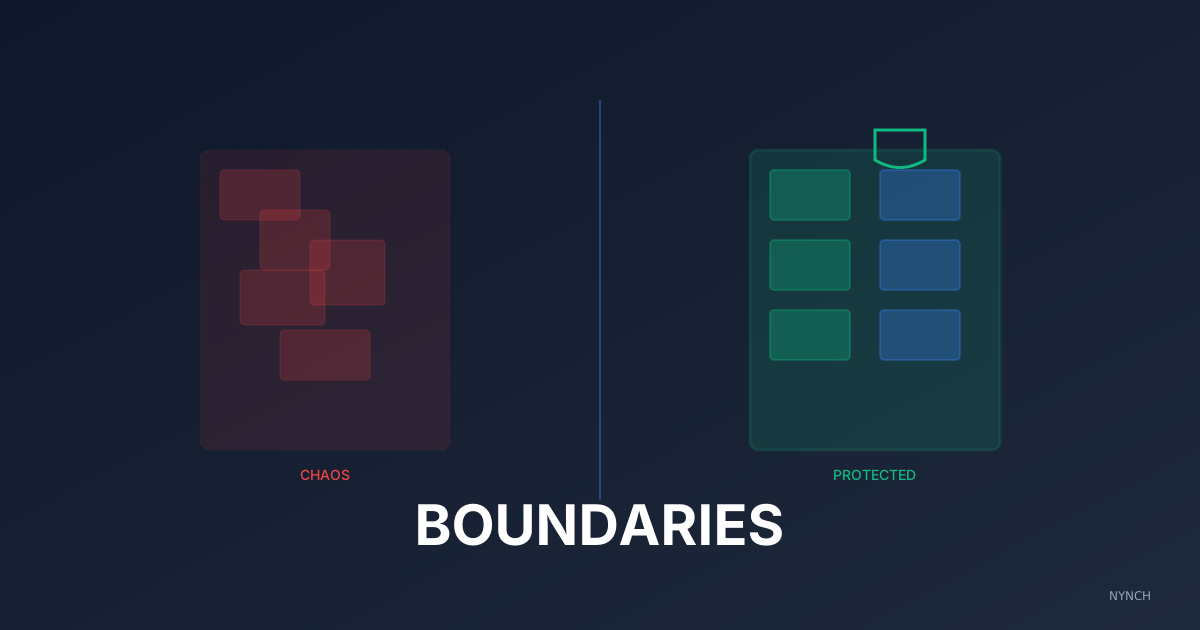
Every time you answer a non-urgent client message during your growth block, you choose present comfort over future revenue, and you train the client to expect more of the same. Boundaries are not about being difficult. They are how you stay in business after the current engagement ends.
You sit down to do your own business development. You finally have an hour of quiet. Then, ping. A client messages you on Slack: “Quick question.” You know it will not be quick. You know that if you answer, you will get pulled into a forty-five-minute thread. You are also afraid that if you do not answer instantly, they will think you are lazy or unresponsive. So you answer. The hour vanishes.
If you treat every client message as an emergency, you teach them that you have no boundaries. You train them to expect instant access. That eats future revenue because you sacrifice the time needed to find new clients in order to service the current ones. Learn how to shift from delivery mode to growth mode to protect your network.
High-value consultants are respected for their time, not only for their speed. Here are three ways to hold that line without blowing up the relationship.
1. The “Pavlovian Training” to reset expectations
Clients are a bit like toddlers. They push boundaries to find where the wall is. If you reply to a non-urgent Slack message in thirty seconds, the wall is paper. You have taught them that you are always available.
During your growth blocks, delay on purpose. If they message you at 2:15pm while you are on sales time, do not reply until 3:00pm. A consistent lag retrains them. They learn you are not an instant-messaging bot.
What you get back is respect. Consultants who are hard to get are usually seen as more valuable than people who sit around waiting for a ping. That is also why knowing if you’re neglecting your future network matters. Boundaries protect growth time.
Concrete example: the client messages:
“Can you look at this?” You see it. You do not type. You wait forty-five minutes. Then you reply:
“Just seeing this now - was in a deep work block. On it.”
Action Step:
Turn off all notifications on your phone and laptop for the next sixty minutes. Do not check them. It will feel uncomfortable. Do it anyway.
2. The “Asynchronous Default” to kill the chat
Real-time chat is a productivity killer. It fractures attention.
Move conversations from Slack or Teams (real-time) to email or video (async) whenever the topic is bigger than a yes or no. If a client asks a complex question on chat, reply:
“This is a great question, but too complex for chat. I’ll record a Loom video and email it to you by end of day.”
You choose when you do the work. You protect the current block and batch the client work for later.
Concrete example:
“Great point, Mike. I want to give this proper thought. I’ll send a structured email on this later this afternoon.”
Action Step: Create a text shortcut on your computer that says:
“In deep work right now, will reply fully by 5 PM.” Use it next time you get interrupted.
3. The “Visual Barrier” to signal unavailability
If you share a calendar or status with clients, use it as a shield.
Mark your sales time as “External Meeting” or “Strategy Block” on shared calendars. Set your Slack status to Away or Focus Mode.
People self-censor when the signal is clear. They see the icon and decide not to interrupt you right now.
Concrete example: Status: Focused Work. Back at 3 PM.
Action Step:
Go to your calendar. Mark your business development time as Private. Go to Slack. Pause notifications until your block is done.
How Nynch Helps You With This
Maintaining boundaries is hard when your tools are built to interrupt you.
Nynch is designed to protect that focus.
A separate space: Nynch is a standalone app, not a browser tab. When you are in it, you are not staring at email or Slack unread counts.
Batched outreach: Nynch encourages you to do outreach in focused bursts, so you can switch off other notifications knowing you are still being productive.
A reminder of the stakes: By showing the potential value of your network, Nynch reminds you why you are not jumping on every client ping. Your future business is worth protecting.
Read next
- The client command centre, the dashboard consultants actually open every morning to spot risk and expansion early.
- 5 Ways To Schedule Review Calls To Align On Goals For The Next Term, The renewal meeting is the most important call of the year.
- Nynch for fractional leaders, how fractional CFOs, CMOs, and COOs build proactive pipeline, protect against cancellation and create more value for clients.
Frequently Asked Questions
How do I stop clients from consuming all my business development time?
Create non-negotiable ‘growth blocks’ in your calendar and treat them like client commitments - because they are commitments to your future clients. Respond to non-urgent client messages at the end of the block, not in real time. Every instant response trains clients to expect instant access.
How do I set response time expectations with consulting clients?
The simplest approach is to establish a stated turnaround time at the start of engagement - for example, ‘I respond to messages within 4 hours during business hours.’ Clients who agree to this upfront rarely complain when you do not reply in 10 minutes, because the expectation was set correctly from day one.
Is it unprofessional to not reply immediately to client messages?
No - in fact, instant availability signals low demand and can undermine your perceived value. High-value advisors are hard to reach because they are in high demand. Deliberate response delays during focused work blocks are a professional discipline, not a failure of client service.
How do consultants protect time for business development when client work is heavy?
Treat business development time as billable time - block it first in the week before client work fills the calendar. A single contact email sent before opening the client inbox is more sustainable than trying to find business development time at the end of an exhausting delivery day.