Most consultants have hundreds of LinkedIn connections and still freeze when it is time to do business development. You open the app, scroll names, and cannot decide who gets the first message. The Daily Relationship Review is the 10-minute fix I use for that: sort your network into four groups (High Trust/High Fit, Medium Trust/High Fit, Referrers, and Hot 100) so you know who deserves attention and when. It sits on top of frameworks from David A. Fields and Chet Holmes. Below is where it comes from, why it works, and how to run it today.
“Just grow your network.”
“Connect with more people.”
“Your net worth is your network.”
That advice has been paralysing consultants for a decade. A bigger network is not a better network. An unorganised network is barely a network at all.
I learned this the hard way.
2,347 Connections. Zero Clarity.
When I started my sales training company [many, many years ago], I had what looked like a decent network. Former colleagues from two companies and past clients. People I had met at conferences, on panels, through introductions.
Every few months someone would send a connection request and I would accept. Another name on the list.
More connections = better network, right?
Then my first major client engagement ended. My network was thin. Time to do some business development.
I opened LinkedIn. Stared at the screen. Scrolled through names.
Where do you even start? Who do you reach out to first? The decision paralysis was overwhelming.
I would recognise some names. Struggle to remember others. Draft a message, delete it, draft another. An hour would pass and I would have sent exactly zero outreach.
“I have a network,” I thought. “So why does it feel like I am starting from zero every time?”
The answer, it turned out, had been worked out decades earlier. I just had not learned it yet.
The Myth of “More Connections”
Most professionals run on an unspoken belief about networking:
“More connections = better network. The bigger my LinkedIn, the more opportunities I will have. I should keep adding people and eventually the network will work for me.”
It feels logical. Is a larger network not more valuable? More people who might hire you, refer you, or connect you to opportunities?
What that belief misses: when every contact is treated equally, you end up treating all of them poorly.
You spend energy on people who cannot help your business while neglecting the relationships that actually matter. The network becomes a weight instead of an asset.
After watching this pattern in 200+ consultancies over 15 years, I have concluded prioritisation is not optional. It is the whole game.
David A. Fields and the 100 Relationship Thesis
The book that changed how I think about this was David A. Fields’ The Irresistible Consultant’s Guide to Winning Clients. Fields makes a claim that initially sounds absurd:
100 strong relationships with decision-makers is enough to sustain a healthy consulting practice.
Just 100. Not 1,000. Not 2,347. One hundred.
Fields is precise about what he means. He categorises contacts along two independent dimensions.
The Relationship Dimension (A/B/C)
This measures how well someone knows you:
A contacts return your calls within a day, consider you a trusted resource, and will take your meeting.
B contacts definitely know who you are but do not think of you as a go-to expert.
C contacts have minimal or no existing relationship with you.
The Influence Dimension (1/2/3)
This measures their ability to generate business:
1s have “power of the purse” - they can directly say “yes” to hiring your firm.
2s are influencers - they can introduce you to decision-makers or have broad reach (journalists, podcast hosts, association leaders).
3s are neither - they cannot buy and cannot meaningfully refer.
The matrix creates six categories, but three matter most:
A1s (strong relationship + buying authority),
A2s (strong relationship + referral power), and
B1s (potential buyers who need relationship warming).
Fields calls this the “Network Core” - the 100-300 relationships where consultants should focus their business development energy. Everything else falls outside the core.
His math: build 300 A1 relationships and you can power a £50 million firm. The contacts themselves are not scarce. The categorisation and systematic cultivation is what most consultants skip.
Chet Holmes and the Priority Accounts
Chet Holmes arrived at the same principle from a different angle.
Working for Charlie Munger’s legal publishing company in the 1990s, Holmes faced a marketing challenge: 2,200 potential advertisers in a fragmented market. The conventional approach would be to market broadly, touch everyone, and hope some convert.
Instead, Holmes analysed the data and found that 167 companies represented 95% of the market’s purchasing power. The rest - over 2,000 companies - controlled just 5% of the spend.
He abandoned broad marketing entirely. All resources focused on those 167 accounts with relentless, persistent outreach.
The result: he doubled sales across nine divisions within 12-15 months.
Holmes codified this approach in The Ultimate Sales Machine as the “Priority Accounts” strategy. The principle, rooted in Pareto’s 80/20 rule: 20% of potential buyers typically generate 80% of revenue. Focus there.
Holmes emphasised what he called “Pig-Headed Discipline” - persistent, systematic outreach over months, not weeks. His foundational case study: four months of outreach before winning the first Priority Accounts account (Xerox, which became the largest sale in industry history). He then won 28 more Priority Accounts accounts in the following five months.
The “100” was a guideline, not a rigid rule. Holmes originally worked 167. Modern practitioners adapt from 25 to 250 depending on capacity. The principle remains: identify your highest-value targets and pursue them with systematic persistence.
Why We Get Prioritisation Wrong
If prioritisation is so clearly valuable, why do more consultants not do it?
Fields identified two cognitive biases that systematically distort how we evaluate our networks. I have seen both play out hundreds of times.
Familiarity Bias causes us to overrate contacts we like talking to. As Fields writes, “as your relationship with a contact deepens, your belief that they can help your consulting firm win business increases disproportionately.” The friendly CEO in the wrong industry gets mentally promoted to A1 when they are actually A3 - strong relationship but zero business potential.
Direct Connection Bias makes us discount contacts who do not work at potential clients. An industry journalist (A2) gets deprioritised because they cannot directly hire us, even though a single mention could expose our work to hundreds of decision-makers.
Research on sales organisations points the same way. One study found that sales professionals consistently overestimate their network quality. Anchoring bias and sunk cost fallacy play a part: having already invested time with a contact, most sellers are reluctant to let them go, even long after they logically should have.
These biases are not moral failings. They are how human brains work. Without a simple categorisation that forces an honest assessment, we drift toward comfortable relationships instead of valuable ones.
What 30 Years Taught Me About These Frameworks
Both frameworks - Fields’ A1/B1/A2 matrix and Holmes’ Priority Accounts - are proven. They work.
But after applying them with hundreds of consultancies, I have learned they share a weakness:
they are static snapshots that do not automatically update.
Contact data rots quickly. People change roles, companies, and priorities constantly, and it happens fastest in fast-moving industries like technology. The categorisation that made someone a perfect A1 in January may be completely wrong by March.
Neither framework has a mechanism for detecting when:
→ A contact changes companies (often their most receptive moment)
→ An organisation secures new funding or enters a budget cycle
→ Competitive dynamics create sudden urgency
→ A contact posts about challenges that map to your expertise
And neither addresses when to reach out - only who to prioritise.
That is why combining buckets with signal detection is so useful. You know who matters (the buckets) and when they are receptive (the signals). More on that later.
The Daily Relationship Review: A Practical Synthesis
Drawing on Fields, Holmes, and 15 years of testing with consultancies, I use a simplified categorisation system for solo consultants and fractional executives.
Four buckets. That is it.
Bucket 1: High Trust / High Fit
Definition: People who know you well AND match your ideal client profile. They would take your call, they could hire you, and they have the kinds of problems you solve.
Fields equivalent: A1s
Action: These contacts get your first and best attention. When you spot a quiet signal from someone in this bucket, you act immediately. Your best outreach starts here.
Target: Build toward 100+ contacts in this bucket - Fields’ thesis for a sustainable consulting practice.
Bucket 2: Medium Trust / High Fit
Definition: They match your ICP - right company size, right industry, right problems - but the relationship needs warming. They know who you are but may not take your call today.
Fields equivalent: B1s (“A1s in waiting”)
Action: Systematic relationship building. Engage with their content on LinkedIn. Send occasional value. Your goal is to warm these into High Trust over 3-6 months.
Target: This is your growth runway. Every B1 that converts to A1 strengthens your long-term foundation.
Bucket 3: Referrers
Definition: They may never buy from you, but they have reach. People inside high-fit companies who can refer you in but not buy directly. Journalists who cover your industry, podcast hosts, association leaders, connectors who know everyone, and complementary service providers who serve your ICP.
Fields equivalent: A2s
Action: Nurture the relationship. Be helpful to them. Share their content. Make introductions. A single referrer can generate more opportunities than 50 direct contacts - but only if they think of you when opportunities arise.
Watch for: Direct Connection Bias. Your brain will deprioritise referrers because they “cannot buy.” Resist this. Referrers are force multipliers.
Bucket 4: Hot 100
Definition: Your Priority Accounts in the Chet Holmes sense. Aspirational targets who would transform your business if won. They may not know you yet - but they are worth systematic, persistent pursuit.
Holmes equivalent: The Priority Accounts
Action: Multi-touch campaigns over months. Engage with their content. Send personalised value. Request nothing at first. Just build familiarity. Holmes’ research showed 80% of business is won on the 5th to 12th contact, yet only 10% of professionals follow up after three touches. I have not done the research, but I would guess that for consultants that figure may be as low as 1%. Be persistent.
Patience required: Holmes’ first Priority Accounts win took four months. When he set up his own consultancy he pursued Jay Abraham for over 5 years before they became business partners. These are long-game relationships.
The 10-Minute Bucket Exercise
Here is how to run The Daily Relationship Review yourself:
Step 1: Pull 50 contacts. Open LinkedIn or your inbox. Pick 50 people you have interacted with in the past 12 months. Do not overthink the selection - just grab 50 names.
Step 2: For each contact, ask two questions.
Trust: Would they take my call or meeting request within a week? (High/Medium/Low)
Fit: Could they hire me or refer me to someone who could? (High/Low)
Step 3: Assign to buckets.
High Trust + High Fit → High Trust / High Fit bucket
Medium Trust + High Fit → Medium Trust / High Fit bucket
High Trust + Broad reach (but will not buy) → Referrers bucket
Aspirational targets (any trust level) → Hot 100 bucket
Step 4: Look at what you have got. How many High Trust / High Fit? That is your current foundation. How many Medium Trust / High Fit? That is your growth runway.
The exercise takes about 10 minutes for 50 contacts - roughly 12 seconds per decision. Do not deliberate. Go with your gut. You can always recategorise later.
I Do This Monthly
Here is something I should admit: I am not above my own advice.
Every month, I re-run The Daily Relationship Review on my network. Because buckets change.
That B1 who just got promoted to CEO? Now they are an A1. That A1 who left the industry? Time to move them out of the core. That referrer who started a podcast? Their influence just multiplied - maybe the time is right for more attention.
Categorisation is not a one-time exercise. It is a lens you keep polishing.
And honestly, I find it clarifying. Ten minutes every month to look at my network and ask: “Who really matters here? Where should I be spending my energy?”
What Changed for Me
After I learned this, I ran The Daily Relationship Review on my first 100 LinkedIn connections.
The results surprised me: only 7 landed in High Trust / High Fit. 7. From 100 connections. Another 12 went into Medium Trust / High Fit. The rest were either Referrers, potential Hot 100 targets, or, honestly, contacts that did not fit any strategic bucket.
But now I had clarity. Those 7 High Trust / High Fit contacts became my priority for relationship building. The 12 Medium Trust / High Fit went into a systematic engagement campaign. I picked 20 aspirational targets for my Hot 100.
When I sat down for my Monday outreach block, there was no decision paralysis. No scrolling through thousands of names hoping one would feel right. I knew exactly who deserved attention and why.
That is what categorisation gives you. Not more contacts - better relationships with the contacts that count.
What Becomes Possible
Picture this: you sit down for your Monday outreach block. Instead of facing an overwhelming list of contacts, you see four clean buckets.
You scan your High Trust / High Fit bucket for signals. One contact posted about scaling challenges. You draft a short, specific message - takes 90 seconds.
You check your Hot 100. Time to send your monthly value-add to the three aspirational targets you are cultivating.
You glance at Medium Trust / High Fit. Your nurture sequence is running. One contact engaged with your last piece, so you flag them for personal outreach next week.
Total time: under 30 minutes. You know exactly who matters, exactly what stage they are at, and exactly what action makes sense.
No decision fatigue. No wasted energy on contacts who cannot help. No guilt about neglecting relationships that actually matter.
That is what bucketing gives you. Not more contacts, but better relationships with the contacts that count.
Start Today
Fields, Holmes, and decades of practice all point to the same truth: prioritisation is not optional. A network without categorisation is just a list of names. The right 100 relationships matter more than 2,000 random connections.
Run The Daily Relationship Review today. Take 50 contacts and categorise them. It takes 10 minutes.
When you are done, look at your High Trust / High Fit bucket. Those are the relationships that will sustain your practice. Those are the people who should be getting your attention first. Those are your 100.
Build from there. Re-categorise monthly as relationships evolve. Convert B1s to A1s through systematic cultivation. Pursue your Hot 100 with Holmes-style persistence.
The frameworks exist. The only question is whether you will apply them.
Frequently Asked Questions
What is The Daily Relationship Review?
The Daily Relationship Review is a contact prioritisation framework for consultants and fractional executives, synthesised from David A. Fields’ A1/B1/A2 matrix and Chet Holmes’ Priority Accounts strategy. It organises your network into four buckets - High Trust/High Fit, Medium Trust/High Fit, Referrers, and Hot 100 - so you know exactly who deserves your attention and when.
How long does The Daily Relationship Review exercise take?
The exercise takes approximately 10 minutes for 50 contacts - about 12 seconds per decision. You categorise contacts on two dimensions: trust level (would they take your call?) and fit (could they hire or refer you?). Speed matters - overthinking defeats the purpose.
How often should you run The Daily Relationship Review?
Monthly. Contact data decays quickly - people change roles, companies, and priorities. A monthly review ensures your High Trust/High Fit bucket reflects current reality, not relationships that were warm six months ago.
How does Nynch automate The Daily Relationship Review?
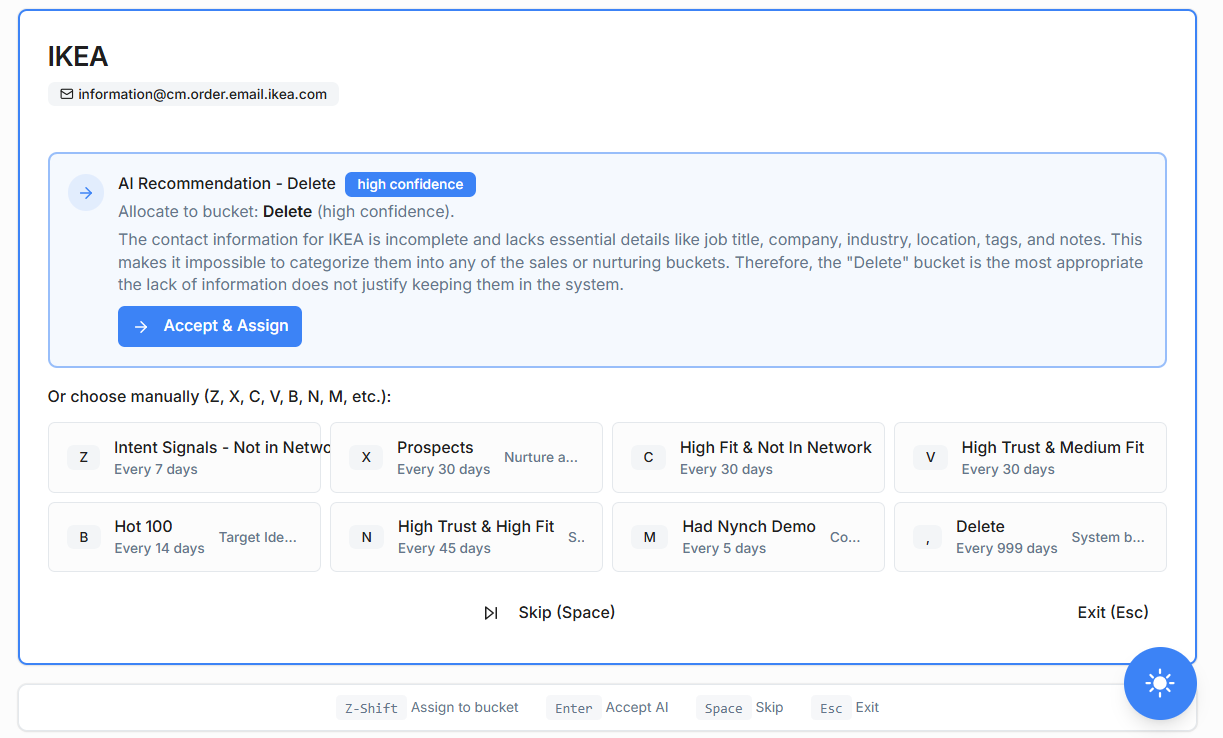
Nynch imports your contacts from LinkedIn, Gmail, and other sources, then suggests bucket assignments based on your ICP and interaction history. You can categorise 50 contacts in under 3 minutes using keyboard shortcuts. The system then monitors each bucket automatically - alerting you when a Hot 100 target posts about a problem you solve, or when a High Trust contact hasn’t heard from you in 90 days.
Who developed the frameworks behind The Daily Relationship Review?
The Daily Relationship Review synthesises two proven frameworks: David A. Fields’ relationship/influence matrix from The Irresistible Consultant’s Guide to Winning Clients, and Chet Holmes’ Priority Accounts strategy from The Ultimate Sales Machine. Both authors have spent decades researching what makes professional service firms grow.
Read next
- Your CRM should not do more, it should pay attention, why most CRMs fail consultants and what relationship-led growth replaces them with.
- Why “Documenting” A New Contact Is Actually More Important Than The Initial Meeting Itself, The meeting starts the relationship, but the record keeps it alive.
- The best AI CRMs for consultants, a side-by-side comparison of every serious option for solo consultants and boutique firms.