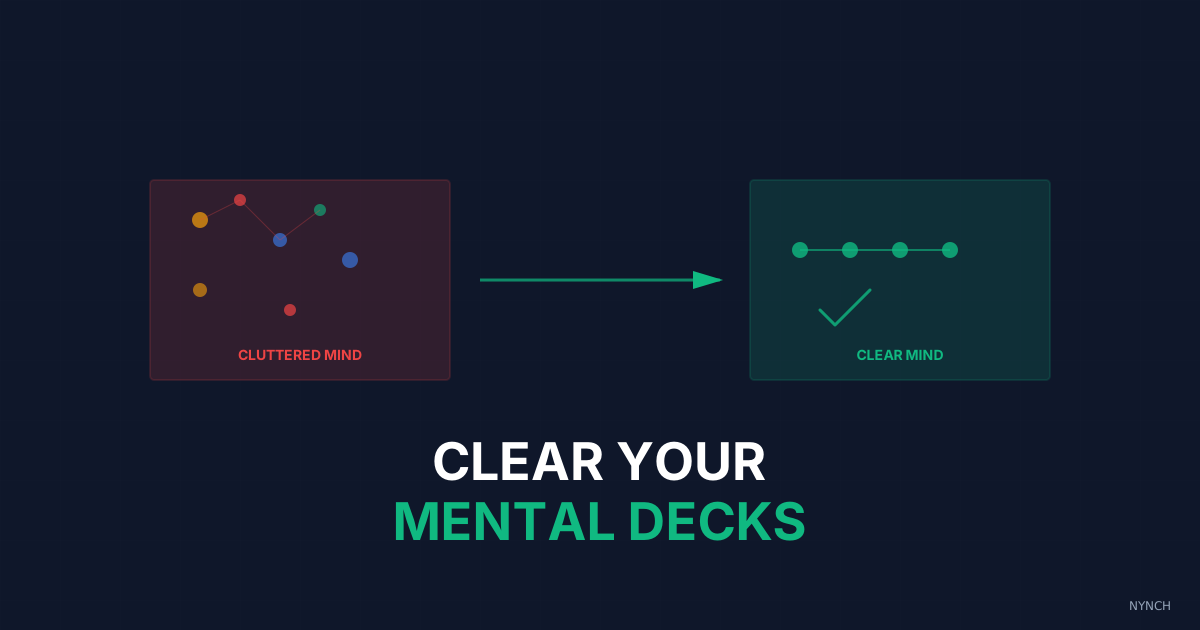
Presence in a client meeting is not a personality trait. It is the result of deliberate preparation. When you empty your mental backlog into a trusted system before you walk into the room, you free your full attention for the conversation. The result is deeper listening, sharper questions, and the kind of calm authority clients read as expertise.
In most pitches you are not fully listening to the client. You are listening to the voice in your head.
The client is explaining their problem. Your internal monologue is louder: call the bank, reply to Steve, did you lock the back door. You nod. You are not really there. You miss the nuance. You miss the readiness signal, the small shift that tells you they are open to a next step.
What people call executive presence is mostly the ability to be fully in this conversation. You cannot do that if your brain is still holding unfinished tasks from earlier or open loops for later. Clearing the decks in the hotel lobby is not admin for its own sake. It is performance preparation. Here is why a quiet mind wins more work.
When your mind is quiet, you hear the subtext. You notice the client hesitated when they mentioned the budget. You notice they looked at their colleague when you mentioned the timeline. Those small signals are often where the engagement is won or lost. If your brain is noisy, you miss them.
A cluttered mind falls back on scripted questions. “What is your budget?” A clear mind asks from the flow of what was just said. “You mentioned X earlier. Does that conflict with Y?” That synthesis in real time is what signals real expertise. It shows you are working with their material, not running a checklist.
Anxiety is contagious. If you are stressed about your to-do list, the client feels the distraction even if they cannot name it. Calm is contagious too. When you sit with full focus on them, they feel safer. Trust rises. Clearing your tasks before the meeting lowers your own noise and raises how you land in the room. I will concede the limit: this does not fix weak expertise or a bad offer. It only makes the expertise you already have fully available.
There is a second payoff after the meeting. Because you cleared the backlog beforehand, you have mental space to process next steps immediately. You do not walk out into a pile of fires. You walk out ready to send the follow-up while the conversation is still sharp.
You still need somewhere to put the noise, or it stays in your head. Nynch works as a parking lot for that. Quick capture: swipe to park a task (“Call bank”) and it is out of your head into a system you trust. Before a meeting, toggle meeting mode so other tasks and alerts hide. You only see the client’s face and history. The tool does not make you present. It removes the competing claims so you can be.
Read next
- The client command centre, the dashboard consultants actually open every morning to spot risk and expansion early.
- The Hidden Cost of Letting Client Relationships Go Cold, When you don’t hear from a client for six months, something changes in their head.
- Nynch for fractional leaders, how fractional CFOs, CMOs, and COOs build proactive pipeline, protect against cancellation and create more value for clients.
Frequently Asked Questions
Why does clearing mental tasks before a meeting improve client outcomes?
When your mind is holding unresolved tasks, part of your cognitive capacity is occupied with tracking them rather than processing what the client is saying. Emptying that backlog into a trusted capture system before the meeting frees your full attention for the conversation, which means you catch the subtle signals - the hesitation on budget, the glance between colleagues - where the real sale is won.
What is executive presence and how do consultants develop it?
Executive presence is the ability to be entirely in the present moment of a conversation - listening deeply, responding to what is actually being said rather than what you expected to hear, and projecting calm confidence. It is developed through preparation: clearing your mental to-do list before the meeting so your internal monologue is quiet and your full attention is available.
How does pre-meeting preparation affect the quality of questions a consultant asks?
A consultant with a cluttered mind asks questions from a prepared script because they lack the bandwidth to synthesise in real time. A consultant who enters the meeting with a clear head asks questions based on what the client just said - connecting earlier statements, noticing contradictions, and probing where the client hesitated. This real-time synthesis is what signals genuine expertise.
How should a consultant use the time between meetings to prepare mentally?
Use a trusted capture system to offload every open mental loop - tasks, reminders, ideas - so your brain can release them. Then spend the remaining minutes before the meeting reading one brief context note about the client. This two-step process switches your brain from background processing mode to present-focus mode, which is where high-performance consulting happens.