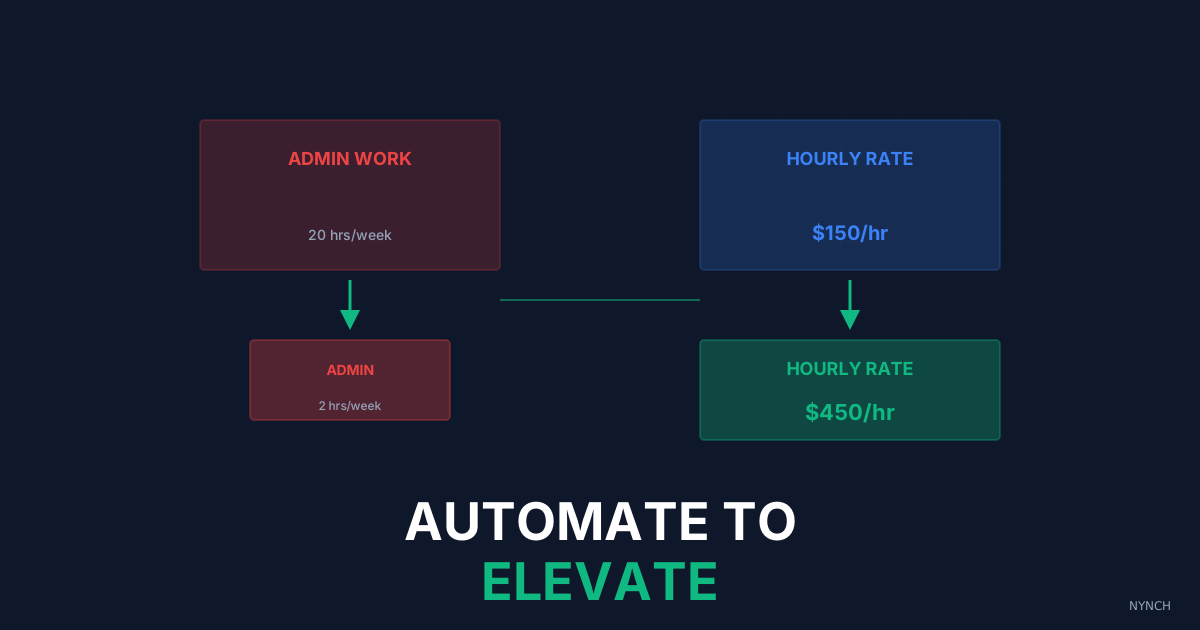
Your effective hourly rate is your fee divided by total hours worked, including all the unbillable admin time. Automating data entry cuts the denominator without reducing the numerator. The result is more revenue per hour of effort, the ability to manage a far larger network as a solo operator, and better client work because you arrive at strategy sessions fresh rather than drained by repetitive tasks.
You can give yourself a pay rise without raising your prices.
You charge £1,000 a day. But you work twelve hours to earn it because four of those hours go on unbillable admin. Your effective hourly rate is far lower than your billed rate. You feel overworked and underpaid despite fees that look healthy on paper.
The only reliable way to raise the effective rate without changing the price is to reduce the denominator. Keep the fee. Cut the hours. The easiest hours to remove are admin hours. When data entry stops eating your evenings, each hour of real effort pays more.
That is why automation is a profit strategy, not only a time-saving trick.
1. Scalability Without Headcount
If everything is manual, you hit a ceiling. Fifty relationships is about what most people can manage by memory and sticky notes. Past that, things fall through the cracks.
If the repetitive filing and enrichment run on their own, five hundred contacts becomes workable. Automation detaches output from input. You handle a much larger volume of relationships without working ten times harder. A solo consultant can run a network that would otherwise need a support hire.
Honest limit: automation does not make you care about five hundred people equally. It stops the admin of five hundred people from being a full-time job. Judgment still comes from you.
2. Searchability Creates Speed
Manual data is usually messy. You cannot find things when it matters.
Automated data is structured. You can search “CTOs in London” and get a list in seconds. That speed lets you react to market opportunities faster than competitors still scrolling through a spreadsheet. When a warm introduction lands, the consultant who already has the context wins the next conversation.
3. Transferability Builds Value
A manual process lives in your head.
“I know where I put that.”
An automated process lives in the system. If you hire an assistant or a junior consultant, they can step in without learning your private filing system. Automation creates a business that can be handed off in pieces rather than only existing as a personal habit.
4. Mental Energy Conservation
Data entry is boring. Boredom drains energy faster than hard intellectual work.
By automating the dull filing, you keep deep-work energy for the client. You show up to the strategy session fresh rather than drained by two hours of copy-paste. Work quality rises, and that quality is what continues to justify premium pricing.
How Nynch Helps You With This
You need something that multiplies effort rather than another tool you have to feed.
Nynch is the AI CRM for consultants who win on relationships. In practice the admin runs while you run the meeting: the call is logged, the contact is saved, the follow-up is scheduled. Contacts get categorised by industry and role so your list stays segmented and ready when you need it. If removing roughly five hours of admin a week is realistic for your practice, that is on the order of a mid-teens percentage improvement in effective rate for the same fees. Treat that as an estimate for your own numbers, not a promise.
Read next
- Build a £500k consulting practice on relationship capital, the operational rhythm that turns a roster of contacts into a compounding business.
- 3 Ways to Prepare Outreach So You Maintain 80% Utilisation Without Burning Out, Most consultants don’t need more contacts, they need clearer outreach prep.
- Wake up your dormant network, fill your week with warm conversations from people you already know.
Frequently Asked Questions
How does automating data entry increase a consultant’s effective hourly rate?
Your effective hourly rate is your day rate divided by the total hours worked to earn it, including unbillable admin time. If you eliminate several hours of manual data entry per week, you keep the same revenue while reducing the denominator - meaning each hour of effort earns more. Automation is a profit improvement, not just a convenience.
What is the difference between a consultant’s billed rate and their effective hourly rate?
The billed rate is what you charge clients per hour or per day. The effective hourly rate is what you actually earn per hour of total work, including all the unbillable time spent on admin, data entry, and network management. For consultants doing significant manual data work, the gap between these two numbers can be large.
How does CRM automation help consultants scale without hiring staff?
Automation decouples output from input - you can manage five times more relationships and network activity without working five times harder, because the system handles the repetitive filing, follow-up scheduling, and data enrichment. This lets a solo consultant operate at a volume that would otherwise require a support hire.
Why is manual data entry bad for client work quality?
Boredom from repetitive admin drains cognitive energy faster than intellectually demanding work. A consultant who has spent two hours on data entry before a strategy session arrives depleted rather than sharp. Automating the admin preserves your best thinking for the client-facing work where your value is highest.