Today is the timing surface. It shows who deserves attention this week, what changed with them, whether a signal has just appeared, what is open, what is waiting, what needs a decision. People holds the relationship context that timing decisions require. Assist turns that context into a specific message that can land as service instead of noise. Together, they create the conditions for the professional move. The system surfaces the signal. The system gives you the reason. The system prepares the draft. You stay in control. You decide whether to send, wait, introduce, or move.
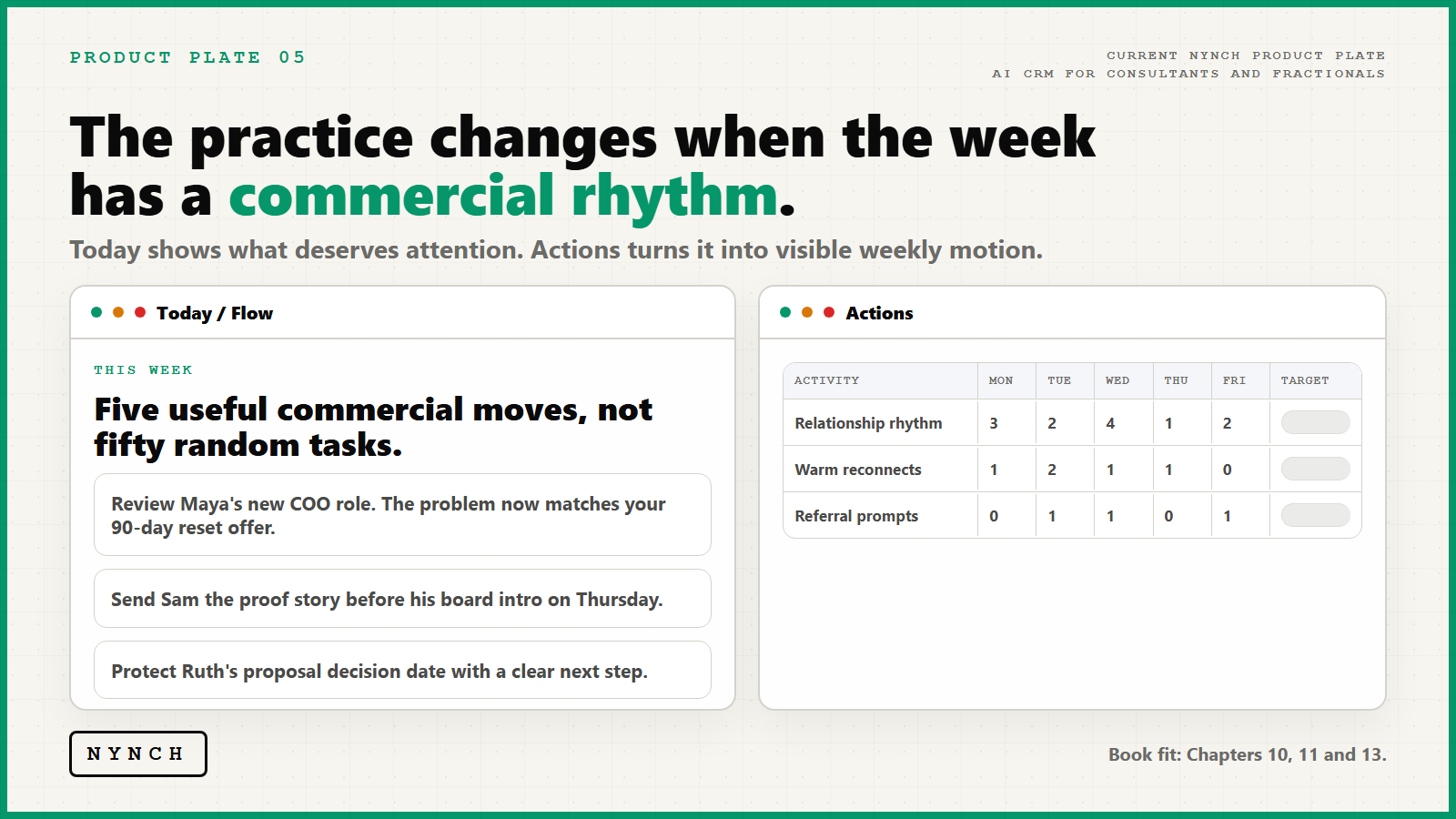
The system works in reverse from how most tools work. Most CRM software assumes you have a large audience and you are trying to figure out how to reach them. This assumes you have a small set of real relationships and you are trying to figure out how to keep them warm and serve them well. That is the design of a relationship-led business. The difference changes what the tool does, what data it surfaces, and what action it prompts.
The daily action is deliberately small. You open Today and see the people who are due for attention. You read the context. You notice whether a signal has appeared, what was last said, what was promised, what has changed in their situation. You decide: send something, wait longer, make an introduction, comment on something public, prepare something in the background, or move this person into a weekly rhythm. None of those moves takes longer than five minutes. Most take two minutes. The system is designed to keep you in your relationships, not to pull you into a tool.
Today works because it is relentlessly scoped. It does not show every contact you have ever met. It shows the ones who matter to your spine, filtered to the ones whose relationships have real revenue potential. It does not show a status field to close out quickly. It shows the history and the signal so the decision is about the relationship, not about changing a status. It does not ask you to log calls or summarise notes. It simply reminds you that these relationships exist and they are worth your attention this week.
The win is not a perfect sequence or a flawless system. The win is catching timing before the relationship goes cold. It is noticing that a past client has started hiring and you know something about how they think about hiring and building teams. It is remembering a conversation from eight months ago because the system reminded you and a signal made it timely. It is responding with context instead of with need, so the buyer feels like you have been paying attention rather than feeling like you are chasing them. It is doing this without turning the practice into a second job of admin and notes. It is becoming the operator who shows up at the right moment with the right context and creates the conditions for a buyer to say yes. That is where the revenue comes from.
Nynch is the AI CRM for consultants and fractionals who win high-value deals based on relationships.
The judgement stays entirely yours. The system can surface a signal. It can remind you of context. It can prepare a message. But you are the one who decides whether to send, wait, introduce, or move. That division of labour is exactly what a senior practice needs. You bring the relationships and the expertise. You bring the judgement about what is useful. You bring the reputation that the buyer respects. The system makes sure that neither the relationships nor the context leak away while you are busy delivering for a client. It is the difference between having opportunity and letting opportunity slip because you were distracted by the work you were in the middle of. Timing is hard. Consistency is harder. The system makes consistency possible.
This week's work
The aim is not to install a perfect timing system. It is to start noticing signals and asking the right question.
- Review your past three months of relationships. Find one client or referrer who went quiet when they should not have. Mark why they mattered.
- Identify one signal from this week that relates to any of your real relationships. A role change, a hiring post, a fundraise, a public problem. Just one.
- For that signal, review the context: what was discussed, what was promised, what changed. Write it in one sentence.
- Decide the next useful move: send, wait, introduce, prepare, or comment. Do not try to do it all at once. Pick one move and take it.
- Review what happened in seven days. What felt like service? What felt forced? Use that to shape the next signal you notice.
Closing argument
Buyers rarely move in a straight line. They get distracted. They stall. They move fast and then pause. Priority shifts. New people arrive. Old promises get forgotten. A thread goes cold. The fractional who can spot the moment when a stalled relationship deserves attention, and who shows up with context instead of need, changes the equation. That is not chasing. That is timing. And timing is work, which means it is something you can own. It is not luck. It is not timing magic. It is a rhythm you build into your week, a way of reading the world, a commitment to remembering what was promised and noticing when the moment arrives to make good on it.
The difference between visibility and timing is the difference between being remembered and being useful right now. You can post and hope to be seen. You can attend events and hand out cards. You can stay loosely connected and hope that when a buyer finally gets around to solving the problem, they think of you. Or you can watch for the moment when the person who saw you before is finally ready to act again, and you can be the one who makes that easier. You can tell them something they have not heard yet, or tell them something they already know at exactly the moment they are ready to act on it. Both are valuable. Both require timing. That is where relationship work becomes commercial without becoming pushy, and where a thriving fractional practice finds the steady motion that compounds. Not the motion of noise or desperation, but the motion of a professional who understands that the best business is built not by chasing, but by showing up with remembered context at the moment it matters.
Where next
Read The Motion next. Timing only pays when a rhythm catches it every week. Thirty minutes with the founder. Free, on your real data, not generic slides. If what you see fits, the next step is the six-week Clients Sprint. Book at app.nynch.com/assistant?lm=book.