 Move Why the old advice felt sensible
Open Why the old advice felt sensible
Book 01. The Umbrella Book
How to build a thriving solo or fractional business you own
A thriving solo or fractional business is built by owning the relationships, positioning, and actions that create the next conversation.
You believe growth is mainly a visibility problem. Post more. Attend more events. Join more platforms. Comment more. Be everywhere, and the right buyer will remember you at the right moment. For a capable executive, that belief is not foolish. It feels practical. It gives anxiety a task and gives uncertainty something to count. Most business advice tells you this is true, which compounds the confidence.
This belief comes straight from the employment world, where it was grounded. In a senior role, the organisation supplied the category, the buyer, the meeting flow, the credibility markers, and the internal reason to listen. Your job was to bring judgement into a structure that already existed. The structure created the demand. You suppli
Why the old advice felt sensible
411 words
Move What changed
Open What changed
Three things shifted in the market, and they happened close enough together to matter.
First, the surface layer of authority stopped being scarce. For most of the last decade, a clear post, a confident proposal, a fluent point of view about a problem showed real competence underneath, because producing them took effort and understanding. Artificial intelligence made that surface easy to imitate. More people can publish a polished post, write a clean proposal, and sound articulate about a problem they only half understand. This does not make real operators less valuable. It changes where the value has to show up. When everyone can sound credible, sounding credible stops being the thing that wins the work.
Instead, the scarce thing is now trusted timing attached to a clear commercial point of view. The proof has to be more specific. The problem has to be sharper. The relationship context has to be harder to fake. A buyer does not ask whether you are clever. They ask whether you are safe to bring into a sensitiv
What changed
489 words
Move The move
Open The move
Growth is ownership, not visibility. A thriving solo or fractional business is built by owning the relationships, positioning, and actions that create the next conversation. Ownership means the answers exist in the market, in your relationships, and in your system, not only in your head on a good day.
The practical test is simple. If a good buyer hears your name, can they answer three questions. What problem do you own. Why are you credible for that problem. Why is now a sensible moment to speak. If not, the practice is still dependent on you being present, articulate, and lucky. Ownership changes that. The market knows. The relationships carry it. The system makes it repeatable.
The whole method comes down to three moves. They form the spine of everything that follows, and the rest of this library is built around them.
The first move is the spine. Turn your experience into a simple commercial shape. The buyer should not have to decode your career to work out why you matter. A spine is not a slogan and it is
The move
577 words
Move The cost of leaving it weak
Open The cost of leaving it weak
When fractional growth stays weak, the damage rarely announces itself. There is no single bad day to point at. It shows up as polite conversations that do not advance, introductions that never quite happen, proposals that take too long to explain, and weeks where a lot of activity happened but the practice did not really move. The decline is slow enough to be mistaken for normal.
That damage is easy to misdiagnose. The consultant assumes the market is quiet. The fractional assumes the network has gone cold. The operator assumes the offer needs a prettier deck or a new headline. More often, the practice has simply not given the market enough structure to know what to do next. Capable people treat a positioning problem as a marketing problem and spend effort in the wrong place.
Weakness also creates a quiet emotional drag that compounds over months. Every message takes longer because the reason is unclear. Every proposal starts from a blank page because the offer has no spine. Every follow-up feels heavier beca
The cost of leaving it weak
299 words
Move The operating model
Open The operating model
Start by making the decision explicit. Write the sentence. Choose the buyer. Define the offer. Name the relationship segment. Set the weekly action standard. A decision you can see is a decision you can keep. A decision that lives only as an intention disappears the first time a client emergency arrives.
Attach the decision to real people. A practice does not grow in the abstract. It grows when a specific past client gets a better update, a specific referrer finally understands the new focus, a specific prospect receives a genuinely useful note, or a specific opportunity moves from vague interest into a clear next step. Abstraction is where good intentions go to die. Named people are where they come back to life.
Attach the decision to proof. The market does not need another claim. It needs evidence that makes the claim safer to believe. Proof can be a short story, a diagnostic, a before-and-after, a pattern you keep seeing, a decision you helped a client make, or a mistake you now know how to prevent. The be
The operating model
307 words
Move A practical example
Open A practical example
A senior operator leaves employment. They have real credibility, a respected network, and enough experience to help in several different ways. At first they describe themselves broadly, because the range feels like the asset. The market is polite. People take the calls. But the conversations do not reliably advance, and the demand stays dependent on luck and timing they do not control.
The turn begins with spine. The operator stops trying to make the whole career impressive and instead makes one commercial choice easy for the buyer to understand. They name the problem they want to own in the buyer's own language, and they tie it to the moment it becomes urgent. The change is small on paper and large in effect. The next conversation has a centre. The buyer knows what to bring, and the referrer finally has a sentence they can repeat.
The second move is network. With a clear spine, the operator can see who actually matters. They stop treating the whole market as a vague audience and start working the smaller gro
A practical example
1,219 words
Move How this library is built
Open How this library is built
This book is the umbrella. It makes the argument and names the three moves. The rest of the library takes each move and makes it practical, so you can go as deep as the problem in front of you requires.
There are three pillar books, one for each move. The Spine is about positioning, so the market can understand and repeat you. The Network is about relationships, so trust becomes the asset base of the practice. The Motion is about rhythm, so growth becomes a system instead of a mood. If you only ever read four books in this series, read this one and the three pillars. They contain the whole method.
Under each pillar sit three shorter books that go one level deeper, because each move has parts that deserve their own attention. The Spine breaks into the problem you own, the buyer you are built for, and the offer they can understand. The Network breaks into the network you have, the network you need, and timing before it goes cold. The Motion breaks into the weekly practice review, proof that travels, and the act
How this library is built
501 words
Move Where Nynch fits
Open Where Nynch fits
Nynch is the operating system that turns the method from intention into habit. Today, Actions, People, Strategy Coach, and Assist work together to tell you who to talk to, why now, and what to say.
The product matters because the method breaks when it has to live in memory. A relationship-led practice creates more context than one person can hold cleanly. Emails, meetings, promises, role changes, timing signals, referral threads, pricing logic, draft offers, proof assets, and conversations that cannot go cold. Hold all of that in your head and the practice quietly leaks the opportunity it worked hard to earn. The leak is invisible until you add it up, and by then the cost is real.
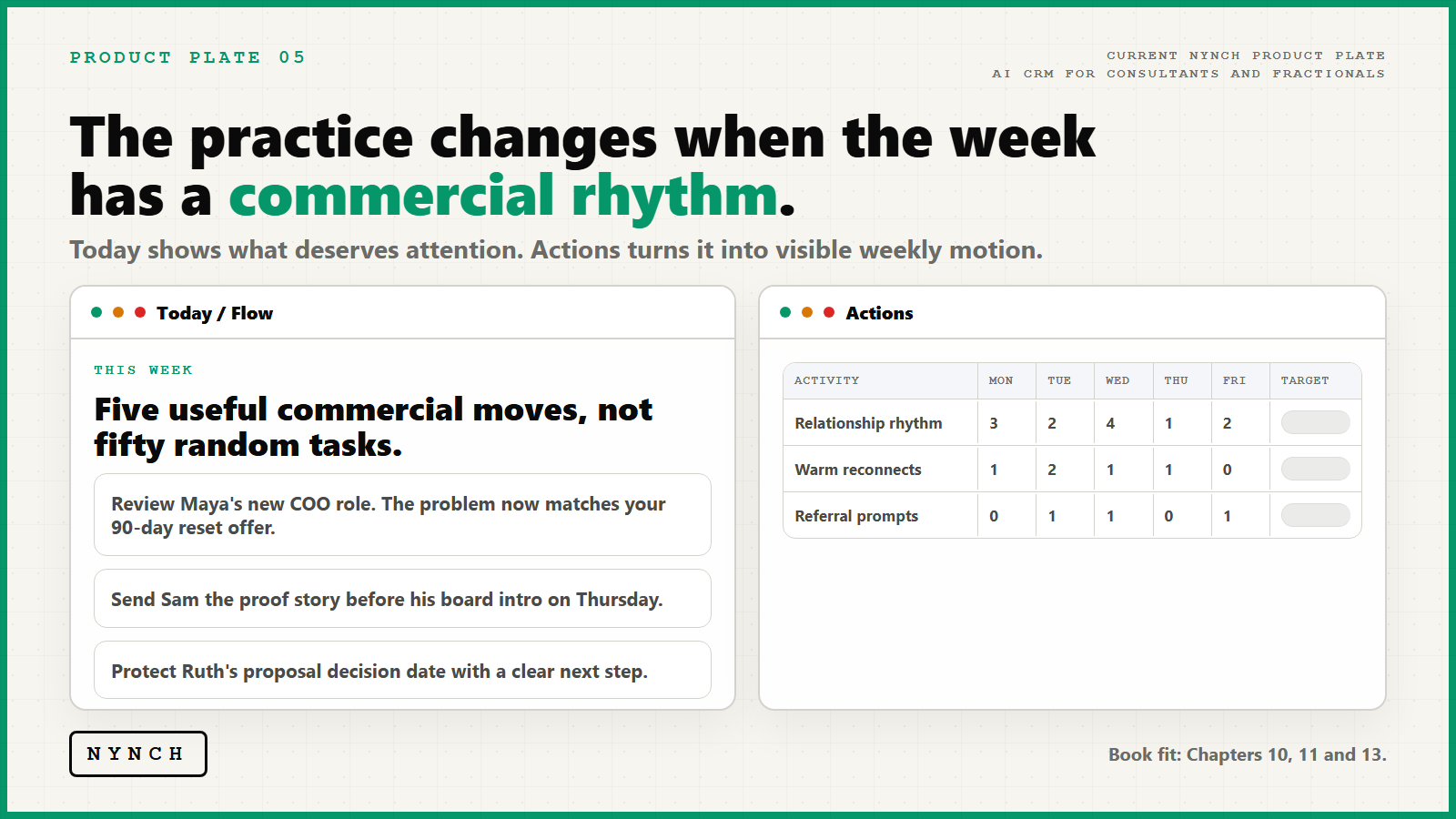 Nynch is the AI CRM for consultants and fractionals who win high-value deals based on relationships. The software serves the way senior work is genuinely bought, which is slowly, through trust, on the buyer's timing. A tool built for high-volume outbound is the wrong shape for this work, bec
Where Nynch fits
697 words
Move Why the old advice felt sensible
Open Why the old advice felt sensible
Book 02. Pillar One
Most consultants do not have a marketing problem. They do not have a spine.
The spine is the commercial structure that lets the market place you quickly. It is not a slogan. It is the answer to what you solve, who feels it, how you help, and why your way is believable.
You probably believe your practice needs better marketing. You have been visible, connected, competent. Yet work does not flow. The market respects you and still does not know what to do next. So you blame the visibility. That is the wrong diagnosis.
The real problem is sharper. Your practice is not spineless because you lack visibility. Your practice is spineless because it has no commercial structure. The market cannot grip you. The buyer respects you but cannot picture what they are stepping into. The referrer admires your background but cannot see which introduction to make. A past client trusts you but cannot remember what to repeat. The invisibility is not the problem. Th
Why the old advice felt sensible
373 words
Move What a spine does
Open What a spine does
The spine is the commercial structure that lets the market understand and place you. It does not reduce your range. It makes your range buyable.
A spine has five pieces. The problem you own. The buyer you are built for. The offer they can understand. The proof that travels without you in the room. The point of view that makes the old way feel unstable and the new way feel necessary.
When you say you help companies with growth or help senior teams move faster, you describe your capability. That is true and defendable. But the buyer still translates. They decode which part matters to them, whether it applies, whether it is urgent. That translation cost is where opportunities leak away.
Consider a different sentence. I help founder-led B2B companies turn founder-dependent pipeline into a repeatable commercial rhythm before the next senior hire lands. The operator can do exactly what the first sentence claims. But only the second sentence gives the buyer something to grip and the referrer something to repeat.
What a spine does
370 words
Move What changed
Open What changed
For the last decade, a strong profile and steady visibility could carry much of the commercial weight. A clear post, a confident proposal, a fluent point of view about a problem all signalled real competence underneath, because making them required effort and genuine understanding. Not many people could do the same thing. That scarcity created signal. When you sounded credible, you probably were credible.
That is no longer true. Artificial intelligence makes the surface of expertise easy to imitate. More people can publish polished posts, write clean proposals, and sound fluent about problems they only partly understand. Real operators are not less valuable. But the value has moved. When everyone can sound credible, sounding credible stops being the signal that wins work.
At the same time, the supply of capable independents has risen sharply. More senior people are leaving employment by choice or restructure, and more of them use similar titles and make similar broad promises. The market that once held a ha
What changed
359 words
Move The five pieces
Open The five pieces
A spine is not one thing. It is a decision made in five parts, each carrying the others.
The first piece is the problem you own. Not a category. Not your general capability. The specific problem you help people move through, stated in the language the buyer would use. A founder who is still the bottleneck. A revenue function that depends on one person's judgement. A board that cannot make decisions without asking. A team that is busy but not moving. This is the precision that matters. The problem is the front door. Vague problems make everything downstream harder.
The second piece is the buyer you are built for. Not every buyer. The specific person in the specific situation where your problem appears most acutely. This is where many operators resist, and resistance is the sign you are close to the right answer. You have sold to many people, and choosing one can feel like throwing away range. It is not. A market cannot hold a vague buyer in memory. It remembers specific situations. A founder with no
The five pieces
539 words
Move Why this matters
Open Why this matters
When your commercial structure is vague, the cost is quiet and compounds over months. Every conversation takes longer. Every proposal starts from zero. Every introduction needs explanation because the buyer decodes your career. Every follow-up feels heavier. The market respects you. It simply does not know what to do next. That uncertainty leaks opportunity.
This affects your own decision-making too. Without a spine, every enquiry looks valuable because you do not know what you are optimising for. With a spine, you can be selective. Does this buyer fit the problem I own. Does the urgency match the offer I have built. Are the trust and timing right. If the answer is no, you say no without feeling like you reject growth. That discipline protects you from low-fit work that wastes months and teaches the market to expect endless timelines.
A spine also changes what your network does on your behalf. Without clear structure, you cannot hand the narrative to others. The story is too complex. The positioning is too
Why this matters
295 words
Move The three pillars beneath the spine
Open The three pillars beneath the spine
This book introduces the five pieces. The three books that follow operationalise each core piece so you can build the spine that works for your practice.
The Problem You Own goes deeper into precision. How to move from broad capability to the specific problem you help people move through. How to test whether the problem is sharp enough. How to use the problem as a filter for which opportunities matter.
The Buyer You Are Built For goes deeper into specificity. How to resist vagueness and choose the buyer situation where your impact is greatest. How to use that choice to sharpen everything downstream. How to turn buyer clarity into a network advantage because referrers will know exactly where to find the people you serve.
The Offer They Can Understand goes deeper into packaging. How to build a flagship service that shows the buyer what transformation they are stepping into. How to price it so value drives the cost, not hours. How to make it clear enough that a past client can repeat it to a colleague without
The three pillars beneath the spine
208 words
Move The fear most operators have
Open The fear most operators have
Many senior consultants resist the spine because they know they have range. They have sold to founders and CFOs and boards. They have worked on strategy, finance, operations, revenue, hiring. They have worked at different stages, in different industries. That range feels like the asset.
The fear is this. Choosing a spine will make the practice smaller. Naming one problem means missing the buyer with a different problem. Specificity is limitation.
This fear is backwards. A spine does not make you smaller. It makes you findable. It makes you buyable. The buyer who respects you and still does not know what to do next will not become a client. They remain a nice person who admires your background. The range that feels impressive to you is not impressive when the market cannot place it. Impressive does not equal buyable.
Consider the difference in practice. A former operations executive says they help founder-led companies scale. True. Defensible. The market is polite. Conversations happen. But they do not adva
The fear most operators have
387 words
Move Where Nynch fits
Open Where Nynch fits
The spine lives in Strategy Coach. What problem do you solve shifts from a form field into the first commercial asset of the practice. Ideal Client Profile stops being a targeting filter and becomes the operating context for every decision. Services and Pricing transforms the work into a package a buyer understands and a referrer can repeat.
But the spine has to be concrete and current. It drifts if it lives only in your head. It gets forgotten the moment a client emergency arrives. It stays stale if it lives in slides because no one updates slides. For a spine to function as a commercial system, it has to live in a place where you review it, refine it, act on it, measure whether it is working.
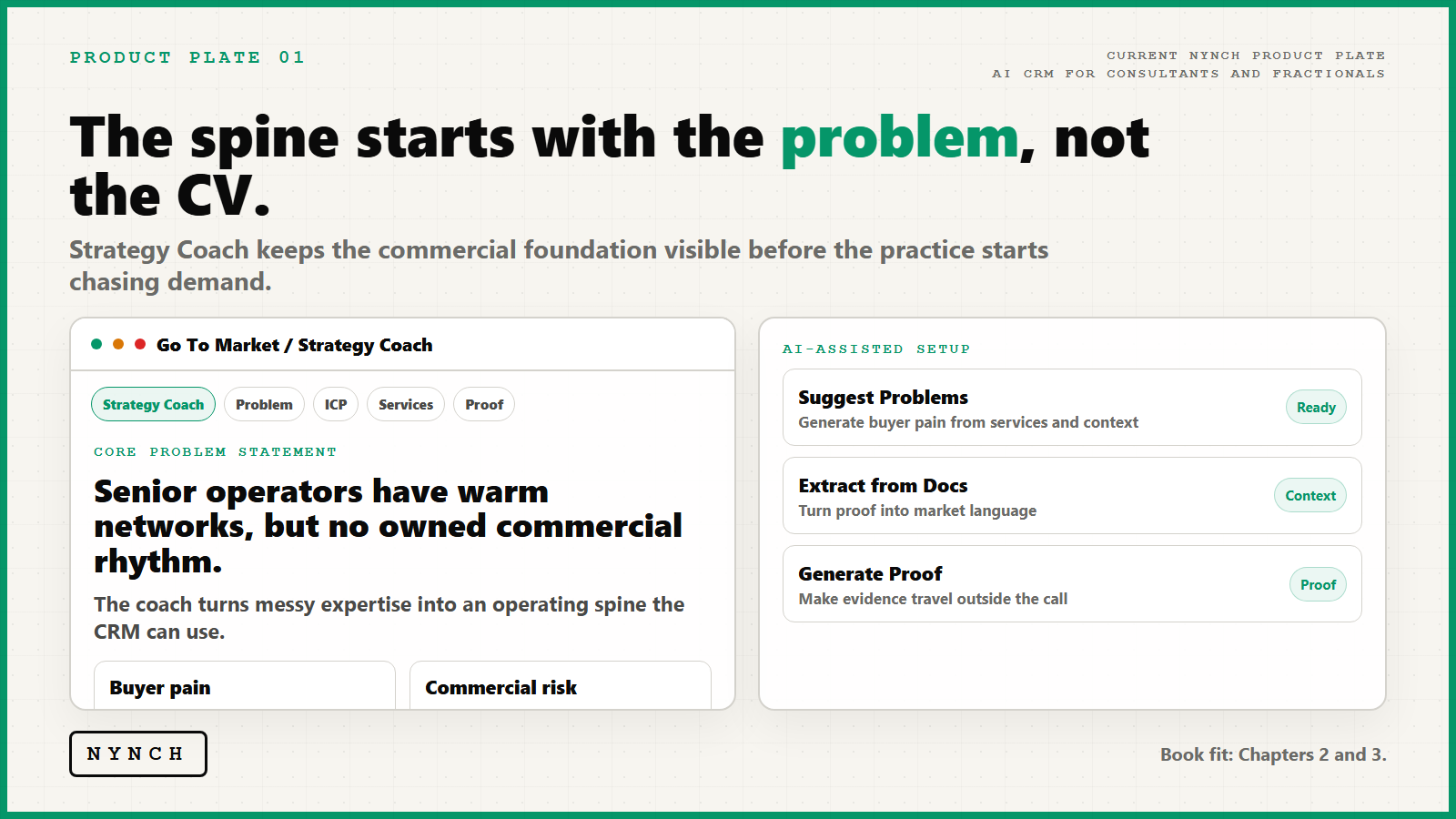
Nynch is the AI CRM for consultants and fractionals who win high-value deals based on relationships.
The difference is this. Nynch remembers what matters. The spine is unusable if it lives only in your head. When the spine is clear and current inside the system, it
Where Nynch fits
707 words
Move What this looks like
Open What this looks like
Most senior consultants are sitting on more spine than they realise. They have the experience. They have the proof. They have the relationships. They have not packaged them into a system the market can hold.
Consider a former chief operating officer. Ten years running the operating team for a software company that grew from 40 to 150 people. They know how to build systems, hire senior people, run operations, handle founders, move a business through growth stages. All of it real. All of it valuable.
But when they describe themselves, they talk about the career. I am a fractional chief operating officer with ten years in SaaS scaling. I work at the intersection of systems, people, and strategy. I help early stage and growth stage companies build the operating foundation they need.
True and defensible. Also too broad. The prospect does not know which problem the operator solves best. When does this operator create the most value. When is this the right hire. The prospect stays interested. The conversation doe
What this looks like
465 words
Move Why the spine comes first
Open Why the spine comes first
Many operators want to skip to the network or focus on actions or build content because those feel like direct paths to opportunity. The spine feels like prep work.
The instinct is backwards. The spine is the real work. Everything else flows from it.
If the spine is vague, every tool downstream is noisier. A network cannot help if they do not know what to help with. Actions cannot compound if they are not tethered to a clear commercial point. Content cannot work if it is not aimed at a specific buyer problem. The best marketing and the best relationships and the best activity are all undermined by a vague spine.
If the spine is sharp, everything becomes easier. Your network knows what to do. Your actions have direction. Your content has a point. Your relationships have reason and depth.
This is why so many capable operators feel stuck. They do activity. Build relationships. Create content. But the spine that should give all that coherence is missing. So the effort does not compound. It stays effort.
Why the spine comes first
176 words
Move Building the spine is not optional
Open Building the spine is not optional
If you want a practice that compounds instead of starting over. If you want the market to choose you instead of you convincing them. If you want your relationships to work on your behalf instead of only when you ask. You need a spine.
This does not require becoming someone new. You do not need to be bolder or louder. You need to give the expertise you already have a shape the market can hold, remember, and act on. That is entirely buildable. None of it requires you to be someone other than who you are.
The next three books make that practical. The Problem You Own shows you how to move from broad capability to the specific problem you help people solve. The Buyer You Are Built For shows you how to choose the buyer situation where your impact is greatest. The Offer They Can Understand shows you how to package the work so a buyer can picture the transformation and a referrer can introduce you with certainty.
Together they form the spine. Not a slogan. Not a summary of your career. A commercial structure that
Building the spine is not optional
508 words
Move The belief that blocks the move
Open The belief that blocks the move
Book 03. Sub-Pillar One
Stop selling the CV. Own the pain.
The problem you own is the front door to your practice. It gives buyers, referrers, and partners a retrieval hook for when the right situation appears.
You describe yourself broadly. Most senior independent people do. The reason feels safe: I help with growth. Or: I help with strategy. Or: I help with operations and revenue. The range is real. In your last role, you moved between domains. You solved leadership problems, revenue problems, operational bottlenecks. You were valuable because you saw connections that function-focused people missed. That capability is genuine.
But here is what you suspect, even if you have not said it aloud: I help with everything is the same as saying I help with nothing.
That sentence is the load-bearing belief. The moment you accept it, you understand why broad feels protective. It keeps the market from narrowing you. What you may not see yet is how this protecti
The belief that blocks the move
402 words
Move What changed in the buyer's world
Open What changed in the buyer's world
The supply of articulate senior people has exploded. More are independent. More describe themselves in the same words. A market that once held a handful of recognisable operators now holds a crowd of strangers who all sound capable. That is good for buyers. It makes it harder for you to stand out. More choice does not mean clearer choice.
The way buyers actually find you has shifted more than most practitioners realise. A decade ago, visibility and credibility were allies. A sharp point of view was rare enough to signal real thinking. That took time and real knowledge. Now artificial intelligence has made the surface of expertise easy. More people publish polished posts. More write smooth proposals. More sound articulate about problems they half understand. Real expertise is still valuable. Where it shows up has changed. When everyone can sound credible, sounding credible stops being the filter. Proof has to be more specific. The problem has to be sharper. The relationship context has to be harder to copy.
What changed in the buyer's world
363 words
Move The sharp problem is a retrieval hook
Open The sharp problem is a retrieval hook
A sharp problem is not niching. It is a retrieval hook. A sharp problem is the difference between sounding like a hundred other people and being the only name that comes to mind when a specific pain appears. It names who you help. It names what hurts. It ties pain to a trigger that makes it urgent. When someone hears your problem from a peer, they know exactly where you fit. When a referrer needs to reach someone, they know which name to repeat. That is the work a sharp problem does. It makes you retrievable.
Compare two statements side by side.
Vague: I help B2B companies with growth strategy.
Sharp: I help founder-led companies turn founder-dependent pipeline into a repeatable sales rhythm before the next sales hire lands.
The second is narrower. It is also immediately useful. The buyer reads it and knows whether it names their Tuesday. A founder with their head of operations knows instantly if this is relevant. A sales director trying to build repeatable process recognises the situation.
When someone
The sharp problem is a retrieval hook
416 words
Move How the sharp problem changes the work
Open How the sharp problem changes the work
Take a fractional CMO. Vague version: I help with growth.
Sharp version: I help founder-led companies turn founder-dependent pipeline into a weekly sales rhythm.
The difference is not cosmetic. Weak language attracts broad conversations that become unpaid diagnosis. A founder calls with a messy situation. The consultant tries to prove range by addressing everything. Nobody leaves with a clear next step. The founder thinks: This person does not understand my stage. The consultant thinks: This founder is not serious.
The sharp problem changes the conversation entirely. The buyer knows what to bring. Founder-dependent pipeline. Founder unable to step back from sales. Demand scattered instead of running through a system. The conversation has a centre. Both sides know what they are discussing.
Sharp language creates better content and better referrals. Instead of writing about generic growth, the consultant writes about founder dependency. The cost of decisions living in one person. What happens when a follow-
How the sharp problem changes the work
256 words
Move How Nynch keeps the problem visible
Open How Nynch keeps the problem visible
In Strategy Coach, the What problem do you solve field is your first commercial asset. This is not a form field. This is the foundation of how the practice moves.
Write the problem in buyer language. Remove internal jargon. Replace capability words with pain words. Tie pain to a trigger that makes it urgent. A problem statement written in operator language sounds like you explaining what you do. A problem statement written in buyer language sounds like your client describing why they picked up the phone in the first place.
Once the problem is clear, everything else becomes easier. The proof you gather supports the claim. Referrers know what to say. Buyers know whether to take the call. Your actions have purpose. Your content is aimed instead of speculative.
Strategy Coach surfaces that problem across the whole app. Visibility changes behaviour. When the problem is in front of you, you reject conversations that do not fit. You write content that supports it. You reach out to relationships who feel it. The p
How Nynch keeps the problem visible
343 words
Move Two worked examples
Open Two worked examples
A fractional CMO in consumer brands used to say: I help with growth and brand strategy. The conversations were polite. Many stalled. The work felt scattered. They rewrote: I help founder-led consumer brands turn social media presence into repeatable customer acquisition before the founder moves into operations.
Clarity changed everything. They started attracting founders at that exact inflection. Their content became sharp: the difference between viral moments and repeatable process. Why founder-led brands mistake attention for traction. The cost of depending on the founder's personal network for demand. Referrers began to repeat the problem. Conversations became shorter. Both sides knew what they were discussing.
Another example: a fractional operations leader said they helped with operational transformation and process. Standard language. The work felt like everything and therefore nothing. They rewrote: I help fast-growing services businesses install operating rhythms so the founder can step out of daily
Two worked examples
262 words
Move Where Nynch fits
Open Where Nynch fits
A relationship-led practice holds more context than one person can carry. Emails, meetings, promises, role changes, timing signals, referral threads, pricing, draft offers, proof assets, conversations that matter. Hold all of that in your head and the practice leaks the opportunity it worked hard to earn. The leak is invisible until you measure it. By then the cost is real.
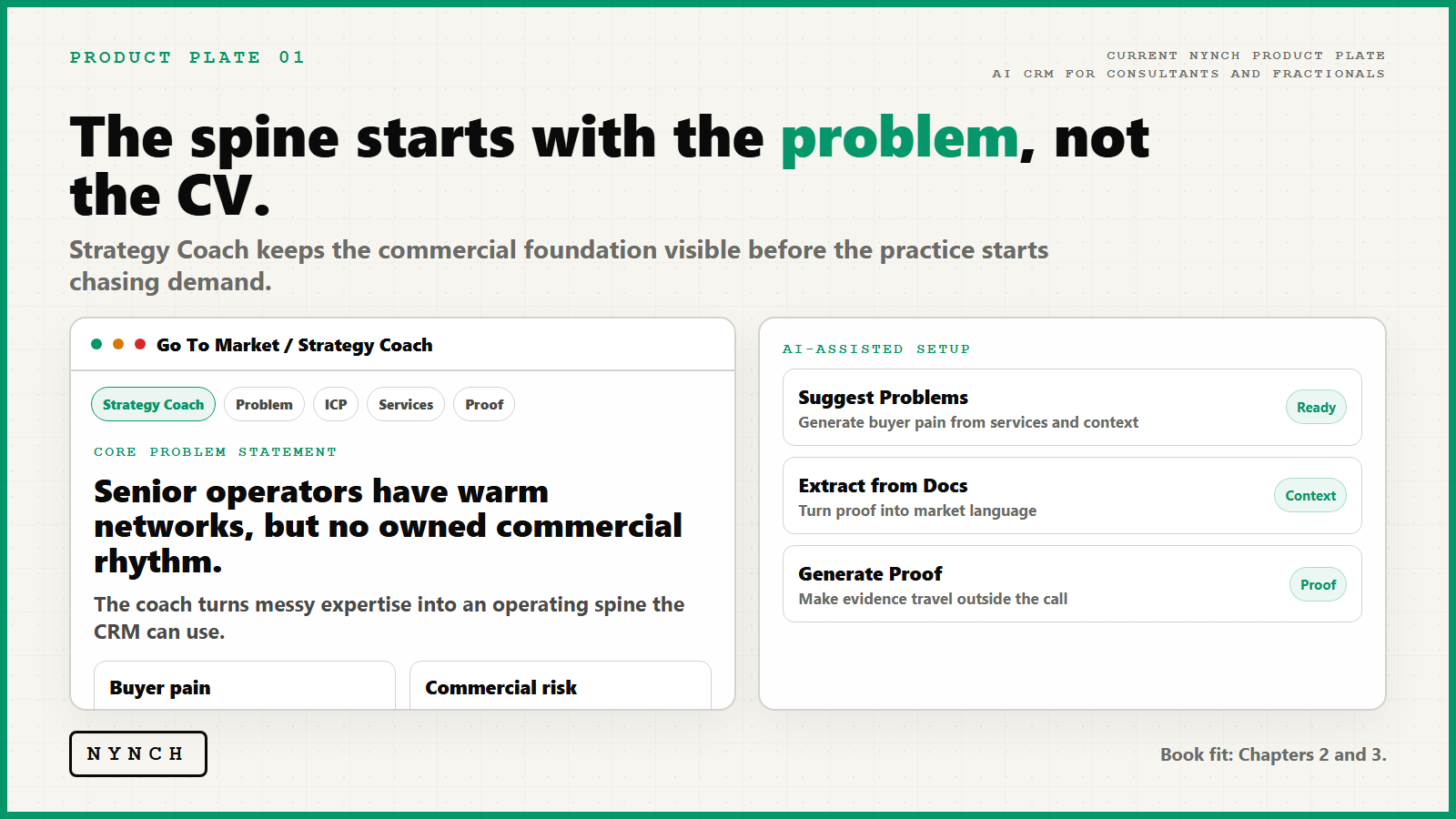
Nynch is the AI operating system for consultants and fractionals who win on relationships.
In Strategy Coach, the problem statement becomes the anchor for every decision the practice makes. Once written and live, every other part of the system can reference it. When you draft a message to a referrer, Assist ensures the language connects back to the problem. When you gather proof, you know which stories support the claim. The problem stays in front as the operating centre.
Nynch does not invent demand that the relationship has not earned. No system manufactures trust you have not built. What
Where Nynch fits
225 words
Move The shape of a working problem statement
Open The shape of a working problem statement
A strong problem statement has a particular shape. It names who you help. It describes what hurts. It specifies when it becomes urgent. It ties pain to a trigger instead of floating in abstraction.
Who you help: Not the whole market. Founder-led companies. Early-stage services businesses. Consultancies in the 10-50 person range. The group that actually feels the pain. Use language from a past client who was successful. The specificity matters because it tells referrers exactly who to think of. When someone can picture the buyer, they can make the connection. Vague buyer language keeps the problem theoretical.
What hurts: Not the capability gap. The specific pain. Pipeline that depends on one person. Sales conversations that happen in hallways instead of a system. Decisions made without process. Proof living in email instead of a document you can send. Founder exhaustion from doing the work and selling the work. Real pain is visceral. A founder tired of taking every sales call. An operations leader watching
The shape of a working problem statement
527 words
Move Why precision compounds
Open Why precision compounds
The difference between vague and precise compounds over time. In the first few months, you might not notice. You are still getting conversations. The network is still moving. The pipeline still feels active. But over six months, the cost of vagueness becomes visible. Conversations that do not advance because you are covering too much ground. Referrals that never quite happen because the referrer is not sure what to say. Introductions that mention your name but not the problem. Meetings where both sides are polite but nobody leaves knowing what to do next.
A vague statement creates a secondary problem that gets harder to diagnose. It makes you try to prove range in every conversation. The buyer does not know what you actually own, so you feel compelled to show you are smart about everything they mention. That is exhausting. It also makes you look less credible, not more, because you are addressing everything instead of going deep on anything. A buyer drowning in founder dependency does not want to hear about
Why precision compounds
561 words
Move The language test you can run now
Open The language test you can run now
Your problem statement should sound like how a buyer would describe their situation after a difficult Tuesday. Not how you would describe your expertise. Not how you would position yourself to an investor. How they would describe the pain to a peer.
If you wrote: I help founder-led companies improve their sales process and eliminate founder dependency through structured cadence, that is you talking. A founder does not say that. They say: I cannot close anything anymore without being in the room. My new sales person asked me what my qualification criteria are and I realised I have never written them down. We are leaving money on the table because opportunities die in conversation and nobody remembers them unless I am tracking them.
That is buyer language. The buyer talks about what is broken right now. What they are feeling. They describe the mess. Your problem statement should sound like the mess they would describe, not the solution you would sell. That is how referrers will recognise it. That is how the n
The language test you can run now
247 words
Move The test to run this week
Open The test to run this week
Read your current problem statement. The one in your bio. Your proposals. Your conversations. Now ask yourself: could a past client read this and name three people who should hear it right now.
If the answer is no, the problem is still doing too much work. It is still covering too much ground. It is still protecting you with breadth instead of helping you with focus. Rewrite it. Make it narrower. Make it hurt. Make the trigger clear. Then ask yourself again.
The work is not to become a different operator. The work is to let the market recognise you without guessing.
This week's work
- Write I help [buyer] solve [painful problem] when [trigger makes it urgent]. Keep rewriting until a real buyer would recognise themselves.
- Read the statement aloud to one past client and ask whether they know three people who should hear it.
- Find one proof point that shows you understand this specific problem, not that you are generally capable.
- Draft one piece of content that speaks to someone living this problem,
The test to run this week
480 words
Move The conflict that stops you
Open The conflict that stops you
Book 04. Sub-Pillar Two
Specific buyers create specific demand.
The buyer is not a demographic. The buyer is the person with the pain, authority, risk, timing, and trust path to make the work real.
You carry proof across multiple buyer types. Founders, CFOs, CMOs, boards, operating partners. Budget problems, scaling problems, crisis fixes, broken operations made functional. That range has worked. You can adapt in the room. You read a buyer's logic and bridge the gap between what they think they need and what actually has to shift. That range feels like the business you built.
But a broad buyer creates broad language. Broad language creates amnesia. The referrer goes quiet because they cannot hold four versions of you in their head. The past client loves you but does not know what to introduce you for. The proposal needs more explaining. The conversation stays abstract instead of landing on something the buyer feels.
A specific buyer creates sp
The conflict that stops you
275 words
Move How the market has changed
Open How the market has changed
Flexibility used to signal sophistication. You were senior enough to see nuance. You could match your approach to any buyer's context. The buyer assumed that adaptability meant you understood their world. Today, every consultant claims to be flexible. Every operator says they can adapt in the room. The buyers hear that promise so often it has stopped meaning anything.
Artificial intelligence made it easier to gather signals about who buys. You can identify candidates by role, company size, budget, recent hires, job changes, funding rounds, hiring sprees. Tools surface more possible targets faster than ever. But more targets do not mean more qualified prospects. They mean more noise. When you can reach a thousand possible buyers, the only thing that makes one real is context that distinguishes them from the thousand others. That context is not a database lookup. It is the understanding of why this particular person, in this particular situation, with this particular trigger, is ready to move now.
The senior
How the market has changed
311 words
Move The move
Open The move
Define a specific buyer. Not a demographic. A buyer is a person with pain they feel acutely, authority to decide, risk riding on the decision, and a moment when the problem becomes urgent. A buyer is a buying situation. A title by itself is not.
You will choose one to build your spine around. The proof, the network, the language, the actions all point that direction first. Once that buyer understands you and trusts you, adjacent buyers become easier to serve because the spine is already clear. You have one lane. The adjacent lanes follow.
The work is three steps. First, define who the buyer actually is. Not the biggest possible market. Not what you want them to be. Who is most likely to feel the problem acutely, have the authority to move, benefit from your help, and recommend you to someone else in the same situation. Second, understand the commercial context around that buyer. What is their business. What pressures surround them. What risks are they managing. What does success look like from their chair.
The move
230 words
Move Understanding the buyer
Open Understanding the buyer
A buyer is not a title. The same title carries different buying logic depending on the situation. A founder with no senior team differs from a founder with a CFO. A CFO buying control differs from a CFO buying visibility. A head of strategy at a growth company differs from a head of strategy at a company in decline. A head of operations in crisis differs from a head of operations maintaining equilibrium. The title is the starting shape. The real buyer lives in the problem they are solving and the moment it becomes urgent. This distinction separates a scattered practice from a sharp one.
When you understand the buyer this way, you see the pattern. Four conditions have to be present for them to move. They have acute pain. It costs something real: sleep, optionality, momentum, political safety, peace of mind. They lose something tangible every day the problem stays unsolved. They have authority to decide. They can say yes and make it stick without ten other approvals. They sit at a level where their judgment is
Understanding the buyer
715 words
Move Where the first buyer comes from
Open Where the first buyer comes from
The first buyer emerges from the pattern you see in your past work. Look at the last five clients that felt easy to work with. Look at the ones where the work was clear, the buying process was clean, and the outcome mattered in the way you wanted it to. What was their situation. What was their title. What was their business like. What problem were they actually solving. That pattern is not an accident. That is a signal.
Some people are drawn to founder-led businesses because that is where they understand decision-making. Some are drawn to large organisations because that is where the politics make sense to them. Some are drawn to companies in transition because that is where they can see the shape of the problem clearly. That is not weakness or inconsistency. That is a signal about where your expertise lands most cleanly. Your job is to recognise the signal and make it a choice instead of an accident.
The second place to look is your network. Who in your past and present network fits the buyer profile you a
Where the first buyer comes from
341 words
Move The disqualifiers
Open The disqualifiers
Part of choosing a buyer is choosing who you are not building toward. Saying no to a cheque still feels wrong. Saying no to a conversation feels like leaving money on the table. But a buyer who does not fit the pattern costs you something real. They cost you clarity. They cost you speed. They cost you the ability to use past work as proof. They cost you the ability to use your language with confidence. Every buyer outside the pattern is more explanation, more adaptation, more work to land. That friction adds up across the year and makes the practice harder.
Good disqualifiers are specific. Not just size, but the kind of size. Not just stage, but the kind of problem that stage creates. Not just industry, but the kind of decision-making that industry requires. A founder in hypergrowth differs from a founder in sustainable mode. The problem they need to solve is structurally different. A CFO trying to go public differs from a CFO trying to stay private. The risk picture is not the same. A board member overseein
The disqualifiers
250 words
Move How a specific buyer changes everything
Open How a specific buyer changes everything
When you choose the buyer, several things shift in the practice. These shifts touch every part of how it operates.
First, the language becomes specific and memorable. Instead of talking about the problems you solve in general, you talk about the problem you solve for this buyer, in their language, at the moment they care most. The founder hears "install a selling rhythm so you can step back from every customer conversation and still know the pipeline is building" instead of "business development support." The CFO hears "take spending from scattered to structured without killing the business" instead of "financial oversight." The operating partner hears "fix the leadership gap before it becomes portfolio drag" instead of "executive coaching." That language sticks. That language travels. That language makes referral easier because the referrer can use your words instead of translating you.
Second, the positioning becomes clearer and more confident. Your offer is not that you can adapt to anything. Your offer
How a specific buyer changes everything
562 words
Move Two worked examples
Open Two worked examples
An operations leader left a large company where they scaled it from fifty to five hundred people. They built systems, installed disciplines, moved people, made the organisation functional at scale. Real credibility. Now independent, they describe themselves broadly. They help companies scale. They help founders build organisations. They help boards understand operations. All true. All proved. And none of it creates enough memory to move the market.
The turn begins with specificity. The work they felt best about was always the same. Founder-led businesses that had grown beyond the founder. The problem was always the same shape. The founder built the company and understood the customer. But the founder was now the limit on growth. Every decision went through them. Every person learned to wait. Every process lived in the founder's head. The founder wanted to step back. They were exhausted. But they feared the company would lose something essential if they were not involved in everything.
That is a specific buy
Two worked examples
889 words
Move Where Nynch fits
Open Where Nynch fits
The buyer lives in a commercial context you have to understand clearly to move them. Their role, their pressure, the trigger that makes them ready to move now, how they think about budget, the trust path that makes them confident enough to move, and which buyers are not a fit. Artificial intelligence can help you gather signals about who has changed jobs or who is in a company that just raised money. But it cannot choose the buyer for you. That choice is always yours to make. It is the most important strategic decision in the practice.
Once you have chosen the buyer, the challenge is keeping that choice stable while you maintain a network and deliver client work. A vague buyer makes the system noisy. A specific buyer lets the system work. Nynch uses the Ideal Client Profile and People to turn the buyer definition into a map of real relationships.
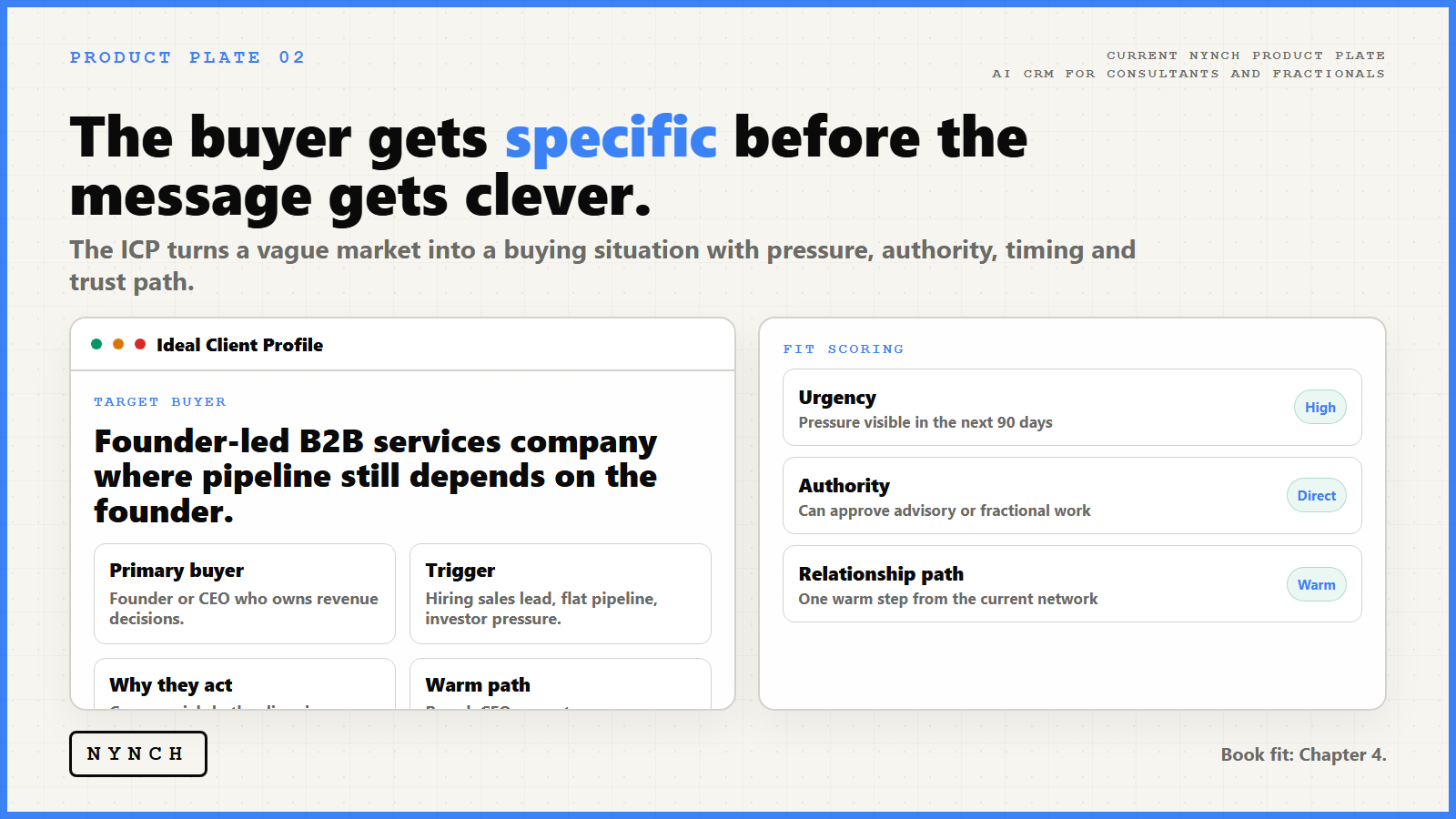
You define the buyer once. The role, the company context, the problem they feel, the trigger that makes them ready to m
Where Nynch fits
720 words
Move Why bespoke felt sensible
Open Why bespoke felt sensible
Book 05. Sub-Pillar Three
Package judgement without making the work shallow.
A strong offer is a container for judgement. It tells the buyer what they are stepping into while leaving room for senior judgement inside the work.
You have resisted packaging your work. Senior work is genuinely bespoke. The team changes. The business history is different. The internal politics vary. Every engagement requires adaptation. The real work always needs judgement.
The mistake is treating packaging as the opposite of judgement. An offer is a container for judgement, not a cage that replaces it. It makes judgement a decision the buyer can say yes to instead of a risk they absorb in silence.
Vagueness worked for a decade when the market moved slowly. A buyer could accept a shapeless engagement, trust would build as work started, and the relationship would carry what the contract did not clarify. That era is over. Buyers now carry more risk, have more option
Why bespoke felt sensible
356 words
Move What changed
Open What changed
The supply of capable operators was once scarce. A buyer had to take risk to get access. There were not many people doing this work. Those who did had opaque positioning and mismatched pricing, but limited alternatives existed. A buyer who wanted senior help had to tolerate vagueness. That market no longer exists.
Artificial intelligence has changed the surface cost of expertise. Anyone can write a clean proposal, a polished email, a thoughtful diagnostic. The surface is easier to fake. That does not make real operators less valuable. It changes where value lives. When everyone can sound competent, sounding competent stops being the signal. Trust, specificity, and relationship context become scarce. The offer has to do the work surface credibility once did. It has to reduce risk. It has to tell the buyer they are stepping into something shaped by experience, not something improvised. The clearer your offer, the higher the signal that you understand what you are doing.
At the same time, the supply of capable
What changed
420 words
Move The move
Open The move
A buyer needs shape before they can buy judgement. A shapeless offer makes the engagement feel risky because the buyer cannot picture it. When you package the work, you are not removing the need for adaptation. You are giving the buyer the certainty they need to say yes to senior thinking.
First, name the offer in plain English. Not a category. A name. Founder-Led Pipeline Reset. Revenue Operations Audit. Belief System Diagnosis. The Culture Code Translation. Something a buyer can understand and a colleague can repeat without confusion. The name tells them what kind of engagement they are stepping into. It signals that this is a shape you have run before, not an experiment you are figuring out as you go.
Second, define the first thirty days. What happens in week one. What conversations or research happens in week two. What the buyer sees by day thirty. The first phase is where trust is earned or lost. Be specific. The buyer needs to know what shape the relationship takes before they commit.
Third, define t
The move
504 words
Move Why ninety days
Open Why ninety days
For many fractionals, the strongest first offer is a ninety-day operating engagement. Ninety days is long enough to create meaningful movement and short enough for a buyer to understand and commit to.
Thirty days is too short. It is barely long enough to understand the problem, let alone move it. A buyer will not see enough evidence that it is working to feel confident about the next phase.
Six months is longer than most buyers want to commit to without seeing initial proof. The buyer worries the work will expand, the cost will blur, urgency will fade, and the internal story will become hard to maintain.
Ninety days splits the difference. It is long enough to do real diagnostic work in the first phase, move something substantive in the second, and build confidence for what comes next in the third. It is short enough that the buyer can hold the vision of the engagement in their head and make the decision without too much internal bargaining. It is long enough that scope creep becomes less likely because the
Why ninety days
236 words
Move Creating the right entry point
Open Creating the right entry point
A named ninety-day offer becomes your flagship. It is the primary service. It is what you lead with. It is what a referrer recommends to a prospect who has a clear problem.
Sometimes you will have a lighter entry point as well. A diagnostic. A one-week sprint. An advisory session. That lighter entry point should have one job only. It should lead to the flagship. It should not become a hiding place for buyers who were never serious, and it should not become a cheaper alternative for buyers who can afford the real work but want to spend less.
Consider a fractional head of growth who runs Revenue Operations Audits. The audit is five days. It includes a current-state diagnostic, a one-hour summary session with the leadership team, and a fifteen-page recommendations document. The entry point works because the recommendations are built such that implementation requires bringing in the fractional for the ninety-day Revenue Operations Reset. The audit reveals the problems but stops short of implementation planning.
Creating the right entry point
360 words
Move What a clear offer does for the buyer
Open What a clear offer does for the buyer
A buyer who likes you can still hesitate if the offer feels vague. They may believe you are smart. They may trust you personally. But they do not know what the engagement will look like day to day. They worry the work will expand. They worry the cost will blur and they will lose control of the budget. They worry they will not be able to explain the engagement credibly to their board or finance team. They worry that bringing you in will open up questions they do not yet know how to answer.
A clear offer reduces each of those fears. It tells them what the work looks like. It tells them the cost and the commitment. It tells them the decision points and when they will happen. It tells them what the endpoint looks like. It tells them what will and will not change as a result of the work. It makes the engagement predictable enough to trust and clear enough to explain.
The offer does not remove the need for judgement or adaptation. It creates enough structure for the buyer to move forward with confidence. The work
What a clear offer does for the buyer
231 words
Move A worked example
Open A worked example
Imagine a founder or business owner who has built a successful company but now realizes the pipeline is broken. The revenue depends on one or two relationships. The founder is still the point of escalation for everything. Growth is stalled because no system exists to generate opportunity without the founder's attention.
A vague offer sounds like this. I help companies fix their sales and strategy. I work with founders. I run diagnostics. I recommend changes. I help with implementation. The engagement depends on what I find.
A clear offer sounds like this. Founder-Led Pipeline Reset. Ninety days. Weekly commercial operating review with the founder. Relationship base audit and analysis. Opportunity identification and qualification. Offer refinement and positioning test. Weekly next conversation plan and playbook. By day thirty. The founder and I have completed twenty founder interviews. We have audited the relationship base and identified high-probability opportunities. We have mapped the pattern of how oppor
A worked example
351 words
Move Another worked example
Open Another worked example
Imagine a consultant who helps teams understand and work through internal organisational change. They usually work with executives who need to move a belief or behaviour inside a company. The work is subtle, political, and requires understanding the history and power structure.
A vague offer sounds like this. I help organisations think through change. I work with executives. We talk about culture and beliefs. I do interviews. I diagnose what is getting in the way. I recommend changes. We figure out how to move it.
A clear offer sounds like this. Belief System Diagnosis. Six weeks. Three interviews with key influencers to understand the current belief about the domain in question. Two strategy sessions with the executive to map the old belief and the new belief they are trying to install. One presentation to the broader leadership team summarising the diagnosis and the proposed path forward. One ninety-day roadmap for how change moves step by step. In week one. You interview three people who are currently re
Another worked example
378 words
Move The test
Open The test
A buyer should be able to repeat the offer to a colleague without you in the room and have that colleague understand what the engagement is. Not every detail or nuance, but the shape. The duration. The rhythm. The decision points. The outputs. The boundaries. That is the test of whether the offer is clear.
If the buyer cannot do that, the offer is still too vague. The buyer might still move forward because they trust you personally or because they are desperate. But the offer is not doing its job. It is not reducing risk. It is not creating certainty. And it is not turning a senior capability into a buyable decision.
You will know the offer has worked when a referrer recommends you to a prospect using the language of the offer. When a past client describes the work to a friend using the structure of the offer. When a buyer moves forward because the offer makes sense, not just because they like you. When a prospect can explain to their finance team what they are buying and get approval without a second conve
The test
237 words
Move Why clear language matters more than clever language
Open Why clear language matters more than clever language
Sometimes people drift into wanting the offer to sound impressive rather than clear. They use language that is polished but vague. They describe the work in layers and abstractions. They assume sounding sophisticated will create confidence.
It does not. The buyer wants clarity, not complexity. They want to picture the work. They want to know what they are stepping into. They want language that is true and specific and plain.
A software engineer helping a founder think through technical architecture might name the offer Technical Foundation Review. Twelve weeks. Deep audit of current technology decisions, why they were made, what they protect and what they limit. Three architecture options with trade-offs spelled out. One chosen path with a six-month roadmap for migration. Weekly technical strategy sessions. A handoff to whoever will own implementation.
Not Technical Excellence Partnership. Not Cloud-Native Transformation Initiative. Not Technology Strategic Alignment. Those are real things, but they do not
Why clear language matters more than clever language
196 words
Move Why day-rate language weakens authority
Open Why day-rate language weakens authority
Sometimes fractionals and consultants use day-rate language because it feels honest and flexible. Four thousand a day. Five days a week. I bill by the hour, and we can adjust based on what comes up. The language feels transparent. The pricing feels safe because it is based on time, not on a claim about the outcome.
But day-rate language invites the buyer to negotiate on price per day rather than on value. It suggests that time is the thing being purchased, not movement. It makes the buyer feel like they are paying for your hours regardless of whether the hours are valuable. It makes the buyer feel like scope is unlimited because they are paying for days, not for outcomes or decisions or phases.
A strong offer prices the commitment and the value. A ninety-day engagement at a certain price. Not four days a week times ninety divided by five. Not an hourly rate scaled up. A price that reflects that the buyer is getting access to your judgement, the result of your experience, and the commitment of your focus. Th
Why day-rate language weakens authority
192 words
Move Where Nynch fits
Open Where Nynch fits
The offer is where your positioning becomes actionable. It is the commercialisation of the thinking you did when you built the spine. Nynch holds that offer and turns it into a proposal without you rewriting it each time. Without a system, the offer lives in your head and your email. It changes slightly each time you send it because you are adapting based on memory and intuition. A good system makes the offer stable and repeatable.
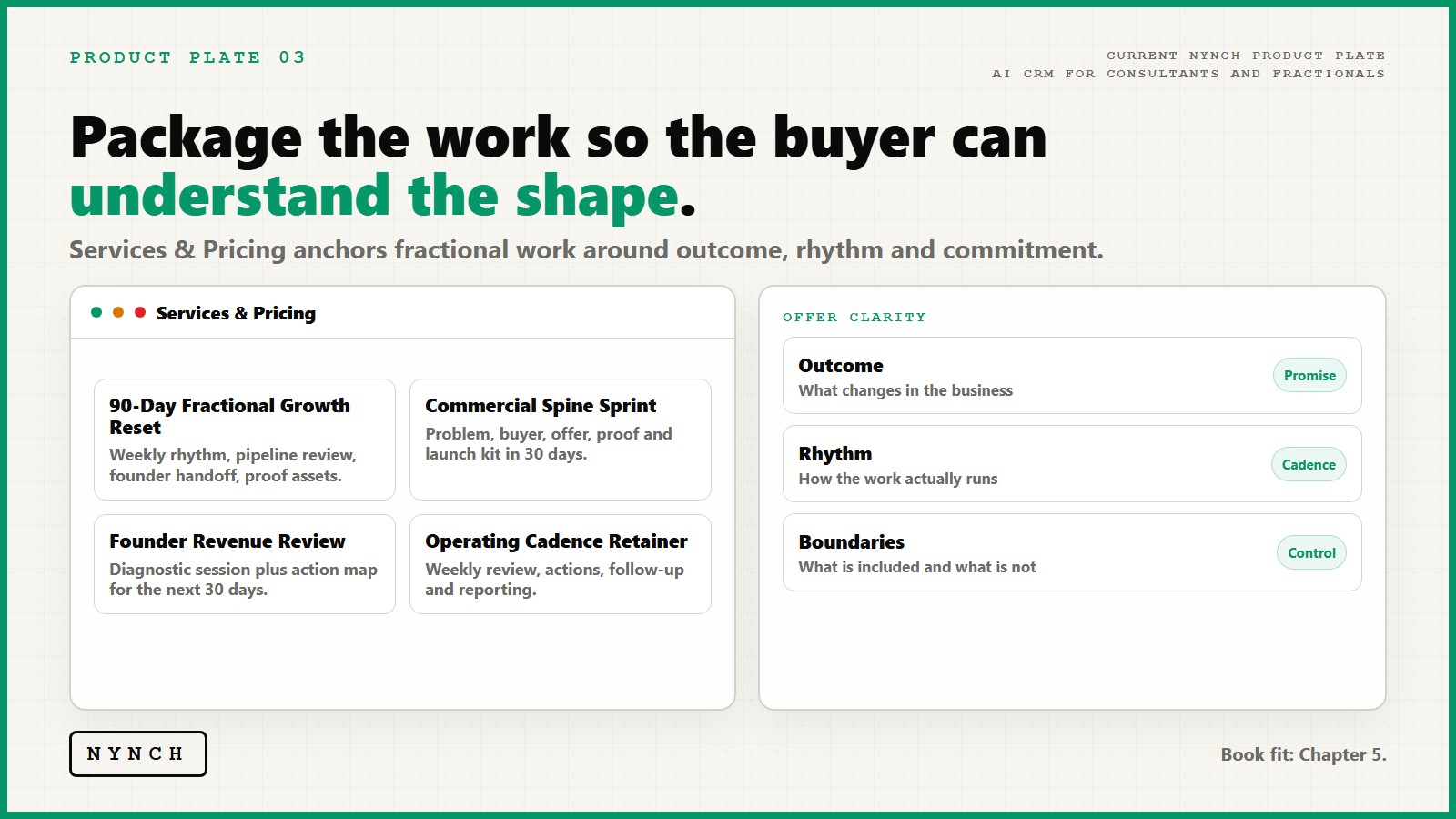
Services and Pricing holds the flagship offer, the pricing logic, what is included and what is not, and the proof that supports the claim. That is the source of truth. Everything else flows from it. When you build a proposal, you are not starting from scratch. You are applying the offer to what you learned in conversation with a specific buyer. The Assist tool turns that application into language without inventing a new story each time.
The system makes the offer repeatable at scale without losing the relationship. You are not automating th
Where Nynch fits
236 words
Move Why the offer is part of the spine, not separate
Open Why the offer is part of the spine, not separate
The spine is the shape the market can understand and repeat. The problem. The buyer. The offer. The proof. The point of view. The offer is not separate from positioning. It is the commercialisation of positioning. It is how the positioning becomes real in a conversation with a specific buyer.
When the offer is weak, the positioning is weak. A buyer might respect your point of view and still not know what to do next. They might understand the problem and still not imagine what an engagement looks like. The offer is the bridge between the thinking and the action. It is what makes the positioning concrete and actionable.
You cannot separate the spine from the offer. You cannot decide on the problem and the buyer and then wait to build the offer. The offer informs the positioning. If you cannot package the work clearly, the positioning needs to be sharper. If the offer feels vague, the problem needs to be more specific. The spine is built in layers. Each layer makes the next one stronger.
Why the offer is part of the spine, not separate
176 words
Move The shape of a strong offer
Open The shape of a strong offer
A strong offer is specific. It names the engagement, the duration, the rhythm, the decision points, the outputs, and the boundaries. It is not a category. It is a shape.
A strong offer is built on the positioning. It shows the buyer they have the problem. It shows the buyer you understand their context. It shows what movement will look like.
A strong offer creates certainty without removing adaptation. The phases are clear. The weekly rhythm is clear. The decision points are clear. The work adapts inside that structure based on what you learn.
A strong offer prices value, not time. The price reflects the commitment, the judgement, the strategic weight.
A strong offer is repeatable. A buyer should be able to tell a colleague about it and have that colleague understand. A referrer should be able to recommend it using the language of the offer. The market should repeat it because it is built on clarity, not on your ability to explain it.
A strong offer is honest about boundaries. It says what is included an
The shape of a strong offer
210 words
Move The hardest part
Open The hardest part
The hardest part of building an offer is being honest about what is not included. Every person building a practice wants to say yes to every variation. You worry you are being narrow. You worry you are leaving money on the table. You worry the buyer will find someone who will say yes to what you are saying no to.
A shapeless yes is weaker than a clear no. A buyer who moves forward because you said yes to everything will feel confused when the work starts to take shape. A buyer who moves forward because the offer is clear and specific is a buyer who is ready for the work.
The boundary is not unkind. It is honest. It says what you are going to do and what you are not. It says the buyer will have to resource what you are not doing. It says the engagement has an endpoint. It says you are a guide, not a permanent member of the team. That is what the buyer wants to hear. It is what creates confidence.
This week's work
Do not turn this book into theory. Turn it into an offer you can send.
The hardest part
492 words
Move Why the network gets underused
Open Why the network gets underused
Book 06. Pillar Two
Relationships are the asset base of the practice.
Your network is not a passive archive. It is the living asset base where trust, context, timing, and opportunity intersect.
Most senior people sit on a stronger asset than they recognise. Past clients who trusted their judgment. Peers who valued their thinking. Founders who asked their advice. Investors who saw them deliver. Colleagues who respect their work. That network is real. It is worth money. It is simply scattered.
The problem is not that you know too few people. The problem is that the network lives everywhere at once. Email, LinkedIn, WhatsApp, calendar history, old proposals, Slack threads, notes scrawled on paper, half-remembered work from years ago. Because it spreads across a dozen systems, it vanishes. You remember some people. You forget others. You notice two years passed since you last made contact. When you reach out, the silence weighs on the message. It feels like you ar
Why the network gets underused
259 words
Move What changed
Open What changed
A decade ago, most senior work was bought through personal networks as a matter of course. You left a company role, called the people you knew, and several of them had problems you could solve or knew someone who did. The network worked because it was the only reliable way for senior buyers to find senior operators. There was no alternative. The buyer could post a job ad and get a hundred unsuitable replies, or call someone they already trusted. The choice was obvious.
Today, the surface of the market feels more open. Job boards, directories, agency listings, LinkedIn search, and algorithmic systems promise connection without personal trust. The promise is false, but it sounds convincing, so the independent operator believes the network matters less than it once did. They believe they can build visibility to compensate for a shallow relationship base. They believe they can be found. That belief is backwards. It reverses causality. You were never bought because the network was the only channel. You were bough
What changed
308 words
Move The belief shift
Open The belief shift
The old belief was common. A network is useful, but real growth comes from new demand. Visibility matters. Content matters. Visibility and volume are the growth levers. Stay in touch with people, but the real work is being found by strangers. That belief made sense in specific moments. When you were first starting out and knew few people. When the market was expanding fast. When you represented a category the market already knew.
None of that is true now. If you are reading this, you have a stronger network than you realise. The market is not expanding. The category you represent is one you have to build yourself. There is more capacity than demand. The old belief no longer applies. Most practices stay stuck because they chase visibility and outreach while the real advantage sits in relationships they have stopped working.
The new belief is both simpler and more durable. Your network is the asset base of the practice. Not a passive archive. Not something you mine for favours. The active operating asset wher
The belief shift
327 words
Move Network work is not networking
Open Network work is not networking
One critical distinction. Network work is not what most people mean when they say networking. Networking conjures a specific picture. Events where you meet strangers. Conferences where you collect cards. Working a room. Building an audience on social media. Creating content. Growing your following. Getting your name out there. The picture is volume, energy, visibility, saying yes to things that get you in front of people. For most people, the picture is exhausting. It sounds like performance. It sounds like you have to become someone else. It sounds like extraction rather than service.
Network work is the opposite. It is quiet. It is specific. It is built on context that exists. It is based on reasons that make sense. It is not about a bigger audience or being seen by strangers. It is about deepening trust you have already earned and creating useful rhythm around those relationships. The work is small enough to sustain even during heavy client delivery. And it needs to be consistent enough that relationships
Network work is not networking
1,601 words
Move The working structure
Open The working structure
This section has three chapters that make this concrete. The first is called The Network You Have. It is about working the relationships that already trust you. Your current clients. Your past clients. Your strong referrers. Your former colleagues. Your investors. Your advisors. Your peers. These relationships are already warm. The work is not to convince them you are credible. The work is to keep the warmth alive and create rhythm around it so trust does not cool while you are heads down doing client work.
The second is called The Network You Need. It is about identifying who should know you that does not yet know you, and creating a real reason to build that relationship rather than scraping a list. It is about expansion with judgement. Expansion built through reasons instead of volume. The new relationship is usually someone who sits one warm step away from your buyer. An investor who already knows them. An operator who moved from the right company. A past client who has context. A founder who moved into
The working structure
318 words
Move Where Nynch fits
Open Where Nynch fits
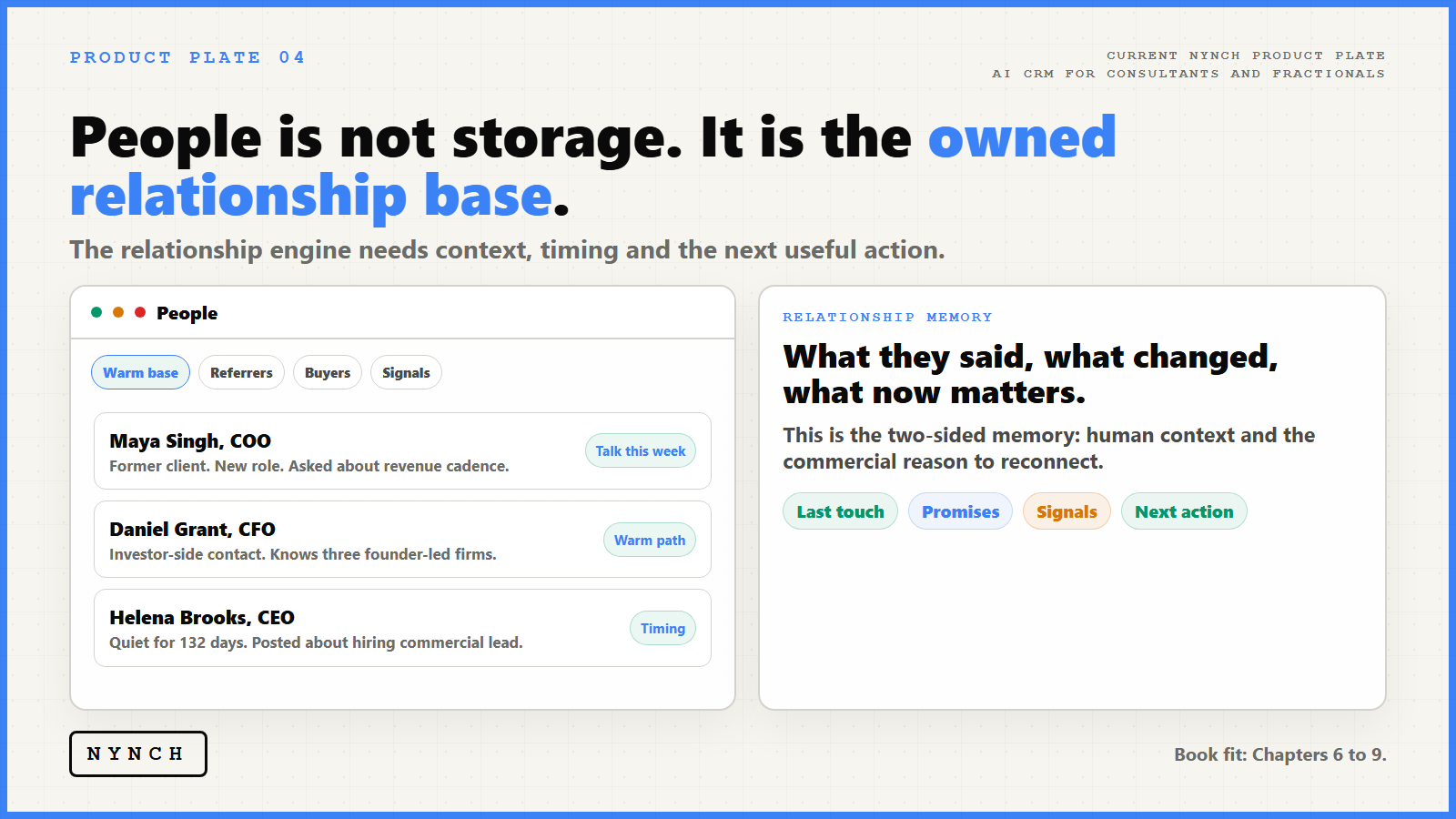
A network-led practice only works if the network stays visible. If the relationships are scattered across email, LinkedIn, WhatsApp, calendar notes, and memory, the system breaks. You remember some people. You forget others. You notice a year passed since you last spoke. When you reach out it feels heavy because you have been inconsistent. So you wait longer. By the time you reach out, the relationship has cooled without you noticing.
The consequence is silent. There is no moment where the practice suddenly fails. It gets quieter. The flow of introductions slows. The referral requests become sporadic. The past client does not call when a new problem emerges because they have not heard from you in so long they have forgotten what you now do. The operator who moved into your target market does not think of you when something relevant happens. The network still exists. It is just not working because you cannot see it and you cannot remember it clearly enough to act.
This
Where Nynch fits
433 words
Move A worked example
Open A worked example
A marketing director in a B2B technology company left her role to become an independent advisor. She had real relationships. Twelve years in the industry. A strong network. People who valued her judgment. But like most operators coming out of employment, she struggled to see it as an asset because it was scattered. Some names in LinkedIn. Some in email. Some in old Slack workspaces. She could not see the pattern.
When she started working the network deliberately, the first thing that happened was that she stopped feeling guilty. She opened People and sorted her past clients into relationship rhythms. Some had become friends and heard from her quarterly. Some had been one-time projects and deserved a light touch, a message every six months. Some were stronger relationships and she chose to touch base monthly. Once sorted and visible, the work became smaller and clearer. Pick one relationship. Review what changed. Decide whether a message made sense. If yes, send it. If no, skip it. Pick another. Same process.
A worked example
401 words
Move Another worked example
Open Another worked example
A fractional operations executive had been in the market for two years. He had work. But it was scattered. Projects came from different streams. He felt like he was starting from scratch every few months rather than building something. Part of it was his message. The other part was that he had not built a real network of peers who understood what he was doing.
He had colleagues from his last corporate role. He had founders he had worked with. He had operators who had gone through the same transition. He had investors he knew. He had formal peer groups he belonged to. But he was not working any of that deliberately. He was treating the network as something that would happen around him rather than something he had to tend. The relationships existed. They were not creating motion.
When he started working the network, the first thing he noticed was that his best source of work was already in it. Operators who had become fractional themselves. Founders who had exited and were advising other founders. Investors w
Another worked example
965 words
Move The belief that kills the warm base
Open The belief that kills the warm base
Book 07. Sub-Pillar Four
Start with the trust already earned.
The network you have is not a list to exploit. It is a trust base to respect, maintain, and make useful before you need anything from it.
You believe staying in touch without a reason feels needy. Reaching out to people you have not spoken to in months, simply to say hello or share something you are thinking about, reads as desperate or as mining old contacts. You believe warm relationships should stay warm on their own, or they were never that warm to begin with. You believe real outreach happens when you have something to offer, not before. You have something valuable to offer, but the moment has not come yet. So you wait for a reason. By then the network has cooled. The people who once cared have moved on. The warmth has faded just enough that when you finally reach out, the message lands on cold ground instead of warm.
This is the most durable false belief in independent practice. Not b
The belief that kills the warm base
462 words
Move Warmth has a half-life
Open Warmth has a half-life
Warm relationships do not die from disrespect or betrayal. They cool from silence. When you do not stay in touch, people do not assume you are lazy or uncaring. They do not feel mined. They feel forgotten. They assume their world has moved and you have moved with it. They take new roles. They inherit new problems. They meet other people doing your work. They solve the problems you could have helped with. They lose the thread of what you are building. They stop thinking of you as someone still in the game.
The cooling is not sudden. It is incremental. A person who cared about you six months ago and has not heard from you since gradually stops thinking of you as part of their active world. They do not know why. The relationship has not ended. It has just faded. Drift looks identical to coldness from the outside, even when the warmth is still there underneath, waiting for a signal to come back alive. The warm feelings persist. But the warmth does not get used. And unused warmth has a half-life.
The core mistak
Warmth has a half-life
336 words
Move Start here, not everywhere
Open Start here, not everywhere
The warm base holds the first three to five meaningful opportunities a new independent practice can create. They rarely look like opportunities. They look like former managers. Old clients. Peers who answer their phone when you call. People who asked your advice and listened. Investors. Practitioners who sat near a problem and kept circling it. These are not glamorous relationships. They are the relationships you have earned already.
The critical work is separating genuine warmth from wishful thinking. Not everyone you respect is equally warm right now. The distinction is not subtle. A past client who loved your work but has never experienced the pain you solve belongs in maintenance, not on a sales list. They are history, not prospect. A peer who regularly hears the problems you solve is a different asset entirely. They are active. A former boss who went quiet after a promising conversation may need timing, not pressure. A senior friend you have not seen in three years is a different category than someone y
Start here, not everywhere
408 words
Move Rhythm before urgency
Open Rhythm before urgency
The pattern repeats reliably. An operator builds a relationship with genuine warmth. Work intensifies. Months pass. Money gets tight. The operator reaches out and finds someone who once cared. The message carries weight. The response is polite but guarded. The conversation does not advance. The operator concludes the relationship is dead when the actual problem was the gap.
The weighted message is destructive because it confirms a fear. The recipient opens something that reads like a request after a long silence, and that silence reframes everything before it. It feels extractive. It confirms a suspicion the recipient may have held: that the relationship was always transactional.
This is preventable. The work is to establish rhythm before urgency warps the relationship. Some relationships earn weekly attention. A current client at the centre of everything. A strong referrer who hears buyer problems regularly. A peer who sits where decisions happen. These people need rhythm. They are the foundation.
Some re
Rhythm before urgency
1,164 words
Move Restore context, not connection
Open Restore context, not connection
The first purpose of rhythm is not to book calls. It is to restore context. To make sure the person understands what you are building now. To remind them of the value they already know you can create. To give them a reason to think about you that has nothing to do with need. Context is what transforms a reach-out from transactional to thoughtful.
One operator from internal communications went independent and spent two months reaching back to clients and referrers with "I wanted to catch up." Generic outreach. The conversations were polite. Nothing shifted. It was not until she sent a specific note about a change in her thinking on proposal quality that anyone responded with real interest. The difference was context. Generic outreach asked people to remember who you are based on nothing new. Specific insight gave them a reason to think about what you are building. They had a hook. Something to think about. Something to react to. That is what opens the door.
Another example. A fractional operations leader tou
Restore context, not connection
343 words
Move The warmth base includes more than clients
Open The warmth base includes more than clients
Clients are the obvious place to start. They have approved the value and paid for it. But the warm base usually includes other categories that matter equally or more. Strong referrers may be more valuable than past clients, because they sit at the table where your work gets named. If a referrer understands your new focus clearly, they become a force multiplier. They remember you in conversations you are not part of. They shape how other people think about the problem you own.
Former colleagues often belong in the warm base, especially if they moved into companies that represent your buyer. They know how you think. They know what you are capable of. They have worked beside you and seen you solve problems under pressure. That credibility does not disappear just because you parted ways. It usually becomes more valuable, because they can now see you solving problems for their company from the outside.
Investors belong in the base too, even if they are not yet investors in the current practice. Someone who backe
The warmth base includes more than clients
352 words
Move What lives in the warm base
Open What lives in the warm base
A practice owner spent three weeks mapping her warm base. Not a quick list, but a real inventory. Current clients. Past clients by recency and depth. Strong referrers who understood the offer. Former colleagues who moved into target companies. Investors. Suppliers. Advisors.
The inventory revealed something she had not seen. She had seventeen relationships that felt warm, but only three got touched more than twice a year. Most had been active six to twelve months ago and then gone quiet. She was not being neglectful. The practice was simply not set up to make maintenance visible. The rhythm was defaulting to zero, and zero felt fine until she needed something and realised the warmth had drifted further than expected.
Once the inventory was made visible, the rhythm became clear. Three relationships deserved weekly touches. These were the strongest referrers and one current client at the centre of everything. Eight relationships deserved monthly attention. These were past clients, strong referrers, and peers
What lives in the warm base
328 words
Move When the warm base gets messy
Open When the warm base gets messy
The warm base is not clean. It is often complicated. A past client who valued you but also frustrated you sometimes. A former boss you respected but who had real flaws. A peer you cared about whose business moved in a different direction. A referrer who asked for favours that felt burdensome. A colleague who turned out to be less ethical than you thought. Most senior people have some of these in their network.
The temptation is to avoid the messiness by only touching relationships that feel untainted. But that usually means touching nobody, because no real relationship is entirely clean. The work is to separate the warmth from the specific reasons it became complicated and then decide whether the warmth is real enough to maintain.
Real warmth can coexist with real friction. A past client who was demanding but paid on time and valued your work is worth maintaining. The demanding part is not relevant to whether you maintain the relationship. The paying and valuing parts are. A former boss who pushed you hard
When the warm base gets messy
452 words
Move The system makes it visible
Open The system makes it visible
This is where most independent operators fail. They believe in relationships. They know the warm base matters. But they cannot see it and they have no rhythm to tend it. So the relationships decay. Not from neglect of intent, but from neglect of structure. Structure makes the work visible. Structure makes the next action small enough for a full week.
The system surfaces who is warm and why. It shows when they were last touched. It captures what changed in their world. It holds conversations you promised. It flags timing. It makes this week's action clear. When a system does this right, maintaining relationships stops being something you carry in your head or feel guilty about. It becomes a small regular practice that happens because the next step is visible and bite-sized.
Without the system, you carry all the texture in your memory. In a good month, memory holds. In a busy month, relationships leak away without a sound. By the time you notice the warmth is fading, months are gone. The effort to restore it
The system makes it visible
216 words
Move Where Nynch fits
Open Where Nynch fits
The warm base must live somewhere visible, or it does not exist at all. Paper lists fade. Spreadsheets go stale. Notebooks disappear. A network that lives only in your head survives until you get busy, then it evaporates.
Nynch People is where the warm base lives and stays warm. It is not a marketing database. It is not a list of targets to burn through. It is a place to see the relationships that matter, capture what you know about them, set rhythms that fit, and surface what is due this week.
The People surface shows who is warm and why. It flags when they were last touched. It shows what changed in their world. It holds the promises you made. It names the next action. It makes the rhythm visible and concrete.
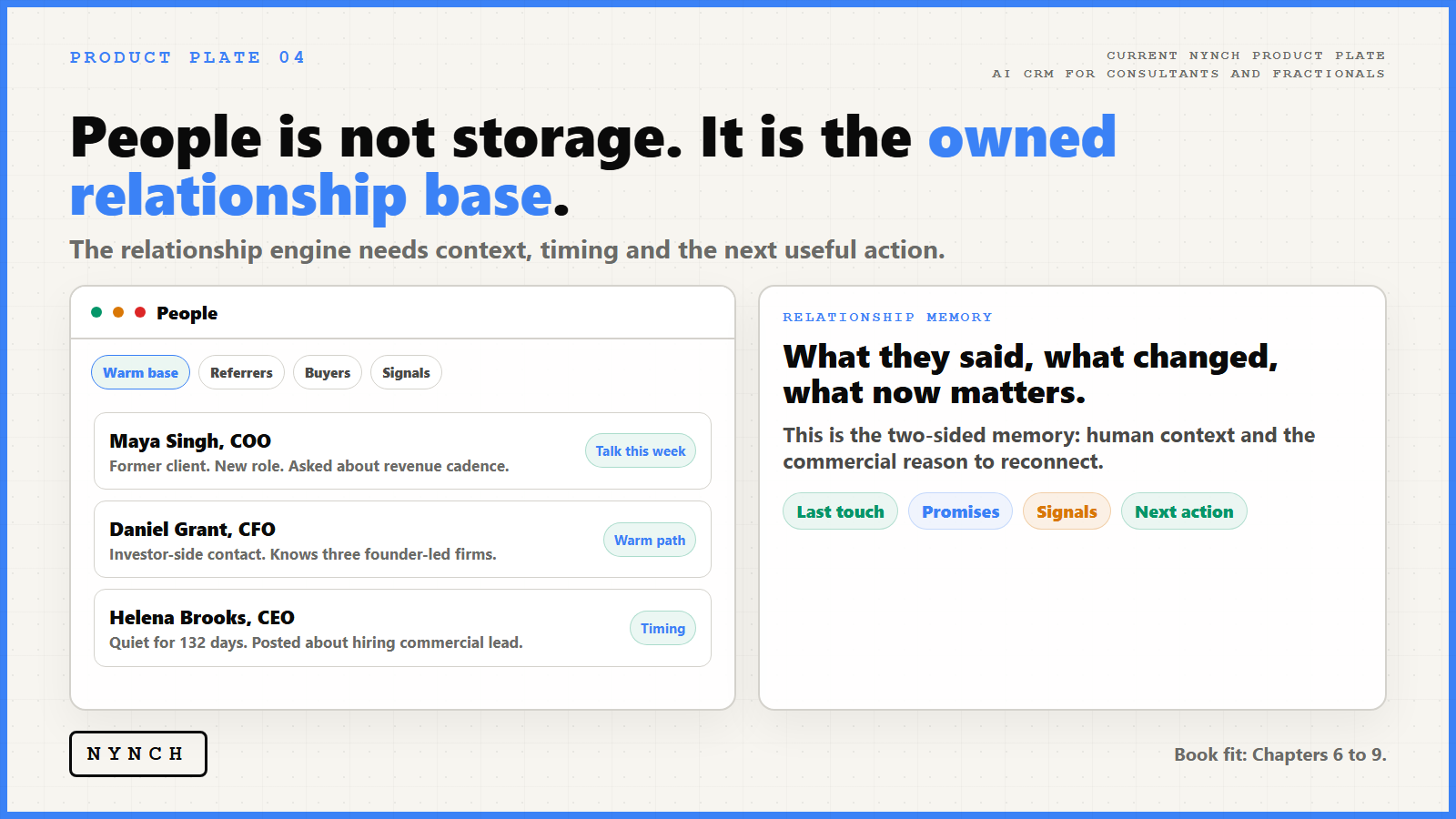
Nynch is the AI CRM for consultants and fractionals who win high-value deals based on relationships.
Today shows who is due for a touch based on your rhythm. It flags people you promised to reconnect with. It marks relationships that are cooling. It surfaces the ac
Where Nynch fits
559 words
Move Why the old approach felt sensible
Open Why the old approach felt sensible
Book 08. Sub-Pillar Five
Build new relationships without spray-and-pray outbound.
The network you need is built through reasons. Shared context, credible triggers, warm paths, and useful points of view create better conversations than generic scale.
Most operators hear network growth and think volume. Find a list. Send messages. Follow up on replies. Scale the script. This formula works for direct response and commodity sales. It clashes entirely with how fractional work is bought. And if you have resisted becoming a cold-outreach person, here is the truth: you never have to.
A fractional buyer is in a sensitive position. They are not shopping for a vendor. They are deciding whether to bring a senior outsider into a private problem. Whether this person understands the politics. Whether they can move without disrupting what matters. Whether they can be trusted with information that shapes the business. Trust cannot be manufactured from a cold message.
Why the old approach felt sensible
315 words
Move What changed
Open What changed
The fractional market used to tolerate generic outreach because credible operators were scarcer. Ten years ago, fewer senior people had left employment to go independent. A well-written cold message from someone senior stood out. That has shifted. More capable independents are leaving employment each year. They describe themselves in similar language and send thoughtful outreach. A senior buyer now receives dozens of relevant-sounding messages each quarter, all well written, all claiming experience, all suggesting a conversation.
In that environment, a generic message is not advantage. It is the baseline everyone meets and then ignores. The scarce resource is not the ability to write a thoughtful cold email. The scarce resource is context that makes a message specific enough to deserve a response. A warm introduction from someone who understands the buyer's world. Evidence that you know something about the situation that only a real peer would know. A trigger that makes this the right moment to speak.
Senio
What changed
283 words
Move The move from volume to reasons
Open The move from volume to reasons
The network you need is built through reasons, not through mass outreach to strangers. A reason can be many things. A shared investor who knows both of you and sits on boards where your buyer sits. A former colleague who moved into the buyer's company and understands the internal politics. A company signal that makes the problem acute now, a new hire, a funding round, a market shift. A hiring gap that shows the buyer is scaling in a particular direction. A point of view you have published that speaks directly to their situation. A mutual peer who could introduce you with credibility and context. A board shift or market change reshaping what the buyer needs to solve. Each reason is an opening. Each reason makes the first move feel like a conversation rather than an intrusion.
A reason changes your posture entirely. You are not interrupting a stranger with a value proposition. You are opening a conversation that has context before the message lands. The buyer does not have to decode why you are writing. You ha
The move from volume to reasons
384 words
Move Building through relationships instead of lists
Open Building through relationships instead of lists
The practical difference appears the moment you compare the two approaches. The volume approach starts with a list. Who is large enough to need what I offer. Build outbound around reaching many targets and expect a low reply rate. The relationship approach starts with a reason. Who do I know who sees this problem. Who sits one step from my buyer. Which of those people deserve real attention this week.
The relationship approach starts smaller and moves more slowly, but builds more durably. A fractional leader might identify twenty companies with the right growth pressure. Rather than scraping every contact at those companies, the leader maps the human path into each one. Which investor knows both the fractional and the company. Which operator moved from that industry. Which past client has a connection. Which peer understands that company's market shifts. The first action is not outreach to thirty people. The first action is research to find the right entry point for five.
This shifts the calculation entirel
Building through relationships instead of lists
1,055 words
Move How to add five relationships this week
Open How to add five relationships this week
The standard for this week is simple. Add five relationships with a real reason, not fifty relationships with a vague hope that one might work out. For each one, write why they belong in your relationship base. If there is no reason, do not force it. If there is a reason, make the first move light and useful. A warm introduction from a mutual connection is ideal. A message that shows you understand the situation is the next best thing. A connection request that explains the reason is the minimum.
Start with the network you know. Who are your past clients. Which of those past clients could introduce you to the kind of company you serve now. Which of your existing relationships have moved into a company that fits your buyer. Which peers sit inside the market you are trying to enter.
Then look one step away. Who knows your ideal client. Which investors fund the kind of company you serve. Which service providers sit across multiple companies in that space. Which conferences or communities attract your buyer. Wh
How to add five relationships this week
465 words
Move The difference between building and forcing
Open The difference between building and forcing
This is where discipline matters. The temptation is to add a contact whenever there is any conceivable reason to do so. They work in a relevant industry. They have a relevant title. They follow you on LinkedIn. The practice becomes less curated and more sprawling. The reasoning becomes weaker. The network stops being a real asset and becomes a list that feels good because it is large.
The alternative is to set a standard. You will only add a relationship if you can explain in one clear sentence why they belong in your network. The sentence has to be specific enough that someone else would understand why you chose them. Not they work in tech. Rather, they were the VP Sales at a company similar to my next target, and they moved into that role last year. Not they seem interested in my work. Rather, they asked about my process in a comment on a post I wrote about founder revenue leadership.
This is not about being precious or exclusive. It is about being honest with yourself about why the relationship matters.
The difference between building and forcing
238 words
Move What this looks like at scale
Open What this looks like at scale
As the practice matures, the network becomes a real operating asset. A fractional with three years of consistent relationship building has around three hundred to five hundred core relationships across different categories. Warm referrers who understand the offer and actively introduce. Past clients who would hire again and could refer to peers. Active opportunities who are not yet ready but are kept warm. Allies in adjacent practices who feed introductions because they see the value. Peers who understand the market and create natural opening points. That is manageable. It is the network you can actually tend, not the list you feel guilty about.
The fractional also has a secondary pool of two to three hundred relationships in active research. These are people with the right profile who might fit the future focus of the practice. The research on why they belong is complete. They are waiting for either a warm path or a specific trigger before the first message goes out. They are not forgotten. They are waiting
What this looks like at scale
422 words
Move Adding relationships from a place of strength
Open Adding relationships from a place of strength
One more distinction is worth making, because it shapes the tone of the whole approach. The best network expansion happens when you are not desperate to fill your pipeline. This sounds like privilege, but it is actually structural. When you are hungry for business, every contact becomes about you. Will they buy. Will they know someone who buys. The energy is need-based. The buyer feels it immediately. That desperation leaks into the message in ways the operator rarely intends. The tone shifts. The ask becomes heavier. The buyer senses they are being pursued rather than invited into a genuine relationship.
When you are adding relationships from a place of strength, because the practice is already working and you are building for next season, the energy changes. You are not trying to convince someone you are worth their time. You are exploring whether a real relationship makes sense. The buyer feels that too. They relax. They share more. The conversation becomes a conversation instead of a pitch. The operator
Adding relationships from a place of strength
1,018 words
Move Why the old belief felt sensible
Open Why the old belief felt sensible
Book 09. Sub-Pillar Six
The right relationship at the wrong moment still stalls.
Timing is part of the work. The fractional who shows up with remembered context at the right moment is helping the buyer act, not chasing them.
A serious buyer will come back when they are ready. That is the belief most operators carry into independence. Inside employment, it was true. A buyer with a problem and a budget would reach back out. The system had momentum. The organisation would send reminders. A stalled deal in a pipeline tool would prompt a follow-up. Someone owned the follow-through, and that someone was not you.
When you leave that structure, the belief stays but the system disappears. No one is tracking the opportunity. No one is sending the reminder. The momentum depends entirely on the buyer's energy, and the buyer is juggling twenty pressures you cannot see. The priority that felt urgent in March is three spots down the list by June. The hire they
Why the old belief felt sensible
546 words
Move What changed
Open What changed
Buyers rarely move in a straight line. A problem surfaces. A conversation starts. A decision follows. The momentum was in the buyer's hands, and the pattern was predictable enough to rely on. You could wait, because the market rewarded the operator who stayed visible while the buyer took their time to decide.
That world has shifted in three ways.
First, the competition for attention is thicker. A buyer today is fielding twice as many options from operators who sound equally credible. When the choice set was small, a stalled buyer would eventually come back because they remembered you. When the choice set expanded, they got distracted and moved to the next option. The silence is not intentional. It is resource scarcity. They have two hours to fix a problem. They spend those two hours with the operator they think of first, not the operator they liked best three months ago but have not heard from since.
Second, the buying cycle is less linear. A buyer moves fast, then stalls for six months, then moves fast ag
What changed
462 words
Move The shift in belief
Open The shift in belief
The old belief: A serious buyer will come back when they are ready. You wait, and the right ones return. Chasing feels undignified, so you do not chase.
The new belief: Timing is part of the work. Showing up with remembered context at the right moment is a service, not a chase. Silence is a signal, not a verdict.
Chasing is when you have nothing to offer except your need to close the deal. You push weight onto the buyer. Timing is when you have context they have forgotten, a promise you remember, or a shape of the problem that has just become urgent. You are bringing it back into the room.
A buyer who hears from you without any reason except your pipeline goal will feel that weight. A buyer who hears from you because their company just hired a Chief Operations Officer in your zone of expertise, and you remember a conversation from six months ago about exactly this problem, will feel recognition. They will feel like you are paying attention. They will feel like you were waiting for the right moment, not try
The shift in belief
216 words
Move How signals actually work
Open How signals actually work
Timing signals are often small. Most operators miss them because they are waiting for something obvious. A major funding round is obvious. A public job posting is obvious. A company restructure is obvious. But the signals that matter most are usually subtler.
A past client starts hiring and posts about it on a professional network. That is a signal. They are building capacity. They are growing. If you had a conversation with them last year about scaling the team, how to structure roles, how to avoid the mistakes that happen when you add too fast, and they said "not yet, we are not ready," this signal means they are finally ready. The urgency that was missing has arrived. That is a reason to reconnect around what you said you would do, not because you are chasing but because the conditions have changed.
A founder comments on a problem you solve in a discussion thread or on social media. That is a signal. They are thinking out loud about the problem in public, which means they are stuck. The comment itself ma
How signals actually work
1,073 words
Move The shape of the move
Open The shape of the move
When your spine is clear, timing gets easier to interpret. You know which signals matter because you know the problem you own, the buyer you are built for, and the offer they can understand. A hiring post is relevant if the role relates to the problem you solve. A fundraise is relevant if the new capital will force the buyer to think about the thing you are expert in. A role change is relevant if the new role puts someone into the context where your help would reduce risk. The spine acts as a filter. Only the signals that connect to the work you are built for get through.
That clarity makes the decision easier and faster. You see a signal, you check it against your spine, and you move quickly. Either it is relevant and you decide what to do, or it is not and you move on. You stay focused.
What the next useful move looks like depends on context, and context lives in the relationship. You do not decide a move until you have reviewed what is true: the history with this person, the last conversation, what was p
The shape of the move
613 words
Move Two examples of timing done well
Open Two examples of timing done well
A fractional strategy consultant had a past client, a founder of a logistics tech company. They had worked together on organisation design eighteen months earlier. The founder posted about a major hiring drive. They were bringing on three senior operations leaders as the company prepared to scale. The consultant noticed the post because hiring signals were part of their operating rhythm. They remembered the specific conversation about how the founder had become a bottleneck in decision-making and how that was blocking the team. The hiring was directly relevant to the work they had discussed. They sent a short, specific email: they remembered the conversation about the founder as a bottleneck. They congratulated the company on the hiring. They offered one thought: if the founder wanted to think through how to position these new leaders so they could take weight off the founder, they had a perspective and had done it before. They did not ask for a meeting. They did not offer a proposal. They simply put the thin
Two examples of timing done well
520 words
Move Where Nynch fits
Open Where Nynch fits
Today is the timing surface. It shows who deserves attention this week, what changed with them, whether a signal has just appeared, what is open, what is waiting, what needs a decision. People holds the relationship context that timing decisions require. Assist turns that context into a specific message that can land as service instead of noise. Together, they create the conditions for the professional move. The system surfaces the signal. The system gives you the reason. The system prepares the draft. You stay in control. You decide whether to send, wait, introduce, or move.
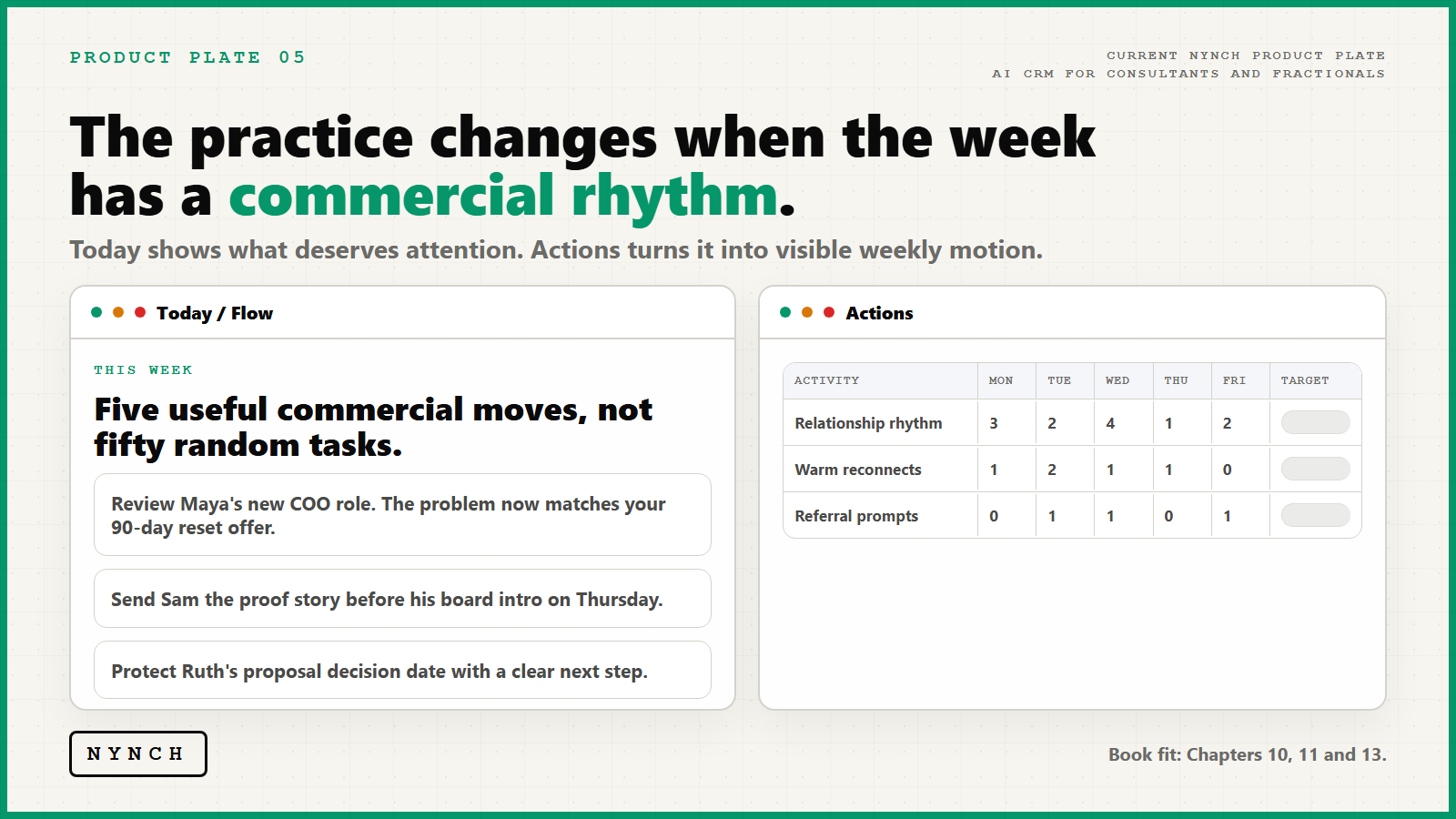
The system works in reverse from how most tools work. Most CRM software assumes you have a large audience and you are trying to figure out how to reach them. This assumes you have a small set of real relationships and you are trying to figure out how to keep them warm and serve them well. That is the design of a relationship-led business. The difference changes what the tool does, what data it surfac
Where Nynch fits
1,140 words
Move Why intention disappears
Open Why intention disappears
Book 10. Pillar Three
Growth becomes real when behaviour repeats.
Motion is the operating rhythm that turns spine and network into real conversations. It is not motivation. It is a small set of behaviours reviewed every week.
Most capable consultants feel the weight of inconsistency. You hold follow-ups in your head. Promises scatter across old messages. You remember good ideas at the wrong time of day. You carry anxiety about relationships you have not touched, knowing full well you should have. The weight is real, even if no one else can see it.
The old belief blames you. You are either the kind of person who does business development, or you are the kind of person who lets it slip when real work arrives. You lack discipline. You lack focus. You lack willpower. So you decide you need to change. Become someone tougher. More driven. More self-aware. Be someone else.
That belief is wrong. It became wrong the moment you moved from employment to independence.
In
Why intention disappears
427 words
Move What changed
Open What changed
When you were employed, the system supplied the structure. You did not invent the calendar. You did not decide when status checks happened. You did not have to remember everything because someone else's system held it.
Now you are the system.
The market is moving fast on small, perishable signals. A warm introduction arrives. A past client has a new problem. A referrer is thinking about you. A buyer is researching alternatives. These signals decay inside weeks. A week of delay is often enough to miss the moment when a conversation becomes possible. Inside employment, you could wait and someone else might catch it. Now you are the one who decides whether the signal moves forward or dies. The market moves. You move or the opportunity disappears.
Consistency is not a test of willpower. It is a design problem that you now own. The design has to fit inside 10 to 15 hours of the week after client delivery is done. It cannot be complicated. It cannot require perfect memory. It cannot depend on you being inspired
What changed
278 words
Move How motion works
Open How motion works
Motion is not motivation. Motion is not energy or enthusiasm. Motion is the visible design that makes the next useful action clear without requiring perfect memory, perfect timing, or a lucky week where nothing else competes for your attention.
Motion starts with a single choice. You cannot hold what matters across hundreds of relationships inside your head. So you stop trying. You write it down. You review it. You decide what matters this week. You take named actions with named people. You see the result. You repeat next week. That is the whole system.
The foundation is the weekly review. Once a week, usually Friday or early Monday, you spend 30 to 45 minutes reviewing the week that just happened and deciding what matters next. The review asks seven questions. Which relationships warmed? Which cooled? Which conversations advanced? Which proof travelled? Which offer got clearer? Which revenue opportunity moved? What are the next five actions?
The questions do not require software. They require honesty. You
How motion works
584 words
Move The three parts of motion
Open The three parts of motion
Motion has three sub-structures. Three books are built around them.
The first is the Weekly Practice Review. This is where the rhythm is created. You look at the week and ask what moved the practice closer to revenue and what only created noise. Without the review, growth feels scattered. With it, you stop carrying every loose thread in your head. The review is how you learn. Which messages landed. Which relationships warmed. Which proof travelled. Which opportunities became real. Without that feedback loop, you collect impressions, and impressions are a poor foundation for commercial decisions.
The second is Proof That Travels. You know your work. You have stories of problems you solved. But if the proof depends on you being in the room to explain it, the proof is fragile. Senior operators often have excellent proof trapped in conversation. They can explain the before state, the pressure the buyer was under, the decision they helped make, the after state, and why it mattered. In conversation, the proof wor
The three parts of motion
350 words
Move What this looks like in practice
Open What this looks like in practice
The difference between a busy week and a moved week is visible only in the review.
Imagine a consultant with a clear spine: she helps founder-led businesses install operating rhythm so they stop being the bottleneck. Her network is warm. She has past clients who would hire her again. Peers understand her focus. An operator friend just moved into a CEO role at a company that probably needs exactly what she does.
The Monday that runs the week
Watch what happens when this consultant sits down on Monday morning with 30 minutes on the calendar. No calls. No emergencies. Just her and the system.
She opens the review from last week. She looks at her notes. Which relationships warmed? She sees that a past client who had gone quiet three months ago just answered a message. That is warm. A founder peer sent her a coffee introduction to another founder who is scaling and probably has the operating rhythm problem. That is warm. A prospect she met six months ago got promoted to Chief Operating Officer at a company
What this looks like in practice
2,584 words
Move Where Nynch fits
Open Where Nynch fits
This design breaks the moment it tries to live inside your head. A relationship-led practice generates more context than working memory can hold. Past client emails. Role changes at companies you work with. Promises made and promises kept. Timing signals that say the moment is now. Referral threads that need completing. Pricing that changes per client. Draft offers. Proof you have built. Conversations that cannot go cold. Try to hold all of that in your head and the practice leaks the revenue it worked hard to earn.
The leak is invisible until you add it up. A conversation you forgot to follow up on. A past client you meant to call. A referral you never completed. A signal that arrived while you were busy. A draft that never got sent because email buried it. By the time you see the cost, months have passed. The moment is gone.
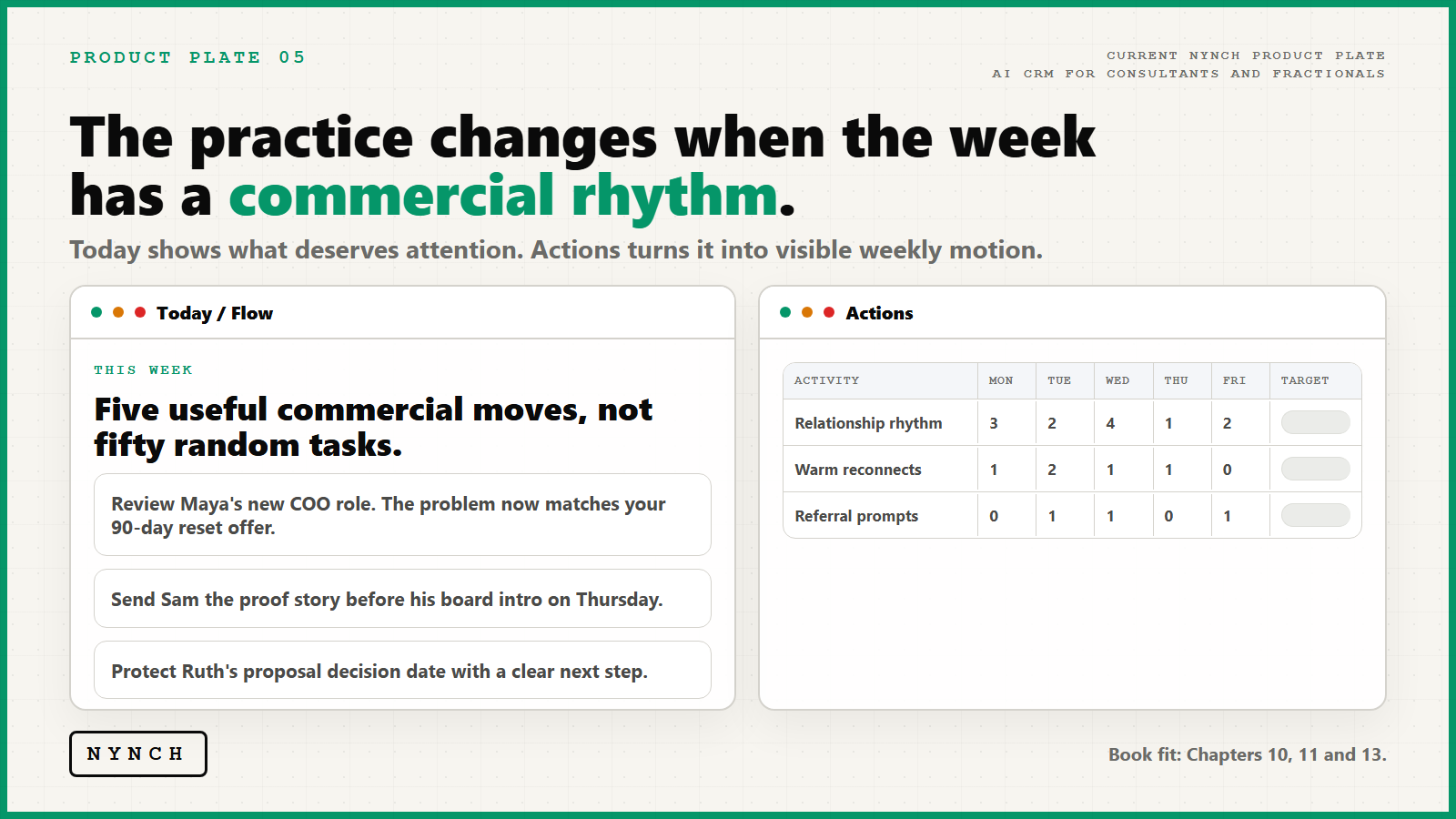
Nynch is the system that makes the next action visible.
Motion sits inside Actions and Today. Actions is where you set the five weekly targets. T
Where Nynch fits
303 words
Move The operating rhythm
Open The operating rhythm
Motion becomes real when you attach it to a rhythm you can protect. The rhythm does not have to be complicated. The best systems are simple enough that they work even when life is chaotic. The worst systems demand perfection and collapse the moment the first client emergency arrives. So build for the messy reality, not the ideal week. Build something small enough that you can protect it even when everything else is demanding your attention.
Monday morning, you open the week. Spend 20 to 30 minutes reviewing last week and deciding what matters next. Which past relationships are warm. Which conversations need follow-up. Which opportunities are live. Which five people deserve attention. Put those five actions into the system. Call this person. Send this proof. Follow up on this conversation. Prepare this proposal. Reconnect with this opportunity. You see them all week because they are in front of you. Not buried. Not forgotten.
Every day, you start with Today. This is your queue. It tells you what is due and w
The operating rhythm
293 words
Move When motion fails
Open When motion fails
Motion fails in two ways. Either the rhythm stops or the actions are too vague.
If you skip the weekly review for three weeks, the system breaks. Memory leaks back in. Priorities become vague. The next action becomes invisible. It takes three weeks of skipped reviews before the practice feels scattered again. The signal decays. The moment passes.
The other failure is vague actions. You say you will do business development this week but do not name five people. You say you will send proof but do not say which proof and to whom. You say you will follow up but do not pick a day. Without specificity, intention evaporates. Friday arrives. The action was never taken because it was never clear. Name the people. Name the action. Name the day. Without those three things, the design does not work.
Skipping the review also stops the practice learning. Which actions created movement. Which relationships warmed. Which proof worked. Which opportunities became real. Without that feedback loop, you repeat whatever you did
When motion fails
215 words
Move The underlying belief
Open The underlying belief
The old belief says consistency is something you have or you lack. You are either disciplined or you are not. If your practice drifts, the problem is internal. You are not trying hard enough. You do not care enough. You are not made for sales.
That belief was never true. You discovered it the moment you left employment. Inside a company, you ran consistent. Not because you were different. Because the system was different. The structure was supplied. The rhythm was supplied. The reminders were supplied. You did not have to hold anything in your head.
Now you are the system. And the design is yours to build.
The new belief is this: Consistency is not a personality trait. It is a design that makes the next useful action visible. I do not need more discipline. I need a system.
When the design is clear, behaviour is almost automatic. When the design is absent, discipline does not matter. The signals pile up. The moments pass.
You do not have to become a different person. You do not have to love selling. You d
The underlying belief
573 words
Move Why the old way felt sensible
Open Why the old way felt sensible
Book 11. Sub-Pillar Seven
A practice you own needs a review you actually run.
The weekly review is the board meeting for the solo or fractional practice. It turns vague impressions into decisions.
Most solo and fractional practitioners believe memory is their system. You were on every call. You know who you spoke to last Tuesday. You know what moved. You know what you promised to send. You know which opportunity felt close. Your intelligence and presence feel like insurance. So the details feel secure.
They are not.
The trap is not a discipline failure. You may be extraordinarily intelligent and extraordinarily good at remembering detail. Human memory was not built for commercial follow-through across hundreds of relationships, changing signals, competing promises, and the kind of live client delivery that consumes all your headspace for three consecutive days. Memory evolved for recall in the moment. It breaks under follow-through at scale. It
Why the old way felt sensible
368 words
Move What changed
Open What changed
The impression is unavoidable. The decision is the lever. When you review a week, you move from vague feelings about which relationships are warm to a written record of what actually moved. You move from hoping you remember what was promised to a checkable list. You move from hunches about where revenue is building to a specific number and a named opportunity. The shift looks small on paper. Decisions change behaviour. Impressions leave behaviour scattered.
When working alone, follow-through is easy to mistake for priority. Good intentions feel genuine. But intention and decision are not the same. A decision is something you can see and review. A decision points to a next action. An intention that lives only in your head renegotiates the instant a client emergency arrives.
The practice that thrives moves past memory into visible commitments. Not everything. Not every contact and conversation. Just the relationships that matter, the conversations that advanced something, the proof that landed, the offers tha
What changed
188 words
Move The mechanism
Open The mechanism
The weekly review separates what you felt from what actually happened. It names what moved and what did not. It creates a checkpoint without becoming a burden. It is short enough to run every week and serious enough to change what you do next week.
The review starts with a single question: What actually moved this week? Not what felt busy. Not what felt important. What actually created movement in a relationship, an opportunity, or a proof asset. The answer sits in seven places, each grounded in what a buyer, referrer, or prospect actually did or said, not in what you hoped would happen.
First, relationships. Which relationships became warmer? Which cooled? Which contacts changed role? Which people need clearer context about what you do now? You do not review all relationships. You review the ones that matter to the next stage of the practice. If you work with fifteen key relationships, review fifteen. If you have fifty in the network, watch thirty. The number matters less than the discipline. You look for
The mechanism
1,209 words
Move What this review prevents
Open What this review prevents
Without a review, growth feels like scattered responsibility. Good weeks and quiet weeks get attributed to luck or market timing instead of decisions. You feel behind constantly, even when working hard, because you carry every loose thread in your head and none are resolved. Every loose thread feels urgent. None feel settled.
The unreviewed practice leaks. A person moves into a new role that is perfect for what you do, and you do not notice because you were not reviewing role changes. An opportunity close to closing goes cold because nobody was watching it and nobody sent the right follow-up at the right time. A referrer stops referring because they forgot what you do, and you did not notice because you were not watching the relationships that matter. A proof asset that worked is never used again because nobody documented that it worked. An action that created movement gets dropped the next week because it was not named in the review. All of these leaks are silent. You do not see them happening. You only see
What this review prevents
369 words
Move How to actually run it
Open How to actually run it
The review does not need to be a big ritual or a formal system you come to dread. You can run it in an hour, on a Friday afternoon or a Monday morning. The venue does not matter. A notebook. A spreadsheet. A product designed for this. The format does not matter. What matters is that it happens at a consistent time every week.
Consistency matters more than format. If you always review on Friday afternoon, your brain starts preparing for the review on Thursday. You notice which conversations advanced, which relationships cooled, which actions created movement. You collect data without extra effort because you know the review is coming. If you skip a week, that collection stops. The next week feels harder because you have to reconstruct what happened two weeks ago. If you skip two weeks, the system breaks. The relationship base starts to feel vague again. Opportunities blur. The discipline collapses.
One rule: the review always ends with clarity about next week. You open your relationships, conversations, comm
How to actually run it
389 words
Move A worked example
Open A worked example
A fractional operations leader works with founder-led businesses. Clear buyer. Clear problem. The founder is still the escalation point for every serious decision. The problem solved is helping that founder install the operating rhythm the business needs at that stage. For the first three weeks, momentum runs on that clarity. People understand what they do. Some conversations advance. A couple of opportunities show up. Things feel like they are moving.
Then week four. The practice owner runs a heavy client delivery. A founder faces an unexpected decision and needs help thinking it through. Tuesday, Wednesday, most of Thursday consumed. A couple of good meetings with prospects. Some follow-up emails go out late, after the client work. The week disappears.
Friday afternoon, review. Seven questions. Relationships? Two people had good conversations, but neither advanced because the practice owner did not send a follow-up or next step. Three people warm last week did not get touched, so they probably cooled. One
A worked example
630 words
Move A second worked example
Open A second worked example
A fractional marketing leader works with B2B SaaS companies. Two years independent. Good proof. A network of past clients and referrers. Enough proof to tell good stories. For months, the network was treated loosely, touched only when a client project was quiet. The assumption: when something is needed, the network will remember because the work was good and the relationships were strong.
Reality is different. One person who used to refer regularly has not talked to them in eight months. No effort to stay in touch. One past client now works at a competitor and would be perfect for what the practice does. The practice owner has not noticed the role change and has not reconnected. One strong advocate got quiet after one interaction six months ago where they felt rushed. No warmth. No follow-up. They stopped thinking about the practice owner. Two people in the network have actually shifted into exactly the role that needs what the practice offers. The practice owner has not noticed either role change. Neither o
A second worked example
729 words
Move Where Nynch fits
Open Where Nynch fits
The weekly review is the home of relationship management for a solo or fractional practice. Without a place to run it, the review leaks back into memory and impression. With a place to run it, the practice becomes operational rather than aspirational.
Nynch Sales Coach is built for this. The Actions surface shows what you intended to do and what actually moved. The People view shows which relationships are warm and which are cooling. Today surfaces what is due and what deserves attention now. Revenue shows what is building and what shifted. Assist prepares the next message, so the decision is small.
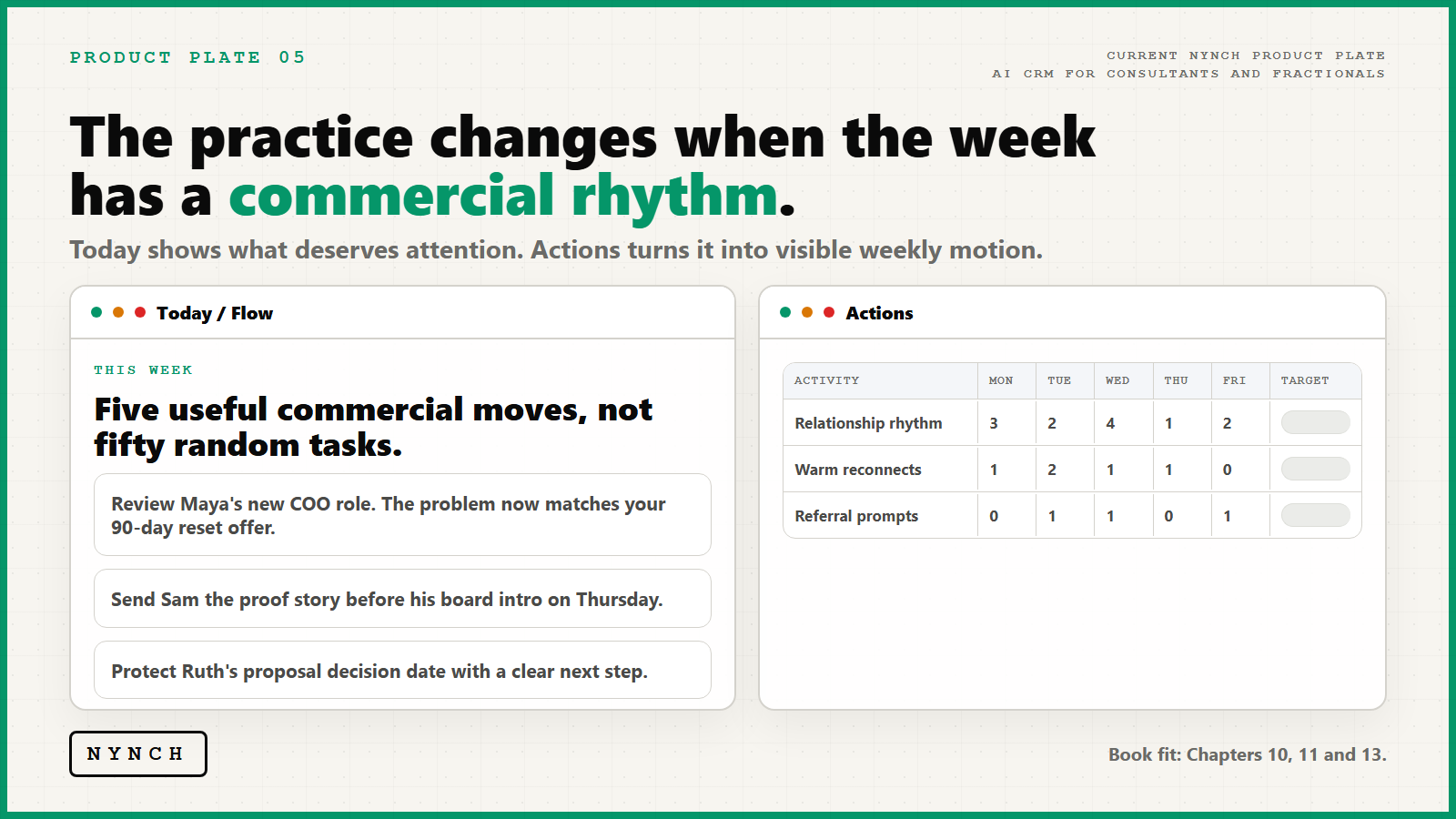
Nynch is the CRM for relationship-driven consultants and fractionals.
The review is serious enough to change behaviour but short enough to run every week. It ends with one sentence. Next week, the practice grows by moving these named relationships forward. That is the discipline. That is the difference between a good intention and a decision that compounds.
This week's w
Where Nynch fits
359 words
Move Why live proof is fragile
Open Why live proof is fragile
Book 12. Sub-Pillar Eight
Your best story should not depend on you being in the room.
Proof that travels is evidence shaped so other people can carry it. It connects a before state, pressure, decision, move, and outcome to your spine.
You believe you are the proof. Your stories land because you are there, explaining the details that matter, adjusting in real time to what the buyer cares about, adding texture when they falter. You have built your practice on the assumption that the strength of your proof depends on your presence. You have organised your entire offer around your ability to show up, be articulate, and defend your methodology in real time.
This assumption is costing you everything. It is a ceiling on your reach and a vulnerability at every handoff.
You have excellent proof trapped in stories. In conversation it works. It lands, it persuades, it opens the next question. But live proof is brittle. It depends on conditions you do not control:
Why live proof is fragile
384 words
Move What changed
Open What changed
Three forces are rewriting how proof travels.
First, the decisive conversation happens without you. A referrer describes you from memory in one message. A buyer mentions you to a colleague and asks for your one-pager. An introduction goes out, the buyer reads it while comparing you against two competitors. Your reputation gets compressed, quoted, and judged in rooms you will never enter. The buyer is not calling you to hear the story. The buyer is reading a summary while an AI tool ranks you. That is your proof test now. Old proof was built for someone who could explain it. New proof works without explanation.
Second, surface polish is infinite. Anyone can produce a polished case study, a confident post, or a well-written testimonial. Polish is not proof. A buyer cannot tell the real from the fabricated by how it looks. Proof has to be specific and sharp enough that it cannot be faked. Specificity is the only filter. Generic statements about your approach survive comparison whether you wrote them or a copy
What changed
296 words
Move The shape of portable proof
Open The shape of portable proof
Portable proof is not a credential list or a testimonial. It is a story shaped so other people can carry it. It shows a before state, pressure, decision, move, and outcome. Crucially, it ends with why the outcome happened, not just that it happened.
The before state is the client's situation when they brought you in. Not the long backstory. Just the conditions that matter. A founder carrying every commercial decision. A growing team with no operating rhythm. A business that knew it needed to change and did not know how.
The pressure is what made the problem urgent. What was the cost of leaving it unresolved. What made this now instead of next year. What was the buyer losing each month they waited. Most consultants skip this entirely. This is where the buyer recognises themselves in your story. Pressure makes the problem real on paper. Without it, the story is about something that happened, not something that mattered. With it, the buyer feels their own urgency in your words.
The decision is what the client
The shape of portable proof
703 words
Move The market is now testing your portable proof at speed
Open The market is now testing your portable proof at speed
What happens when you send a summary into the world. A referrer reads it and decides whether they can confidently repeat it. One question: is this specific enough that I will look foolish if I misquote it. If the answer is no, they do not use it. They invent their own description, and your proof disappears. They may still like you, but they cannot carry you.
A buyer receives an introduction and reads your material while talking to a colleague. That conversation happens without you. They compare you to two alternatives. They ask an AI to summarise the differences. Your proof is in a market test now, competing against other operators in rooms you will never enter. The ones that survive are the ones where specificity and point of view are real enough to persist, real enough that an AI reading three summaries can identify which one actually understands the problem.
A prospect pastes your one-pager next to two competitors and tries to work out the difference. If your proof is generic, you look identical to the o
The market is now testing your portable proof at speed
258 words
Move What this looks like in practice
Open What this looks like in practice
Portable proof starts as one strong story. A founder was carrying every commercial decision. The team had activity but no rhythm. They knew they needed operating discipline and had no template for it. You helped them install a weekly cadence, clarified the language they should use when they moved decisions, and moved follow-up out of the founder's memory into a system they could trust. The result was visible. The business grew without the founder driving every conversation. The team could commit and deliver without constant escalation.
That one story becomes several assets. A short referral note that a relationship partner sends in two sentences. A founder email in an intro thread. A LinkedIn post on your profile. A one-page case story. A proposal paragraph. A meeting opener. The point is not to produce content for its own sake. The point is to make proof easier for the network to carry. One strong story, shaped right, becomes an asset that travels through your network on its own.
Take the referral note fir
What this looks like in practice
826 words
Move The reality of proof in the age of AI comparison
Open The reality of proof in the age of AI comparison
A buyer receives an introduction to you and four other consultants. They have fifteen minutes. They do not read carefully. They paste your summary and the others into an AI assistant and ask it to find the differences. That is your proof test.
What signal survives that compression. Not language quality. Not your brand. Not testimonials. The signal that survives is the specific point of view and the evidence that shows you understand a problem differently.
Scenario one. Three consultants, all working with founder-led businesses. Your proof describes the moment when the founder becomes the bottleneck and why the solution is building an operating rhythm, not better hiring. Competitor A says they help founders scale without losing control. Competitor B says they help companies install professional management. When an AI assistant reads all three, yours is the one that shows understanding of a specific problem. You are not claiming you are better at consulting. You are claiming you understand the founder-to-foun
The reality of proof in the age of AI comparison
317 words
Move Where Nynch fits
Open Where Nynch fits
Your strongest proof is trapped in your head. You carry the stories. A client sends a warm introduction and because you have never shaped the story for other people to repeat, the referrer describes you from memory and some of the evidence dies in translation. You get asked about your work in a proposal and because you are writing from blank page again, this buyer sees a different version than the last one saw. The specific language that works gets invented and forgotten and invented again. The proof that should be compounding instead gets rebuilt every quarter.
Nynch Manifesto turns that into a system. You write the story once, complete. Before state, pressure, decision, move, outcome. You describe not just what happened but why the outcome was inevitable because of what you understood. You attach it to your spine so the reader knows the exact problem you own. Once that proof exists, it does not disappear when a client gets busy. It does not get weaker each time someone repeats it because you built it to su
Where Nynch fits
486 words
Move The cost of portable proof staying weak
Open The cost of portable proof staying weak
When proof stays generic, every relationship depends on you being present to explain it. A referrer sends your name but cannot give language to remember you by. A prospect reads your material but cannot quickly see what makes you different. An introduction goes out, and the buyer calls you to work out what you do. That is a practice that cannot grow beyond what one person can explain.
Generic proof is most vulnerable to comparison. When every consultant says they help teams be more effective or founders scale better, the buyer cannot tell the difference. They default to the warmest introduction or the lowest price. Your practice becomes one option among many instead of one operator with a clear point of view.
The quiet cost is this. When your proof is weak, the network cannot be useful. A warm connection who would happily refer you does not know how to describe you. They do not want to damage their credibility by making a vague introduction or repeating something that does not feel true. So they do not intr
The cost of portable proof staying weak
280 words
Move How to make proof portable
Open How to make proof portable
Start with one story. The strongest one you have. The one where before, pressure, decision, move, and outcome are all clear. Write it down completely. Get the shape right. Show your understanding of why the outcome was possible, not just that it happened. This is archaeology, not marketing. You are digging into what actually happened, what the client was actually struggling with, what actually changed, and what was true underneath that made change possible. The difference between a story and portable proof is that the story lives in your head, but portable proof has to survive outside it. It has to work when a referrer is repeating it from imperfect memory. It has to survive compression when an AI assistant is summarising you against three competitors. It has to stay true to the original even when it is shaped into four different formats for four different moments. Build for that from the start.
The story should be specific enough that someone recognises themselves in the before state. If you work with found
How to make proof portable
934 words
Move Activity is not motion
Open Activity is not motion
Book 13. Sub-Pillar Nine
Activity is cheap. Named commercial movement is the point.
Revenue actions have names attached. Named person, named company, named reason, named next step, and named commercial implication.
You can fill a week with movement and make zero progress. You post, message, reply, attend calls, update files, and handle admin. The calendar looks full. The inbox empties and refills. Your battery is spent by Friday. And yet the practice stands still.
Activity is not motion. The difference is naming. A full week of generic action is noise. A week where five conversations moved a relationship closer to a commercial decision is direction.
Revenue actions have names attached. Not segments or audiences or personas. Named people. Named companies. Named problems in context. Named next steps. That level of specificity is where a relationship practice becomes commercial.
The old belief measures activity. How many people did you message.
Activity is not motion
582 words
Move Why the old standard felt sensible
Open Why the old standard felt sensible
For most of a career in employment, activity and progress felt the same. You attended meetings, sent reports, moved work through a system, and the business changed because of it. The system existed. It supplied the buyers, the category, and the credibility markers. Your job was to bring judgement into a structure that worked without you.
When you move to independent practice, the structure disappears but the habits remain. You assume enough activity will generate enough demand. You measure a week by how busy you felt. You believe the market is mainly a visibility problem and the answer is more noise.
That belief fit an older market. When expertise was scarce on the surface, volume worked. If you posted more than your peers and sounded articulate, you got noticed. If you attended enough events and worked the room, you built a network just through showing up. If you replied to every message, you earned a reputation as responsive. The market had space for generic activity to convert into selective demand.
Tha
Why the old standard felt sensible
330 words
Move What changed
Open What changed
The shift becomes visible when an independent practice stops growing on luck. You do all the activities you used to do. You post, network, follow up, attend events, send proposals. And slowly, demand stops correlating with effort. You feel busier and more stuck at the same time.
The root cause is not that you stopped trying. It is that effort and progress are no longer the same thing. You need to name the actions. You need to attach them to people. You need to know which ones move a relationship forward and which ones only create noise.
The shift is also driven by how senior decisions happen now. When you are not in the room, the conversation about you happens without your presence to shape it. A referrer describes you from memory in a single message. A peer mentions your work to a friend. A past client pastes your one-page summary into a chat and compares you against two other options while you are not there to defend it or clarify. Your reputation gets compressed and judged in your absence. That means it
What changed
301 words
Move The action ladder
Open The action ladder
Not every action asks for a meeting. Not every connection needs a direct ask. Not every opportunity is ready to move. Most independent practices treat every conversation as if it is the only conversation. You reach out as if this week is the moment. You ask too early. You push because you are not sure there will be another chance. And the relationship gets damaged because the action did not match the timing.
The action ladder is a discipline for choosing the right action at the right moment. It protects the relationship while it moves the practice forward. It converts a vague instinct about who matters into a specific decision about what to do. The rungs are useful first, commercial second, pressure last.
Useful first means the action has a clear point beyond your own calendar. You are not reaching out because you want something. You are reaching out because you have something that serves the other person. You send proof that helps someone solve a problem. You make an introduction that creates mutual value.
The action ladder
889 words
Move Five named people is enough to change a week
Open Five named people is enough to change a week
The scale of motion does not need to be large. Five named people is enough to change a week.
Not fifty prospects. Not a hundred anonymous contacts. Five people where the problem is real, the relationship is worth protecting, the timing is worth checking, and the next action is worth reviewing.
One of them might need a warm reconnection after six months of silence. You are not asking for anything yet. You are just checking in and reminding them why you matter. One might need a referral prompt because they sit next to someone who feels the problem. One might need a proposal follow-up because a conversation ended with a maybe and time has passed. One might need a useful note because something changed in their world and you have proof that matters. One might need to be left completely alone because trust is low or the moment is clearly not ready.
The discipline is to know why each person is on the list. It is not enough to have a big network. You have to know which part of the network is worth acting on this w
Five named people is enough to change a week
284 words
Move Where Nynch fits
Open Where Nynch fits
The method breaks when it lives only in memory. A relationship-led practice carries more context than one person can hold cleanly. Emails and notes and promises and role changes and timing signals and referral threads and pricing conversations and draft offers and proof assets and conversations that should not be allowed to go cold. Hold all of that in your head and the practice leaks the opportunity it worked hard to earn.
The leak is invisible until you add it up. Months later, when you review the week, you realise that three valuable relationships went cold because there was no system to keep them warm, two opportunities died because no one captured the timing, and one introduction never happened because you forgot what the person promised to do. The cost becomes real.
The tool does not fix the method. It frees you to run the method without the admin. Your system should remember what a buyer said. It should remember what was promised. It should remember what changed. It should remember what action is now
Where Nynch fits
278 words
Move The action loop in practice
Open The action loop in practice
Consider a former client. You worked together two years ago. The work went well. The relationship ended cleanly. Then it went quiet.
Without a system, this relationship stays vague. You know it is good. You know you should stay in touch. But you do not know what to do this week. So you do nothing. Time passes. The relationship feels cold. When you finally reach out, it feels heavy and needy. You are reaching out because your pipeline is thin, not because something changed that makes now the right moment. The person replies politely. And it goes quiet again. That is not motion. That is hope disguised as activity.
With a system, the work is clearer. You review the relationship and know that two years is long enough. You capture who they are, what they do, what the organisation looked like then, what the problem was that you solved, and what you would solve for them now. You know what changed in their world. You read their recent post or notice they moved to a larger company. You know whether they likely still
The action loop in practice
907 words
Move Closing the circle
Open Closing the circle
This is the last book in the library. It brings spine, network, and motion together into one practice you own.
A clear spine gives you something to teach and a reason people remember you. Without motion, the spine is just something you wrote. It does not move through the network. It does not create revenue. It becomes a document you created, not a position you live by.
A strong network gives you people who understand your work and would refer you if they remembered the focus. Without motion, the network is just a list of contacts. It does not move. The relationships do not stay warm. The proof does not travel. It becomes a spreadsheet of names and promises unfulfilled.
Motion converts spine and network from potential into practice. Motion is the weekly rhythm that keeps your positioning alive in the market. Motion is the discipline of five named actions that move real relationships toward real decisions. Motion is the practice you own because you run it every week, and the market starts to know what to do
Closing the circle
764 words