The buyer lives in a commercial context you have to understand clearly to move them. Their role, their pressure, the trigger that makes them ready to move now, how they think about budget, the trust path that makes them confident enough to move, and which buyers are not a fit. Artificial intelligence can help you gather signals about who has changed jobs or who is in a company that just raised money. But it cannot choose the buyer for you. That choice is always yours to make. It is the most important strategic decision in the practice.
Once you have chosen the buyer, the challenge is keeping that choice stable while you maintain a network and deliver client work. A vague buyer makes the system noisy. A specific buyer lets the system work. Nynch uses the Ideal Client Profile and People to turn the buyer definition into a map of real relationships.
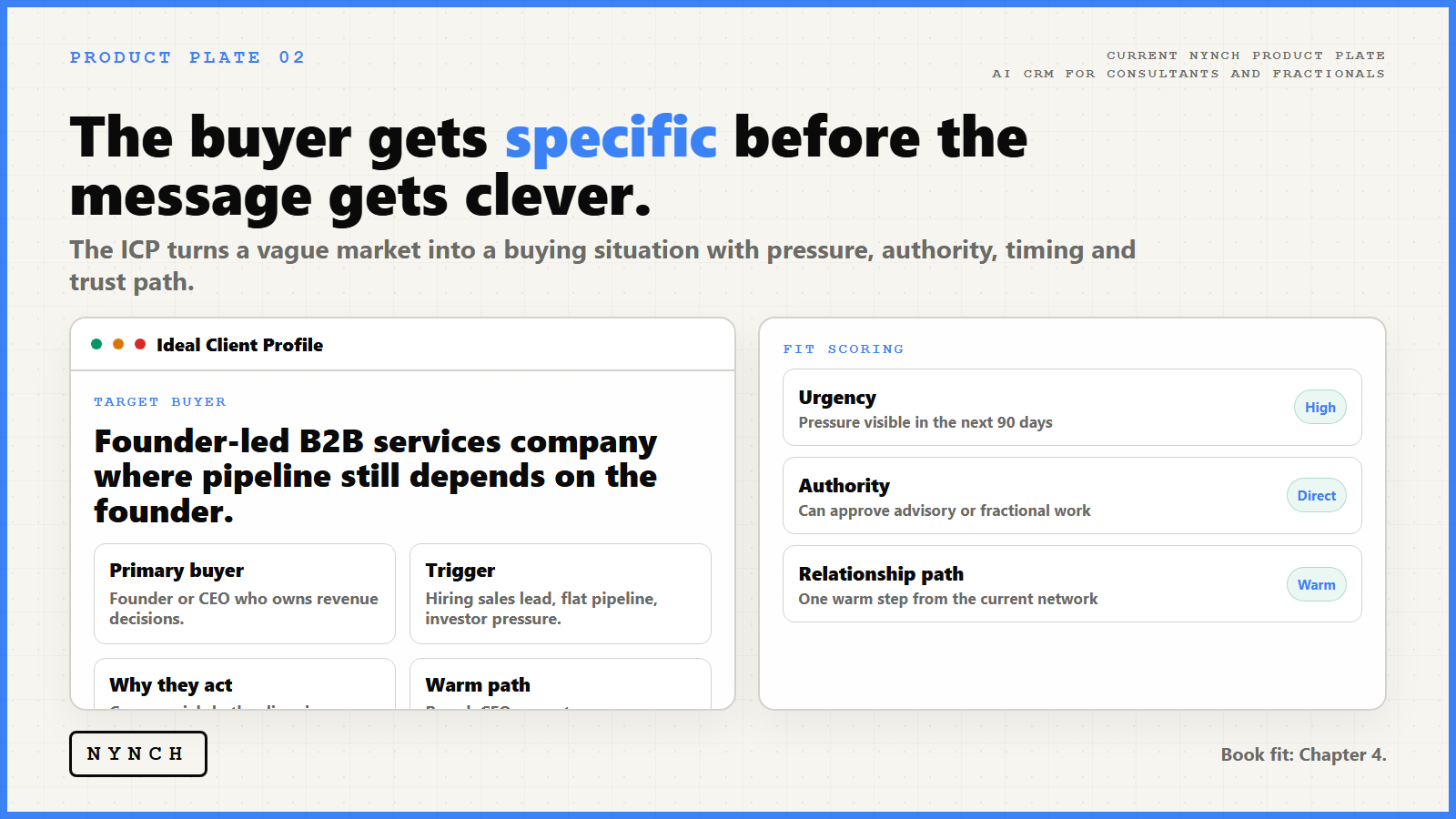
You define the buyer once. The role, the company context, the problem they feel, the trigger that makes them ready to move, how they think about budget, the path to their trust, and who is not a fit. Then you connect that profile to the people in your network. Which past clients fit. Which peers understand this buyer. Which operators are one step away. Which investors, board members, recruiters, advisors, or suppliers sit in that orbit. Nynch is the AI CRM that connects the buyer you have defined to the relationships that matter. The important phrase is relationships. The software has to serve the way senior work is genuinely bought. Slowly. Through trust. On the buyer's timing.
The advantage Nynch brings is that you do not have to hold all of that context in your head. The buyer definition lives in the Ideal Client Profile. The relationships live in People. You add context as you learn it. You review the context when a relationship moves. You see who is closest to matching the buyer profile. You see which warm paths are worth exploring. You can sort by company type, by whether you know them warm or cold, by whether they have already bought from you. You can see the people who understand your buyer because you have already worked with them. You can spot the people one warm step away who could become introductions. The practice does not leak the opportunity it worked hard to earn because the context has a place to live. The knowledge that took years to acquire in your head is now a map you can return to, revisit, and act on.
This week's work
Do not turn this book into admiration. Turn it into a clear choice.
- Write down the one buyer you are building toward. Not the broadest possible market. The one that feels most real based on the work you have done and the relationships you have.
- Name the pain they feel, the authority they have, the risk riding on the decision, and the trigger that makes them ready to move now.
- List five past clients or relationships that fit this profile. Be specific about why they fit.
- Identify one referrer or contact who understands this buyer and could help you reach more of them.
- Block thirty minutes on your calendar this week to update a relationship with someone who fits the pattern. Do not try to sell. Try to be useful first.
Closing argument
The fear of specificity is that you will miss the people who do not fit the pattern. The reality is that the people who do fit the pattern will move faster, remember you more clearly, and refer you more readily. You are not throwing away proof. You are choosing the proof that creates the most momentum.
A buyer is not a demographic. A buyer is a buying situation. A person with a specific pain, a specific authority, a specific risk, and a moment in time when the problem becomes urgent. Choose that buyer. Choose them clearly. And watch what happens when the market finally remembers you for the problem you actually solve.
Where next
Read The Offer They Can Understand next. It turns the problem and the buyer into something the market can buy. To build the whole spine in three days on your real business: nynch.com/offer-sprint.