The spine lives in Strategy Coach. What problem do you solve shifts from a form field into the first commercial asset of the practice. Ideal Client Profile stops being a targeting filter and becomes the operating context for every decision. Services and Pricing transforms the work into a package a buyer understands and a referrer can repeat.
But the spine has to be concrete and current. It drifts if it lives only in your head. It gets forgotten the moment a client emergency arrives. It stays stale if it lives in slides because no one updates slides. For a spine to function as a commercial system, it has to live in a place where you review it, refine it, act on it, measure whether it is working.
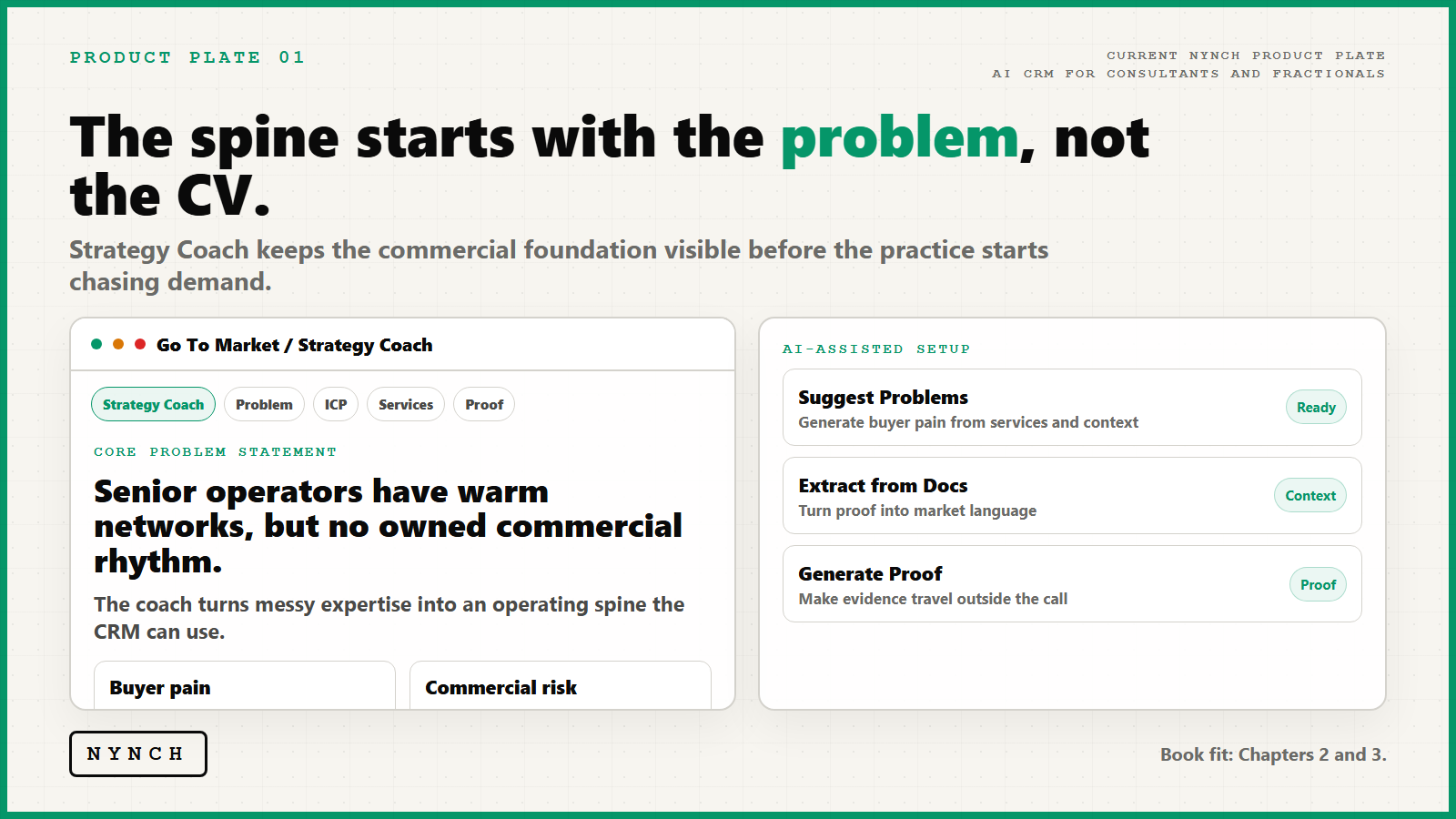
Nynch is the AI CRM for consultants and fractionals who win high-value deals based on relationships.
The difference is this. Nynch remembers what matters. The spine is unusable if it lives only in your head. When the spine is clear and current inside the system, it becomes the operating language of the whole practice. How you reconnect with old relationships. How you explain work to referrers. How you decide which opportunities matter and which to skip. How you prepare for founder calls. How you write useful posts. How the whole practice makes consistent decisions without reinventing on every Tuesday.
Growth does not happen in the abstract. It happens when a past client receives a better update because you remembered what they care about. It happens when a referrer understands the new focus and knows exactly which introduction to make. It happens when a prospect receives a useful note because the context already makes sense. It happens when an opportunity moves from vague interest into a clear next step because the system surfaced it at the right moment. None of that happens if the spine is fragmented across notebooks, slides, and memory. All of it happens when the spine is clear and current.
Where the spine shows up in the market
The spine operates in several channels at once. Some direct, some indirect. All consequential.
A prospect hears your name and asks what you do. That conversation only advances if the spine is clear enough to explain in one or two sentences. If you stumble, hedge, or start with your background, the prospect stays interested but uncertain. If you land the problem, the buyer, the offer, and the timing in one sentence, the conversation moves forward. That clarity comes from a spine sharp enough to explain at speed.
A referrer wants to make an introduction. They think of you. But they only make it if they can picture who you actually help. If your positioning is vague, they stay quiet. They are not sure the fit is right and do not want to waste your time. If your positioning is clear, they introduce you because they know exactly which client or prospect fits the problem you solve. A referrer becomes a distribution channel only when they understand what you solve and who you solve for.
A past client remembers you and wants to help, but they do not know what you are building now. So they stay quiet. They only mention you when someone says I need help with what you used to do. With a spine, the past client knows what to remember and what to repeat. They can introduce you not because they remember your job, but because they remember the problem you solve. That is a different kind of advocate to have working on your behalf.
An AI assistant is drawing up a comparison between you and an alternative. The assistant is not trying to help you. It is trying to help the buyer. It reads your website, your recent content, your summary. It compares what you claim against what the alternative claims. It synthesises a recommendation. If your positioning is scattered or vague, the comparison will be scattered. If your positioning is a clear spine, the assistant sees the shape of what you do and compares you accurately. The market is increasingly making these decisions without you present. Your spine has to be clear enough that an AI can read it and represent you accurately.