The practical difference appears the moment you compare the two approaches. The volume approach starts with a list. Who is large enough to need what I offer. Build outbound around reaching many targets and expect a low reply rate. The relationship approach starts with a reason. Who do I know who sees this problem. Who sits one step from my buyer. Which of those people deserve real attention this week.
The relationship approach starts smaller and moves more slowly, but builds more durably. A fractional leader might identify twenty companies with the right growth pressure. Rather than scraping every contact at those companies, the leader maps the human path into each one. Which investor knows both the fractional and the company. Which operator moved from that industry. Which past client has a connection. Which peer understands that company's market shifts. The first action is not outreach to thirty people. The first action is research to find the right entry point for five.
This shifts the calculation entirely. With a list approach, you send messages to one hundred contacts and hope for five replies. With a relationship approach, you research five contacts, find a real reason to reach each one, and the first message carries context. The reply rate is higher because the message deserved a response. The conversation is richer because it started with understanding. The opportunity has a longer timeline but a stronger foundation.
The tone also shifts in a way that protects the practice. Compare two versions of the same outreach. First version: I help B2B companies like yours scale revenue during growth phases. I work with founder-led companies across multiple sectors. I would love to explore whether there is a fit for a conversation. This message could apply to anyone. It signals the sender has not done the work.
Now compare: I saw you are hiring your first dedicated revenue leader while the founder still owns most of the commercial relationships. I work specifically with founder-led B2B companies at exactly that handoff point, and that transition is much easier when someone who understands the founder's vision helps shape the process. Would it be useful to talk about how other founder teams have managed this.
The second message may still be ignored. But it is specific enough to deserve attention. It shows the sender understands the situation. It positions the offer around a real problem rather than a generic claim. And it is the kind of message that would make a peer comfortable carrying a warm introduction, because the peer can see you understand what they are asking for.
Start one step away
A fractional working with founder-led SaaS companies at the hiring stage would start by identifying twenty companies with the right profile. Not by scraping a list from a database. By looking at hiring announcements, funding rounds, and market moves that signal when a founder is most likely to bring in a dedicated revenue leader. For each of those twenty companies, the fractional then maps the human path in. Which investor sits on the board or has backed the company. Which operator moved from a similar business into a role at that company. Which past client has a connection or credibility in that space. The research is specific. The goal is honest relevance.
Most of those companies will not have a warm path. That is fine. The fractional is filtering for the ones that do. Five companies with a real connection are worth more than twenty companies with a generic outreach list. The connections come from different directions. An investor who knows both of you and can introduce the fractional. A peer who worked at a comparable company five years ago and now sits at a complementary firm. A past client who can vouch for the work and make an introduction based on their own credibility.
The first move is light and useful. It is not trying to land a deal immediately. It is trying to start a conversation that would feel natural to both sides. A warm introduction from someone who understands both you and the company. A message that shows clear research and real understanding of where the company is right now. A connection request that explains why the relationship matters at this moment. The distinction from list buying is stark. A list says, I found your contact details and I want your attention. The human path says, I found a reason to know you and I did the work to make the approach feel relevant.
Where Nynch fits
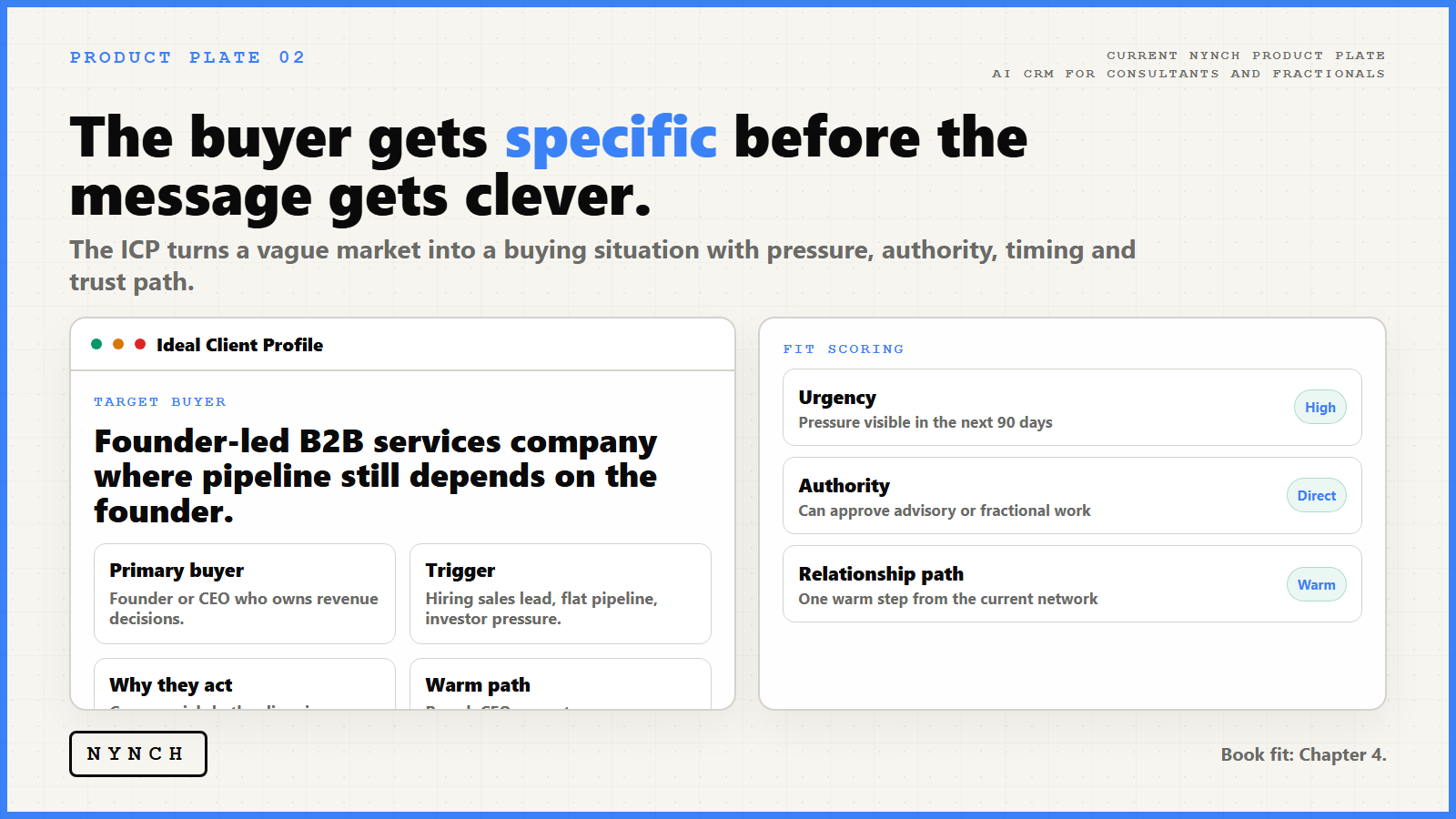
The Ideal Client Profile tells you who your buyer is. People shows you the existing trust paths in your network. Find Relationships maps the high-fit opportunities you should build relationships with before you need them.
Find Relationships is the operating surface for quality-gated relationship building. It is not list scraping. It is a live pool of high-fit people to build relationships with before the moment arrives when you need them. The system works at around five hundred core ICP contacts, plus room for campaign-specific targets. The fit score acts as a gate. Someone does not enter the core relationship pool unless the evidence suggests they belong there. A reason for the connection is visible before you take the first action.
The practical advantage is that Find Relationships holds the context you discover about each person. When you research a potential relationship, you write why they belong in your network. Shared investor. Former colleague. Hiring signal. Market shift. Relevant point of view. That reason is recorded. It is visible the next time you think about outreach. It makes the first message easier to write because the context is already captured. It makes the decision to reach out more intentional because you can see whether the reason is still current or has shifted.
The system also shows you the relationship status. Have you already connected. Is the relationship warm or dormant. What did you promise last time you spoke. When is the right moment to reconnect. This prevents the practice from losing the small trust you have already built. Many operators sit on thousands of dormant relationships that never get tended because the relationships are scattered across email, LinkedIn, and memory. The same relationships become an asset the moment they are visible and the reason for reconnecting is clear.