Stage 07 / Message + record
The message, and the record. If you send without logging, you built a mood, not a system. If you log without a real observation, you built admin.
Stage 07 / note and log
| Channel order | Prefer the channel you already use with them. Work email first when you have a clean address. LinkedIn second. Do not double-send the same text the same day. |
| Draft time | 8–12 minutes when four layers are already on the sheet. If drafting takes 30, you are still researching or still afraid. |
| Follow-up | One follow-up only, four to six business days later, shorter, with one new fact or an offer to close the thread. Then stop unless they reply. |
| Address finding | Usually already held. If missing, search your archive first, then the companion book’s waterfall. Do not rebuild the stranger stack by default. |
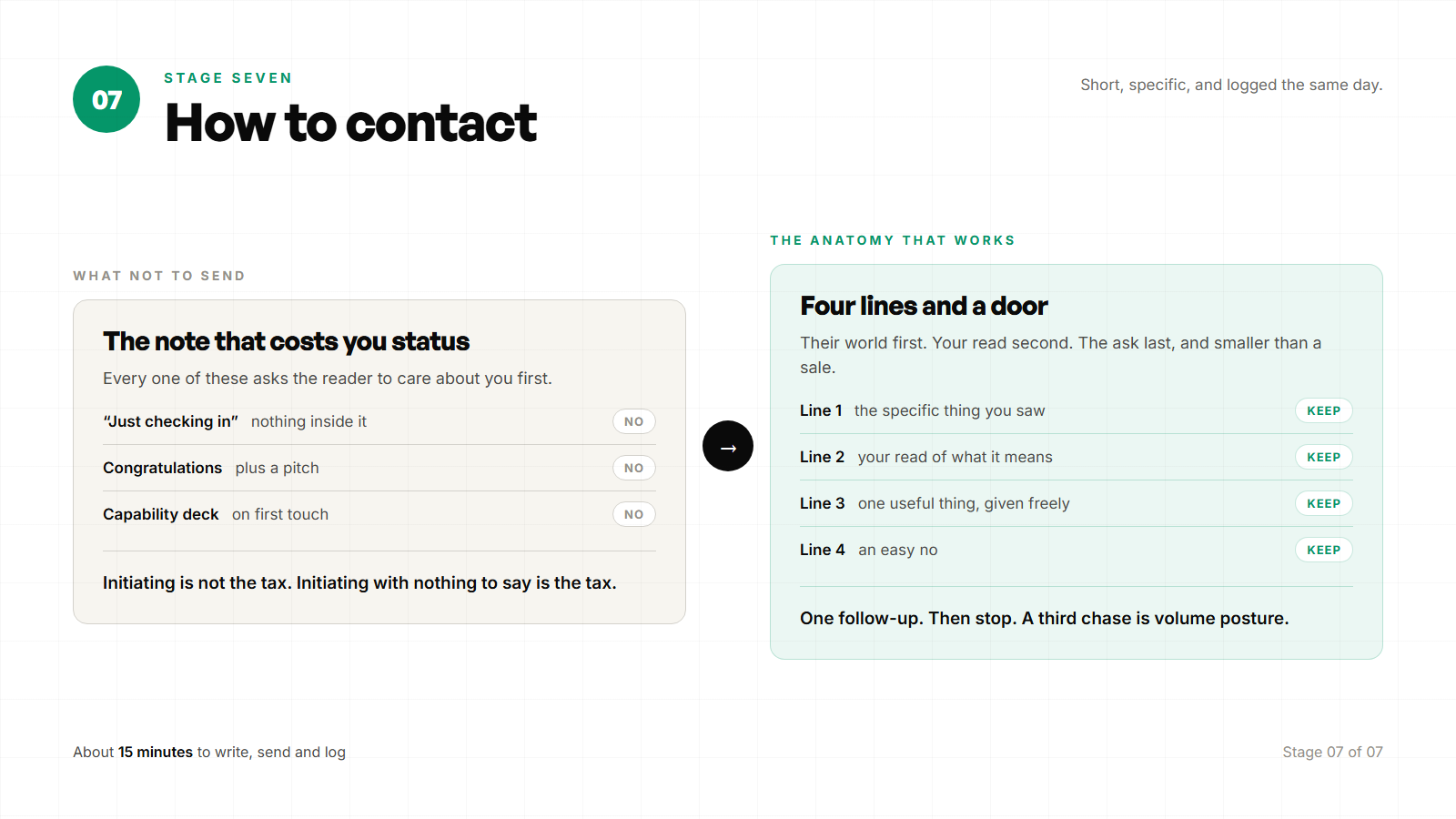
Anatomy of a network note that earns its place
- Name + bridge from their world (signal language or shared history), not your capability.
- One stacked observation that could only come from the cascade (or from shared work).
- A useful next step that is small: a one-page artefact, a short pattern, a twenty-minute conversation, permission to send something. Not “pick your brain.” Not “jump on a quick call” with no gift.
- An easy out. Experts leave doors open without hanging on the handle.
- No attachment that is a capability deck unless they asked for one. Decks ask them to care about you. Artefacts help them with Tuesday.
Warm referrer / post about reorg / LinkedIn
James, the reorg note tracked with what you said last autumn about protecting the advisory bench from becoming a delivery factory. If that fight is live again, I have a one-page pattern from two similar transitions that might save you a week. Want it?
Cool past client / promise date due / email
Subject: July, as you asked
Maya, you said in February to come back in July once the budget cycle settled. July is here. I am not assuming the need is live. I am keeping the promise.
If the board-pack load is still eating ops time, I can send the two-page comparison we used at Northline. If timing is still wrong, tell me when a sane check-in would be and I will hold to it.
Sam
Channel, send, follow-up
Email: best for stacked observations and for anyone who already corresponds with you there. Subject lines name the problem or the promise, not “quick question” and not your company name.
LinkedIn: best when the signal lived on LinkedIn and the relationship is mostly there. Shorter. Still specific. Connection-request pitches are banned in this book. If you are not connected and they are Watch-tier, a short note after connecting is fine. The pitch is never the connection request body.
Phone or voice note: only for warm relationships where that is already normal. Do not “surprise call” a cool contact with a four-layer monologue.
Follow-up ceiling: one. Four to six business days. Add one new fact or offer a clean close (“happy to leave this with you”). A third chase is volume posture. Ceiling: two outbound touches total per person per signal.
The record (non-negotiable)
Log the same day you send. A sheet updated weekly is a diary. A sheet updated at send time is a system.
Minimum columns for this motion:
- Date, person, company, title
- Signal type and source
- L1–L4 one-liners (or a link to the research note)
- Channel, address or profile URL
- One-line observation you sent
- Status and next date
- Outcome when it lands (replied, meeting, no, later, artefact sent)
When they say “not now,” ask when a sane check-in would be, write that date, and set Watch accordingly. That date is a future signal. Losing it is how networks go quiet while everyone pretends they are being respectful.
What happens after they reply
A yes to a short conversation is not a pitch meeting. Open with the problem you named. Ask what is true for them now. Only then, if it still fits, describe how you have solved it and what a first engagement would look like. If they want the artefact only, send it within a day, without a five-email nurture sequence. Generosity with a clean exit builds the next conversation. Desperation spends it.
~12 min send+log. Draft, send, and log on a prepared target. About 5 minutes for the single follow-up when it comes due. Cap researched network sends at four to six a day so quality holds. Exhaustion produces spam even to people who know you.
How this stage fails
- You send “hope you are well” after an hour of research. The research never reaches the page.
- You attach a twelve-slide deck to a first touch.
- You forget to log, then re-contact the same person three weeks later with a slightly different angle.
- You follow up four times because silence feels like disrespect. Silence is often busy, not rude.
- You pitch in the first paragraph before the observation lands.
When the middle starts to feel absurd
You now have a full path: map the network, score it, stand a multi-surface watch, deepen a signal, run four research layers, judge timing, write, send, and log. The path is correct. Running the middle by hand, every week, forever, while you also deliver client work, is the part that should start to look like a second job. There is a product that follows people, knows your ICP, and prepares the bridge. It is called Nynch. It is not required to run anything above. The closing chapter is where that choice is spelled out. Not here.