Stage 02 / Score
Turn a list of names into a scored, current picture. Without this stage, monitoring is noise and outreach is guilt mail.
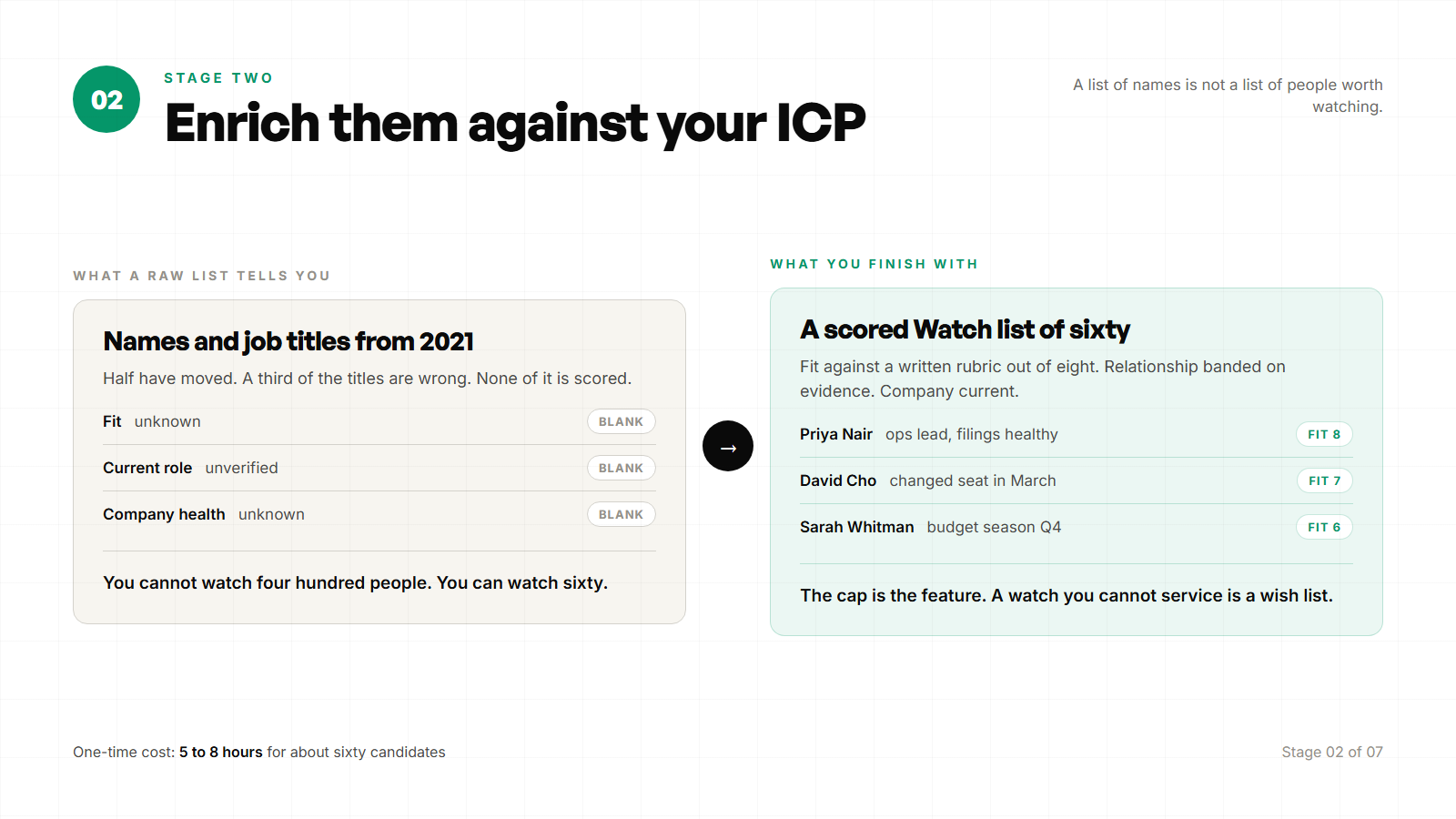
Stage 02 / scored picture
| What you produce | Fit score, relationship band, current company and title, and a Watch flag for the people who deserve signal monitoring. |
| Software you open | LinkedIn (profile + company), LinkedIn Sales Navigator if you already have it, Apollo or similar for bulk company data, Companies House for UK entities, your own ICP rubric on one page. |
| Time cost | First pass: ~2–3 minutes per person for a light enrich, ~6–8 minutes for a full score on high-value rows. Batch by priority, not alphabet. |
| Companion cross-ref | The fit rubric in Play 01 of The 7 Network Plays is the same spine. Reuse it. Do not invent a second scoring religion. |
Write the ICP as a rubric, not a vibe
Four fields on one page, scored 0–2 each. Perfect fit is 8.
- Title patterns you sell to (and the one step above them)
- Company size band you can actually serve
- Industry or problem domain where your proof is strongest
- Buying context (growth pressure, cost pressure, post-hire chaos, board demand, new mandate)
Write the rubric in the buyer’s language. “Series B SaaS CFOs drowning in board pack theatre” is a rubric. “Passionate leaders in dynamic organisations” is a mood board. If you cannot score a real profile in fifteen seconds against the rubric, rewrite the rubric until you can.
How to enrich a row
Step 01: Confirm they are still at the company you think.
Open LinkedIn. Current role and start date. If the title changed, update the sheet. If they left, update company. Stale company data is how you write a clever note to someone who does not work there any more.
Step 02: Score fit 0–8 against the rubric.
Green 6–8, amber 3–5, red 0–2. Work in batches of forty. Do not write outreach. By row eighty the rubric will drift. Stop and reset with the written page. Red rows can stay on the sheet without a Watch flag. The play is a ranking, not a reunion tour.
Step 03: Score relationship for greens and ambers only.
Warm, cool, or polite-stranger. Four questions: When did you last speak? Have they hired you or referred you? Would they take a call without wondering who you are? Was the last contact substantive or performative? A like is not contact. A conference hello is polite-stranger until proven otherwise.
Step 04: Enrich company facts you will need for research later.
For every green and high amber: company website, LinkedIn company URL, approximate headcount, HQ country. UK companies: search Companies House for the legal entity, directors, and recent filings. Free, under-used, and often more honest than the marketing site. Apollo’s company view or LinkedIn company insights can fill headcount and industry when the website is vague. Do not buy ZoomInfo for this motion unless you already have it for a team.
Step 05: Set Watch = Y for the active set.
Default rule: every green, and amber rows that are warm. Cap the first Watch list at a number you can actually monitor. For most solo operators that is 40–80 people, not 400. You can rotate ambers quarterly. Breadth without a cap is how Stage 03 becomes theatre.
Step 06: Fill the address only if it is missing.
Prefer Gmail or Outlook search for their name or domain. Prefer calendar invite headers. Prefer an old proposal PDF. Only if all of that fails, use the email waterfall from the companion book’s public-signal bench. For network motion, address finding should be rare. If it is not rare, your Stage 01 email harvest was thin.
Bulk tools without becoming a data project
LinkedIn Sales Navigator helps when you re-check titles and company filters in batches. Apollo helps when you need company firmographics at volume. Wiza or similar can enrich a LinkedIn list with emails, but for this motion use it only on Watch rows missing addresses. Companies House (find-and-update.company-information.service.gov.uk) is free for UK statutory filings, officers, and accounts. OpenCorporates helps when entities span jurisdictions. Do not build a warehouse. Enrich enough to rank and watch.
~6 min / green. Full enrich on a high-value row. Light pass on everyone else is about two minutes. On 60 Watch candidates that is roughly six hours once, then 45–60 minutes a month to re-check titles and company moves on the active set.
How this stage fails
- Everything is green because saying no feels rude. The Watch list becomes unusable.
- You score titles and ignore company size, then spend weeks watching people you cannot serve.
- You enrich forever and never set a Watch flag.
- You treat polite-strangers as warm because they are in your first-degree graph.
- You skip Companies House on UK targets and miss director changes and filing pressure that would have been the bridge.