Stage 05 / Cascade
Macro industry trend, then micro trend, then company, then person. Each layer narrows. Each one changes the sentence you write. This is the part nobody teaches, and it is the mechanism that makes the note land.
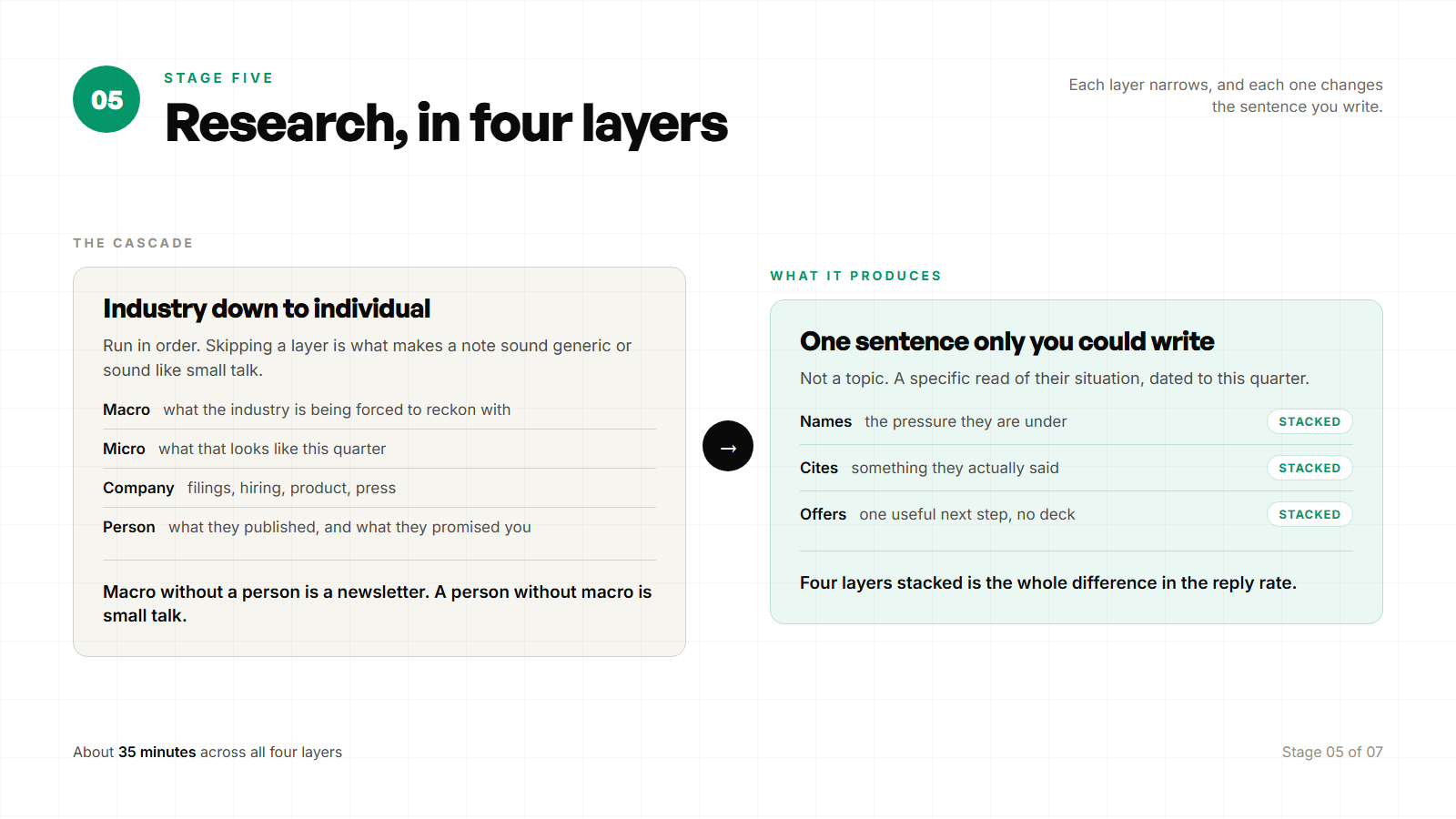
Stage 05 / four layers
The cascade
- L1, Macro. Industry pressure this quarter
- L2, Micro. Trend inside the function
- L3, Company. What is true here now
- L4, Person. Their words, role, week
A macro finding without a person is a newsletter. A person finding without a macro read is small talk. The message lands when all four are stacked.
Budget 25–40 minutes for a full cascade on a serious target. Light version for a warm past client with a clean signal: 15–20 minutes. If a layer returns nothing useful in its time box, write “thin” and move. Do not pretend depth you did not earn.
LAYER 1
Layer 1: Macro industry trend
What you are looking for: the pressure the whole industry (or the buyer’s category) is under this quarter. Regulation, cost of capital, supply, labour, technology shift, demand shock, public scrutiny. Not “AI is changing everything.” A force a CFO or operator would recognise as real.
Where you actually find it:
- One quality industry note: FT section, trade journal, McKinsey/Deloitte/BCG public article if relevant, or a specialist newsletter you already trust
- For UK companies: Bank of England or ONS releases when the pressure is macro-economic, plus sector bodies (Make UK, techUK, and so on) when the pressure is sector-specific
- Companies House aggregate patterns only if you already watch a cohort (for example many late accounts in a sector). Do not force this.
- Your own last three client conversations in that industry. Primary evidence beats a generic think-piece.
Time box: 6–8 minutes. Read for the force, not for a bibliography.
What a good finding looks like: “UK mid-market manufacturers are still absorbing ERP and systems programmes that slipped through 2024–25, and board confidence in monthly numbers is the quiet casualty.” Specific enough to be falsifiable. Not “digital transformation continues.”
How it changes the sentence: the first clause of your note can sit inside a world they already feel. You stop sounding like you only read their LinkedIn, and start sounding like you read their quarter.
LAYER 2
Layer 2: Micro trend
What you are looking for: the narrower pattern inside the function you sell to. Forecast trust after system change. Fractional seats replacing stalled full-time searches. Pipeline quality under a new CRO. Board packs that grew while headcount shrank. The micro trend is where your craft lives.
Where you actually find it:
- Job descriptions in the function (LinkedIn Jobs, company careers pages): repeated phrases are micro-trend evidence
- Comments under posts by peers in that function (LinkedIn). Pain language is denser in comments than in polished posts.
- Podcast interviews with operators in the same seat
- Your own delivery notes and proposal language from the last two wins. If three clients used the same sentence, that sentence is a micro trend.
Time box: 6–8 minutes.
What a good finding looks like: “After ERP cutovers, CFOs are rebuilding driver-based forecasts because the system’s first outputs are not trusted by the board.” That is a craft sentence. It is also a positioning sentence.
How it changes the sentence: you name the mechanism, not only the mood. The reader feels understood at the level of their actual work.
LAYER 3
Layer 3: Company
What you are looking for: what is true at this company right now that supports or modifies the micro trend. Hiring, product launches, leadership changes, filings, funding, restructures, office moves, customer wins, public complaints, tech stack clues.
Where you actually find it:
- Company website: news, blog, careers, team page
- LinkedIn company page: posts, people count movement, job listings
- Companies House for UK entities: accounts, confirmation statements, officer appointments and resignations, charges. Free. Under-used. A new director or overdue accounts is a real fact.
- Google News query: "Company Name" with a date limit of past 90 days
- Glassdoor or Indeed snippets only as weak secondary colour, never as the spine of a note
- BuiltWith or similar only if tech stack is part of your offer. Otherwise skip.
Time box: 8–10 minutes. Stop when you have two solid facts. You are not writing an equity research report.
What a good finding looks like: “Careers page shows three finance systems roles still open three months after the ERP go-live post. Companies House shows a new non-exec appointed in January.” Two facts. Enough.
How it changes the sentence: the note becomes about their house, not “companies like yours.” Specificity is status.
LAYER 4
Layer 4: Person
What you are looking for: their words, their mandate, their recent emphasis, and any history with you. The person layer is where you earn the right to write “you” instead of “CFOs in your sector.”
Where you actually find it:
- Their last five to ten LinkedIn posts and a scan of recent comments they left on other people’s posts
- Podcast appearances, conference talks, Substack or newsletter if they write
- Your email and notes: promises, budget mentions, timelines, referral names, tone of the last goodbye
- Mutual connections only if you will actually use an introduction path. Do not name-drop without a plan.
Time box: 6–8 minutes for public material, plus 3 minutes for your own archive search.
What a good finding looks like: “In her comment she used the phrase ‘rebuilding the forecast.’ In our last project debrief she said board packs were already a two-week tax. Those two lines rhyme.”
How it changes the sentence: you can open with their language. That is the opposite of a template. It is also the opposite of surveillance cosplay. You are using what they chose to make public, plus what they already told you.
Stacking rule
Before you write, force one line per layer onto the sheet:
- L1 macro:
- L2 micro:
- L3 company:
- L4 person:
If any line is empty, either fill it in the time box or consciously send a thinner note with lower ambition (for example a short useful artefact with one observation, not a full diagnostic ask). Do not bluff a layer.
WORKED EXAMPLE
Worked example, industry to message
This example is illustrative composite, not a claim about a real company. It exists so you can see the cascade produce a note without guessing.
Target
Priya Shah, CFO at a UK industrial manufacturer, ~280 people, Midlands. Past client 14 months ago (board reporting redesign). Fit 8. Relationship: cool (good work, then quiet). Signal from Stage 04: her comment on a peer’s ERP post, “we are still rebuilding the forecast after the ERP cutover.”
L1 Macro (7 minutes): Trade and general business press this quarter still show mid-market UK manufacturers under margin pressure and unfinished systems programmes. Boards want faster monthly numbers while teams are still reconciling two sources of truth. Finding: systems change is not the story. Trust in the numbers after systems change is the story.
L2 Micro (7 minutes): Multiple CFO peers in comments describe “shadow spreadsheets” returning after go-live. Job ads for FP&A partners emphasise “business partnering” and “driver-based forecasting” more than pure systems admin. Finding: the craft problem is forecast credibility and board-pack labour, not the ERP brand name.
L3 Company (9 minutes): Company LinkedIn posted about ERP go-live three months ago. Careers page still lists a Finance Systems Analyst and a temporary FP&A contractor. Companies House: confirmation statement filed on time, one new non-executive director appointed in January, accounts not overdue. Finding: the programme is live, the team is still patching capacity, governance attention is up with a new NED.
L4 Person (8 minutes): Priya’s comment is plain and operational, not celebratory. Older posts from last year show pride in shortening the board pack. Your last project with her killed two weeks of pack waste. Finding: she already paid to fix board-pack theatre once. The ERP has reopened a cousin of the same wound.
Stacked bridge: Industry pressure on number-trust after systems change + micro pattern of shadow forecasts + company still hiring finance systems capacity post go-live + her own language about rebuilding the forecast + prior work on board packs.
Past client / cool / email / four layers stacked
Subject: Forecast trust after the cutover
Priya, your line about still rebuilding the forecast after the ERP cutover landed. I am seeing the same pattern across mid-market manufacturers this quarter: the system goes live, the board’s confidence in the monthly number does not, and the shadow sheets quietly return.
When we worked together you had already killed two weeks of pack theatre. If the cutover reopened a cousin of that problem, I have a one-page “first 90 days of forecast trust” checklist from two similar post-go-live situations. Happy to send it. No pitch attached.
Either way, hope the NED onboarding is not eating the whole month.
Sam
Every sentence in that note maps to a layer. Remove L1 and L2 and it becomes a small personal check-in. Remove L3 and L4 and it becomes a newsletter. Stacked, it is a reason.
~35 min / target. Full four-layer cascade on a serious network target. Warm past clients with a clean signal can land in 15–20 minutes. Cap at 40. Research past 40 minutes is usually fear of sending, not lack of facts.
How this stage fails
- You only do Layer 4 and wonder why the note feels small.
- You only do Layer 1 and send a mini essay they did not ask for.
- You invent a macro trend from one blog post with no operator corroboration.
- You cite Companies House or private details in a way that feels like surveillance. Use public facts as context, not as a gotcha.
- You research five people fully and send to none of them the same week.