Stage 03 / Watch
Standing watch across many signal types, not one fundraise alert. Breadth is the point. If your stack only rings for funding rounds, you rebuilt the old belief in software form.
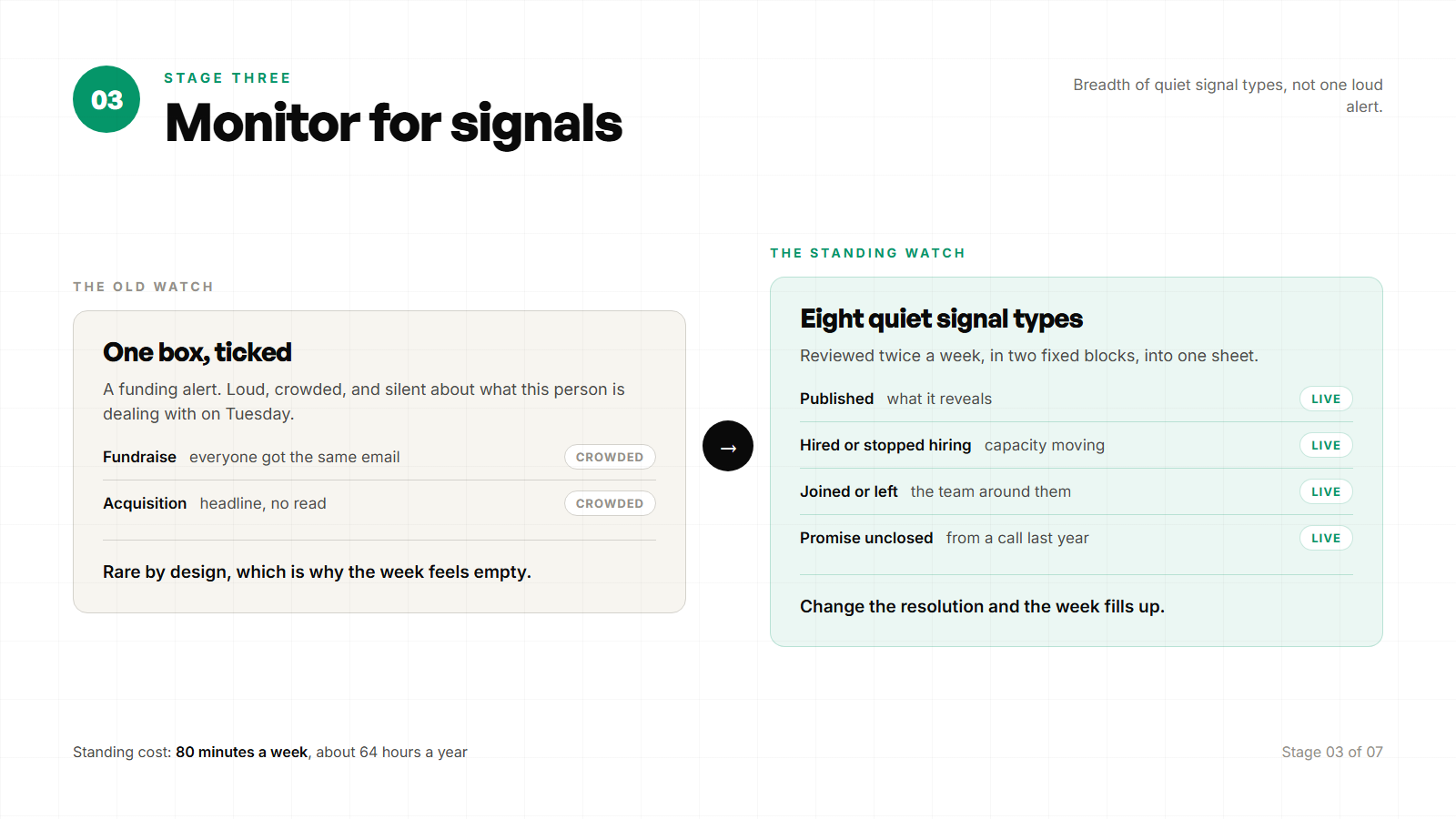
Stage 03 / standing watch
| What you produce | A weekly intake of candidate signals on Watch people, written into the sheet with source, date, and one public fact. |
| Cadence | Two fixed blocks, 40 minutes each, Monday and Thursday. Not “when free.” Alerts can interrupt. The review block is still required. |
| Time cost | ~80 minutes a week of standing watch, plus 15–20 minutes of alert triage if your surfaces are noisy. Setup: 2–3 hours once. |
| Rule | You are not writing outreach in the monitor block. Classify, capture, move on. Research is Stage 04 and 05. |
What counts as a signal (the field, not the siren)
Signal field for a network watch
| 01 | What they publish | Posts, newsletters |
| 02 | What they hire | Jobs, freezes |
| 03 | Who joins / leaves | Org moves |
| 04 | What they stop | Absence pattern |
| 05 | Comments they make | Language of pain |
| 06 | Company news | Press, product |
| 07 | Statutory filings | UK Companies House |
| 08 | Your own memory | Promises, dates |
Funding and acquisition alerts are optional extras, not the core. If they dominate your intake, raise the quiet-signal share until the week looks like people again.
Named surfaces to stand up (indicative 2026 stack)
You will not run every surface for every person. You will run a core set on the whole Watch list, and deeper surfaces on the top tier.
Core (every Watch person):
- LinkedIn (free): follow or connect already. Weekly, open their activity. Sales Navigator saved lead lists make this less painful at 60+ people. Notification settings: turn on “posted about” and job changes where available.
- Google Alerts (free): one alert per company name on the Watch list, and one for distinctive personal names when the name is uncommon. Deliver to a dedicated label, not the main inbox.
- Company blog / newsroom RSS or email where it exists. Feedly or Inoreader if you prefer one reader. Free tiers are enough for a solo watch.
- Your CRM or sheet “next date” column for promises and callbacks you already hold. This is a signal surface. Treat it like one. A February “call me in July” is a July alert if you logged it.
Strong second tier:
- LinkedIn Sales Navigator (~£80–100 / month indicative): saved lead lists, job-change filters, account lists. The practical way to review a Watch cohort without clicking sixty profiles by hand every Monday.
- Companies House email alerts or manual weekly check (free) for UK entities you care about: new filings, officer changes, accounts overdue. Officer change is often a quieter cousin of “new in role.”
- Job boards on target accounts: LinkedIn Jobs company filter, and the careers page of your top twenty accounts. Hiring is a signal even when the person you know is not the hiring manager.
- Podcast and newsletter subscriptions where Watch people host or regularly guest. Apple Podcasts, Spotify, Substack, Beehiiv. When they publish, that is a bridge into the topic they chose to own that week.
- Industry press you already trust (one or two titles, not twelve). FT, trade journals for your domain, Sifted for European tech, and the newsletters your buyers already quote. Skim for company names on your Watch list only.
Optional paid, only if a motion justifies it:
- Mention or Brand24 (indicative low tens to low hundreds of pounds / month): broader web and social mention tracking for company names. Useful when clients are mid-market and appear in trade press often. Overkill if your Watch list is twenty people.
- Owler, Crunchbase, or Dealroom alerts for funding and M&A on target accounts. Use as a minority of intake, not the whole diet.
- Champify or UserGems for job-change automation if many of your relationships move seats often. Expensive relative to a solo desk. Manual Sales Navigator watching is the cheaper substitute and the first thing that dies in a delivery week.
How to run the monitor block
Step 01: Open the intake surfaces in a fixed order.
Same order every session so you do not improvise. Suggested: Sales Navigator lead list activity → Google Alerts label → Companies House / filings queue → jobs on top accounts → promise dates due this week → anything left in a press reader. Forty minutes. Timer on.
Step 02: For each candidate, write one row or update one row.
Minimum fields: Date seen, Person, Company, Signal type, Source URL or location, One public fact in plain language, Status = new. If you cannot state the fact in one sentence, you do not have a signal. You have a vague feeling. Skip it.
Step 03: Bin hard, keep few.
Bin: pure congratulations bait with no personal angle, content that is pure reshare with no comment of their own, hiring noise at companies outside your size band, and anything you already contacted on in the last 30 days. Keep: specific language of pain, a hire that changes their mandate, a filing or director change, a promise coming due, a stop pattern, a comment that reveals priority.
Step 04: Cap the deep-work queue.
End of block: pick at most three to five signals that deserve Stages 04–07 this week. Everything else can wait for the next block or age out. Unlimited queues are how monitoring becomes a second career.
Stage minutes
One-time setup of lists, alerts, and labels: 2–3 hours. Steady state: 40 minutes × 2 sessions = 80 minutes a week. If you consistently need more than 90 minutes, your Watch list is too large or your bin rate is too soft. Shrink the list before you buy another tool.
How this stage fails
- You only enable funding alerts and call it a system.
- You check when free. Free never arrives in feast mode.
- You research inside the monitor block and finish zero reviews.
- You keep 200 people on Watch and skim none of them properly.
- You ignore your own promise dates, which are the highest-precision signals you will ever hold.