 Move How this book sits next to the other one
Open How this book sits next to the other one
Preface
There is a companion field manual on this shelf: The 7 Network Plays to Fill Your Pipeline. That book is about seven shapes of conversation you can open, six of them with people you have never met. This book is about the people you already know, and the system for deciding when a note is justified and what that note should carry.
Read them as siblings, not substitutes. The stranger plays need a public-signal bench, an address waterfall, and the discipline to show up the week a need goes public. This book needs a complete network map, a standing watch, a four-layer research cascade, and the judgement that separates a real bridge from a congratulations note that four hundred other people are also writing.
If you already own a network of any real size, run this motion first. Contact finding is mostly already done. Warmth is already partly paid for. Cost per conversation is lower. Status risk is lower when the observation is real. The stranger motion still matters. It is simply more expensive p
How this book sits next to the other one
331 words
Move There is no reason to contact them right now.
Open There is no reason to contact them right now.
The belief

The false quiet
In your own words it sounds like this: *There is no reason to contact them right now. Nothing has happened.*
That sentence feels responsible. It feels professional. It keeps you from becoming the person who sends empty “just checking in” notes and burns the only brand asset that pays your day rate. You are not inventing urgency. You are waiting for a real reason. On that much, you are right.
The problem is the category of event you were taught to treat as a reason.
Where the old belief came from (absolution)
Every tool you have ever been sold taught you that a reason means a big reason. Databases sell trigger alerts. The trigger is almost always a funding round, an acquisition, or a job change. You tick a box. You get a fundraise alert. You send a congratulations note along with four hundred other people who got the same alert from the same product category. The reply rate is terrible, and the note does nothing to distinguish y
There is no reason to contact them right now.
902 words
Move Stage 01: Identify who is in your network
Open Stage 01: Identify who is in your network
Stage 01 / Map
Everyone, from every surface, not just LinkedIn. If a name only lives in one place, it is not in your system. It is in a drawer you will not open on a Tuesday.
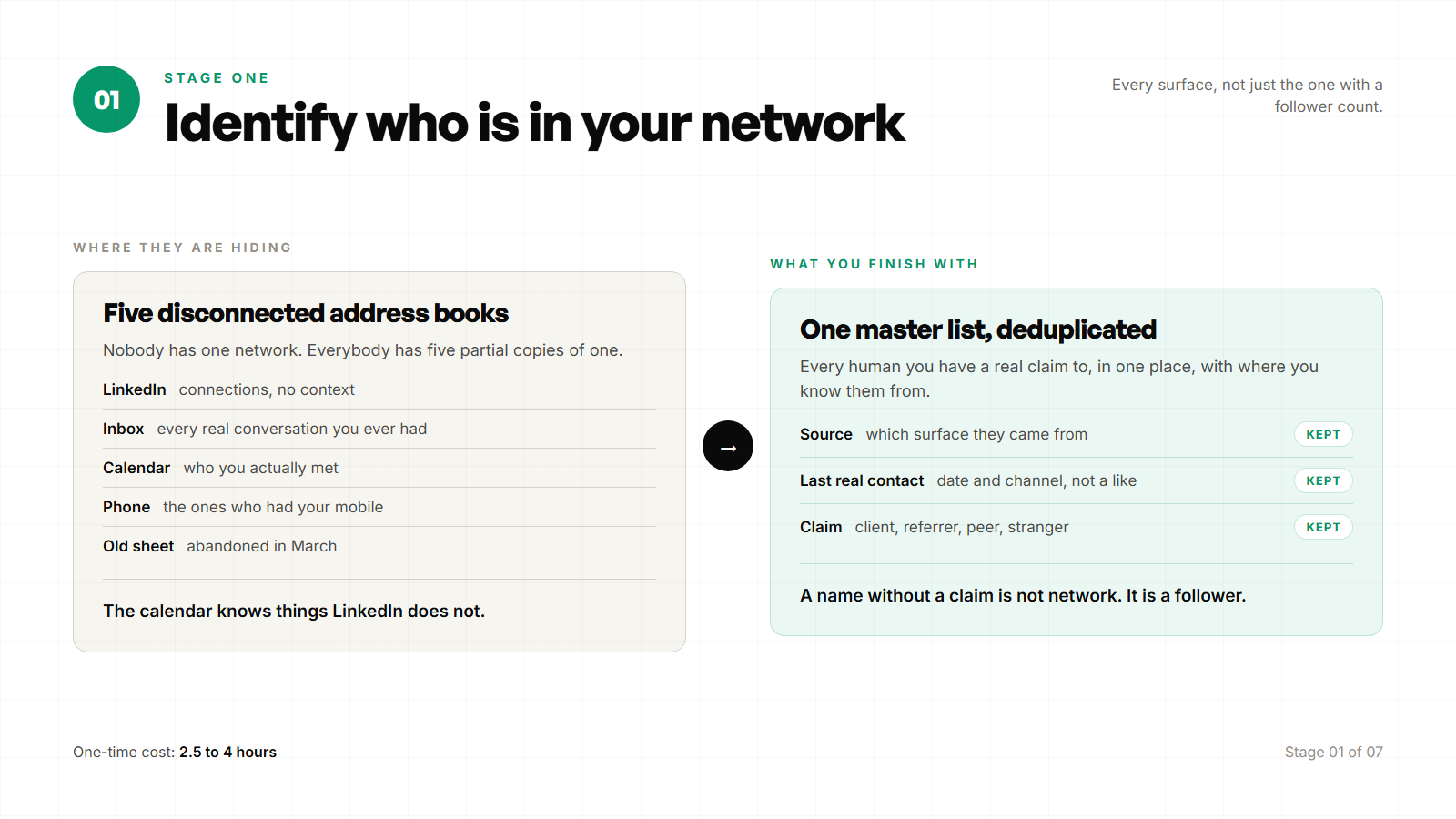
Stage 01 / every surface
|
|
| What you produce |
One master list of people you already have a path to, with source surface and last-known company and title where available. |
| What you are not doing yet |
Scoring fit, watching signals, or writing notes. Identification only. Mixing stages is how the afternoon dies. |
| Software you open |
LinkedIn, Gmail or Outlook, Google Calendar or Outlook Calendar, your phone contacts, and any CRM or spreadsheet that already exists. |
| Time cost |
2.5–4 hours for a first full map on a mid-sized network. About 30 minutes a quarter to refresh sources. |
Why this stage exists
Most operators think their network is “LinkedIn connections.” That is one surface. The people who will hire you again, introduce you, or open a doo
Stage 01: Identify who is in your network
910 words
Move Stage 02: Enrich them against your ICP
Open Stage 02: Enrich them against your ICP
Stage 02 / Score
Turn a list of names into a scored, current picture. Without this stage, monitoring is noise and outreach is guilt mail.
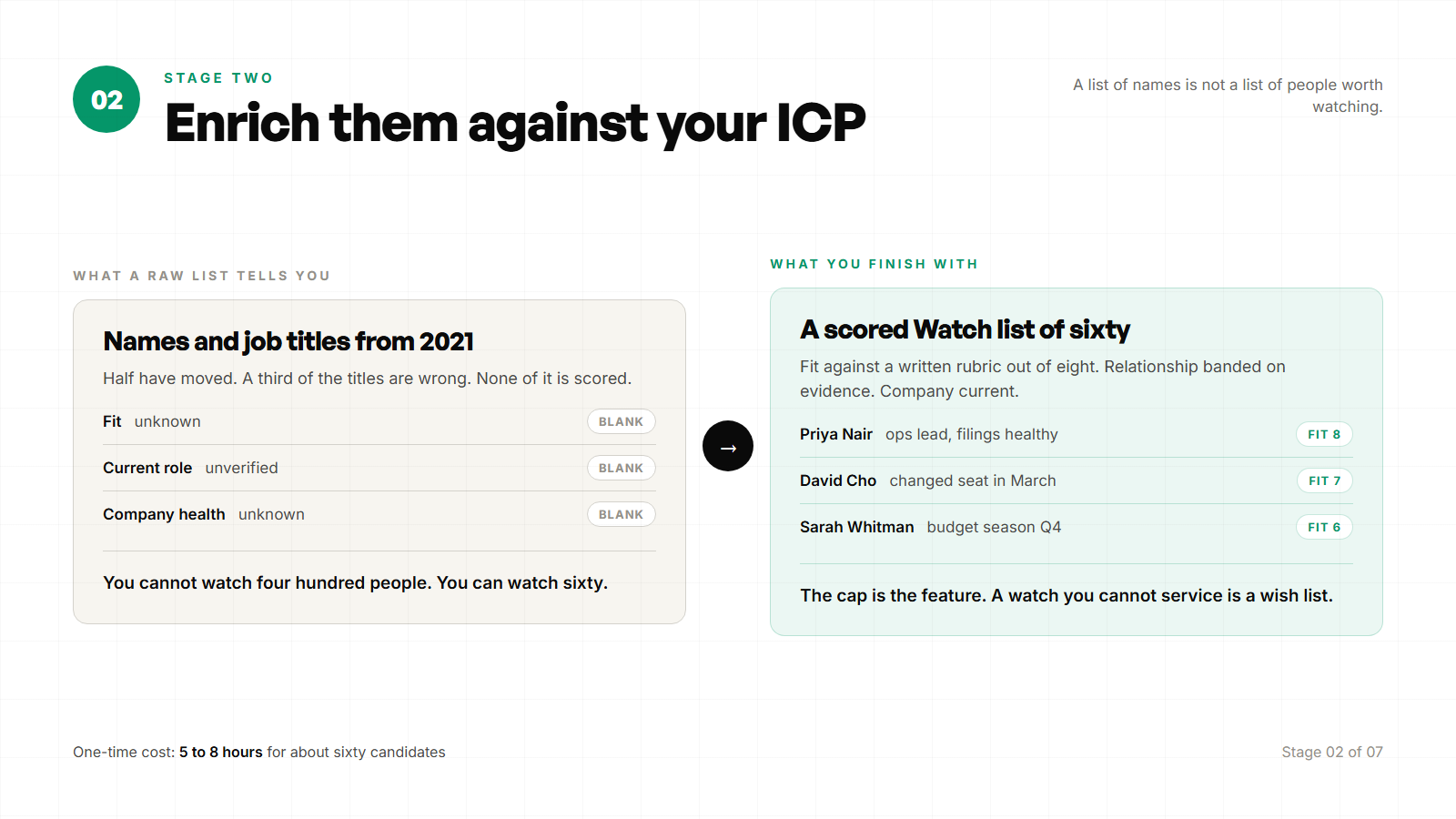
Stage 02 / scored picture
|
|
| What you produce |
Fit score, relationship band, current company and title, and a Watch flag for the people who deserve signal monitoring. |
| Software you open |
LinkedIn (profile + company), LinkedIn Sales Navigator if you already have it, Apollo or similar for bulk company data, Companies House for UK entities, your own ICP rubric on one page. |
| Time cost |
First pass: ~2–3 minutes per person for a light enrich, ~6–8 minutes for a full score on high-value rows. Batch by priority, not alphabet. |
| Companion cross-ref |
The fit rubric in Play 01 of The 7 Network Plays is the same spine. Reuse it. Do not invent a second scoring religion. |
Write the ICP as a rubric, not a vibe
Four fields on one page, scored 0–2 each. Perfect fit is 8.
Stage 02: Enrich them against your ICP
857 words
Move Stage 03: Monitor for signals
Open Stage 03: Monitor for signals
Stage 03 / Watch
Standing watch across many signal types, not one fundraise alert. Breadth is the point. If your stack only rings for funding rounds, you rebuilt the old belief in software form.
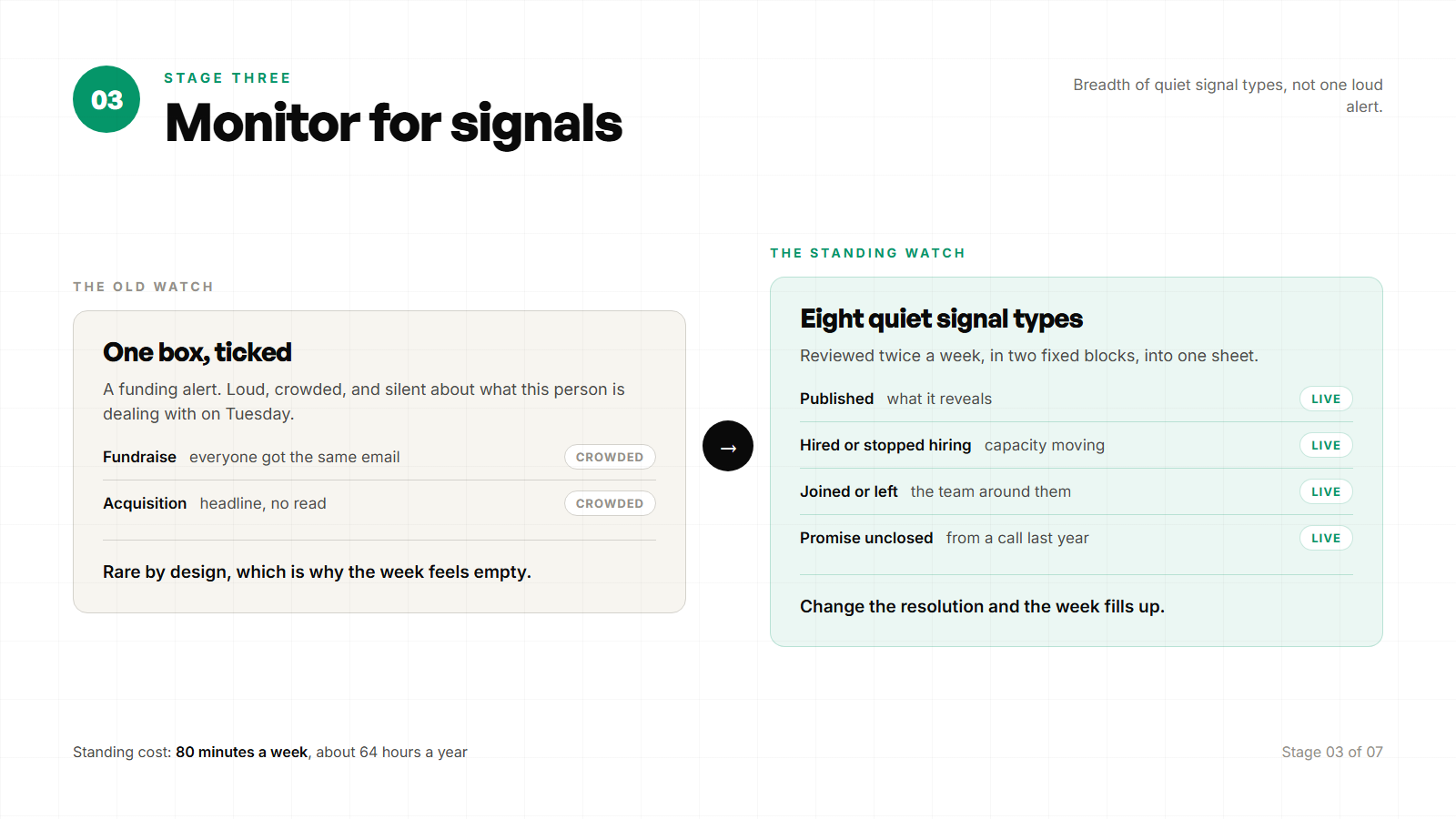
Stage 03 / standing watch
|
|
| What you produce |
A weekly intake of candidate signals on Watch people, written into the sheet with source, date, and one public fact. |
| Cadence |
Two fixed blocks, 40 minutes each, Monday and Thursday. Not “when free.” Alerts can interrupt. The review block is still required. |
| Time cost |
~80 minutes a week of standing watch, plus 15–20 minutes of alert triage if your surfaces are noisy. Setup: 2–3 hours once. |
| Rule |
You are not writing outreach in the monitor block. Classify, capture, move on. Research is Stage 04 and 05. |
What counts as a signal (the field, not the siren)
Signal field for a network watch
|
|
|
| 01 |
What they publish |
Posts, newsletters |
| 02 |
What the |
|
Stage 03: Monitor for signals
1,096 words
Move Stage 04: Go deep on a signal
Open Stage 04: Go deep on a signal
Stage 04 / Focus
Something fired. This stage is the hour where you decide whether it is a real bridge, a dead end, or a “not yet.” You are not writing the final note yet. You are making the signal specific enough to research.
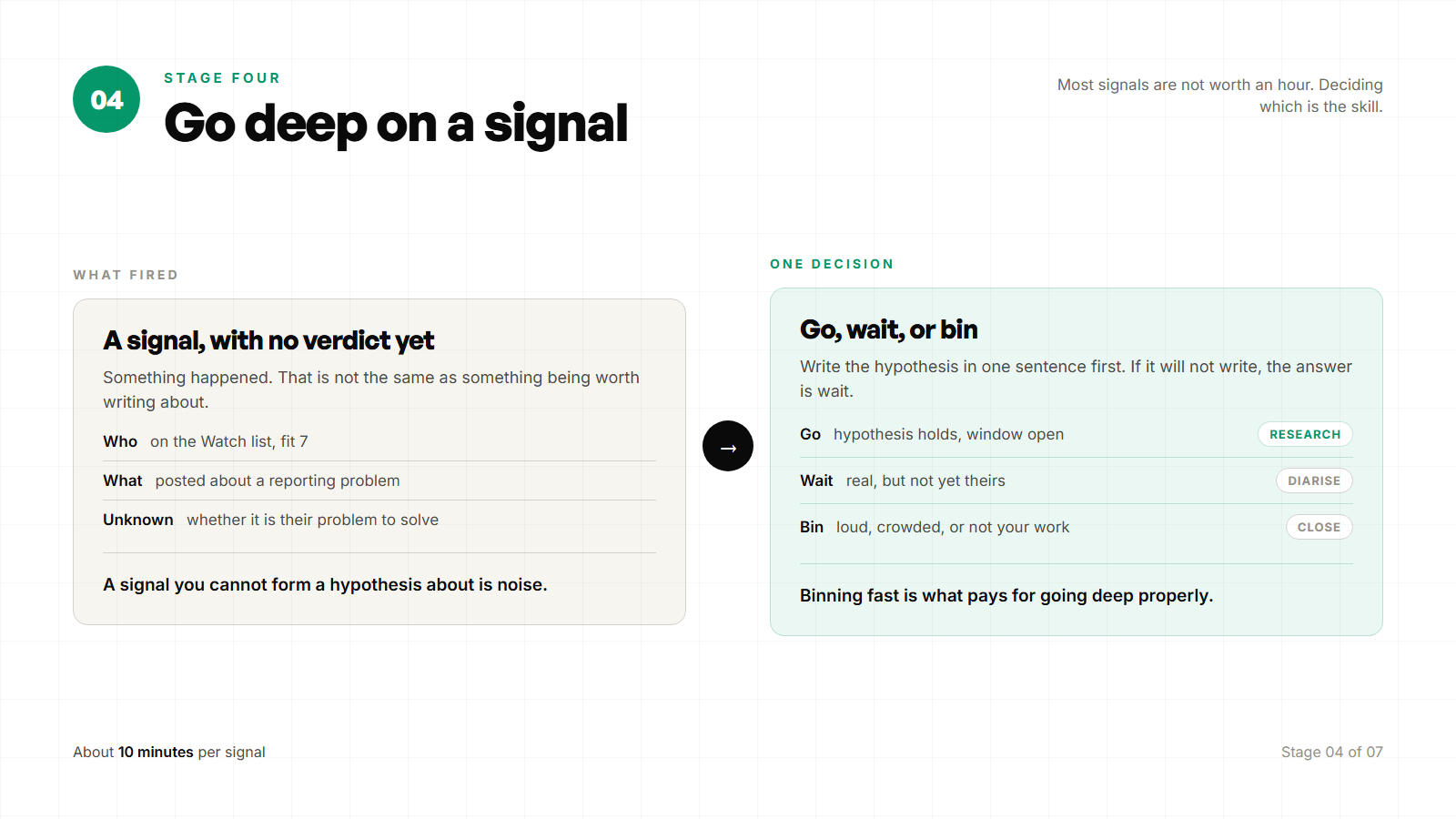
Stage 04 / one signal open
|
|
| Input |
One row from the monitor queue with a source and one public fact. |
| Output |
A go / no-go / wait decision, a one-sentence hypothesis of their week, and the research questions for Stage 05. |
| Time cost |
8–12 minutes per signal. Cap at 15. If you need longer, the signal is not clean enough to use. |
| Software |
The source itself, LinkedIn profile, company page, last email thread if any, sheet. |
Procedure
Step 01: Re-read the source in full, not the notification snippet.
Open the post, the job ad, the filing, the article, the comment thread. Quote the line that matters into the sheet. Notifications lie by compression. The bridge is usually in a clause, not a
Stage 04: Go deep on a signal
594 words
Move Stage 05: Research, in four layers
Open Stage 05: Research, in four layers
Stage 05 / Cascade
Macro industry trend, then micro trend, then company, then person. Each layer narrows. Each one changes the sentence you write. This is the part nobody teaches, and it is the mechanism that makes the note land.
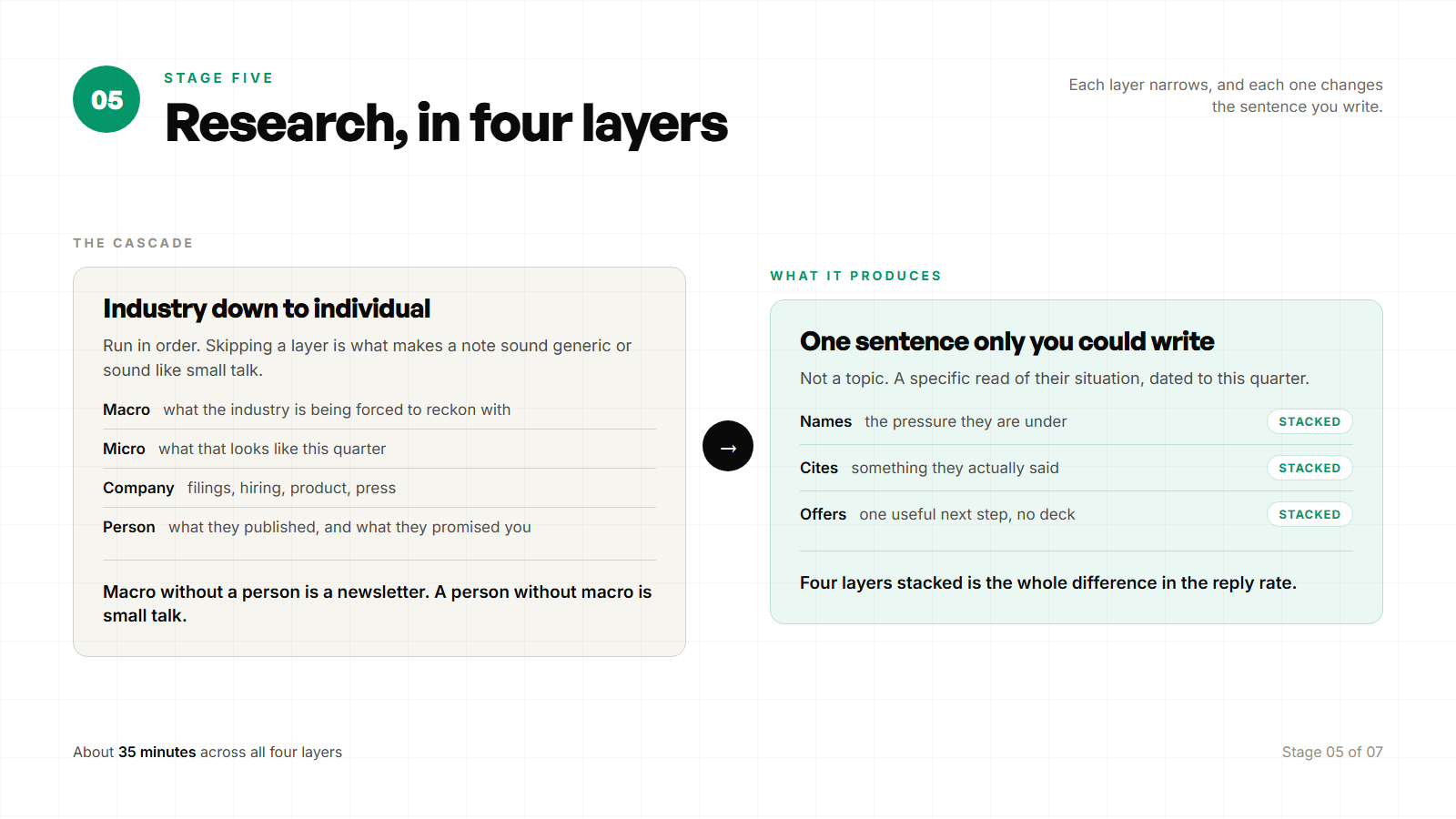
Stage 05 / four layers
The cascade
- L1, Macro. Industry pressure this quarter
- L2, Micro. Trend inside the function
- L3, Company. What is true here now
- L4, Person. Their words, role, week
A macro finding without a person is a newsletter. A person finding without a macro read is small talk. The message lands when all four are stacked.
Budget 25–40 minutes for a full cascade on a serious target. Light version for a warm past client with a clean signal: 15–20 minutes. If a layer returns nothing useful in its time box, write “thin” and move. Do not pretend depth you did not earn.
LAYER 1
Layer 1: Macro industry trend
What you are looking for: the pressure the whole industry (or the buyer’s category
Stage 05: Research, in four layers
1,689 words
Move Stage 06: When to contact
Open Stage 06: When to contact
Stage 06 / Timing
The timing judgement. A true signal with a late note is almost as wasted as a false signal with a fast one. This stage is a set of rules, not a vibe.
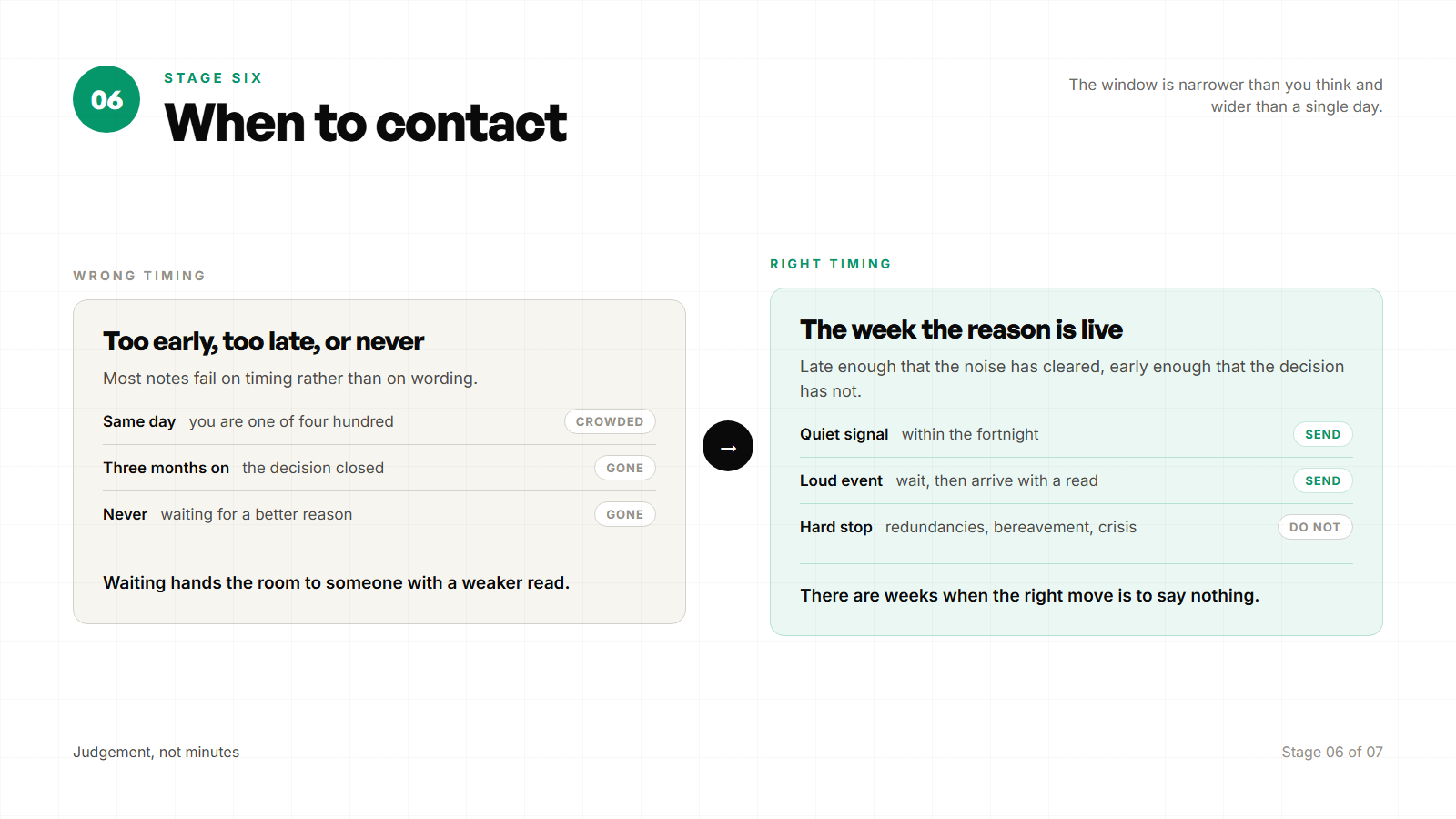
Stage 06 / the window
|
|
| Default |
If Stages 04–05 say go, send within two business days of the signal. Same day is better when the signal is a comment, a post, or a promise coming due. |
| Hard stop |
If you cannot name why this week is better than next month, you do not have timing. You have anxiety. Wait for a cleaner signal or a logged promise date. |
| Time cost |
2–4 minutes of pure judgement once research is done. Longer only when you are deciding between two targets for the same hour. |
| Output |
Send now, send on a dated hold, or park. No third fog state called “keep thinking.” |
Timing rules that survive a busy week
Rule 01: Public language they just used: within 48 hours.
A post, a comment, a talk, a newsletter. Fresh language is a bridge that deca
Stage 06: When to contact
726 words
Move Stage 07: How to contact
Open Stage 07: How to contact
Stage 07 / Message + record
The message, and the record. If you send without logging, you built a mood, not a system. If you log without a real observation, you built admin.
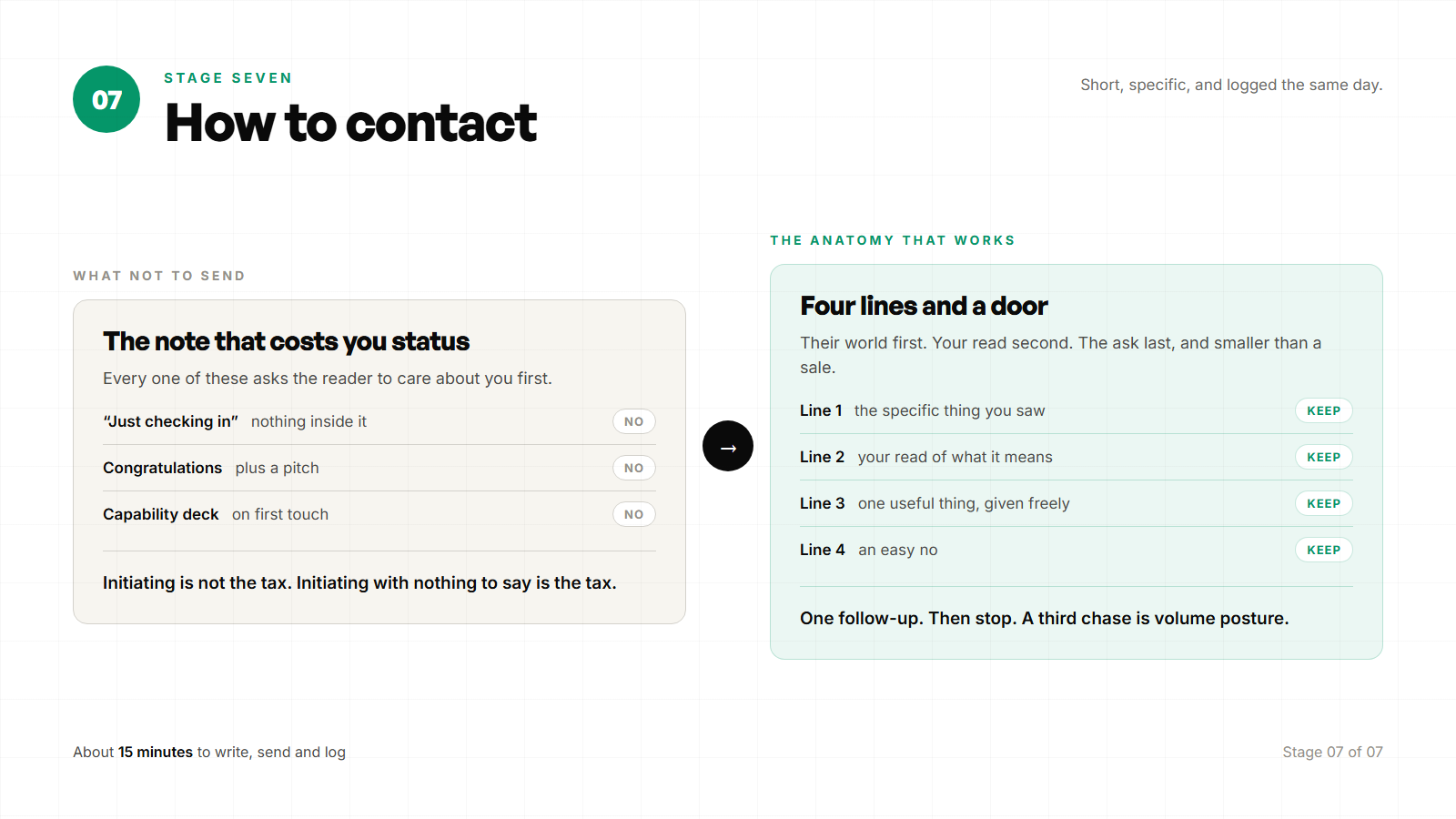
Stage 07 / note and log
|
|
| Channel order |
Prefer the channel you already use with them. Work email first when you have a clean address. LinkedIn second. Do not double-send the same text the same day. |
| Draft time |
8–12 minutes when four layers are already on the sheet. If drafting takes 30, you are still researching or still afraid. |
| Follow-up |
One follow-up only, four to six business days later, shorter, with one new fact or an offer to close the thread. Then stop unless they reply. |
| Address finding |
Usually already held. If missing, search your archive first, then the companion book’s waterfall. Do not rebuild the stranger stack by default. |
Anatomy of a network note that earns its place
- Name + bridge from their world (signal language or
Stage 07: How to contact
994 words
Move The honest cost of contacting your network on purpose
Open The honest cost of contacting your network on purpose
The math
The method works. The hours are real. If the hours were fictional, you would already be doing this every week and this book would be a poster.
Minutes per stage (steady state, after setup)
Stage minutes that become a week
| Playbook |
Hours a year by hand |
| Watch (×2) |
80 min/wk |
| Go deep |
~10 min |
| Four layers |
~35 min |
| When + how |
~15 min |
Per live target after monitoring: about 10 + 35 + 15 = 60 minutes to a sent, logged note. Three researched network notes a week: about 3 hours of deep work plus 80 minutes of watch ≈ 4.3 hours weekly.
One-time setup (first month):
- Stage 01 full map: 2.5–4 hours
- Stage 02 enrich and Watch list: 5–8 hours depending on network size (assume ~6 hours for 60 serious candidates at ~6 minutes each, plus rubric time)
- Stage 03 monitor setup: 2–3 hours
First-month labour: roughly 10–15 hours of setup, plus the weekly run rate once the watch starts mid-month.
Steady weekly run rate (serious but sustainable): abou
The honest cost of contacting your network on purpose
835 words
Move Where to start, and what Nynch is for
Open Where to start, and what Nynch is for
Where this leaves you
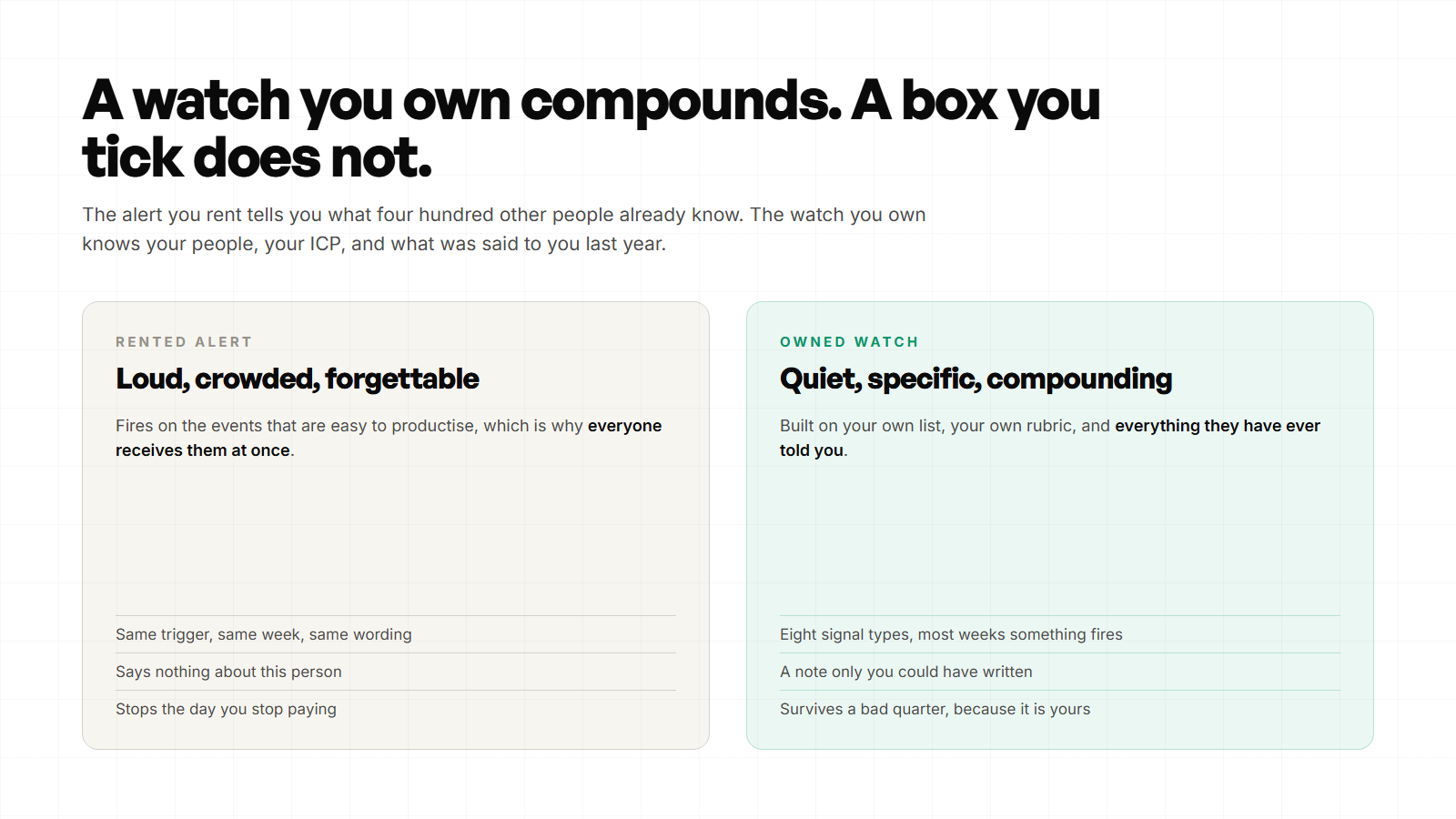
Own the watch
Every stage here is something you can start this week. Where you start depends on what is already true.
- No single list of your network exists → start with Stage 01. Two to four hours. Do not skip surfaces.
- You have a list but no ranking → start with Stage 02. Write the rubric. Score. Set a Watch cap.
- You already know who matters and still send nothing → start with Stage 03 and the belief chapter. The watch is empty of quiet signals, or the old belief is still running.
- Signals fire and notes still feel empty → start with Stage 05. Stack the four layers once on a real person today.
Either way, you will get further by hand than you think, right up until the week delivery wins and the multi-surface watch quietly stops. You know it will. It always has.
That failure mode is not a moral weakness. It is a plumbing problem wearing a character story. The reasons keep appearing at the quiet resolution. Your att
Where to start, and what Nynch is for
489 words