Stage 04 / Focus
Something fired. This stage is the hour where you decide whether it is a real bridge, a dead end, or a “not yet.” You are not writing the final note yet. You are making the signal specific enough to research.
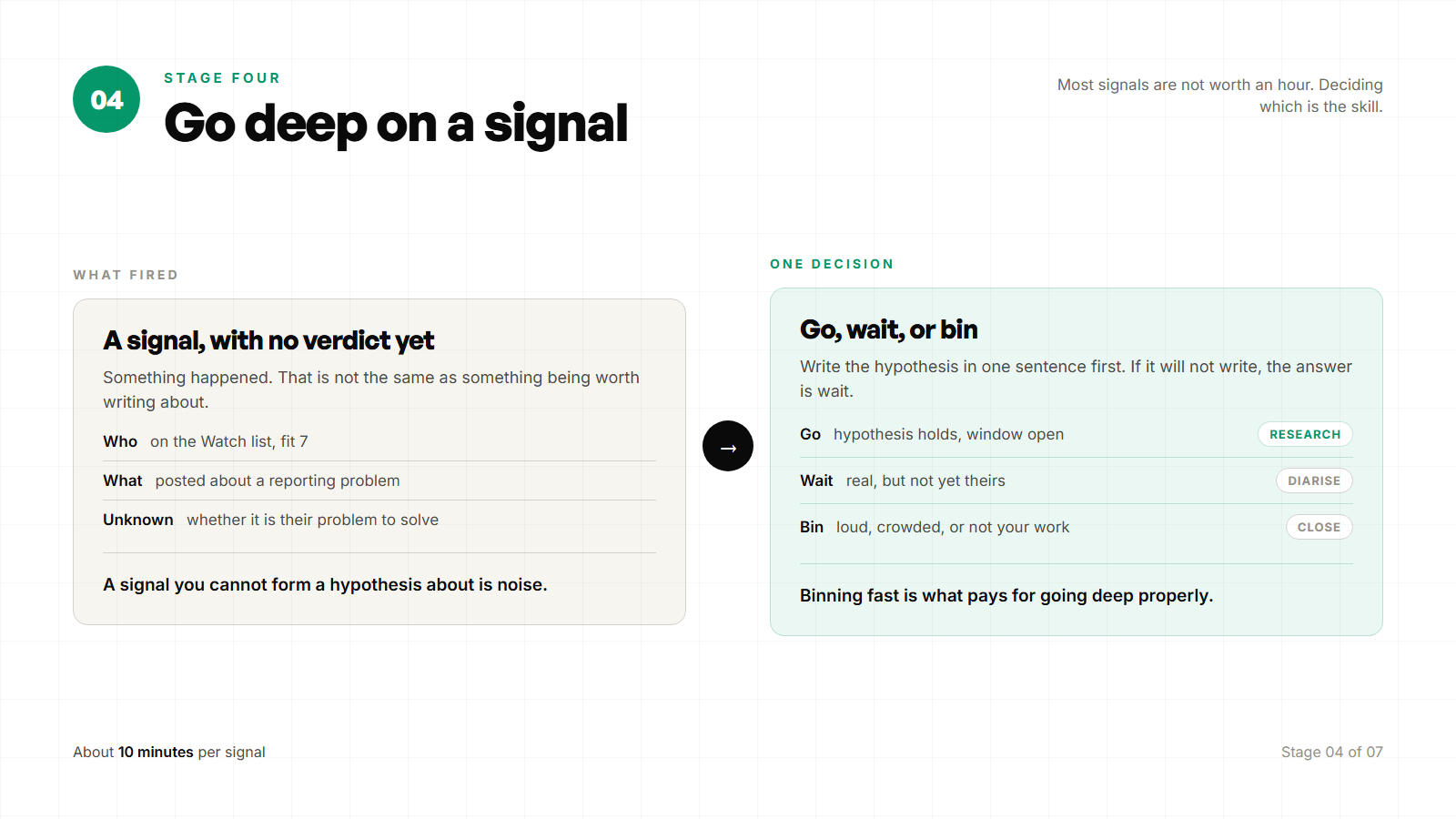
Stage 04 / one signal open
| Input | One row from the monitor queue with a source and one public fact. |
| Output | A go / no-go / wait decision, a one-sentence hypothesis of their week, and the research questions for Stage 05. |
| Time cost | 8–12 minutes per signal. Cap at 15. If you need longer, the signal is not clean enough to use. |
| Software | The source itself, LinkedIn profile, company page, last email thread if any, sheet. |
Procedure
Step 01: Re-read the source in full, not the notification snippet.
Open the post, the job ad, the filing, the article, the comment thread. Quote the line that matters into the sheet. Notifications lie by compression. The bridge is usually in a clause, not a headline.
Step 02: Check relationship and recency.
Warm and six months quiet is a different note from polite-stranger and two years quiet. If you have a live commercial thread already, you may not need a cold-style bridge. You may need a continuation. Do not invent a new outreach when a reply in an existing thread is the honest move.
Step 03: Write the week hypothesis in one sentence.
Template: “Because [signal], they are probably dealing with [operational consequence] this month.” If you cannot name a consequence, you only have news, not a bridge. News becomes a congratulations note. Consequences become expert notes.
Step 04: Decide go, wait, or bin.
Go: fit is green or high amber, hypothesis is specific, you have something useful to offer or ask, and you have not contacted them on this angle in the last 30 days. Wait: signal is real but early (for example a hire announced with no mandate yet), or you need one more data point next week. Put a next date. Bin: low fit, pure vanity signal, or the only available note is congratulations with no angle.
Step 05: Write the four research questions before you open twenty tabs.
One question per layer: What is true in their industry this quarter? What micro-trend inside that industry touches their function? What is true at the company right now? What is true for this person? Stage 05 answers them in that order. If you skip this step you will free-associate and call it research.
What a good Stage 04 output looks like
Person: Priya Shah, CFO, mid-market UK manufacturer. Signal: comment under a peer’s post: “we are still rebuilding the forecast after the ERP cutover.” Hypothesis: Because the ERP cutover wrecked forecast trust, she is living in board-pack uncertainty this quarter. Decision: Go. Questions: (macro) what is happening to UK mid-market manufacturers on systems programmes this year, (micro) forecast credibility after ERP, (company) what the cutover timeline was and any public mention, (person) her recent posts and any prior conversation about board reporting.
How this stage fails
- You treat every notification as a go and drown Stage 05.
- You write the note before the hypothesis, then reverse-engineer a reason.
- You spend forty minutes on a signal that should have been a two-minute bin.
- You ignore an existing thread and open a parallel conversation that confuses them.