Stage 06 / Timing
The timing judgement. A true signal with a late note is almost as wasted as a false signal with a fast one. This stage is a set of rules, not a vibe.
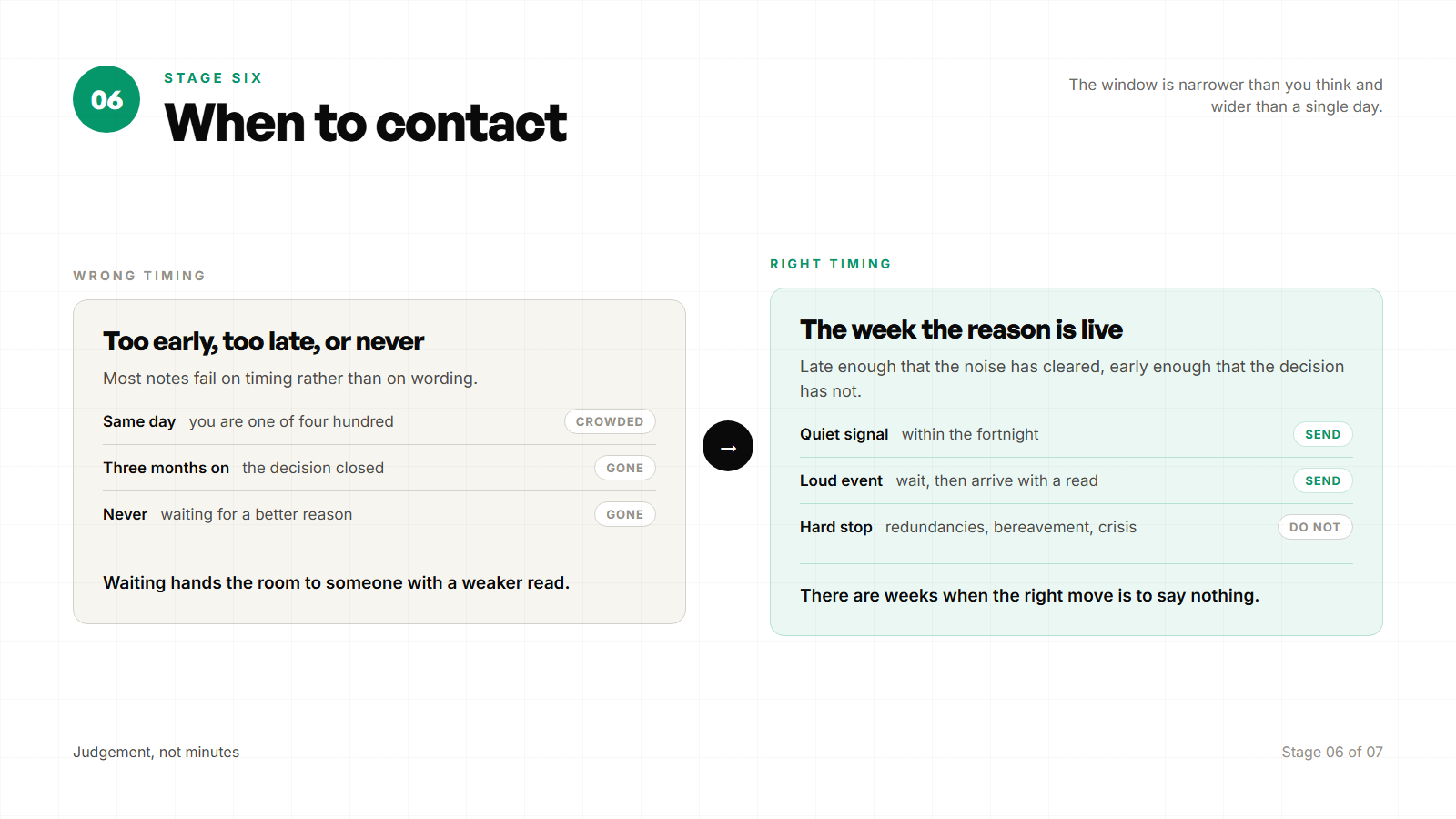
Stage 06 / the window
| Default | If Stages 04–05 say go, send within two business days of the signal. Same day is better when the signal is a comment, a post, or a promise coming due. |
| Hard stop | If you cannot name why this week is better than next month, you do not have timing. You have anxiety. Wait for a cleaner signal or a logged promise date. |
| Time cost | 2–4 minutes of pure judgement once research is done. Longer only when you are deciding between two targets for the same hour. |
| Output | Send now, send on a dated hold, or park. No third fog state called “keep thinking.” |
Timing rules that survive a busy week
Rule 01: Public language they just used: within 48 hours.
A post, a comment, a talk, a newsletter. Fresh language is a bridge that decays. After a week it reads like you have a social listening tool and no life. After a month it is archaeology.
Rule 02: Hiring and org change: while the seat is open or the first 30 days of a new mandate.
Cross-reference the companion book’s New In Role and hiring plays for stranger versions of this window. On your network, the same clocks apply. A peer who just hired a Head of Ops is living the integration problem now, not in a quarter.
Rule 03: Promise and callback dates: the week before they fall due.
“Call me in July” becomes a mid-to-late June note. “We have leftover budget at year end” becomes a November note. This is two-sided memory. If you did not log the promise in Stage 01–03, you will miss it and call that fate.
Rule 04: Funding and acquisition headlines: only with a people-level angle, and not on day one.
Day one is congestion. Day three to ten can work if Layers 2–4 give you something the congratulations crowd does not have. If all you can say is “congrats on the round,” do not send. You are late to a crowded room with an empty tray.
Rule 05: Silence after your last good conversation: ninety days is a review, not an emergency.
If no external signal has fired, a quarterly value note can still be right for warm past clients. It needs a real observation or artefact. It does not need a fake emergency. Absence of a loud event is not absence of a reason if you still hold shared context.
Rule 06: Do not stack two first-touch notes in seven days on the same person.
One bridge, one follow-up ceiling (Stage 07). Parallel cleverness reads as campaign software. You are a human they know.
When not to contact, even if it itches
- They are in an obvious personal crisis that is public. Human first. Commercial later, if ever from that signal.
- You only want the contact because your calendar is empty. That hunger leaks into the prose. Wait until the observation is clean.
- The only available note is “hope you are well” with a capability paragraph. That is not timing. That is spam with manners.
- A mutual has already introduced you this month on the same angle. Do not double-path them.
- You are angry they hired someone else. Do not write from that state. Ever.
The one-line timing test
Complete this sentence before you send: “This week is the right week because ___.” If the blank is “I finally had time,” you are timing your guilt, not their world. If the blank names their signal, their promise date, or a seasonal fact from Layer 1 that is live now, you are timing their world. Send.
How this stage fails
- You wait for perfect confidence and send after the window closed.
- You send instantly on every alert and train people to ignore you.
- You treat funding day as mandatory outreach day.
- You never use promise dates because they only live in your head.